After a wreck, the hardest question often is not who caused it. It is how to explain what changed. You may return to work while gripping the steering wheel whenever traffic slows. Sleep can come in broken stretches. A short hike, grocery trip, or afternoon with your children may now end in pain.
Pain and suffering captures the physical and emotional effect an injury has on daily life, including fear behind the wheel, lost activities, disrupted sleep, and dependence on others. It is a legal claim whose value rests on jurisdiction, evidence, prognosis, credibility, and how decision-makers interpret the facts.
Two people with similar injuries can receive very different results. There is no universal calculator that settles the issue. Strong documentation and a credible account usually matter more than a formula that promises a neat answer.
A Wreck, a Whiplash, and a Number That Feels Impossible
A client sits across from me after a rear-end collision. The scan shows a cervical injury. The medical records show treatment. But the client keeps returning to a different part of the story.
“Driving to work feels dangerous now,” the client says. “I wake up whenever I roll onto my neck. I stopped hiking because the first incline starts hurting. I know the bills are there, but the bills don't explain what my days feel like.”
That gap creates the legal problem. Courts must translate a lived experience into a monetary award, even though no invoice captures fear behind the wheel, restless sleep, embarrassment about visible scarring, or the frustration of needing help with ordinary tasks.
Historically, courts have treated pain and suffering as a measurable part of injury compensation rather than a purely moral idea. A Maryland Law Review historical study found that pain-and-suffering payments represented about 23% of total auto-accident bodily-injury awards during the mid-1980s period studied, compared with about 37% in pre-1940 cases. The same scholarship describes an earlier expansion in which observers estimated that pain-and-suffering damages eventually represented roughly half of all tort damages and about $50 billion annually in the United States.
Those figures show why the phrase matters. Courts and insurers have repeatedly tried to measure, reduce, and rebalance this category as medicine, automobile claims, insurance systems, and tort doctrine changed. Modern pain science also recognizes pain as both sensory and emotional. The International Association for the Study of Pain's revised definition, discussed in an NIH-hosted review, replaced the prior definition and reflects that broader understanding.
You'll hear about three ways to estimate value:
- Multiplier method: Applies a factor to economic damages.
- Per diem method: Assigns a daily amount to the recovery period.
- Jury-verdict comparisons: Uses outcomes from allegedly similar cases.
None is a promise. Two people can have nearly identical imaging and receive very different results because their records, recovery paths, testimony, insurance circumstances, and legal venue differ. Colorado adds another layer through its rules governing noneconomic damages.
Defining Pain and Suffering as a Legal Category
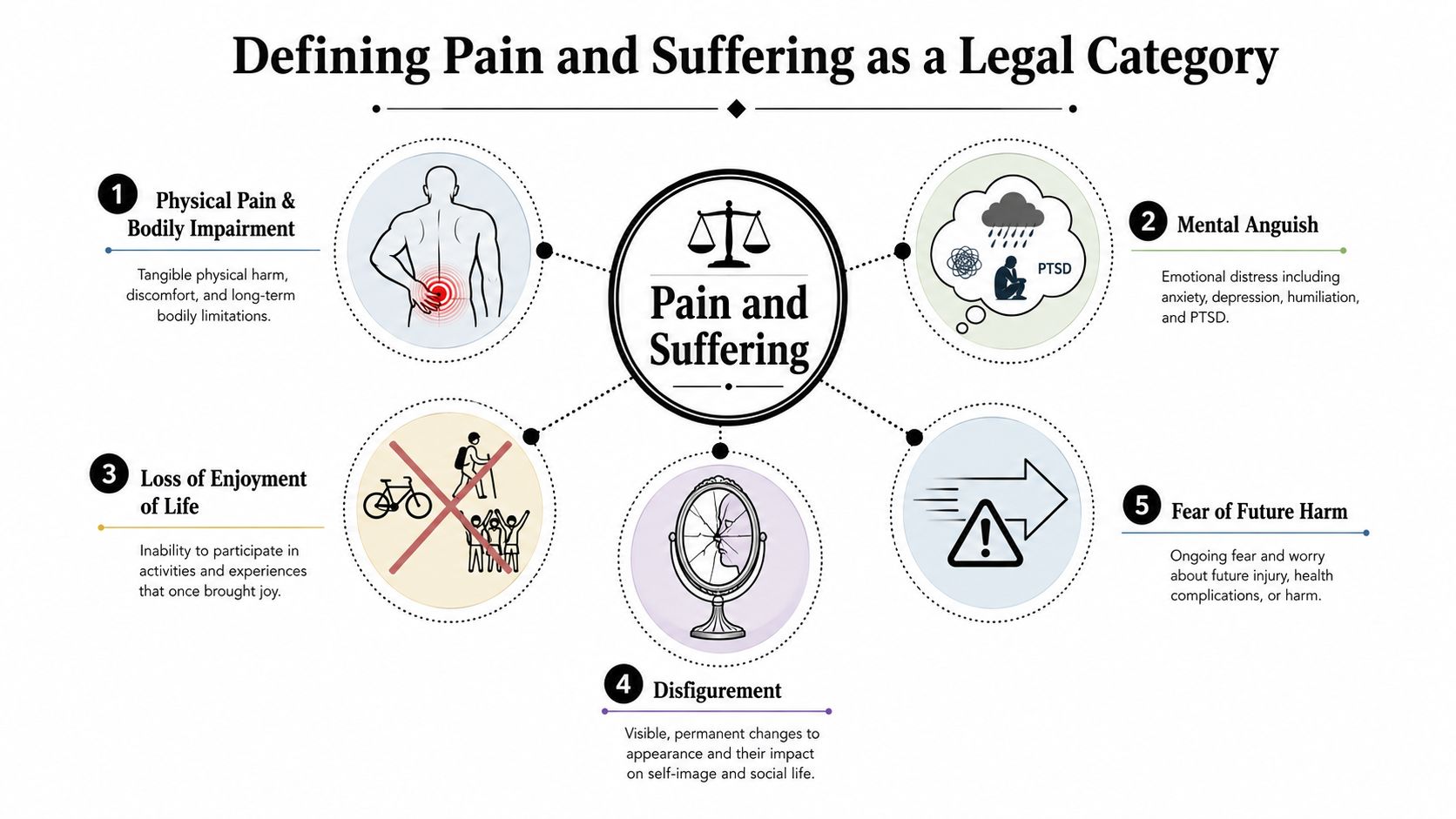
Pain and suffering is a form of non-economic damage. It covers harm affecting the body, mind, relationships, independence, and enjoyment of life, beyond specific financial charges. This category usually sits beside economic losses such as medical expenses and lost wages, but its value depends on the injury's documented effect and the rules of the jurisdiction.
The legal category includes several connected experiences:
Physical pain and bodily impairment
Physical pain begins with the injury itself and can continue through treatment, surgery, restricted movement, headaches, nerve symptoms, and lasting limitations. Bodily impairment may change how you walk, lift, drive, sleep, work, or care for yourself.
A diagnosis does not establish the full value. The stronger question is what the condition prevents you from doing, how often those limits occur, and whether medical records and daily-life evidence support the account.
Mental anguish and emotional distress
An injury can cause anxiety, depression, fear, irritability, disrupted sleep, or trauma-related symptoms. You do not have to describe yourself as emotionally fragile for those effects to count. Avoiding driving, waking from crash-related dreams, or losing concentration at work can show how the injury changed your life.
The NIH-hosted review of pain and suffering describes suffering as an anguishing experience that can affect a person at psychophysical and existential levels. It also explains that pain is shaped by beliefs about its causes, consequences, and meaning. That distinction matters. An injury may hurt physically while also changing how safe, capable, or independent you feel.
Loss of enjoyment, disfigurement, and fear
Loss of enjoyment covers activities and relationships that no longer feel available. Examples include hiking, coaching, playing with children, attending social events, or maintaining a normal routine.
Disfigurement addresses visible or lasting changes, including scarring or altered appearance. Fear may involve concern that pain will continue, another accident will occur, or ordinary movement will cause further injury.
These damages require proof. Your claim must connect the defendant's conduct to the injury and show its effects over time. The Colorado-focused explanation of non-economic damages provides context for how pain and suffering fits within the broader category of non-economic damages.
Two people with the same diagnosis can receive different results. Their treatment records, recovery, testimony, daily limitations, and jurisdiction can point to different values.
Practical rule: Medical bills show that care cost money. They do not, by themselves, show what the injury took from your life.
How Courts and Insurers Put a Number on Suffering
After a wreck, an adjuster may put a figure on your pain before anyone has fully examined how the injury changed your life. That figure is not a legal answer. There is no binding calculator that dictates what an adjuster, mediator, or jury must award. Valuation methods provide starting points, then the parties argue over the evidence, applicable law, and facts that support or weaken the proposed amount.
The three methods you'll hear about
The multiplier method begins with economic damages, such as medical expenses and lost income, then applies a factor to estimate noneconomic damages. It gives negotiations a quick anchor, but the anchor can mislead. A large medical charge does not automatically mean greater daily suffering, and a modest bill does not establish a minor life impact.
The per diem method assigns a daily value to pain during recovery. It can organize a claim when the recovery period is documented clearly. It loses force when the end date remains uncertain, symptoms vary, or the opposing side challenges the chosen daily amount as unsupported.
Jury-verdict comparisons review prior outcomes involving similar injuries. They can provide more useful context than a formula, but no comparison is automatic. The analysis must account for jurisdiction, evidence, legal rules, insurance limits, venue, counsel, and the jurors who decided the case. An out-of-state verdict may offer little guidance for a Colorado claim.
A formula can also hide human judgment. A 2025 study on biased evaluations of pain-and-suffering awards found evaluation effects indicating that framing, injury severity, and decision-maker bias can influence compensation judgments. Presentation affects how evidence is understood, but it cannot replace credible proof.
Valuation Methods at a Glance
| Method | How It Works | Best Used For | Common Weakness |
|---|---|---|---|
| Multiplier | Applies a factor to economic losses | Early negotiation discussions | Anchors to bills that may not reflect lived harm |
| Per diem | Assigns a daily value to recovery | Clearly documented, time-limited recovery | Breaks down when duration or daily impact is disputed |
| Jury verdicts | Compares prior cases | Venue-specific strategy and mediation | Prior cases may differ in evidence, law, limits, and jurors |
Use these methods to organize an argument, not to promise a result. A guide to calculating pain-and-suffering damages explains the mechanics, while the claim's jurisdiction and evidence determine whether the proposed value can withstand scrutiny.
What Moves the Value Up or Down
The strongest claims connect four things: what happened, what the injury did, how long it lasted, and how convincingly the evidence proves it. Medical imaging matters, but its value depends on the surrounding record. Symptoms, treatment, restrictions, and a credible recovery history give a scan legal meaning.
Severity and permanence
A temporary soft-tissue sprain can cause real pain and disruption. Its value usually turns on duration and functional effect. A herniated disc requiring surgery follows a different medical course. A documented traumatic brain injury may raise concerns involving cognition, headaches, personality changes, sleep, and independence.
| Factor | Weak Presentation | Strong Presentation |
|---|---|---|
| Injury severity | Diagnosis appears without functional detail | Records connect the diagnosis to restrictions and daily limitations |
| Prognosis | Future symptoms are asserted without medical support | Treating professionals explain expected persistence and care needs |
| Treatment history | Long unexplained gaps or inconsistent attendance | Care follows recommendations and the timeline is clear |
| Personal testimony | General statements such as “everything hurts” | Specific examples show changes in sleep, driving, work, and relationships |
Recovery trajectory and medical records
A prognosis can matter more than a dramatic description of the first week. Records should show whether symptoms improved, plateaued, returned, or became permanent. Future pain and suffering may require medical or expert testimony stated to a reasonable degree of certainty, particularly when the facts do not make ongoing symptoms clear. The legal category includes more than a diagnosis. It can cover the continuing effect of an injury on daily life.
Treatment gaps do not automatically destroy a claim. Work schedules, transportation problems, cost, or a provider's recommendation may explain them. Unexplained silence creates the problem. Tell your provider why care was delayed, and keep records showing what happened during the gap.
Testimony and credibility
A symptom journal can document sleep, lifting limits, driving anxiety, missed activities, and changes in family life. Keep it factual rather than argumentative. Specific, ordinary observations carry more weight than repeated conclusions.
Insurers also look for contradictions. Pre-existing conditions require careful disclosure and medical analysis, not concealment. Social-media posts can create trouble when a photograph or caption appears inconsistent with reported limitations. Statements to providers should remain accurate and consistent because defense counsel may compare every version later.
The practical evidence base includes ER notes, imaging, surgical reports, prescriptions, physical therapy notes, and mental-health records. Research discussed in Injury Law Authority's discussion of pain-and-suffering damages associates poorer quality of life with greater pain intensity and psychological distress. The practical lesson is direct: document both symptoms and function. Two people with similar injuries can receive different evaluations because their recovery histories, records, credibility, and jurisdictional rules differ.
Colorado-Specific Rules and Practical Limits
Colorado doesn't treat noneconomic damages as an unlimited blank check. C.R.S. § 13-21-203 governs important limits and procedures, and the precise application depends on the nature of the claim, the procedural posture, and the law in effect when the case is evaluated. A Colorado attorney should review the current statute and facts before anyone relies on a specific cap or exception.
The statute's framework can affect how a jury receives a noneconomic-damages claim and how an award is handled after trial or on appeal. Settlement posture can also matter because negotiating parties may address the practical value of a claim differently than a jury does. Exceptions may apply, including circumstances involving clear and convincing evidence of permanent impairment, but you shouldn't assume an exception applies merely because an injury feels permanent.
Colorado's fault rules matter too. If the injured person shares responsibility, contributory negligence can reduce recovery under the applicable framework. The defense may argue that the claimant caused or aggravated the harm, failed to follow treatment, or waited too long to seek care. Your records and testimony need to answer those arguments with a coherent timeline.
Common insurance defenses
Adjusters frequently question claims through familiar themes:
- Low-impact argument: The vehicle damage supposedly proves the occupant couldn't have been seriously injured.
- Treatment-gap argument: A break in care supposedly means symptoms resolved.
- Pre-existing-condition argument: Earlier complaints supposedly explain all current symptoms.
- Subjective-symptom argument: Pain supposedly lacks value without dramatic imaging.
None of those arguments decides the case by itself. Vehicle damage, biomechanics, medical findings, prior health, and post-crash limitations must be evaluated together.
Venue can influence litigation strategy. A case tried in Denver may present different practical considerations from one tried in El Paso or Weld County, including local jury composition and how the evidence is received. That doesn't justify predicting an outcome from a county label. It does justify rejecting internet averages that ignore Colorado law and local litigation realities.
What to Document and When to Call an Attorney
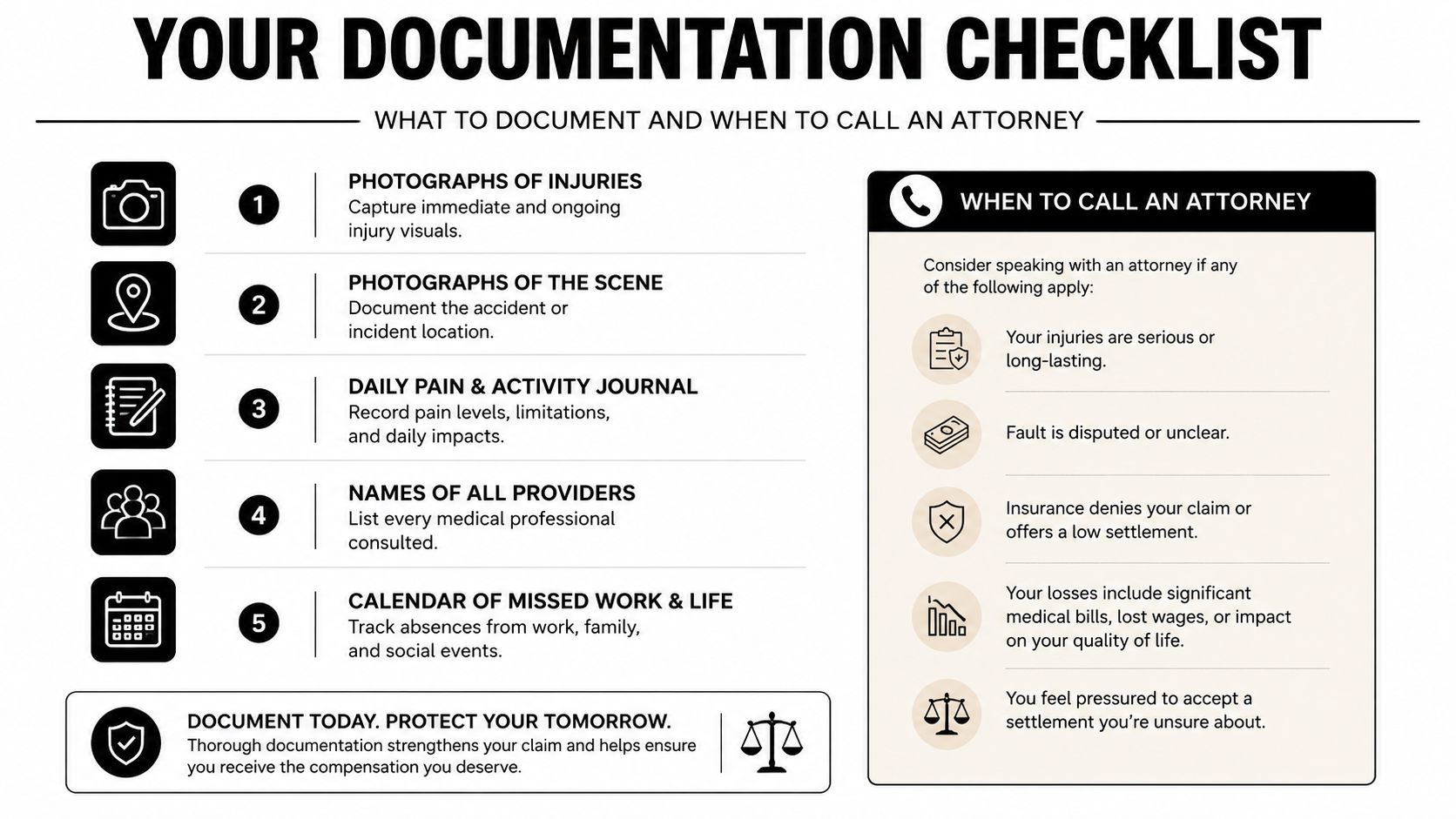
Start documenting on day one, while the sequence is fresh. Take photographs of visible injuries and the crash scene, save medical paperwork, and write down what changed instead of waiting until a settlement discussion forces you to reconstruct months of symptoms.
Build a usable record
- Photograph injuries: Capture bruising, swelling, wounds, scars, and changes during healing.
- Record daily function: Note sleep, driving, lifting, walking, self-care, work tasks, and activities you avoid.
- List every provider: Include emergency clinicians, primary-care doctors, specialists, therapists, physical therapists, and mental-health professionals.
- Track missed life: Record missed work, family responsibilities, exercise, travel, social events, and ordinary obligations.
- Preserve communications: Keep insurer emails, letters, texts, claim numbers, recorded-statement requests, and settlement offers.
Tell providers about emotional symptoms as well as physical ones. If fear, sleep disruption, concentration problems, or mood changes began after the crash, put that information into the medical record rather than keeping it only in a private journal.
This resource on proving pain and suffering explains why personal testimony works best when it matches treatment records and observable limitations.
Before you post: Assume an insurer may read public social-media content without knowing the context behind it.
Watch the practical guidance in this video before giving an insurance carrier a detailed account of your injuries.
Call before the problem compounds
Speak with an attorney if the insurer denies or delays the claim, requests a recorded statement, makes a policy-limit offer, or disputes fault. A consultation also makes sense after a surgical recommendation, permanent-impairment finding, traumatic brain injury diagnosis, or significant change in work and family responsibilities.
Colorado filing deadlines can be strict. The planning notes for this guidance identify a two-year limitations concern for many Colorado injury claims, but the correct deadline can depend on the defendant, claim type, discovery rules, and other facts. Don't wait until the deadline is close. Evidence is harder to reconstruct, witnesses become harder to locate, and an early statement can shape the insurer's position before the full injury is understood.
Putting It Together Without Overpromising
Return to the client in the opening scene. The legal answer isn't that anxiety, sleeplessness, or a lost hiking routine has a fixed price. The answer is that those effects belong in a non-economic damages claim, and their value depends on jurisdiction, proof, prognosis, and credibility.
The multiplier, per diem, and jury-verdict approaches can help lawyers negotiate. None can replace medical records, consistent treatment, functional evidence, and honest testimony. A formula may produce an opening number, but it can't explain why one person with similar medical bills continues to suffer while another recovers quickly.
Colorado's statutory limits and fault rules add practical boundaries. Two claimants with similar scans may still reach different outcomes because one has a clear treatment timeline, documented restrictions, and reliable testimony, while the other has unexplained gaps and conflicting statements.
Review your records now. Schedule medical follow-up for unresolved symptoms, preserve every insurer communication, and get Colorado legal advice before discussing the value of your pain and suffering with the adverse adjuster.
Nares Law Group LLC helps injured people in Colorado understand non-economic damages, organize evidence, coordinate the legal process, and pursue compensation after motor-vehicle crashes, truck wrecks, traumatic brain injuries, and wrongful death. Visit Nares Law Group LLC to request a consultation before an insurance company turns your lived experience into an unsupported low offer.