A personal injury settlement is a negotiated agreement that resolves a tort claim before trial in exchange for payment and a release of claims. In one large federal dataset, 23.14% of terminated civil cases were recorded as “dismissed: settled,” while only 1.49% reached trial, making settlement the dominant path compared with a courtroom verdict.
You may be reading this after a Colorado crash, with treatment still underway, bills arriving, and an insurance adjuster asking whether you'd accept a quick payment. Your family needs money now, but accepting too soon can leave future care, lost income, and unpaid medical balances out of the calculation.
The most useful way to understand what is a personal injury settlement is to look past the headline amount. A settlement's real value is the take-home recovery, the money left after attorney fees, case costs, and medical liens or other repayment claims. This guide explains what a settlement resolves, what damages it can include, how negotiations move from a claim to payment, and how to assess an offer before signing away your rights.
Introduction to Personal Injury Settlements
Suppose you're recovering after a Denver-area collision. Your doctor has ordered follow-up care, you've missed work, and a hospital bill arrives before you know whether your symptoms will improve. Then an insurer calls and offers money immediately, describing it as a way to put the accident behind you.
That offer may sound reassuring, but it raises difficult questions. Does it cover future treatment? What happens to bills already paid by health insurance? How much will remain after legal fees and case expenses? And if you accept, can you seek more money later if your condition worsens?
A personal injury settlement answers the underlying claim through an agreement. The injured person receives payment, and in return typically signs a release giving up further claims against the responsible party and applicable insurer for the incident. Unlike a trial, the parties negotiate the result rather than asking a judge or jury to decide liability and damages.
Civil litigation usually ends through resolution rather than trial. The federal dataset cited by Settlement Insight's federal lawsuit outcomes research examined 10,760,226 terminated cases, finding 23.14% recorded as “dismissed: settled” and 1.49% reaching trial. A separate federal-court summary for the year ending September 30, 2025, reported 3,377 civil trials against 303,563 civil filings, figures that help explain why settlement is so common.
The settlement figure itself isn't a universal price tag. It reflects the evidence, the seriousness of the injury, the responsible party's available coverage, disputed facts, the likelihood of proving the case, and the risk that either side could lose at trial. The gross number isn't the amount your family can use.
The practical question is: what will reach you after deductions, and when?
Understanding What a Personal Injury Settlement Really Means
Think of a settlement as a negotiated exchange. One side agrees to provide compensation. The other agrees to close the claim and release the people or businesses legally responsible from additional demands arising from the injury.
That exchange has several moving parts:
- The injured person identifies a claim. The claim may arise from a vehicle crash, unsafe property, a defective product, or another event involving alleged wrongdoing.
- The evidence establishes responsibility and harm. Records must connect the event to the injury and show the financial and personal consequences.
- The parties negotiate value. The insurer or defendant weighs the evidence, the likely damages, and the risk of continuing.
- The parties document the deal. A signed settlement agreement and release define what is being resolved.
- The payment is distributed. The gross funds move through the required deductions before the injured person receives the net recovery.
Settlement value often reflects litigation risk, delay, and proof problems, not a simple mathematical formula. The federal outcomes data referenced earlier illustrates why a negotiated resolution is the usual route, but a high number of settlements doesn't mean every claim deserves the same amount. A clear injury with consistent treatment and reliable wage records gives the other side less room to challenge the claim. Gaps in care, disputed fault, or uncertainty about future impairment can reduce your negotiating strength.
What the release changes
The release is more than a receipt. It usually says that, after payment, you won't pursue additional compensation for the claims covered by the agreement. If doctors haven't determined whether you need surgery, long-term therapy, medication, or assistance at home, signing a broad release can create serious problems.
The agreement may also identify which parties are released, how liens will be handled, whether the settlement is confidential, and when payment is due. Read those terms carefully. If legal wording is hard to follow, resources such as video walkthroughs for legal contracts can help you understand how contract explanations are presented, but they aren't a substitute for advice about your specific injury claim.
Practical rule: Don't judge an offer by its gross number until you know what obligations will be paid from it and what rights the release removes.
The person or entity that pays may be an insurer, a business, an individual, or another responsible organization, depending on the claim. The settlement resolves the legal dispute, but it doesn't erase the medical consequences. Your family still needs a plan for treatment, income, transportation, and ordinary expenses after the paperwork is complete.
What a Settlement Typically Covers and How Damages Are Grouped
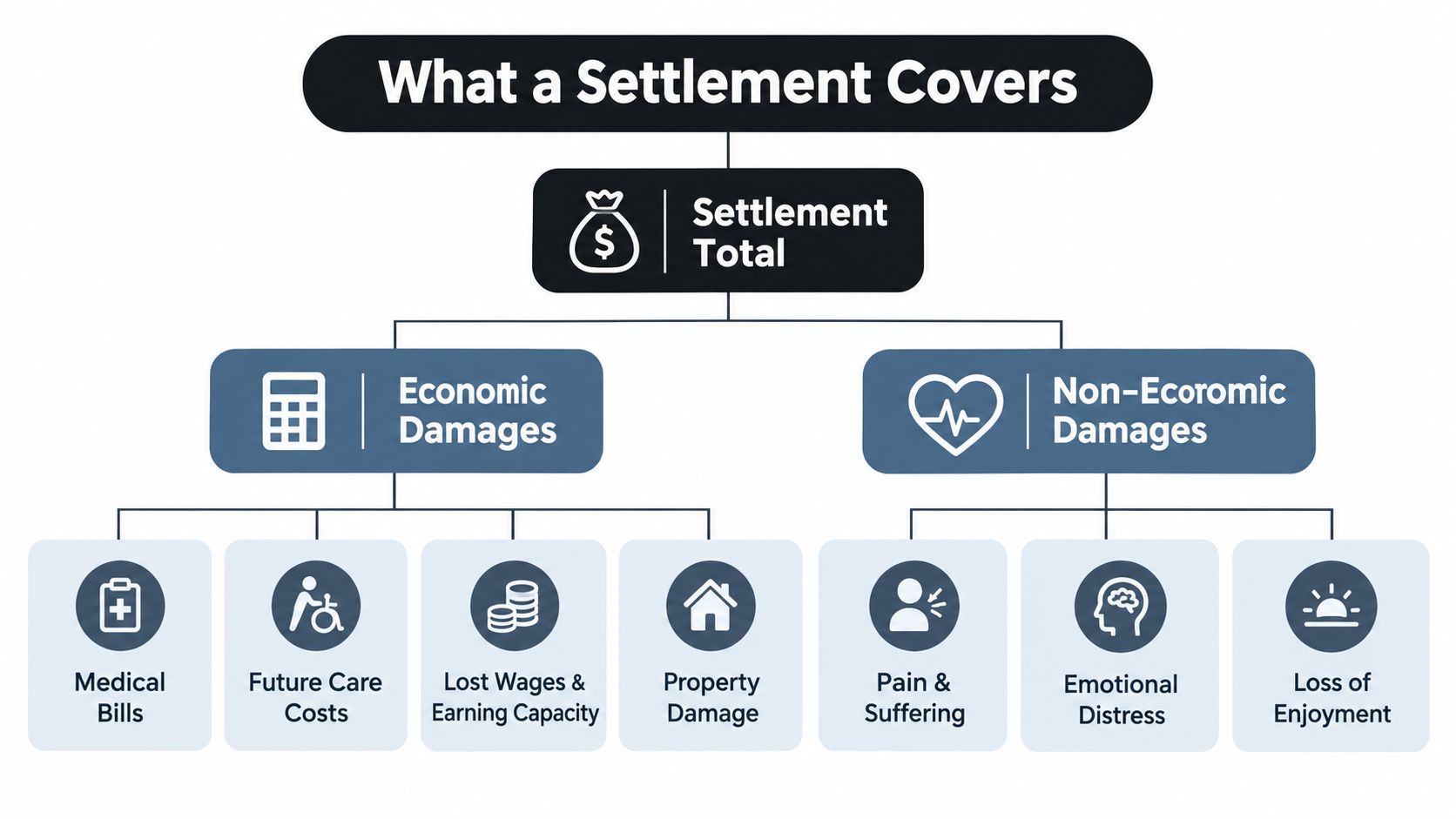
A settlement usually organizes compensation into two broad categories: economic damages and non-economic damages. The distinction helps lawyers and insurers understand both the bills that can be calculated and the human effects that don't arrive with a receipt.
Economic damages
Economic damages are the measurable losses caused by the injury. They may include:
- Medical expenses: Emergency care, hospital treatment, physician visits, rehabilitation, medication, imaging, and related services.
- Future treatment: Anticipated care, procedures, therapy, equipment, or support that medical evidence connects to the injury.
- Lost wages: Income you couldn't earn while attending appointments, recovering, or remaining unable to work.
- Reduced earning capacity: The effect of a lasting impairment on the type or amount of work you can perform.
- Out-of-pocket costs: Transportation, household assistance, accessibility changes, and other documented expenses related to the injury.
These items are often supported by records rather than estimates alone. Medical records and imaging can show the injury and its progression. Billing codes and itemized statements help establish treatment costs. Employer documentation can verify missed work and wages, while medical opinions and future-care notes may support ongoing needs. The Justia overview of personal injury settlement negotiations describes this evidence-based approach to documenting both economic and non-economic damages.
A missing receipt doesn't automatically erase a loss, but it gives the insurer an opening to question it. Keep a simple file for bills, mileage, prescriptions, wage records, appointment dates, and expenses relatives incur while helping you.
Non-economic damages
Non-economic damages address consequences that are real but harder to audit:
- Pain and suffering: Physical discomfort, restrictions, and the experience of recovering from the injury.
- Emotional distress: Fear, anxiety, sleep disruption, depression, or other psychological effects supported by the circumstances and records.
- Loss of enjoyment: Activities, relationships, routines, and independence you can no longer experience in the same way.
These damages aren't calculated by adding invoices. The severity of the injury, recovery period, permanent limitations, visible scarring, effect on daily activities, and consistency of the medical history all influence the discussion. A person who can no longer lift a child, drive comfortably, work a normal shift, or participate in a valued activity may have losses that don't appear in a billing statement.
The phrase pain and suffering can sound vague, but it represents specific changes in a person's life. A plain-language explanation of how pain and suffering is evaluated can help families identify the daily effects they should document for their legal team.
The strongest claim usually connects each category to evidence. Treatment records show what happened medically. A personal journal can capture sleep, pain, and activity changes, while statements from family or coworkers may help explain functional losses. The goal isn't to exaggerate. It's to present a complete account of how the injury affects the person behind the claim.
How the Settlement Process Works From Claim to Payment
The settlement process doesn't end when an adjuster says yes. For a family planning around rent, medical bills, or lost income, the final distribution stage matters as much as the negotiated gross amount.
Investigation and treatment
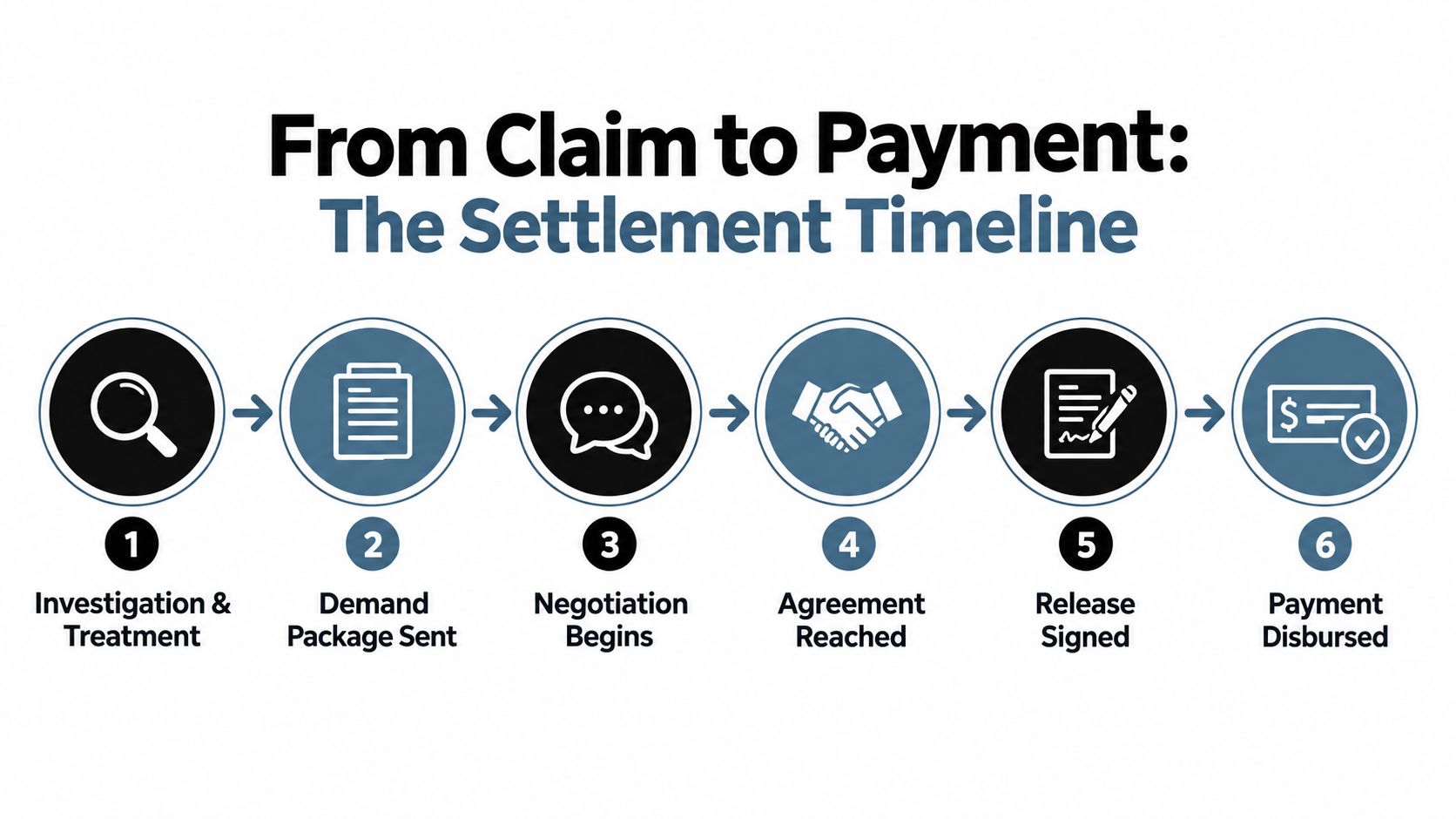
The process begins with the facts. A legal team may gather crash reports, photographs, witness information, insurance details, medical records, and other evidence relevant to fault and injury. You should seek appropriate care and follow medical instructions, because treatment decisions also create the record used to evaluate the claim.
A claim is often valued more accurately after doctors have a clearer view of recovery and future needs. Settling before that point can make it difficult to account for complications that haven't yet appeared.
Demand and negotiation
After the evidence is organized, the attorney may send a demand package. It generally explains what happened, why the other party is responsible, the injuries, the documented losses, and the compensation requested. An insurer may accept, deny, or respond with a lower offer.
Negotiation can involve several rounds. Each response should be tested against the evidence, not treated as an objective valuation. A useful settlement demand letter resource can help explain how the demand stage fits into the broader process.
Agreement, release, and funding
When the parties reach an agreement, the written terms become critical. Confirm the payment amount, released parties, lien responsibilities, costs, fee calculation, and deadlines before signing. The release normally closes the covered claim, so the settlement should account for known and reasonably supportable future needs.
After the insurer sends the funds, they commonly go to the attorney's trust account first. Medical liens, case costs, and contingency fees are paid from the settlement before the remaining amount is sent to the client, as explained by the neutral settlement payment and net recovery guide.
The number on the settlement agreement is the gross recovery. Your household budget depends on the net recovery.
Payment timing can involve several separate intervals. One 2025 explainer describes insurer payment as taking 1 to 2 weeks, lawyer deductions as taking 2 to 6 weeks, and final disbursement as taking 6 to 8 weeks. Those are planning ranges, not guarantees. Lien negotiations, missing documentation, disputed balances, court approval, or delays in receiving the insurer's check can change the schedule.
Ask for a written closing statement before distribution. It should show the gross amount, each fee and cost, every lien or reimbursement payment, and the precise amount you'll receive. If the numbers don't match your understanding, ask for an explanation before approving the disbursement.
Settlement Versus Going to Trial and How to Weigh the Choice
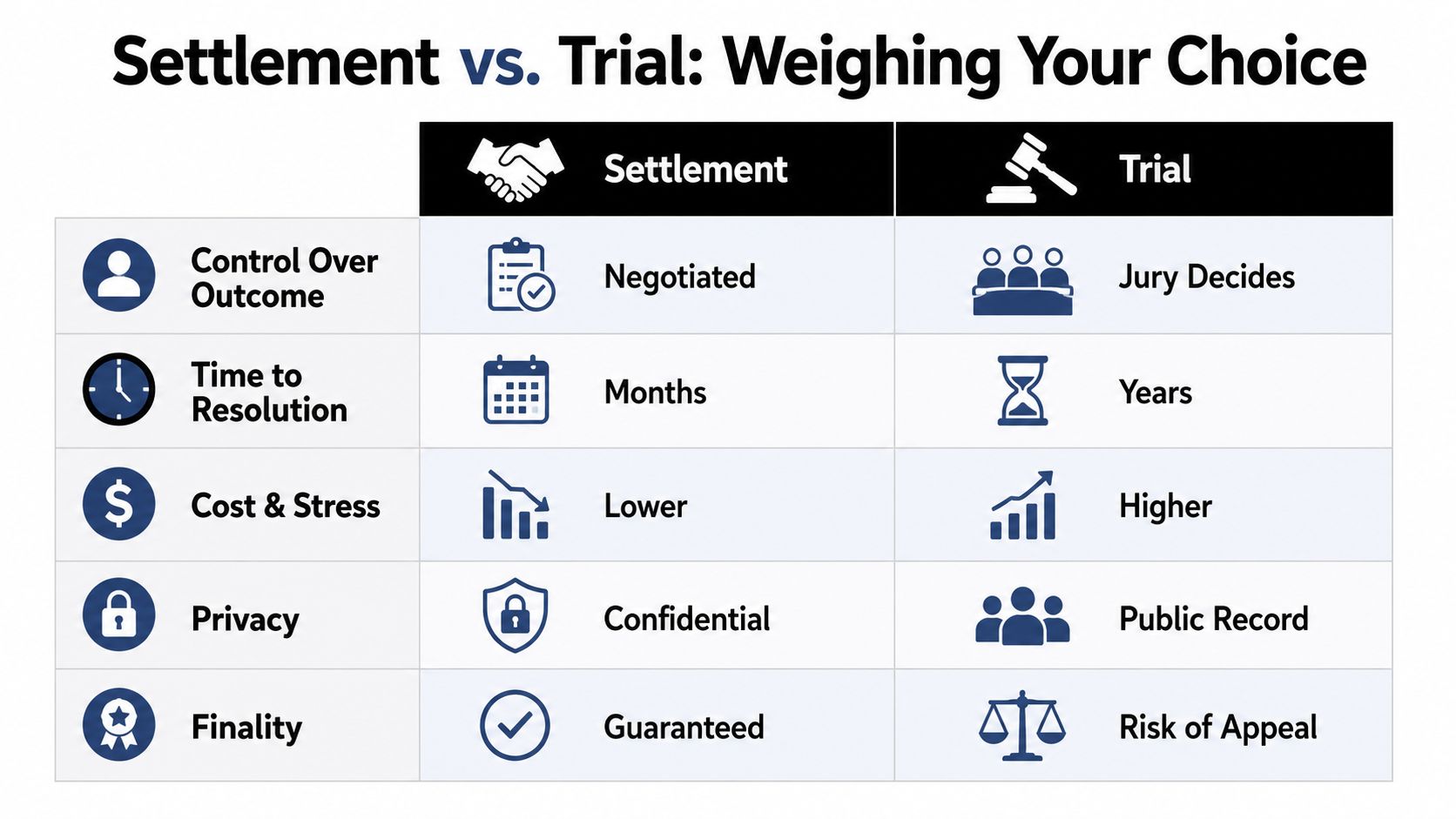
Settlement and trial solve the same dispute through different forms of risk. A settlement gives the parties control over the outcome through negotiation. A trial places the decision with a judge or jury, which can award more, less, or nothing depending on the evidence and legal findings.
| Factor | Settlement | Trial |
|---|---|---|
| Control over outcome | The parties negotiate the result | A judge or jury decides |
| Resolution experience | Usually avoids courtroom testimony | Requires formal litigation and a verdict |
| Cost and stress | Often reduces the demands of continued litigation | Can require extensive preparation and participation |
| Privacy | Terms may remain private depending on the agreement | Court proceedings and filings may be public |
| Finality | A signed release generally closes the resolved claims | A verdict may involve post-trial proceedings or appeal |
Neither choice is automatically right. A family facing urgent bills may value certainty and a defined path to payment. Another injured person may reject an offer because it fails to account for permanent impairment, future care, or substantial lost earning capacity.
What settlement offers provide
A settlement removes the uncertainty of a jury's decision and lets the parties agree on terms. It can also reduce the time, emotional strain, and expense associated with preparing witnesses, responding to discovery, and appearing in court. The trade-off is that you accept a negotiated amount rather than pursuing whatever a jury might award.
What trial can change
Trial preparation can strengthen negotiations even when the case ultimately settles. It forces both sides to confront evidence, legal theories, witnesses, and weaknesses. But trial brings its own uncertainty. A compelling injury doesn't guarantee a verdict, and a favorable verdict can still lead to post-trial disputes or delay before payment.
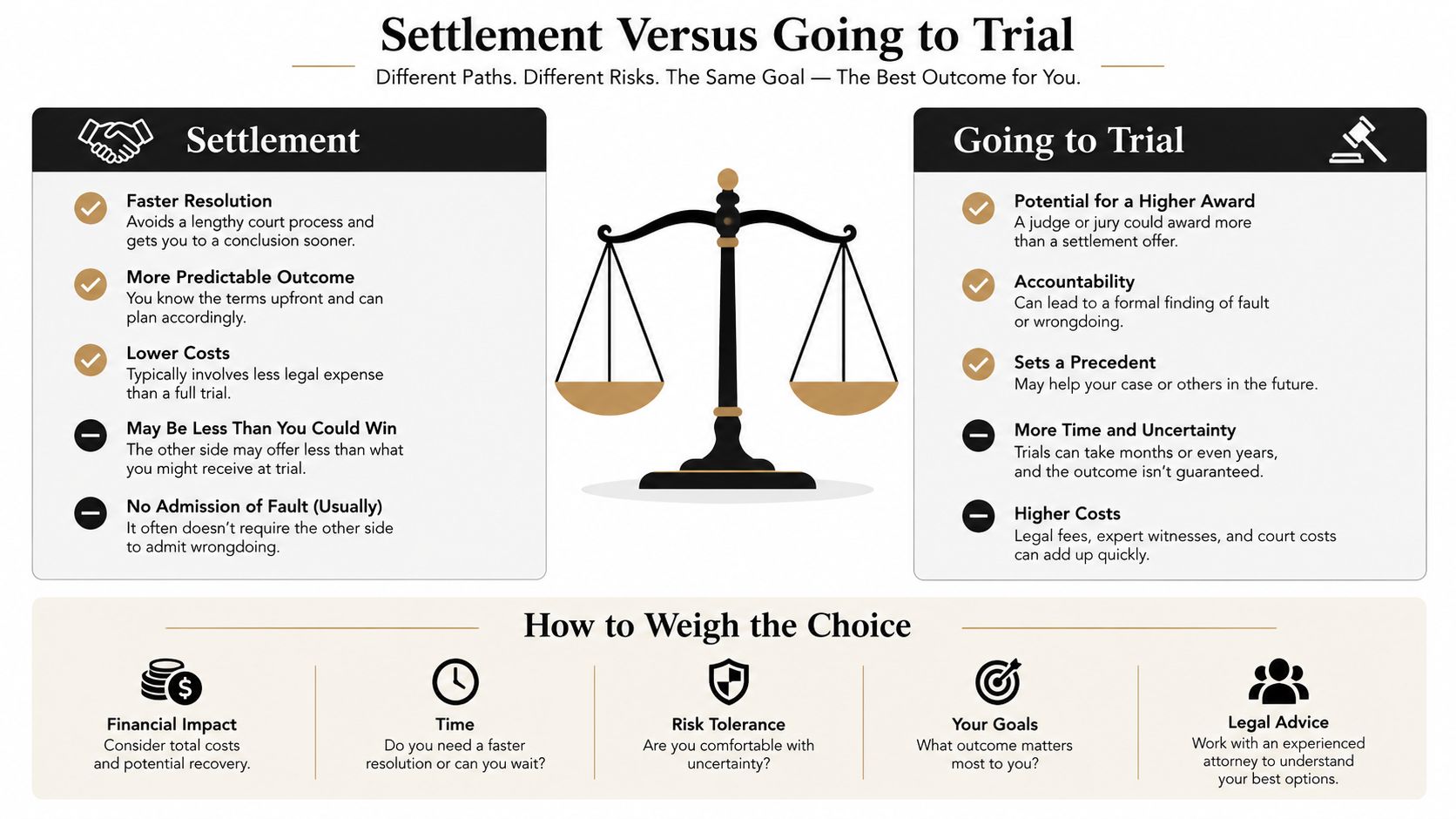
The right question isn't just, “Could trial produce more?” Ask whether the possible additional recovery justifies the added uncertainty, expense, time, and emotional burden. Your attorney should explain the strengths and weaknesses of both paths, the likely net result, and the effect of any release or judgment on your future rights.
Nares Law Group prepares injury claims for serious negotiation while handling the litigation path when a fair resolution isn't available. That approach lets a family consider settlement without treating trial as an empty threat or an automatic destination.
How to Evaluate a Settlement Offer With Confidence
Start with the net amount, not the bold figure at the top of the offer. Write down the proposed gross recovery, attorney fee, case costs, medical liens, insurance reimbursements, and any other deductions. Then calculate what would remain and compare that amount with the expenses your family still expects.
Test the offer against the full injury
Use this checklist:
- Past medical care: Does the offer account for all treatment already received?
- Future care: Has a qualified provider addressed follow-up treatment, surgery, therapy, medication, equipment, or supervision that may be necessary?
- Income loss: Are missed wages and any reduction in future earning capacity supported by employer and medical records?
- Daily impact: Does the evaluation reflect pain, emotional distress, sleep disruption, lost independence, and activities you can no longer enjoy?
- Responsibility: Does the evidence clearly connect the defendant's conduct to the injury?
- Available insurance: Is the proposed payment being compared with the coverage and responsible parties that may be available?
- Deductions: Are liens, costs, and fees documented rather than described generally?
A common valuation benchmark uses the multiplier method. Medical special damages may be multiplied by roughly 1.5 to 5, with the figure influenced by injury severity, permanence, recovery time, and disruption to daily life, according to the personal injury compensation chart from CHG Lawyers. This is a negotiation anchor, not a legal entitlement or an automatic calculator.
Another benchmark is the per diem approach. It assigns a daily value to pain and multiplies that amount by the number of recovery days. Both methods can organize a discussion, but neither replaces proof. Medical records, imaging, treatment consistency, future-care opinions, and documentation of work loss determine whether an anchor has persuasive support.
Before you accept, ask what the offer leaves uncovered, what the deductions will be, and whether the net payment can carry you through the recovery that remains.
An insurer may emphasize that an offer covers current bills while ignoring unresolved symptoms. You can respond by asking which future needs the adjuster considered and what evidence supports the proposed amount. Don't let a quick payment turn an uncertain medical future into a permanently closed claim.
Moving Forward After You Understand Your Settlement Options
A settlement should give your family a workable path forward, not just a satisfying-looking headline number. The evaluation should account for medical care, income loss, daily limitations, and the human effects of the injury, then show what remains after liens, costs, and attorney fees.
Begin by preserving the evidence. Keep medical records, bills, wage information, insurance correspondence, photographs, and a dated record of symptoms and activity restrictions. Don't discuss fault or accept a recorded statement from an insurer without understanding how it may affect the claim.
You also have the right to ask direct questions. What happens if treatment continues? Which liens must be paid? How are fees calculated? When will funds arrive? What does the release prevent you from pursuing? Clear answers can make a stressful decision more manageable.
Medical balances may also affect the final recovery. A resource on negotiating medical bills after settlement can help explain why lien resolution belongs in the take-home calculation, rather than being treated as an afterthought.
Nares Law Group LLC handles personal injury matters through investigation, treatment coordination, negotiation, settlement, and litigation, with a focus on helping injured Colorado families understand their options. A consultation can help you review the offer, identify unresolved damages, and estimate the net recovery before you sign a release.
If you're facing medical bills, lost income, or an insurance offer after a Colorado crash, Nares Law Group LLC can review your claim and explain the settlement process in plain language. Contact the firm for a free consultation focused on protecting your rights, documenting your losses, and understanding what you may take home.