Joint and several liability allows an injured plaintiff to recover 100% of the damages from any single at-fault party, even when that party was only partly responsible. The rule can protect your compensation when another defendant is uninsured, underinsured, or insolvent, but it can also create serious disputes over who ultimately pays.
You may be dealing with a wreck, painful medical treatment, missed work, and insurance adjusters who keep asking you to explain the same facts. The situation becomes harder when more than one driver, business, manufacturer, or property owner may have caused the harm. You might know that several people share blame, yet still wonder whether each one pays only a portion of your losses.
For a Colorado injury victim, that question can affect whether a judgment becomes a meaningful recovery or an unpaid piece of paper. The legal answer depends on the type of claim, the evidence of fault, available insurance and assets, and the rules that apply to the parties involved.
Understanding the Accident Scenario
You're driving south on I-25 when traffic suddenly stops. A distracted driver changes lanes without looking, another vehicle follows too closely, and the collision pushes your car into the median. Your shoulder and back hurt immediately. In the following days, medical bills arrive, your employer asks when you'll return, and two insurance companies point at each other.
Both drivers may have acted negligently. One may carry little insurance and own almost nothing that could satisfy a judgment. The other may have substantial coverage or assets. You're left with a practical question, not an academic one: who can pay for the full harm?

Shared fault creates a collection problem
A jury might decide that both drivers contributed to the crash. That finding doesn't automatically tell you whether you can collect the entire award from one defendant. The answer comes from the liability rule governing the claim.
Under joint and several liability, each liable defendant may be responsible for the entire amount of an indivisible injury. Under several liability, each defendant generally pays only the portion assigned to that defendant. The distinction matters most when one wrongdoer can't pay.
Your own conduct can matter too. Colorado uses comparative-fault principles in injury litigation, so the defense may argue that your decisions contributed to the collision or increased your losses. A plain-language overview of how shared fault can operate in another state is available through this guide to fault rules after a crash in NC, but Colorado law must control a Colorado claim.
Practical rule: A fault percentage and a collectible payment aren't always the same thing. Your lawyer must investigate both.
The same concern arises in truck crashes, unsafe-property cases, and wrongful-death claims. A trucking company, driver, maintenance contractor, property owner, or other party may have different insurance coverage and defenses. Identifying every potentially responsible party early helps protect your ability to pursue the compensation the evidence supports.
What Is Joint and Several Liability
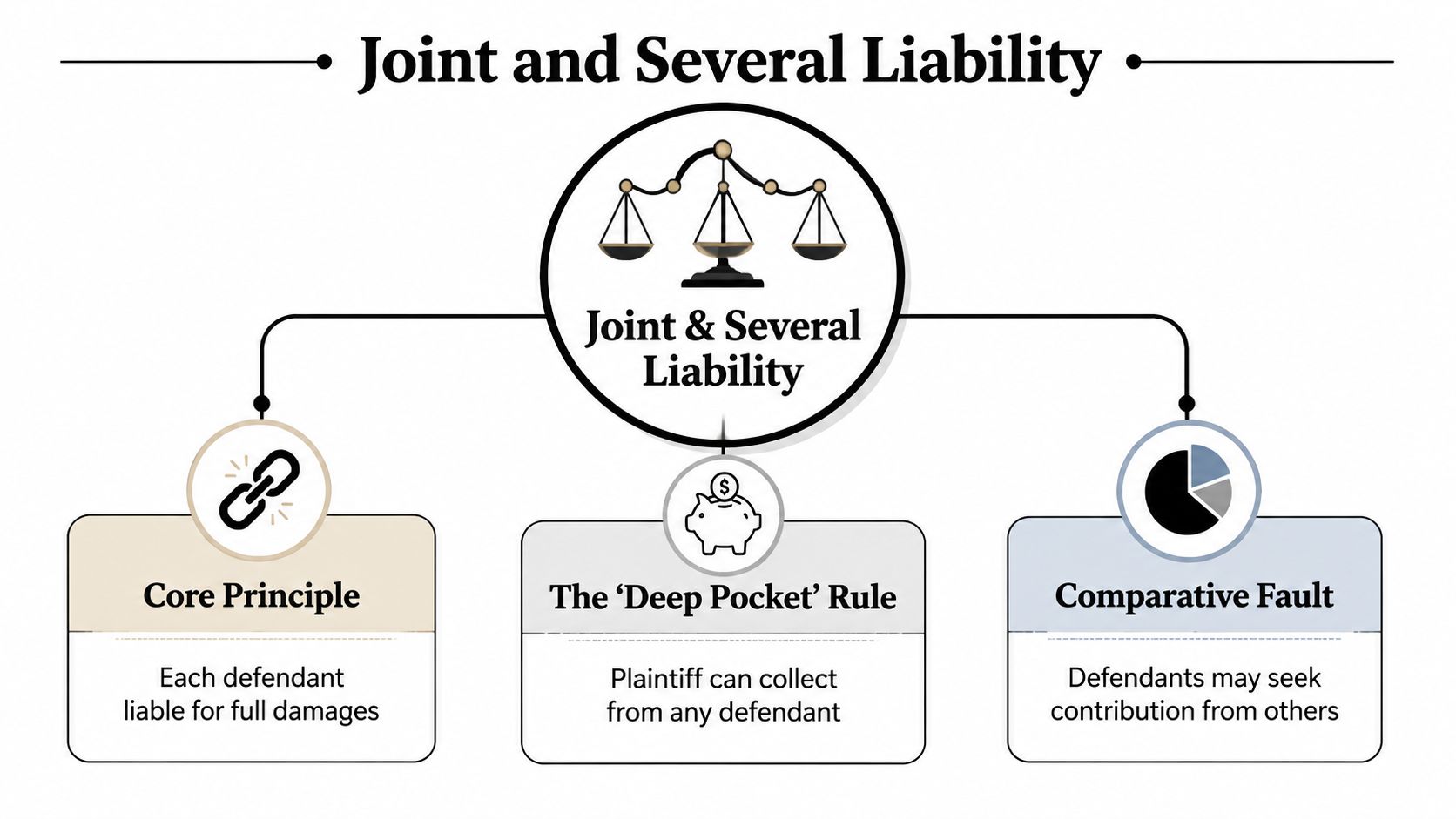
Joint and several liability is a tort-law recovery rule. When multiple defendants cause one indivisible injury, each liable defendant can be pursued for the full judgment, even if that defendant caused only part of the harm. The plaintiff doesn't have to absorb another wrongdoer's unpaid share because that wrongdoer lacks money or insurance. Cornell Law School's legal reference describes the rule as permitting collection of the full amount from any one defendant, with contribution issues handled afterward among the defendants.
The phrase has two parts:
- Joint liability concerns shared responsibility for the same injury.
- Several liability means each defendant is independently responsible for the whole recoverable amount under the rule.
That second meaning often surprises people. “Several” doesn't mean the plaintiff receives several small checks. It means each defendant's obligation can stand independently, while the plaintiff may seek the complete award from one defendant.
The difference from several-only liability
Suppose two defendants cause an indivisible injury. A court awards damages, and one defendant has no insurance or assets. Under joint and several liability, you may pursue the other liable defendant for the unpaid balance, subject to the law governing the claim and the defendant's available resources.
Under several-only liability, each defendant generally pays only that defendant's assigned share. If the less-affluent defendant cannot pay, the unpaid amount may remain unrecovered. That is the judgment-proof defendant problem. A judgment-proof person may legally owe money but lack the income, property, or insurance needed to satisfy the judgment.
The rule therefore shifts some insolvency risk away from the injured person and toward the defendants. The paying defendant can later seek contribution from co-defendants, but that private dispute doesn't require the injured plaintiff to wait while defendants divide responsibility.
The United States has no single nationwide approach. A legal survey reports that approximately 41 jurisdictions had abolished joint and several liability completely or partially in response to comparative negligence, while 10 jurisdictions retained pure joint and several liability. Another modern summary reports that 46 of the 50 states still retain some form of the doctrine, although about two dozen have reformed it, and several states have adopted pure several liability. The Maryland legislative survey illustrates how widely the rules differ.
How Judgments and Contribution Work
The easiest way to understand the payment mechanics is to follow the money. Assume a plaintiff receives a $100,000 judgment, with Defendant A found 10% at fault and Defendant B found 90% at fault. Under a joint and several rule, the plaintiff may pursue the full $100,000 from Defendant B, rather than limiting collection to Defendant B's fault percentage.
Defendant B's payment doesn't erase Defendant A's responsibility. It changes the next legal question: how much, if anything, can Defendant B recover from Defendant A? That claim is called contribution. Contribution is a dispute among defendants about allocating the financial burden after one defendant has paid more than that defendant's comparative share.
A simple payment sequence
- The court enters judgment. The judgment states the recoverable damages and identifies the parties found liable.
- The plaintiff seeks payment. The plaintiff may pursue the defendant with the most realistic ability to satisfy the judgment, subject to applicable limits and procedures.
- A defendant pays more than its share. That defendant may assert a contribution claim against another responsible defendant.
- The defendants resolve contribution. They may negotiate, litigate, or face separate allocation proceedings.
Contribution isn't a guarantee that the paying defendant will recover money. If Defendant A has no assets, insurance, or reachable resources, Defendant B may be unable to collect contribution. The plaintiff's recovery can still be complete while the defendants' internal allocation remains imperfect.
Don't confuse contribution with subrogation
Contribution addresses what co-defendants owe one another. Subrogation usually concerns an insurer, health plan, or other payer seeking reimbursement from a recovery after paying benefits connected to the injury. Those are different claims with different documents, priorities, and negotiation issues. A separate explanation of how a subrogation claim works can help distinguish the concepts.
The judgment also may not be fully collectible merely because joint and several liability applies. Insurance exclusions, policy limits, bankruptcy issues, protected assets, and procedural requirements can affect the money available. Your lawyer should evaluate collection prospects while building the liability case, rather than treating the judgment as the end of the process.
Application in Personal Injury and Wrongful Death
In an ordinary personal-injury case, the rule can affect whether you recover for medical care, rehabilitation, lost income, property damage, pain, and lasting limitations. A crash may involve two negligent drivers, a trucking company, a vehicle manufacturer, or a public or private entity responsible for roadway conditions. Each defendant may raise a different defense, but the injury may remain one indivisible loss.
Colorado practice requires careful attention to the specific statutory framework and claim type. Colorado generally follows a form of pure joint and several liability for certain tort claims, while other claims may be governed by modified rules or statutory exceptions. You shouldn't assume that a Colorado case follows the rule because several people appear responsible. The pleadings, evidence, nature of the injury, and applicable statute all matter. A broader resource on Colorado personal injury laws provides additional context for evaluating a claim.
Personal injury versus wrongful death
Personal-injury cases center on the injured person's losses and ongoing needs. Medical records, treatment recommendations, employment records, and testimony about daily limitations can show the full scope of the harm. Joint and several liability may help the plaintiff pursue payment from a defendant with meaningful coverage when another responsible party cannot contribute.
Wrongful-death claims involve a family confronting both grief and financial disruption. The recoverable losses and eligible claimants depend on Colorado law and the facts of the death. Multiple defendants can include negligent drivers, employers, manufacturers, contractors, or property owners. A family may need to establish not only how each party contributed, but also how the death affected the people legally entitled to seek damages.
A family should never assume that a defendant's lack of resources automatically ends the claim. The investigation may reveal another responsible party with insurance, assets, or a separate legal duty.
The doctrine doesn't create damages that the evidence doesn't support. It addresses collection among parties who are legally liable for the same injury. The plaintiff still must prove negligence or another recognized basis for liability, causation, damages, and compliance with filing requirements.
Insurance Implications and Settlement Strategy
Insurance often determines whether a liability rule produces an actual payment. The defendant with the greatest apparent “deep pocket” may be an individual with substantial coverage, a commercial carrier, a business, or an employer. Yet the available policy may contain exclusions, competing claims, reservation-of-rights issues, or limits that don't match the size of the injury.
A careful evaluation starts with coverage, not just fault. Counsel may need to identify every applicable policy, determine whether multiple insured parties share coverage, preserve evidence, and assess whether your own uninsured or underinsured motorist coverage may apply. The practical meaning of policy limits is explained in this guide to insurance policy limits.

Settlement decisions need a recovery plan
Settling with one defendant can provide funds sooner, reduce litigation risk, and remove one party from the case. But a release may affect claims against remaining defendants, allocation arguments, liens, and the total amount you can recover. Never evaluate an offer only by asking whether the check seems helpful today.
Before signing, ask:
- Release language: Does the agreement release only the settling defendant, or does it affect other potentially responsible parties?
- Allocation: Does the document explain how the settlement is credited against the judgment?
- Coverage: Have all relevant policies and insured entities been identified?
- Future needs: Does the amount reflect continuing treatment, lost earning capacity, and permanent limitations?
- Liens and reimbursement: Will a health insurer, benefit plan, or other payer assert a reimbursement claim?
Joint and several liability can create pressure because a defendant with resources may face exposure beyond its assigned share. That pressure isn't automatic. Defense counsel may challenge causation, argue that the claim falls under a several-only exception, or contend that another party caused most of the harm.
A strong settlement strategy connects fault proof, collectability, medical documentation, and release terms. It also accounts for the possibility that a defendant who appears solvent today may have limited coverage or disputed responsibility.
Common Defenses and Misconceptions
The most common misunderstanding is that the “deep pocket” always pays everything permanently. Joint and several liability may allow the plaintiff to seek the full judgment from one defendant, but that defendant can pursue contribution from co-defendants. The final economic burden may shift after payment, although an insolvent defendant may leave the paying party without a practical recovery.
Another misconception is that naming multiple defendants guarantees full compensation. It doesn't. The plaintiff must prove each defendant's legal responsibility, connect that conduct to the injury, and establish damages. A defendant may also lack collectible insurance or assets, and a court may apply a statutory exception that limits exposure.
Arguments defendants may raise
- Several-liability argument: A defendant may contend that the applicable Colorado rule limits payment to that party's share of fault.
- Causation challenge: The defense may argue that its conduct didn't cause the injury, or that another event caused the claimed symptoms.
- Apportionment position: Counsel may seek a fault allocation that reduces the defendant's responsibility or places blame on a nonparty.
- Damage challenge: The defense may dispute treatment, wage loss, future limitations, or whether unrelated conditions explain the symptoms.
Reform trends make state-specific analysis essential. The University of Denver law review survey describes how reforms expanded as comparative-fault systems spread, replacing full exposure in some jurisdictions with several liability or modified rules tied to fault. Those reforms produced a patchwork. Some states preserve broad joint exposure, while others restrict it to defined circumstances.
South Carolina's 2025 reform provides a current example. A defendant under 50% at fault isn't subject to joint liability there, while willful, wanton, reckless, intentional, and certain drug-related conduct can still trigger full joint liability, as summarized by the American Tort Reform Association's 2025 reform overview. That comparison doesn't determine Colorado law, but it shows why online explanations can mislead people who assume every state uses the same rule.
Next Steps for Injured Parties
If several parties may have caused your injury, protect the evidence before the facts become harder to prove. Keep photographs, medical records, discharge instructions, bills, wage information, insurance letters, and a written account of what happened. Don't give a recorded statement or sign a release before you understand how it may affect claims against other defendants.
A practical first review should identify:
- Every potential actor: Drivers, employers, vehicle owners, manufacturers, contractors, property owners, and other parties may have different duties.
- Every insurance source: Coverage may exist through a defendant, a business, a commercial carrier, or your own policy.
- The judgment-proof risk: A fault finding matters less if the responsible party has no practical ability to pay.
- The filing deadline: Missing a legal deadline can prevent an otherwise valid claim.
- The settlement effect: A release may alter allocation, contribution, liens, and claims against remaining parties.
If your crash seemed minor at first, symptoms can still develop later. Basic safety and documentation guidance, including what to do after a minor car, can help you preserve information and seek appropriate medical attention.
Colorado's joint and several liability rules can offer an important path toward full recovery, but the result depends on proof, collectability, insurance, comparative fault, and settlement wording. Nares Law Group LLC can investigate multi-party crashes, coordinate with medical providers, evaluate insurance coverage, negotiate with insurers, and pursue personal-injury or wrongful-death claims through settlement or trial.
If multiple people or businesses may have contributed to your injury, contact Nares Law Group LLC for a case evaluation focused on both liability and the money you can realistically recover. Bring your accident records, medical documents, insurance communications, and any settlement offer so the firm can help you understand your options.