The crash is over, but the decision may be starting now. Someone is sitting in the passenger seat with a headache, insisting they're fine. A child fell, cried, and then became quiet. An older adult slipped, stood up, and seems normal again. The question is immediate: when should you go to the ER after a head injury, and when is careful observation reasonable?
Use three urgency levels. Call 911 now for loss of consciousness, a seizure, inability to wake, repeated vomiting with worsening symptoms, new weakness or numbness, slurred speech, unequal pupils, or rapidly increasing confusion. Go to the emergency department the same day for a resolved period of confusion, amnesia, or loss of consciousness, a worsening headache, suspected skull injury, repeated vomiting, a dangerous crash or fall, blood-thinning medication, or a higher-risk age group. Monitor at home only when symptoms are mild, stable, and no high-risk history is present, with a responsible adult watching closely and clear instructions to escalate.
That framework protects two things at once: the injured person's health and the record of what happened. Write down the impact, the first symptom, every change, and every medical decision. A person who looks well now may still need evaluation.
The First Hour After a Head Injury: What to Do
A person may stand up after a crash, answer questions, and still have a dangerous brain injury. Adrenaline can mask pain, confusion, or drowsiness, while bleeding or swelling may develop after the impact. The CDC head injury warning signs explain why a blood clot can form and compress the brain after an apparently mild injury. Treat a change from normal behavior as a medical warning, not reassurance.
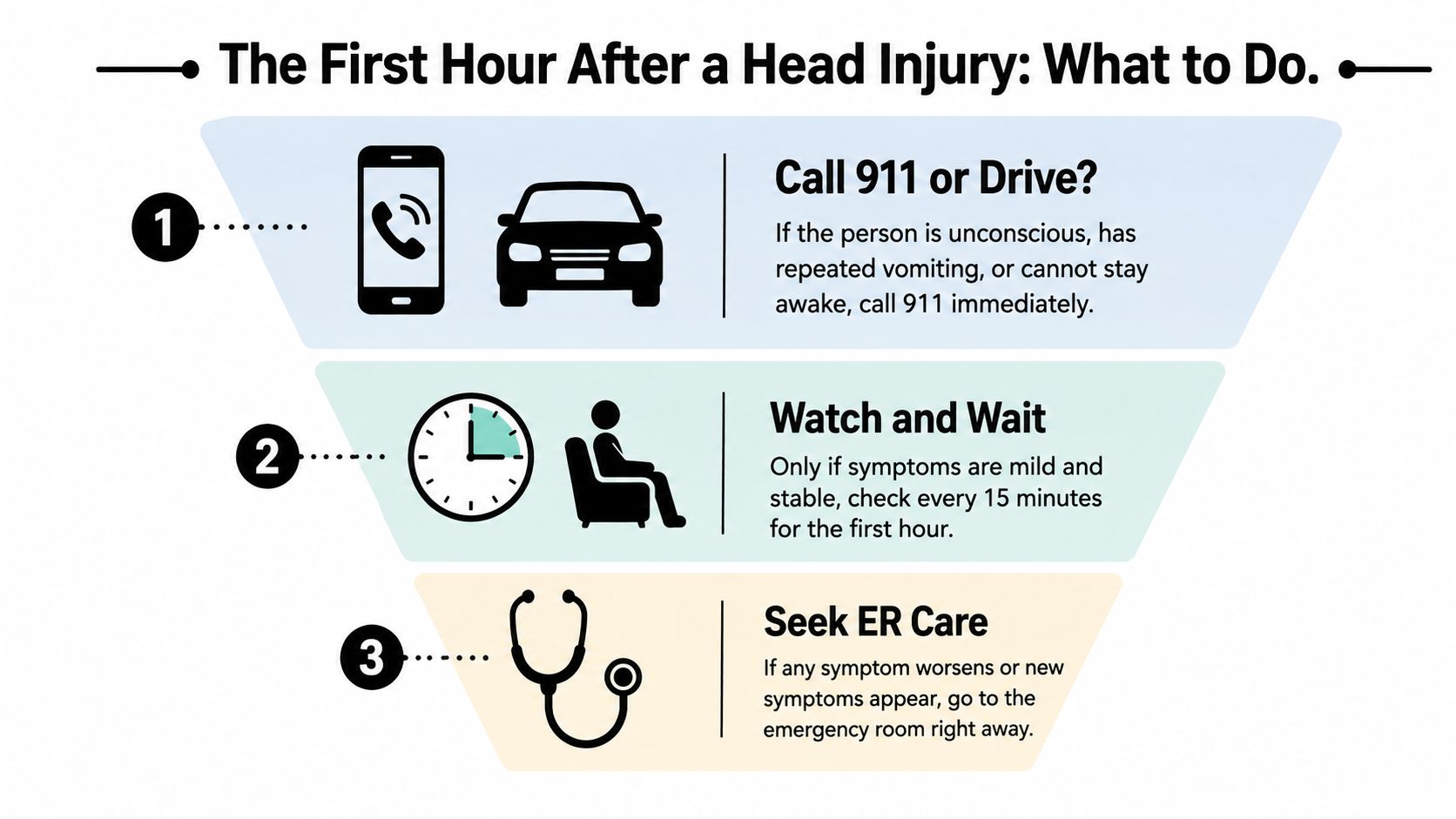
Choose the emergency level
Call 911 now if the person is unconscious, difficult to wake, having a seizure, vomiting repeatedly, becoming more confused, or developing weakness, numbness, slurred speech, unequal pupils, or serious trouble walking. Do not let someone with neurological symptoms drive. Keep the person as still as practical while emergency responders assess and transport them.
Go to the emergency department the same day after any loss of consciousness, even if it was brief and the person recovered. The same recommendation applies to amnesia, temporary confusion, a worsening headache, more than one vomiting episode, suspected skull fracture, or a high-force event such as a vehicle or truck crash. The visible symptom may resolve while the injury history remains medically important.
Monitor at home only when symptoms are mild and stable, no warning signs or risk factors are present, and a responsible adult can stay nearby. Record each symptom, its timing, and every change. If the condition worsens, leave for the ER.
The force and setting of the impact matter. A small bump during a low-level incident is not automatically harmless, while a seemingly modest blow during a crash or fall deserves careful attention. Record whether the head struck a windshield, dashboard, seat, floor, helmet, or another object. Note whether the body was thrown or twisted. These details can help doctors evaluate the injury and preserve an accurate record if negligence or a crash later becomes disputed.
Practical rule: Judge the change from the person's normal condition. New or worsening neurological symptoms should move the decision toward emergency care.
Do not give alcohol or sedating medication while deciding what to do, and do not leave the person alone. Write down the event, symptoms, times, and medical decisions while the details remain clear. That record supports both prompt treatment and later documentation.
Red Flag Symptoms That Require an ER Visit
The right response depends on how the person is changing, not on whether the injury looks dramatic. Use three urgency levels: call 911, go to the ER the same day, or monitor closely at home. That choice protects the person first and creates a clearer record of what happened if a crash or negligence claim follows.
Call 911 for signs of deterioration
Emergency transport is appropriate when the person cannot be awakened, has a seizure, develops new weakness or numbness, speaks unclearly, becomes increasingly confused or agitated, or has pupils of different sizes. A worsening headache or repeated vomiting becomes more concerning when it appears with drowsiness, poor coordination, or behavior that is out of character. The CDC lists these kinds of changes among the danger signs after traumatic brain injury, as noted earlier.
The reason matters. Unequal pupils can reflect pressure affecting the brain's control of the eyes. One-sided weakness or slurred speech can indicate impaired brain function. A seizure, falling alertness, or rapidly worsening confusion may signal that the injury is progressing. Families should not try to identify the exact cause at home. They should call 911 and avoid driving an unstable person.
Write down the time each change began, who saw it, and what happened before emergency services arrived. That timeline can help clinicians and preserve the facts while they are still clear.
Go to the ER the same day
A same-day ER visit is appropriate after any loss of consciousness, amnesia, or temporary confusion, even when the person seems normal again. Suspected skull fracture, fluid or blood from the nose or ears, more than one vomiting episode, or a dangerous mechanism also deserves prompt assessment. NICE recommendations address urgent evaluation and imaging for reduced Glasgow Coma Scale scores, suspected fracture, seizure, focal neurological deficit, repeated vomiting, and selected cases involving loss of consciousness or amnesia (NICE head injury recommendations).
Risk changes with age, bleeding or clotting disorders, anticoagulant or antiplatelet medication, and the force of the event. A normal-looking face does not rule out a serious injury. Record the impact, symptoms, medication list, and any change before arrival.
The signs of traumatic brain injury include changes that may appear subtle. Slower answers, unsteadiness, unusual irritability, or difficulty recalling the event still warrant careful triage.
Monitor only when symptoms remain mild and stable
Watchful waiting fits only when there are no warning signs or high-risk factors and a responsible adult can remain nearby. Track each symptom, its timing, and whether it improves or worsens. If the person's condition changes, stop monitoring and seek emergency care.
| Situation | Why it matters | Action |
|---|---|---|
| Reduced alertness, seizure, or new weakness | Possible serious brain dysfunction | Call 911 |
| Unequal pupils, slurred speech, or worsening confusion | Possible neurological deterioration | Call 911 |
| Loss of consciousness, amnesia, or repeated vomiting | Injury history that may require assessment or imaging | Same-day ER |
| Mild, stable symptoms with no risk factors | May permit observation with supervision | Monitor closely |
What Happens in the Emergency Room
Families often arrive worried that clinicians will dismiss a head injury or order a CT automatically. The emergency team starts with triage, the injury history, and neurological checks. Tell them how the impact occurred, whether the person lost consciousness or memory, which symptom appeared first, and what has changed since the event. That record supports medical decisions and preserves details that may matter in a later claim.

The examination comes before the scan
A clinician may record the Glasgow Coma Scale, pupil responses, strength, speech, coordination, orientation, memory, and behavior. Staff may repeat these checks because a worsening examination can reveal a problem that one reassuring observation misses.
Under NICE head injury guidance, some adults need urgent CT imaging based on a low or declining GCS, suspected skull fracture, seizure, focal neurological deficit, or repeated vomiting. For selected patients with loss of consciousness or amnesia, additional risks can support imaging later in the emergency assessment. Age, bleeding or clotting disorders, dangerous mechanisms, and substantial retrograde amnesia can affect that decision.
A CT is not automatic for every bump. Clinicians weigh the injury history, examination, radiation exposure, and likelihood of finding a clinically important problem. Decision rules such as the Canadian CT Head Rule can guide imaging for appropriate adults, while children need age-appropriate assessment. Tell the team about blood thinners, antiplatelet medication, suspected fracture, or any change in mental state.
Before discharge, ask:
- What were the documented GCS and neurological findings?
- Was imaging performed, and what did the report show?
- Which symptoms require an immediate return?
- Who should provide follow-up care?
- Which activities, medications, driving, work, or sports should be avoided?
Cost concerns can add pressure after a frightening injury. Families can find out what a medical emergency really means for coverage and financial planning, but cost must not delay emergency treatment when warning signs are present. Keep the discharge papers, radiology report, medication list, and written instructions.
For a closer explanation of traumatic brain injury CT scans, review how imaging fits into the medical decision after immediate care.
Monitoring at Home During the First 24 to 48 Hours
Home observation is not passive. It means a responsible adult stays nearby, checks for change, and acts quickly if the person deteriorates. If no clinician has evaluated a person who had loss of consciousness, amnesia, repeated vomiting, a worsening headache, or a high-risk mechanism, don't use home monitoring as a substitute for same-day emergency assessment.
Build a written monitoring routine
Keep a notebook or phone log. Record the time of the injury, the person's initial symptoms, any medication taken, food and fluids, sleep, vomiting, pain changes, walking ability, speech, and behavior. A timestamped record gives clinicians a clearer history and preserves details that families often forget after a stressful event.
During waking checks, ask simple questions such as the person's name, location, and what happened. Watch them walk only if they're steady and safe. Check whether they can speak normally, use both sides of the body, and respond in their usual way.
The infographic's wake-up guidance reflects a common home-monitoring practice, but sleep instructions should follow the treating clinician's discharge plan. Don't repeatedly wake someone against medical advice or assume that sleep itself is dangerous. The urgent problem is an inability to wake, an abnormal response, or a new decline.
If the person is harder to wake, more confused, vomiting again, developing a worse headache, stumbling, speaking unclearly, or showing weakness, return to the ER or call 911.
Avoid alcohol, recreational drugs, sedatives, driving, and risky physical activity. Don't leave the injured person alone during the monitoring period, and keep emergency contact information, discharge instructions, and transportation plans ready.
Return immediately for worsening headache, repeated vomiting, seizure, unequal pupils, new weakness or numbness, slurred speech, increasing agitation, balance problems, unusual behavior, or inability to wake. Delayed symptoms can matter, so families should review delayed traumatic brain injury symptoms and follow the medical team's specific return precautions.
Special Considerations for Children and Older Adults
A child may not describe a headache clearly. An older adult may not recognize or report confusion. Age changes how a head injury appears, so the same impact can require a different response.
Children under 16
Children may show irritability, unusual quietness, sleepiness, crying, poor feeding, trouble walking, or a sudden behavior change instead of describing a specific symptom. NICE applies separate criteria for children under 16, including seizure, reduced consciousness, suspected skull fracture, signs of a basal-skull injury, focal neurological deficit, and, for a child under 1, a sizable bruise, swelling, or laceration on the head.
A child who stops crying is not automatically ready for school, sports, climbing, biking, or rough play. Ask what hurts, whether vision feels strange, whether dizziness is present, and whether the child remembers the event. For infants, refusal to feed, inconsolable crying, or a marked change in alertness warrants urgent evaluation.
Record what the child was doing before the injury, what changed afterward, and who observed those changes. Those details help clinicians assess the injury and give families a reliable account if a crash or unsafe condition caused it.
Older adults and people at bleeding risk
Age 65 or older is a high-risk factor in the Canadian decision rule and in NICE pathways when other circumstances apply. A fall that looks minor can still cause significant injury, particularly when the person takes anticoagulant or antiplatelet medication or has a bleeding or clotting disorder.
Confusion may be the only obvious change. Compare the person with their usual behavior, ask family members what is normal, and tell the ER team about every medication, especially blood thinners. Do not wait for a dramatic bump or visible wound.
Mechanism matters more than bump size. A hard fall, vehicle collision, truck crash, or impact involving possible amnesia deserves medical attention even when the skin looks normal. Note the person's baseline, medications, symptoms, and timing for the medical record.
Documentation Tips If a Crash or Negligence Caused the Injury
After a crash or unsafe-property incident, preserve facts while they're fresh. Photograph the scene, vehicle damage, debris, lighting, surface conditions, damaged helmet or head protection, and any visible injury. Don't risk further harm to get a picture, and don't interfere with emergency care.
Write down:
- Timeline: Record the impact time, first symptom, worsening symptoms, calls, transport, arrival, examinations, and discharge.
- People present: Save witness names, contact details, responding agency information, and the names of every clinician involved.
- Medical instructions: Keep discharge papers, imaging results, prescriptions, restrictions, referrals, and return precautions.
- Daily effects: Note headaches, sleep changes, concentration problems, balance issues, missed work, childcare needs, and help required with ordinary tasks.
Request the emergency department record, nursing notes, physician notes, GCS documentation, radiology report, imaging disc or electronic access, and follow-up plan. Keep the original files and make a backup.
A symptom journal should remain factual. Write what happened, when it happened, who observed it, and how it affected work or daily life. Avoid guessing the diagnosis or exaggerating the description. If an insurer requests a recorded statement before the medical picture is clear, consider getting legal advice first.
A Practical Action Plan Before You Finish Reading
Call 911 for inability to wake, seizure, loss of consciousness with deterioration, worsening neurological symptoms, unequal pupils, repeated vomiting with decline, or rapidly increasing confusion. Go to the ER today after resolved loss of consciousness, amnesia, confusion, worsening headache, suspected fracture, repeated vomiting, a high-force crash, blood-thinning medication, or a high-risk age. Monitor only when symptoms are mild and stable, with a responsible adult, a written log, and clear return precautions.
If the injury came from a crash or unsafe condition, symptoms persist, or an insurer is pressing for a statement, a consultation can protect your options. Families seeking general injury legal advice can start with an independent resource, then bring their medical records and timeline to a qualified attorney.
Nares Law Group LLC helps people injured in motor vehicle crashes, truck wrecks, and traumatic brain injuries with investigation, medical coordination, insurance negotiations, and litigation. Visit Nares Law Group LLC to discuss what happened and learn what steps may protect your family's claim.