You're standing beside a damaged vehicle, still trying to understand what happened. The other driver has disappeared, traffic is moving around you, and every passing car may look like the one that struck you. You don't need to solve the case yourself. You need to protect your safety, preserve evidence, and give investigators useful facts before cameras overwrite footage and memories fade.
The practical answer to how to find a hit and run driver starts with speed and organization. Driver identification is closely tied to visibility and timing. Research involving 7,696 pedestrian crashes found that drivers were identified in 3,301 cases, and drivers were more likely to be identified when crashes occurred during the day or in daylight conditions (the crash-identification study). In Colorado, your first practical advantage is the information still available around the scene.
Your First Actions at the Scene of the Crash
Shock affects memory, balance, and judgment. Take one breath, then work through the priorities in order. Safety comes before evidence.
Protect people before property
If you can move your vehicle safely, get it out of active traffic. Turn on your hazard lights. Don't chase the fleeing driver. A pursuit can create another collision, and it can place you in danger.
Call 911 if anyone is injured, traffic is unsafe, or the crash may involve serious property damage. Check passengers and other people involved. Don't assume an injury is minor because adrenaline is masking pain. If you're dizzy, confused, short of breath, or experiencing severe pain, tell the dispatcher immediately.
Once people are safe, avoid disturbing the scene unless movement is necessary for safety or medical care. Keep broken parts, loose trim, and other debris where they are until officers document them, when conditions allow.
Record the facts while they're fresh
Use your phone's notes app or a voice memo. Record:
- Exact location: Include the street, intersection, nearby businesses, lane, parking area, or highway marker.
- Time: Note when you felt or heard the impact, not just when you called police.
- Direction of travel: Identify the lane and direction the other vehicle used after leaving.
- Vehicle description: Write the color, body style, approximate size, make, model, visible damage, and unusual features.
- Plate information: Record every character you remember, even if it's incomplete or uncertain.
- Driver details: Note clothing, apparent age, hair, and anything else you saw.
Separate what you know from what you're guessing. “Dark SUV traveling north” is useful. “Black Ford Explorer” should be reported only if you're reasonably confident.
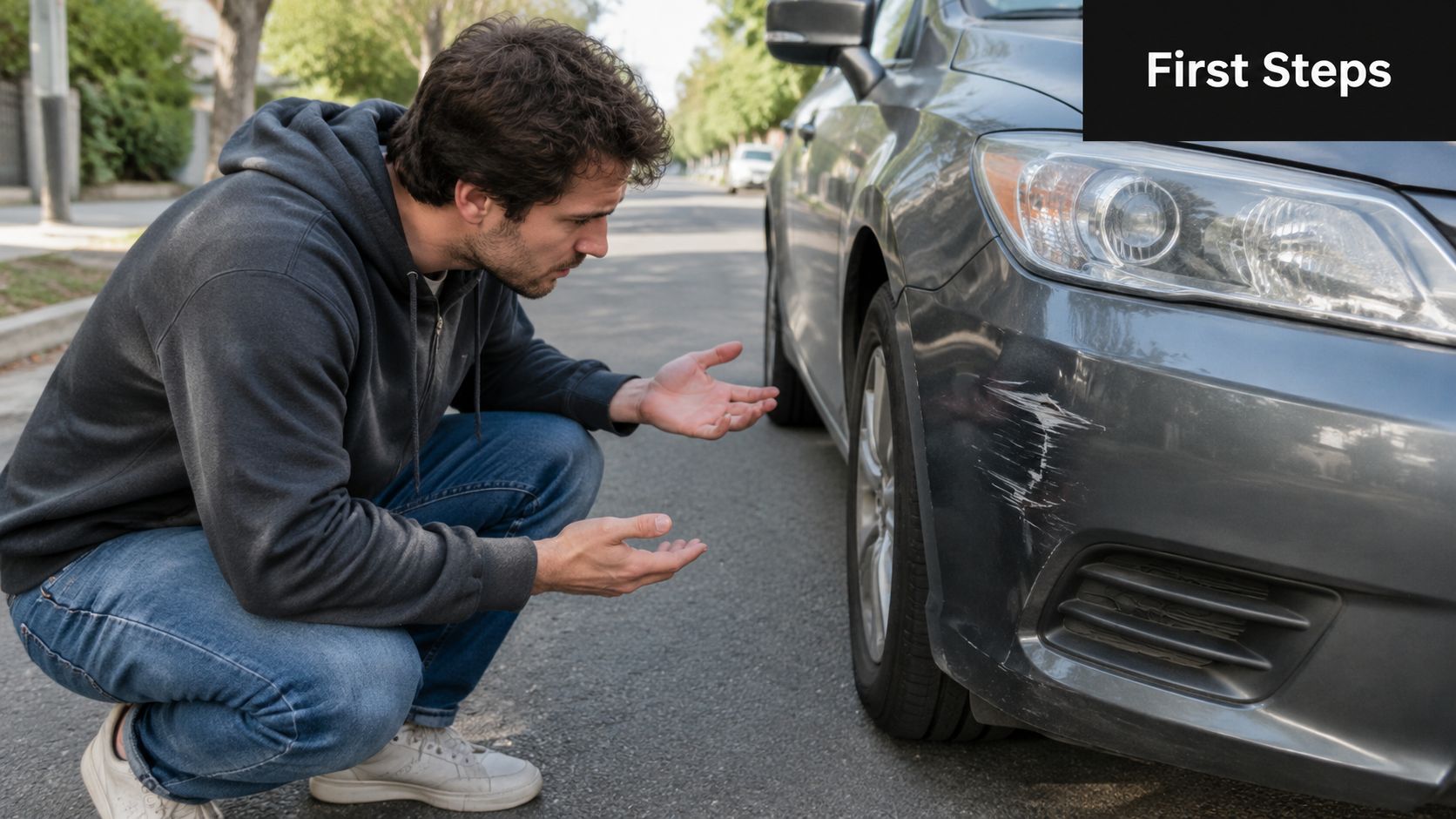
Take wide photographs showing the roadway and nearby cameras. Then take close photographs of your vehicle, including dents, scratches, paint transfer, broken lights, and tire marks. Photograph before washing or repairing anything.
Practical rule: Preserve uncertainty honestly. A partial plate or approximate vehicle description can help, but a confident-sounding guess can send an investigation in the wrong direction.
Gathering Key Evidence the Fleeing Driver Left Behind
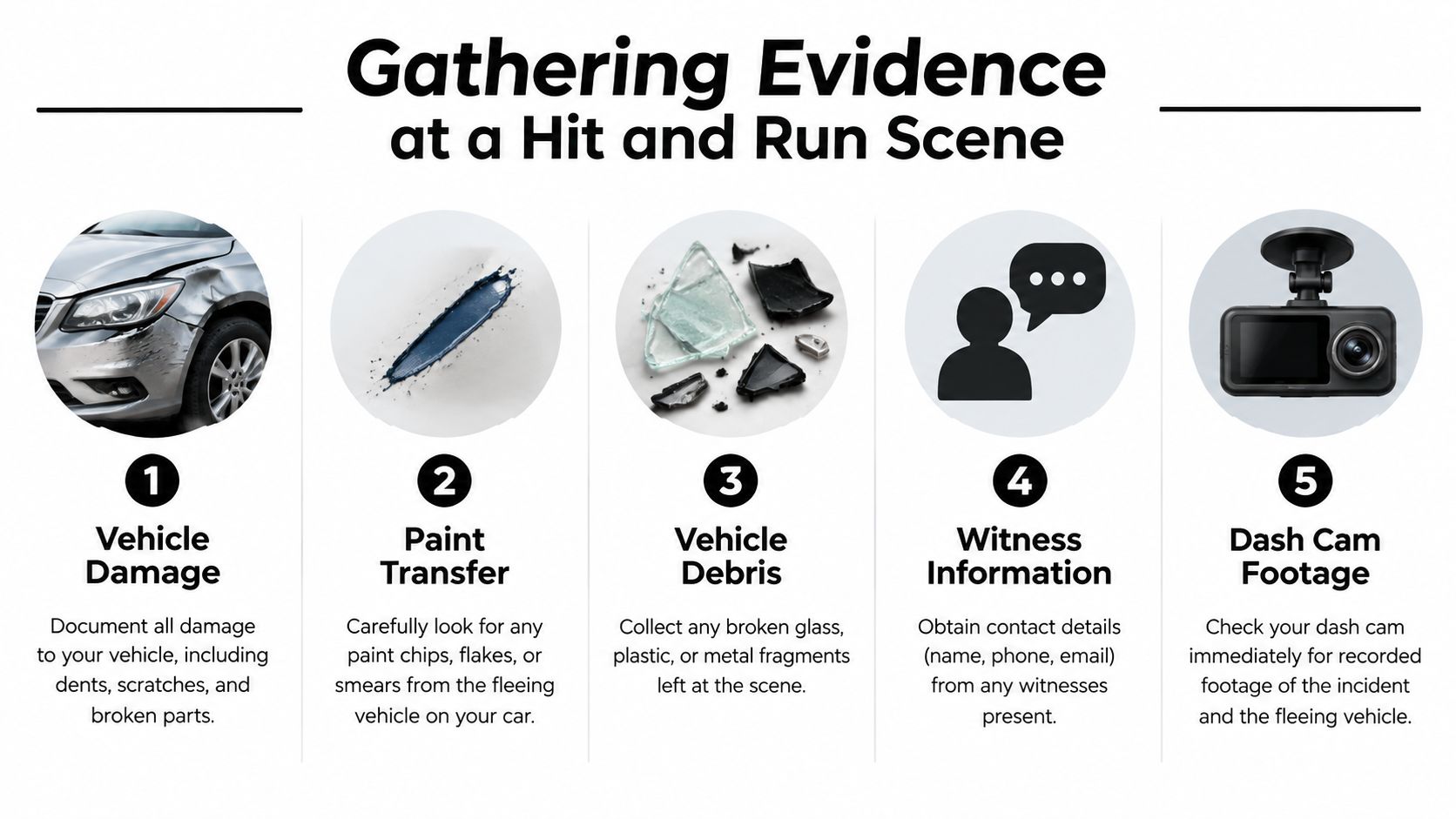
The fleeing vehicle may have left physical evidence even when the driver is gone. Don't scrape paint, clean the bumper, or throw away broken pieces. Photograph everything in place, and ask the responding officer how the evidence should be preserved.
Build a vehicle profile
Look for paint chips, smears, plastic fragments, glass, metal, detached trim, and pieces of a mirror or light assembly. Paint transfer can help distinguish the color and type of vehicle involved. Broken parts may narrow the vehicle's make, model, or body style when examined with the damage on your vehicle.
Photograph damage from several angles. Include one image that shows the entire vehicle, another that shows the damaged area in context, and close images that show texture, color, and transfer marks. Keep the original files. Don't edit them in a way that removes metadata or changes the appearance.
Ask witnesses focused questions instead of “Did you see anything?” Try:
- Vehicle: “What color and body style was it?”
- Plate: “Did you see any characters, even part of the plate?”
- Movement: “Which way did it go, and which lane was it in?”
- Driver: “Did you see the person behind the wheel?”
- Recording: “Did your phone, dash camera, or nearby camera capture it?”
Get each witness's name and contact information. Ask them to describe what they personally saw, not what another person told them.
Search locally, but don't investigate recklessly
A 2026 AAA Foundation brief found that over 70% of fatal hit-and-run crashes occurred within 10 miles of the fleeing driver's home ZIP code, and nearly 85% occurred within 25 miles (AAA Foundation brief). That doesn't identify a particular person, and it doesn't justify confronting a damaged vehicle. It does support a focused search of nearby routes.
Tell police about likely travel paths, nearby neighborhoods, workplaces, parking areas, and distinctive vehicle details such as stickers, roof racks, unusual wheels, or fresh damage. If you later notice a vehicle that appears to match, don't follow it. Record the location and notify law enforcement.
The strongest result usually comes from combining physical evidence, witness information, and objective records. A single remembered plate fragment may be wrong. A plate fragment supported by video, route information, or matching damage is much more useful.
Filing an Official Police Report
A police report is the foundation for both the investigation and your insurance claim. It gives law enforcement a formal event record and creates a document your insurer will usually request when you report an unidentified driver.
The scale of the problem makes prompt reporting important. The AAA Foundation reported an average of 682,000 hit-and-run crashes per year, while NHTSA data recorded 2,972 fatal hit-and-run deaths in 2022 (hit-and-run data summary). Officers and agencies handle many reports, so a precise report helps your case stand out from an incomplete account.
Report facts, not conclusions
At the scene, provide the dispatcher and officer with the exact location, time, travel direction, vehicle description, visible damage, plate fragments, witness contacts, and nearby cameras. Tell them whether you or anyone else was hurt.
Use language that reflects your confidence. Say, “I believe the vehicle was a silver sedan,” rather than stating an uncertain identification as fact. Don't fill gaps with assumptions about the driver's speed, reason for fleeing, or identity.
If you're transported for medical care, make sure the report still reflects your injuries and the fact that the other driver left. Ask how to provide photographs, dash-camera files, and witness information after the initial response.
Keep the report details
Write down the responding officer's name, badge number, agency, report number, and instructions for obtaining the completed report. Ask whether a detective or traffic investigator has been assigned. If no officer comes to the scene, use the appropriate non-emergency reporting process as soon as you're safe.
A report doesn't guarantee that police will identify the driver. It does give investigators a starting point for video requests, plate-reader checks, witness follow-up, and evidence collection. It also helps your insurer connect your injuries and property damage to the crash.
Keep a copy with your photographs, medical records, repair estimates, witness information, and communications with police. For practical guidance on obtaining and using crash documentation, review this resource on a motor vehicle crash report.
How to Find Surveillance Footage and New Witnesses
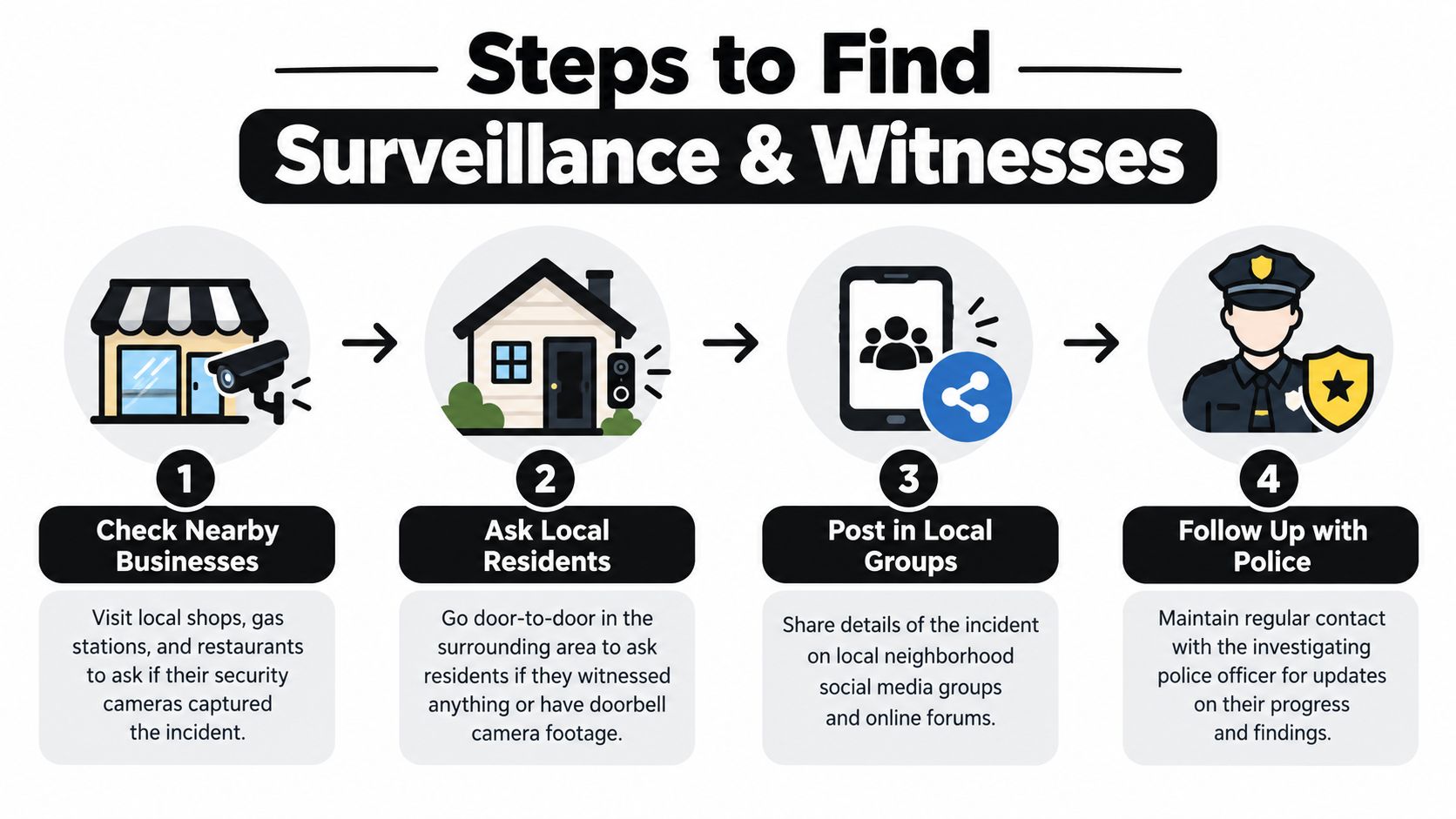
The first few hours can determine whether useful video still exists. Ask police to request footage, but don't assume every camera system will be checked automatically. You can identify likely sources and give investigators a focused map of the area.
Start with the route, not just the impact point
Walk or drive only when you're medically able and the area is safe. Identify businesses, fuel stations, apartment entrances, parking structures, schools, offices, traffic signals, and homes facing the roadway. Look for cameras aimed at entrances, driveways, intersections, and exits. The best recording may show the vehicle leaving, not the collision itself.
Use a direct request:
“A vehicle struck me near this location at approximately [time] and left. Could you please preserve and review exterior camera footage showing vehicles entering or leaving between [earlier time] and [later time]? I'm providing the information to the investigating officer.”
Give the business the police report number and officer's contact details when available. Ask the owner or manager to preserve the original file, including its time stamp. Don't pressure anyone to hand over footage immediately. Private businesses may require a formal request from police or counsel.
Treat video as a timeline
Ask residents and businesses about footage before, during, and after the collision. A camera may capture a distinctive vehicle several minutes earlier or later, showing its direction and route. Doorbell cameras can also reveal a damaged vehicle traveling toward a nearby neighborhood.
Community groups may help locate witnesses, but protect your privacy. Don't publish medical details, your address, or accusations against a suspected driver. Share the location, approximate time, vehicle description, and a request for witnesses to contact police.
For broader context on how modern camera monitoring supports incident review and footage management, see these 2026 London CCTV monitoring insights. The technology can help, but investigators still need a tight time window and travel direction.
Automated license plate recognition, or ALPR, can produce useful matches when police have a narrow search area. It isn't a magic database. Plate visibility, camera angle, weather, traffic, and an inaccurate vehicle description can all reduce its value. A British Columbia deployment reported about 1.6% of scanned plates produced a hit and roughly 4 hits per hour during Phase I (ALPR research). That's why video, witnesses, and plate data should reinforce one another.
Using Your Insurance When the Driver Is Not Found
You may do everything correctly and still face an unidentified driver. That outcome is painful, but it doesn't necessarily eliminate your recovery options. Your own policy may provide uninsured motorist coverage, collision coverage, or both.
Uninsured motorist coverage, commonly called UM, may apply to bodily injuries caused by an unidentified hit-and-run driver. Underinsured motorist coverage, or UIM, generally becomes relevant when the driver is found but doesn't have enough insurance to cover the loss. Policy language controls, so don't rely on a general explanation instead of reading your declarations page and endorsements.
Open the claim promptly
Notify your insurer as soon as you can. Ask specifically whether your policy includes UM or UIM benefits and collision coverage. Provide the police report number, medical records, photographs, witness information, repair documentation, and a clear timeline.
Keep communications factual. You can report what happened without speculating about fault or giving a recorded statement before you understand the claim process. Ask the adjuster to identify every document they need and confirm deadlines in writing.
UM claims can involve medical bills, lost income, and other injury-related losses, depending on the policy and applicable law. Collision coverage may address vehicle damage when the driver remains unidentified, subject to the policy's terms and deductible.
Document the financial impact
Create a running file that includes medical appointments, prescriptions, mileage records, missed work, repair estimates, rental-car costs, and correspondence. Don't settle an injury claim before you understand the medical outlook. Early settlement can close rights you may need later.
Property damage can create a separate dispute over repair cost or total loss value. If the insurer declares the vehicle a total loss, an independent total loss settlement guide can help you understand the appraisal and negotiation issues before accepting an offer.
Many cases remain unresolved. An LAPD memo reported that slightly less than 20% of approximately 20,000 annual hit-and-run cases were solved, while a Houston review found arrests in about 1.4% of assigned matters (reported hit-and-run enforcement data). Those figures aren't a prediction for your Colorado case, but they explain why insurance planning matters even while identification efforts continue.
Review the process for filing insurance claims and keep your own calendar. An insurer's interests may not fully match yours, particularly when the claim involves disputed medical treatment, causation, or policy limits.
When to Hire a Colorado Hit and Run Attorney
Legal help becomes more valuable when the case requires work you can't safely or effectively perform while recovering. Injury, disputed coverage, missing footage, and an inactive investigation can each justify a consultation.
Seek counsel when the evidence window is closing
Contact a Colorado hit-and-run attorney if:
- You suffered an injury: Medical records, treatment decisions, lost income, and long-term effects need careful documentation.
- The crash involved a pedestrian, cyclist, passenger, or death: These cases can involve serious damages and complex insurance questions.
- Police haven't followed up: Counsel can organize evidence and communicate with investigators without asking you to manage every request alone.
- A business won't release footage: An attorney may use preservation demands and formal legal procedures when voluntary cooperation fails.
- Your insurer delays or undervalues the claim: A lawyer can review coverage, liability positions, and settlement communications.
- The vehicle may belong to someone else: Ownership, permissive use, household policies, and employer-related coverage may require investigation.
A lawyer may coordinate investigators, canvass witnesses, send preservation letters, analyze vehicle damage, and pursue available insurance. Counsel can also protect you from giving an inconsistent statement while you're still under stress.
Colorado consequences and deadlines require case-specific advice
Colorado law treats leaving an accident differently depending on the circumstances, including whether the crash caused property damage, injury, or death. Criminal classification and potential penalties depend on the facts, so don't assume a fleeing driver's conduct is merely a traffic matter.
Civil deadlines also depend on the claim type, parties involved, governmental entities, and other details. Don't wait for the criminal investigation to finish before asking about your civil rights. Evidence can disappear long before a deadline arrives.
A stalled investigation isn't the same as a closed case. It means you need to preserve what can still be preserved and evaluate other recovery paths.
A legal team may also use administrative support to organize medical records, insurance correspondence, witness files, and evidence requests. Understanding the role of legal assistants can help you see how a law office manages the practical workload behind an investigation.
If you're unsure whether your situation warrants counsel, review when to hire a personal injury attorney. Nares Law Group LLC handles investigations, medical coordination, insurance negotiations, trial preparation, and settlement work for injured people and families. A consultation can clarify what evidence should be preserved now, what coverage may apply, and whether pursuing the driver remains realistic.
Nares Law Group LLC can help Colorado hit-and-run victims preserve evidence, investigate possible vehicle leads, and pursue available insurance compensation when the driver isn't found. Visit Nares Law Group LLC to request a consultation and discuss your crash, injuries, report, and next steps with a legal team.