You're still dealing with pain from the crash, your employer needs an update, and another medical bill has arrived. Then the insurance company sends a denial. Before you call the adjuster in anger or assume you're stuck paying everything, put the letter beside your policy and your records. The insurer has taken a position. That doesn't make its position correct.
The Letter That Changes Everything
Consider a familiar situation: you're rear-ended on your way home, get emergency care, and begin follow-up treatment. You submit the requested information and expect the insurer to address the bills. Instead, a letter says the available documentation doesn't support payment.
That language can feel like an accusation. You know the collision happened, you know you're hurting, and you can't understand why someone who hasn't examined you gets to reject your claim.
Don't turn that frustration into an unprepared phone call. First, establish what the insurer denied. A rejected rehabilitation bill, a dispute over the other driver's responsibility, and a refusal to provide coverage under your own policy require different responses.
Ask Before You React
- Who refused payment? Identify whether the letter came from your health insurer, your auto insurer, or the other driver's liability carrier.
- What was rejected? Determine whether the decision concerns a particular service, a category of damages, or the entire claim.
- What explanation was given? Separate an actual policy provision or evidence problem from a vague statement that the claim isn't supported.
Keep the envelope, attachments, and any portal message. Write down when you received the decision and what documents you had already submitted. If you need clarification, ask for it in writing rather than relying on an adjuster's summary.
Starting rule: Gather before you call. Read before you react.
A denial isn't a court judgment about your injuries. Treat it as an argument you need to examine, not a verdict you must accept. Your immediate job is to identify the disputed issue without making unnecessary statements, signing away rights, or losing track of deadlines.
What a Denial Really Means
Why do insurance companies deny claims? At the most basic level, the insurer concludes that the requested payment doesn't fit the coverage or isn't supported by sufficient proof. Insurance claims are coverage-and-proof questions, not sympathy questions.
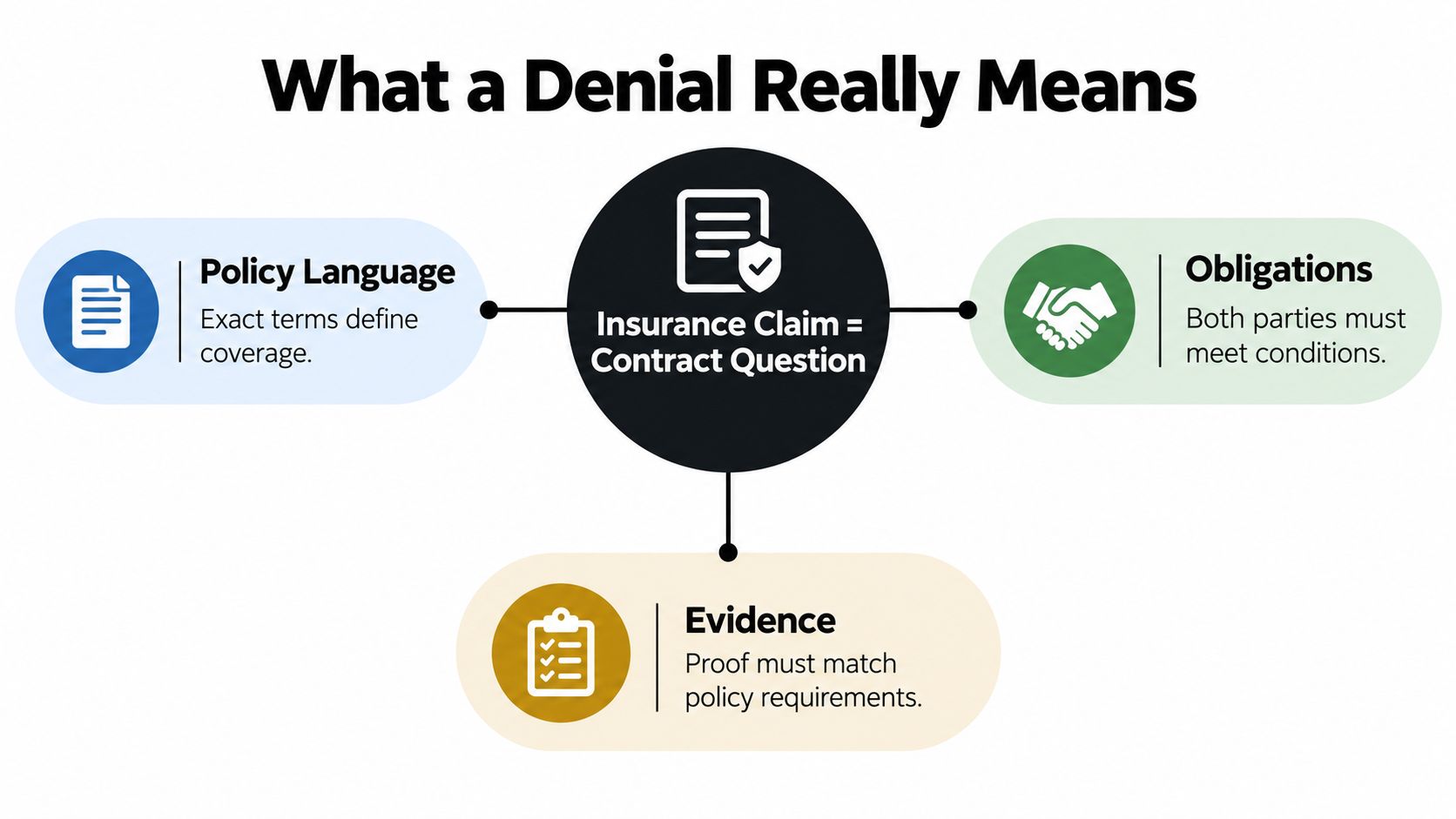
The policy provides the framework. Its insuring agreement describes the protection purchased; exclusions remove specified losses; conditions establish obligations; and the evidence must establish that the claim qualifies. The NAIC's analysis of denied or reduced insurance claims identifies contractual denial grounds including ineffective coverage, lapse, misrepresentation, excluded benefits, and unmet conditions.
This diagram separates the elements you need to examine.
An Exclusion Isn't a Missing Document
An exclusion means the insurer says the contract doesn't cover that kind of loss. A condition precedent concerns something that must occur before a contractual obligation arises. Whether a particular requirement operates that way, and what happens if it wasn't satisfied, requires analysis of the actual wording and applicable law.
For a hypothetical rear-end crash, suppose the insurer invokes an intentional-act exclusion. Your response should address whether the evidence supports an intentional collision and whether that exclusion applies. Sending additional wage records won't resolve that issue.
If the insurer instead says it never received notice, submission receipts and dated correspondence become central. Same crash, different dispute, different evidence.
| Insurer's position | Question to investigate |
|---|---|
| Coverage doesn't apply | Which provision removes this loss? |
| A requirement wasn't met | What was required, and what proves compliance? |
| Evidence is insufficient | Which disputed fact remains unsupported? |
The NAIC model claims-handling framework also identifies unreasonable investigation, inadequate explanations, and coverage misrepresentation as improper conduct. A model standard isn't automatically the law governing your case. Use it to identify concerns, then have counsel evaluate the applicable rules rather than declaring every disagreement bad faith.
The Six Most Common Denial Reasons
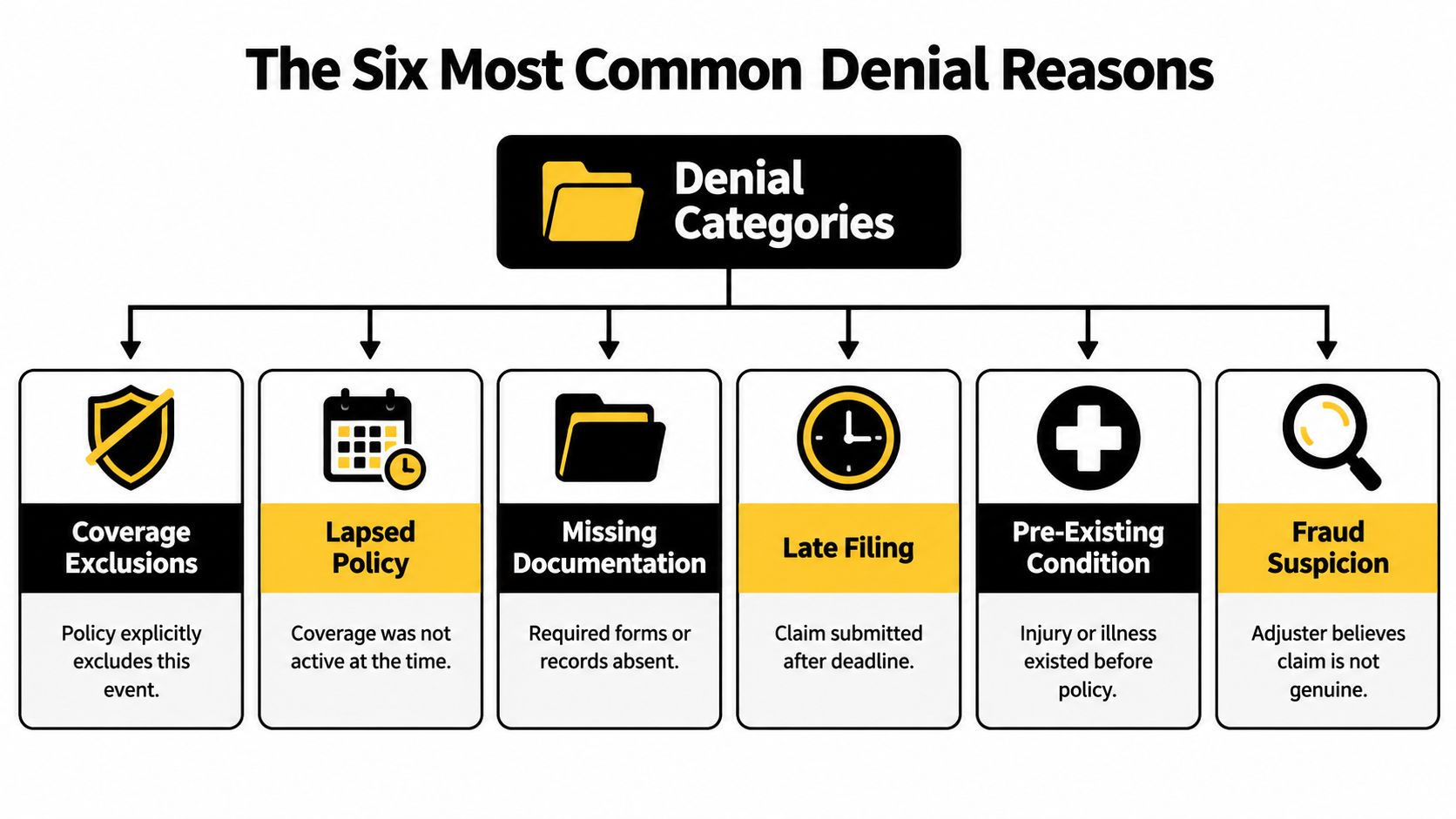
Don't assume a denied bill means the insurer decided you weren't injured. In ACA marketplace coverage, 6% of in-network denials involved medical necessity, while 34% were classified as “other” and 18% involved administrative problems, according to KFF's analysis of marketplace claims denials. Those are health-insurance findings, not auto-injury denial rates.
Use the categories below to sort your letter. The illustration highlights additional labels you may encounter, including lapsed coverage and disputes about prior conditions.
Match the Reason to the Response
- Coverage exclusions or inactive coverage. If the insurer says the driver, vehicle, or loss falls outside the policy, obtain the complete contract and relevant endorsements. For an alleged lapse, examine effective dates, payment records, and cancellation communications.
- Liability or comparative-fault disputes. A hypothetical adjuster might argue that your driving contributed to the crash. Identify the factual allegation, then preserve photographs, witness accounts, and available footage. Don't confuse disputed fault with a policy exclusion.
- Late or insufficient notice. Ask which notice requirement applies and what the insurer says was missing. Preserve evidence of calls, online submissions, and acknowledgment messages.
- Missing documentation. A bill without supporting treatment records may leave an evidence gap. Find out whether the provider must correct coding, send records, or substantiate the service.
- Prior authorization or utilization review. Ask whether the dispute concerns permission for treatment, clinical criteria, or both. The remedy should address the actual reason, not merely resubmit the same bill.
- Fraud or claim-buildup suspicion. Request the specific inconsistency. Then answer it with accurate records rather than broad assurances that you're honest.
For the provider-side paperwork issues behind rejected medical bills, RevGuard revenue protection insights offer a separate resource to consider alongside your insurer's explanation. Don't substitute general billing guidance for the requirements governing your claim.
Prior injuries deserve particular care. Disclosing an earlier condition doesn't answer whether the crash caused new harm or worsened existing symptoms. Ask your treating provider to explain the distinction using your actual medical history.
How Insurers Frame Legitimate Claims as Suspicious
A legitimate injury and an insurer's suspicion can exist at the same time. Missing records, conflicting accounts, unexplained treatment gaps, or overstated damages can become grounds for closer scrutiny. Your response should distinguish what the records establish from what the adjuster is inferring.
The investigation may focus on details that seem peripheral to your recovery.

Suppose you missed rehabilitation because transportation fell through. A treatment calendar alone won't explain that interruption. Preserve messages about the canceled ride, appointment scheduling, and your symptoms during the gap.
Likewise, don't let a photograph become your entire medical history. A hypothetical social-media image of you attending a family event says little about how long you stayed, what assistance you needed, or how you felt afterward. Preserve relevant material and discuss it with counsel; don't alter or destroy evidence.
Keep Answers Accurate, Not Convenient
Before a recorded statement, clarify who is requesting it and whether your policy imposes a cooperation obligation. Don't guess about speed, distances, diagnoses, or recovery dates. If you don't remember, say so.
Consistency means telling the truth accurately. It doesn't mean repeating an early mistake after you discover it.
If an earlier answer was wrong, make a documented correction and explain why. For a fuller discussion of what to expect, review this guide to an insurance company investigation.
Scrutiny alone doesn't establish improper conduct. But if an adjuster repeatedly changes the explanation, ignores responsive evidence, or uses partial payment to press for a broad release, stop treating the conversation as routine paperwork.
Separate the payment from the release. Ask what the offered amount covers and what rights the proposed agreement would surrender. A disputed valuation and an unreasonable investigation are different issues, and your records should allow counsel to evaluate each independently.
Turning a Denial Letter Into a Rebuttal
A useful rebuttal connects each stated reason to the policy language and evidence that answers it. An emotional account of everything you've suffered may explain the stakes, but it won't necessarily address the insurer's objection.
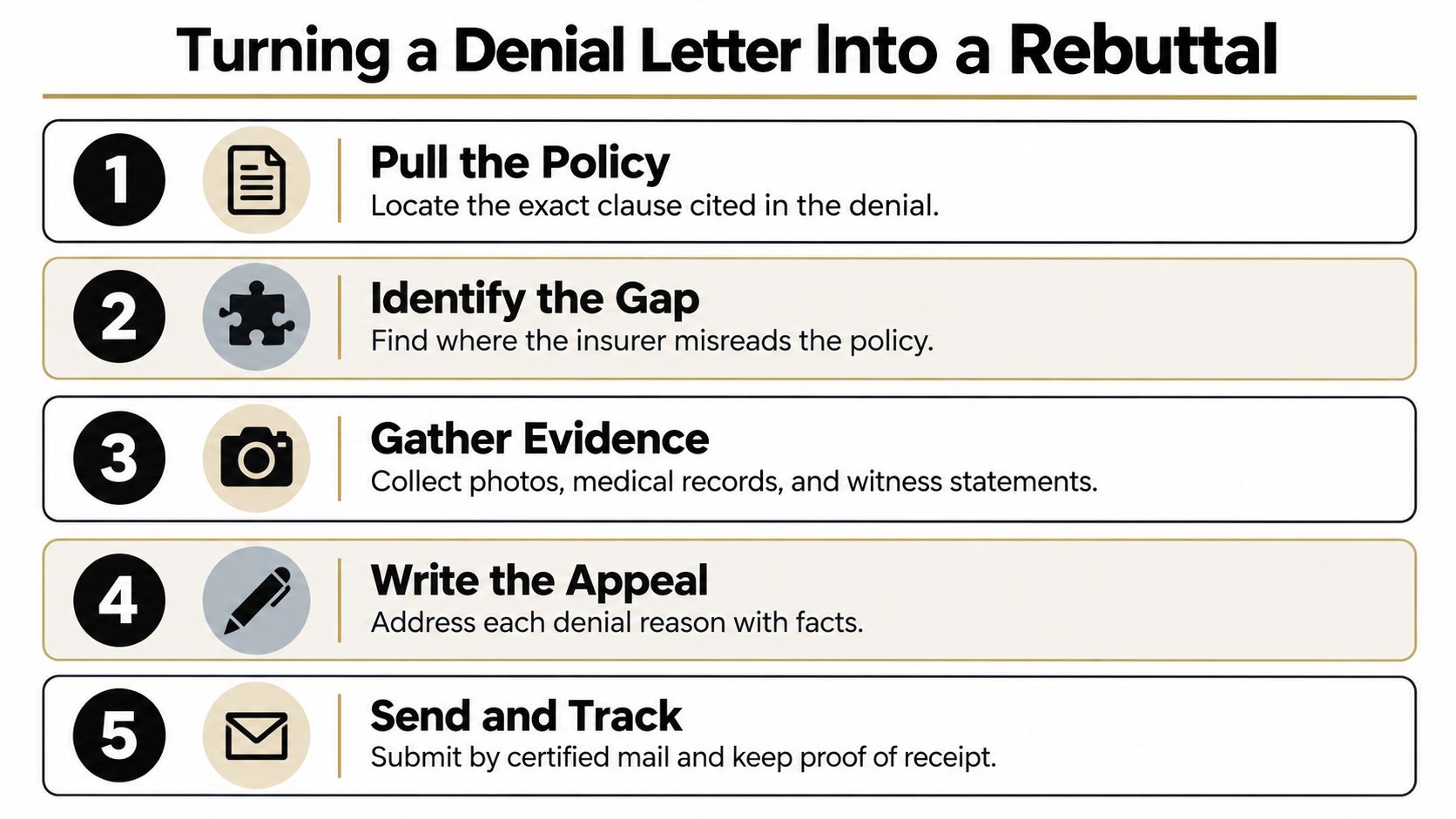
The checklist below provides a practical sequence.
Assemble a Reason-by-Reason File
- Pull the decision and policy. Obtain the complete denial, explanation of benefits where applicable, denial codes, endorsements, and review instructions.
- Request the underlying material. Ask for the claim file, documents considered, and relevant clinical-review notes or criteria. Keep the request and any refusal; don't assume every requested internal document must be disclosed.
- Assign each evidence gap. Your provider may need to correct a billing record. Your employer may need to verify missed work. A treating clinician may need to explain causation or functional limitations.
- Write a focused response. Address each reason separately, cite the relevant policy language, and identify the attached document that answers it.
- Submit and track. Use an accepted submission method, retain the complete packet, and preserve confirmation of delivery or portal acceptance.
KFF's reporting on denial reasons and appeals found that consumers appealed only about 1% of denied in-network marketplace claims, and insurers upheld 56% of appealed denials. Those findings don't predict your result; they underline why submitting an appeal and winning one are different things.
Request a Defined Decision
End by specifying what you want reconsidered: coverage for a named service, correction of an administrative rejection, or reassessment based on identified evidence. Ask for a written response addressing the disputed grounds.
Use this guidance on preparing an insurance dispute letter to organize the request. A health-benefit appeal and a request to reconsider a liability claim aren't interchangeable; follow the process available for your particular claim.
The accompanying video is available below.
Check the deadline before perfecting the packet. If records are outstanding, ask how to preserve review rights and supplement the submission. Don't assume a records request pauses any deadline.
When the Denial Comes From an Algorithm
Generic references to treatment duration, expected recovery, or review criteria deserve follow-up questions. They may reflect standardized rules or software-assisted review, but wording alone doesn't prove an algorithm made the decision.
Insurers can use diagnosis codes, procedure histories, authorization requirements, and treatment benchmarks to assess requests. The problem arises when a reviewer treats that profile as a substitute for your individual circumstances. The American Bar Association's analysis of automated coverage review discusses concerns about opaque criteria and individualized review, including CMS's January 2024 Medicare Advantage requirements concerning individual circumstances and review by an appropriate physician or health professional.
Ask for Criteria and Individualized Review
Those Medicare Advantage requirements aren't a universal rule for every insurance policy. Identify the governing coverage first, then request the review protections that apply.
A 2025 survey of 600 insured adults found that 67% feared AI could unfairly deny their care, as described in PBS NewsHour's reporting on AI and denied insurance claims. Concern is understandable, but it isn't evidence that your particular decision was automated or incorrect.
You can use this request, adapted to your circumstances:
Please identify the criteria applied, the records considered, and whether an automated system contributed to this decision. I request review by an appropriately qualified professional who considers my treating provider's explanation of my injuries, functional limitations, prognosis, and treatment needs.
Support that request with a clinician's narrative, objective findings where available, and concrete descriptions of daily limitations. For a brain injury, ask the provider to address relevant cognitive and functional difficulties rather than relying only on the diagnosis label.
Don't argue solely that software was involved. Show what individualized evidence the decision failed to address. Ask the reviewer to explain why the cited benchmark fits your circumstances, especially if your treating provider has documented reasons it doesn't.
Handling It Yourself Versus Bringing in a Lawyer
Not every denial requires litigation. A clearly identified billing error may be something you and the provider can correct. A dispute over crash responsibility, long-term brain-injury care, and policy coverage is a different undertaking.
Base your decision on the financial stakes, the complexity of recovery, and the disputed issue. Don't hire someone because the letter sounds intimidating, but don't underestimate a dispute because the insurer describes it as routine.
Choosing How to Handle a Denied Claim
| Path | Best For | Main Strength | Main Limit |
|---|---|---|---|
| Handle the response yourself | Clear administrative errors or manageable evidence gaps | Direct coordination with the insurer and provider | You must identify the right process and preserve deadlines |
| Consider a public adjuster | Property-loss valuation or documentation disputes, subject to applicable licensing rules | Assistance presenting the property claim | Not a substitute for injury representation or legal coverage analysis |
| Retain an injury attorney | Serious injuries, disputed fault, causation, coverage, or concerning claim handling | Coordination of evidence, negotiation, and potential litigation | Representation terms, scope, and costs require careful review |
A provider's billing office may be the right first contact for an incorrect procedure code. Ask what it will submit and obtain confirmation. Keep that correction separate from your bodily-injury demand so neither issue disappears into the other.
When the Stakes Justify Counsel
For prolonged rehabilitation or a traumatic brain injury, the dispute may extend beyond today's unpaid bill. You need to consider future care, lost earning capacity, medical reimbursement issues, and the consequences of settling before the long-term picture is clear.
Speak with an insurance dispute attorney when the insurer refuses a meaningful explanation, repeatedly disregards responsive evidence, or seeks a release you don't understand. Ask counsel which claims can be pursued, against whom, and whether any claims-handling remedy is available under the governing law.
Interview the lawyer about the work, not just the promised outcome. Ask who will obtain medical opinions, manage communications, evaluate coverage, and explain settlement deductions. No representative should promise that a denial will reverse just because an attorney sends a letter.
Deadlines, Red Flags, and Your Next Move
Different deadlines can govern notice of loss, proof of loss, benefit review, and filing suit. Don't assume the date printed in the denial is the only one that matters.
The applicable policy and law control those obligations. A lawsuit concerning the accident and a claim concerning insurer conduct may involve different timing questions. Don't assume continued negotiations, a complaint, or an appeal extends the time to sue. Get that question answered directly.
Build Your Deadline Record
- Identify the requirement. Record the deadline, the document that states it, and the event used to calculate it.
- Verify the submission method. Confirm where the response goes and what counts as timely receipt.
- Preserve confirmation. Save portal receipts, delivery records, and the exact version submitted.
- Ask about unresolved dates. Have counsel review conflicting instructions or a deadline you may already have missed.
Recognize Conduct That Needs Review
An unexplained denial, contradictory reasons from different adjusters, or repeated requests for records without a stated connection to the dispute deserves scrutiny. Threats involving unrelated coverage or demands for silence should prompt legal review before you agree to anything.
These signs don't establish a legal violation by themselves. They do tell you to preserve the communications and stop relying on informal assurances.
Today, create a single folder containing the decision, policy, evidence, and correspondence. Calendar the identified dates and send a narrow written request for whatever explanation is missing. If serious injuries, disputed coverage, or troubling conduct are involved, arrange a legal review before giving another statement or signing a release.
Your next move should answer the insurer's actual position while protecting the rights you haven't yet exercised.
Bring your denial letter, policy, crash records, and medical bills to Nares Law Group LLC for a free consultation about your injury claim and insurance dispute. The firm represents injured people through investigation, medical treatment coordination, negotiation, and trial, and can help you assess the denial, identify evidence gaps, and decide what action to take next.