The settlement check has arrived, but your money still isn't ready to spend. Your lawyer's closing statement shows attorney fees and case costs, the hospital has sent a lien demand, an insurer wants reimbursement, and a collection agency is calling about a separate account. Treating every demand as the same kind of bill is how injured people lose their negotiating power.
Negotiating medical bills after settlement is a triage exercise. First identify who has a legal claim against the recovery, who has a contract connected to the case, and who owns an unsecured medical account. Then challenge validity, preserve the disbursement deadline, and make a written lump-sum offer before the money leaves the settlement account.
The Week the Settlement Check Arrives
The first week after settlement is not a payday. It's a controlled closing period. The settlement statement tells you what came in, what must be paid, and what remains for you. Until the claims are verified and resolved, releasing funds can create problems with lienholders, insurers, creditors, and sometimes your own lawyer.
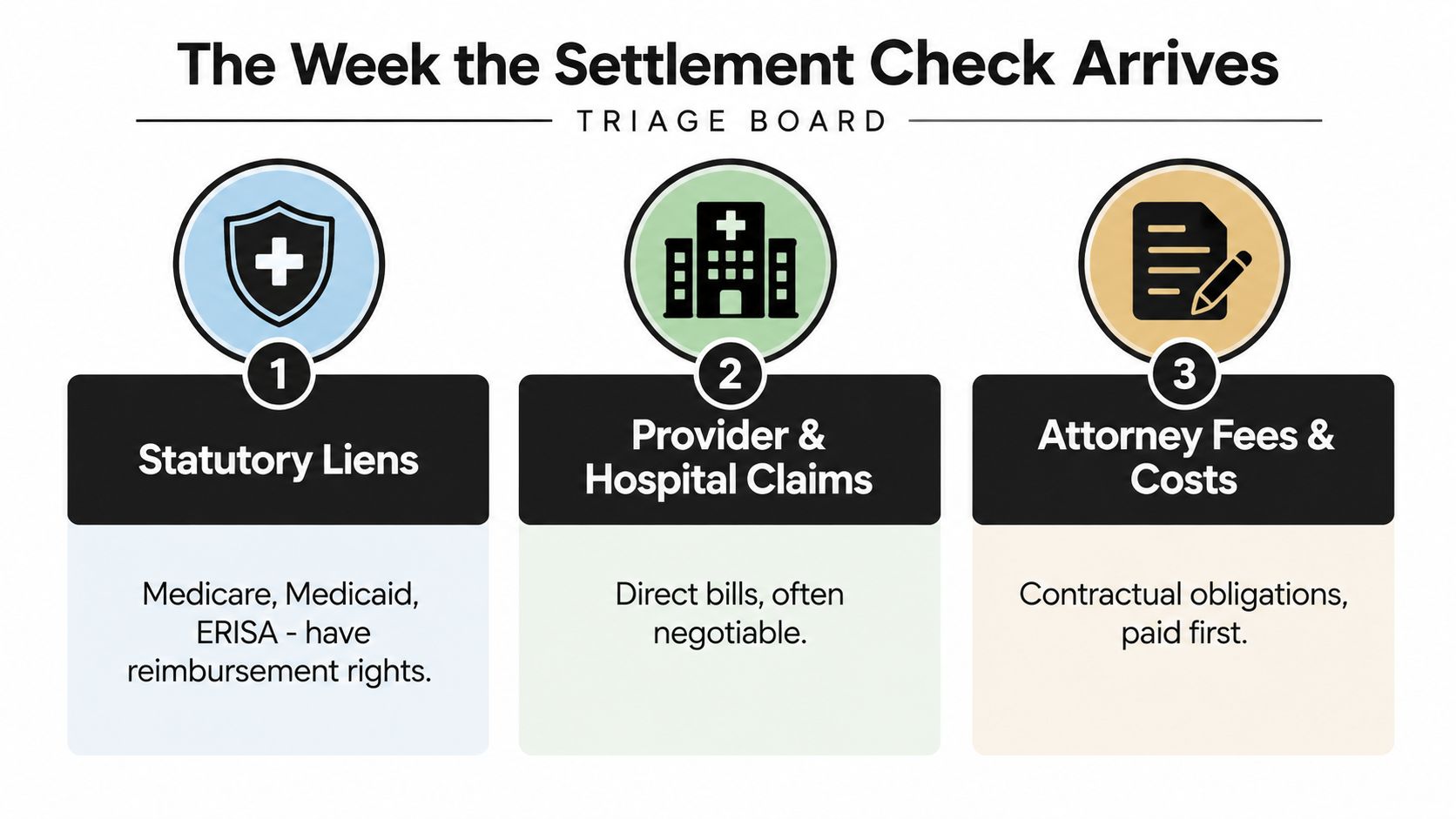
Start by separating demands into three buckets.
Statutory liens and reimbursement claims include Medicare, Medicaid, certain ERISA health plans, and workers' compensation carriers. These entities may have reimbursement rights created by statute or plan language. Their demands can delay distribution because the settlement account may need to hold enough money to resolve the claim.
Provider claims are different. A hospital, doctor, imaging company, or rehabilitation provider may have billed treatment under a letter of protection, assignment, or other agreement tied to the injury case. That claim usually depends on the document signed by the patient and the provider. The provider may have meaningful influence, but it doesn't automatically own the entire settlement.
Consumer medical debt is the third category. This is an ordinary patient balance that may have been assigned to collections. It generally isn't a lien on the injury recovery merely because the account exists. It is an unsecured debt, which makes documentation, timing, and a cash offer important.
Your first 72 hours
Pull the complete closing file, not just the check image. You need the settlement agreement, final settlement statement, medical ledger, every lien letter, every provider demand, and the date the trust account is scheduled for disbursement.
Then make a working chart with the creditor, account number, dates of service, amount demanded, claim type, supporting document, and response deadline. If a demand doesn't identify the legal basis for payment, mark it as unverified rather than treating it as final.
Finally, stop automatic payments from the settlement account unless counsel has approved them. A recurring payment can reduce the funds available for a negotiated resolution before anyone has confirmed that the charge is valid.
Practical rule: The order of your moves matters more than the opening dollar figure. Verification first, written challenge second, settlement offer third.
Hospitals have used formal collection tools even when the claimed debt is relatively modest. A BMJ Open study of hospital collection actions found that 26 U.S. hospitals filed 38,965 court actions between 1 January 2018 and 31 July 2020, including 28,808 lawsuits and 10,157 wage garnishments or liens. Where amounts were available, the average amount pursued was US$1,842. That history is a warning: don't assume a provider will wait for you to sort things out.
Challenging Whether the Bill Is Even Valid
The first negotiation move shouldn't be, “What discount will you give me?” It should be, “Show me why this amount is legally and factually owed.”
A demand can be reduced or eliminated when the provider billed beyond the amount allowed by the health plan, duplicated charges across hospital and physician groups, included services unrelated to the injury, or relied on a lien that wasn't properly filed. A health-plan reimbursement claim can also fail when the plan document doesn't grant the asserted right, the notice was defective, or required appeal procedures weren't followed.
Request the itemized bill, not a summary statement. Match each date of service against the medical records and the explanation of benefits. The EOB shows what the insurer allowed, paid, denied, or assigned to patient responsibility. The plan's subrogation and reimbursement provision shows whether an ERISA plan claims a right to recover from the settlement.
For medical records, use a documented request process such as this guide to obtaining medical records. You need enough detail to separate accident-related care from treatment for unrelated conditions.
What to test before offering money
| Claim Type | Typical Defect | Document to Request |
|---|---|---|
| Provider balance | Duplicate charges, unrelated services, or balance billing beyond the allowed amount | Itemized bill and EOB |
| Hospital lien | Missing filing, notice, or timing requirement | Recorded lien, notice, and filing information |
| ERISA reimbursement claim | No controlling plan language or missed procedural requirement | Complete plan document and summary plan description |
| Medicaid recovery claim | Incorrect dates, unrelated treatment, or unresolved eligibility issue | Agency demand, payment history, and service dates |
| Collection account | Wrong debtor, unsupported balance, or no proof of collection authority | Validation documents and account history |
Your written challenge should identify each disputed charge, state why it's disputed, request supporting documents, and ask the creditor to place the account on hold while the review occurs. Don't make a payment or sign an acknowledgment before you know whether the demand is enforceable.
The available negotiation evidence supports this sequence. In one study of out-of-network bills, people negotiated 19% of bills, and negotiations lowered costs 56% of the time. Success was higher with providers than insurers, 63% versus 37%, as reported in the PubMed study on medical-bill negotiation. The lesson isn't that every bill will fall by a predictable amount. It's that the provider's own billing records often offer the strongest starting point.
A bill that cannot be documented is a weak claim. Challenge it before you reveal that settlement funds are available.
Prioritizing Creditors After Settlement
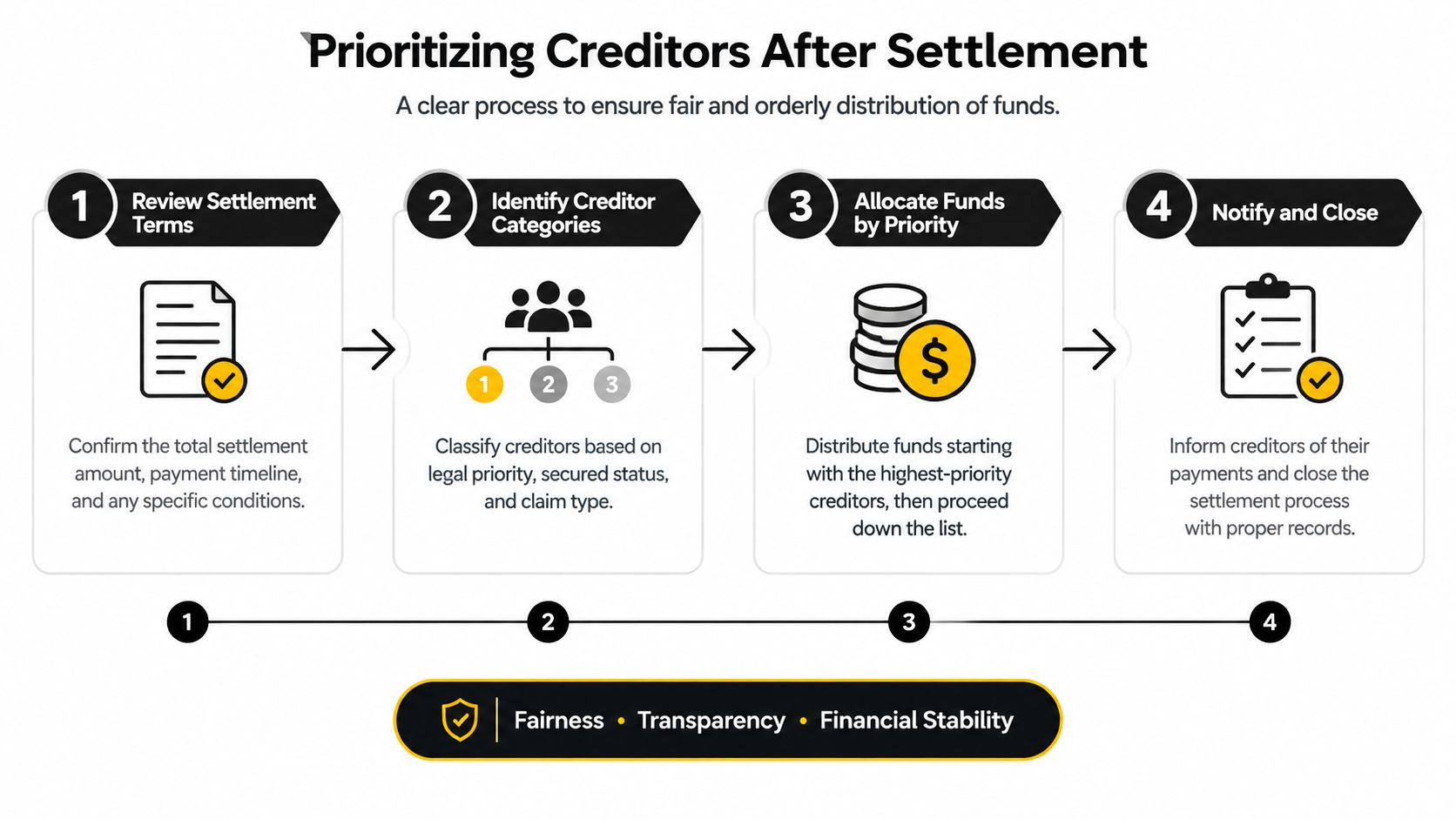
Not every creditor stands in the same place. I prioritize claims by legal authority first, deadline second, and negotiability third. That approach prevents a client from paying an unsecured collection account while a government reimbursement demand remains unresolved.
The priority stack
First, address Medicare and Medicaid. These programs may assert statutory recovery rights. The practical advantage is accuracy, causation, hardship procedures, and documented procurement costs, not a casual request for a courtesy discount. Don't distribute funds based on an estimate when a final demand or agency resolution is required.
Next, review a self-funded ERISA plan. State-law arguments may not control an ERISA reimbursement claim, but the plan still has to produce the governing language and follow its own procedures. Ask for the complete plan document, not just a benefits summary. Confirm the plan's claimed payments relate to the injury and that the claim was asserted within the applicable process.
Then examine a hospital lien. Colorado hospital liens depend on statutory requirements, including proper notice and perfection. A hospital that threatens payment without producing the lien and filing information may be seeking voluntary payment rather than enforcing a perfected lien.
Provider balances under letters of protection follow. These are usually contract-based claims connected to the case. Their strength comes from the signed agreement and the prospect of future collection, but the provider still must prove the balance and the services.
Collection accounts come last. A collection agency may demand payment, but an ordinary medical account isn't automatically attached to settlement proceeds. Your negotiating position is strongest when you dispute the account, correct insurance errors, and offer an immediate payment from a finite settlement pool.
Set the closing calendar
Create one deadline for each claim:
- Government claims: Get a final demand, appeal result, compromise decision, or waiver before distribution.
- ERISA claims: Request plan documents immediately and calendar every appeal or response deadline.
- Hospital liens: Verify filing and notice before discussing the amount.
- Provider contracts: Review the signed agreement and set a written offer deadline.
- Collections: Send validation and settlement terms before paying anything.
The NBER and Harvard Business School materials on medical-debt relief found that relief reduced collections by US$1,215, equal to 29% of the control mean of US$4,147, and modestly increased credit access for a subset of people whose medical debt otherwise would have been reported. Those results, described in the medical-debt relief research summary, support treating bill reduction as a real financial intervention, not paperwork.
Don't promise a creditor a share of the settlement until you know its legal priority. A creditor with weak documentation may accept less than a creditor with a valid statutory claim, even when the first demand looks larger.
Negotiating Hospitals and Providers Down
Provider negotiations work best before the check is mailed. Once the patient receives unrestricted funds, the provider loses a major reason to compromise. Your offer should therefore be specific, documented, time-limited, and conditioned on a written release of the account.
Start with the itemized bill. Compare every line with the EOB, treatment records, and the settlement's injury allocation. Look for duplicate line items, unbundled procedure codes, unexplained quantities, charges from the wrong facility, and treatment unrelated to the accident. Don't argue about a vague “hospital balance.” Identify the exact account and disputed entries.
Next, confirm the provider's legal position. Ask for the signed assignment, letter of protection, or filed hospital lien. If no enforceable document connects the provider to the case or proceeds, the provider may be an unsecured creditor rather than a lienholder.
Make the offer concrete
Use a short deadline, such as 14 days, only if the settlement funds are available and counsel can honor it. State the gross demand, the proposed lump-sum payment, the source of funds, and the condition that acceptance resolves the account in full.
Offer language: “This payment is offered from a finite personal-injury settlement and is available only if accepted in writing as full satisfaction of the account, including interest, collection costs, and any asserted lien.”
Don't rely on unsupported percentage benchmarks. The verified evidence shows that 90% to 93% of consumers who tried to negotiate medical bills reported some success, while 54% to 66% obtained exactly what they requested, according to the medical-debt negotiation survey. Use that evidence to justify making a specific offer, not to promise a particular reduction.
A practical letter can read like this:
We dispute the balance of account [number] pending production of the itemized bill, EOBs, treatment dates, and documentation supporting any assignment, letter of protection, or lien. Without waiving these objections, we offer US$[amount] as a one-time payment from settlement proceeds if accepted in writing by [date]. The agreement must state that the payment satisfies the account in full, releases the patient from further liability, and withdraws any lien, collection referral, or reimbursement demand.
On the phone, ask for the billing supervisor or lien-resolution department. Say: “The settlement funds are finite. I can recommend a prompt lump-sum payment, but only after you confirm the balance and provide written payment-in-full terms.” Don't disclose the maximum available recovery.
Send the demand letter, EOBs, itemized bill, disputed-charge list, settlement statement if necessary, and hardship documentation. If your situation involves broader creditor negotiations after a case changes course, the discussion of debt settlement after bankruptcy dismissal may help distinguish a settlement offer from an admission of the full debt.
Before paying, confirm the writing addresses payment in full, lien release, future collection, credit reporting, and tax treatment. A debt reduction can have tax consequences in some circumstances, so ask your tax professional before assuming the entire settlement is tax-free.
Handling Medicare and Medicaid Liens
Government claims require a different playbook. A provider may choose to discount a balance. Medicare and Medicaid may have statutory recovery rights that require a formal review, appeal, compromise, waiver, or release.
For Medicare, obtain the conditional payment information through the Benefits Coordination and Recovery Center. Review each listed service against the injury records. Remove unrelated treatment, duplicate payments, and charges that another primary payer should have handled. Keep proof of procurement costs because the recovery calculation may account for the expense of obtaining the settlement.
A compromise or waiver request may be available in the right case. Counsel should also evaluate whether the settlement includes money for future medical care and whether Medicare Set-Aside language is necessary. The governing framework includes 42 C.F.R. § 411.46, but the correct treatment depends on the settlement facts, the claimant's Medicare status, and the nature of future care.
Colorado Medicaid recovery
Colorado Medicaid recovery is handled through the Colorado Department of Health Care Policy and Financing. The agency's position may become clearer after the settlement identifies liable parties and allocates the recovery. Request the claim detail, payment history, service dates, and the agency's instructions for resolving the claim.
If hardship is relevant, assemble income records, housing costs, medical needs, dependent-care obligations, and the settlement statement. Colorado rules include hardship provisions under 10 CCR 2505-10 § 8.100, but eligibility depends on the facts and documentation.
Use an allocation memo that is accurate and supported:
“The parties allocate the settlement among compensatory categories based on the claims asserted, medical documentation, liability evidence, and expected future needs. The medical-expense allocation is limited to accident-related medical damages supported by the treatment ledger. No allocation is intended to misrepresent the nature of any payment or defeat a valid reimbursement right.”
A demand disputing the amount can state:
“We dispute the asserted recovery amount because the attached ledger includes services outside the accident-related treatment period and charges not supported by the medical records. Please provide the payment detail, remove unrelated services, and issue a revised demand before any settlement funds are distributed.”
| Action | Medicare | Medicaid, Colorado HCPF |
|---|---|---|
| Verify the claim | Review conditional payment information and identify primary payments | Request the agency demand and payment detail |
| Challenge charges | Dispute unrelated, duplicate, or incorrectly attributed services | Dispute services outside the injury and documented recovery period |
| Seek reduction | Consider compromise, waiver, and procurement-cost treatment | Consider applicable hardship procedures and supporting evidence |
| Protect funds | Hold enough money for the final resolution | Follow HCPF instructions before distributing disputed funds |
| Escalate | Bring in counsel when federal deadlines or future care are involved | Bring in counsel when the agency issues a recovery notice or rejects documentation |
Don't sign a release that allocates all proceeds to medical expenses simply because a lienholder requests it. For a broader explanation of how a medical lien on a settlement can affect distribution, review the claim's legal basis before selecting a negotiation number.
Using Settlement Structure to Protect Proceeds
Settlement structure is a defensive tool, not merely a tax-planning exercise. The release, allocation memo, trust arrangement, and settlement account should accurately describe what the money compensates. Sloppy drafting gives lienholders an argument that more of the recovery represents medical damages.
A structured settlement under IRC § 130 can separate payment categories when the facts support doing so. The documents might state that the settlement compensates medical expenses, lost wages, pain and suffering, and future needs, with each allocation tied to the evidence. Never insert an allocation solely to defeat a creditor. The allocation must reflect the claims and negotiation record.
A useful allocation clause might read:
“The settlement consideration resolves disputed claims for past medical expenses, future medical needs, wage loss, loss of earning capacity, physical pain, emotional distress, and other legally recoverable damages. The parties allocate the consideration based on the pleadings, medical records, wage documentation, expert evidence, and negotiated compromise. This allocation does not waive or impair any valid statutory reimbursement right.”
That language won't automatically defeat Medicare, Medicaid, or an enforceable ERISA claim. It does create a factual record and prevents an unexplained lump-sum description from doing unnecessary damage.
Keep control of the payment process
A Qualified Settlement Fund under IRC § 468B can hold settlement money while claims are verified and releases are obtained. That controlled account preserves the ability to make a prompt lump-sum offer without distributing the recovery prematurely. It also lets the settlement administrator track payments and retain documentation.
A Special Needs Trust or pooled trust may matter when preserving Medicaid eligibility is a priority. The governing federal framework includes 42 U.S.C. § 1396p. This requires individualized planning, because the wrong transfer or distribution can affect eligibility and available resources.
The cost-benefit analysis changes with the settlement size. A smaller recovery may not justify complex structuring costs unless public-benefit eligibility or future-care obligations make the structure essential. A larger recovery may justify careful administration, professional fees, and a formal allocation process because a preventable reimbursement claim can consume a substantial part of the net proceeds. The decision should be based on the claimant's benefits, future care, creditor claims, and administrative burden, not on a generic percentage.
When to Bring in Counsel and What to Hand Off
Some settlement-creditor problems should not be handled through ordinary phone calls. Stop self-directed negotiation when a creditor asserts a federal reimbursement right, files a lien, threatens litigation, or demands a share of the recovery that could change the client's ability to recover.
Bring in a Colorado personal-injury attorney when:
- An ERISA plan is active: Anti-assignment language and plan-document issues can require federal analysis.
- Medicare issues a conditional payment demand above US$5,000: Federal deadlines and future-medical questions make a casual response risky.
- A hospital files or threatens a lien or lawsuit: The filing, notice, and enforcement requirements need immediate review.
- Colorado Medicaid sends a recovery notice: HCPF documentation and hardship procedures should be handled before distribution.
- A provider files bankruptcy: Payment instructions and claim status may change.
- A creditor demands more than 40% of the net recovery: The demand requires a priority and validity analysis before anyone agrees.
The practical guidance on when to hire a personal-injury attorney is especially relevant when the settlement has closed but the financial obligations haven't. Counsel can challenge defective liens, raise ERISA preemption arguments where appropriate, handle Medicare Set-Aside issues, and draft settlement language that accurately limits unnecessary takebacks.
Prepare a clean handoff
Give counsel one organized package:
- Settlement agreement and release
- Final closing statement
- Medical-provider ledger with dates of service and account numbers
- All EOBs and insurance correspondence
- Every lien letter and collection notice
- Signed letters of protection or assignments
- Prior negotiation emails and notes
- A timeline of calls, lawsuits, and collection activity
- Written authorization allowing counsel to negotiate
Counsel's first actions should be practical. The attorney will freeze unauthorized disbursement, classify every claim, demand missing documents, contact government recovery units or plan administrators, challenge unrelated charges, and set written settlement deadlines. The attorney should also update the closing statement so the client can see exactly what is being held, paid, disputed, and released.
Nares Law Group LLC reviews medical bills, insurance liens, reimbursement claims, and settlement obligations before distributing proceeds, and its attorneys negotiate reductions and repayment terms when the documentation supports it. If your settlement check has arrived and a hospital, insurer, government program, or collector is claiming part of it, visit Nares Law Group LLC for a case-specific review before funds are released.