A normal errand can turn into a legal problem in seconds. You walk into a grocery store after a Denver snowstorm, step onto a patch of tracked-in slush, and your feet shoot forward. Or you visit an apartment building, head through a dim parking area, and miss a broken curb you couldn't see. At first, you're not thinking about a claim. You're thinking about pain, embarrassment, who saw it happen, and whether the injury is going to disrupt work, school, or caring for your family.
Then the practical worries hit. Who pays for the emergency room? Should you report the incident? What if the property owner blames you? What if your head hit the ground and you feel "mostly fine" now, but not tomorrow?
That's where the idea of premises liability comes in. In plain language, it means a property owner or occupier may be legally responsible when unsafe conditions on their property cause someone to get hurt. A denver premises liability attorney helps sort out whether that responsibility applies in your case, what evidence matters, and how to protect you while the insurance process unfolds.
Your Life Changed on Someone Else’s Property What Now
Maria had planned a quick stop at a neighborhood shop before heading home. Instead, she slipped near the entrance, landed hard, and felt sharp pain in her knee and wrist. The manager brought over a form. Someone mentioned calling insurance. Maria's phone started buzzing with messages from work asking if she'd be in that afternoon.
That kind of moment feels chaotic because it is. Individuals often don't know what to do when an injury happens on someone else's property, especially when they're in pain and trying not to panic.

What premises liability means in real life
The law starts with a basic idea. If a business owner, landlord, homeowner, or other property controller allows an unsafe condition to exist, and that condition hurts a lawful visitor, they may have to answer for the harm.
That sounds simple until you apply it to real life. Was the floor wet long enough that staff should've cleaned it? Did the apartment complex know the stairwell light was out? Was there a warning sign, and if there was, was it enough?
Practical rule: If an injury happened because a property wasn't kept reasonably safe, it's worth getting the facts reviewed before you assume it was "just an accident."
Why people feel stuck after a property injury
Most injured people are dealing with at least three problems at once:
- Physical pain: You may need urgent care, imaging, follow-up visits, or physical therapy.
- Financial pressure: Missed work and medical bills can start piling up before anyone accepts responsibility.
- Confusion about fault: Property owners and insurers often focus on what you did, where you were looking, or whether the hazard was "obvious."
A denver premises liability attorney helps untangle those issues. The job isn't just filing papers. It's identifying the dangerous condition, preserving evidence before it disappears, and connecting the injury to what happened on the property.
If your injury involved a fall, poor lighting, unsafe stairs, inadequate security, a pool hazard, or another dangerous condition on private or commercial property, you're not overreacting by asking questions now. You're protecting yourself.
Understanding Colorado’s Premises Liability Law
Colorado doesn't treat every visitor the same way. The duty a property owner owes depends in part on why you were on the property. That can sound technical, but there's a simple way to think about it.
If you invite a customer into your store, you take on more responsibility than if someone walks into your backyard without permission. If a friend comes over for dinner, the law treats that differently from a delivery driver or a shopper.
A simple way to think about visitor status
Think of a property like a home with different kinds of access:
- A customer enters because the property owner benefits from the visit.
- A social guest enters with permission, but mainly for the guest's own purpose.
- An uninvited person enters without permission.
Colorado premises liability law uses categories similar to that common-sense distinction. Those categories affect what an injured person has to prove and what the owner should've done to keep the property safe.
Colorado Property Visitor Status and Duty of Care
| Visitor Status | Definition | Owner's Duty of Care | Example |
|---|---|---|---|
| Invitee | A person on the property for business or mutual benefit | Use reasonable care to protect against dangers the owner knew about or should've known about | A shopper in a Denver retail store |
| Licensee | A person allowed on the property for their own purpose or convenience | Address dangers the owner created or actually knew about, and warn about hidden hazards not usually found on similar property | A friend visiting a private home |
| Trespasser | A person on the property without permission | Generally owed the lowest duty, though important exceptions can apply, especially involving children or deliberate harm | Someone entering a fenced area without authorization |
What "duty of care" really means
Lawyers use the phrase duty of care, but the practical question is straightforward: what should the property owner have done to reduce the risk?
That might mean clearing ice from a walkway, replacing broken lighting, fixing a loose handrail, cleaning a spill, blocking access to a dangerous area, or warning visitors until a repair is made. The answer depends on the type of property, the hazard, and the visitor's legal status.
A common point of confusion is this: property owners do not guarantee that nobody will ever get hurt. The law usually focuses on reasonableness. Did the owner act reasonably in light of the hazard?
The strongest claims usually show more than a bad outcome. They show that someone responsible for the property failed to deal with a danger they created, knew about, or should've discovered.
The role of notice
Many cases turn on notice. That means whether the owner knew, or reasonably should have known, about the dangerous condition.
For example, a spill that happens seconds before a fall raises different questions than ice that has been left untreated for hours. A broken step reported repeatedly to management creates a different picture than a defect no one had a chance to discover.
This is why evidence matters so much. Photos, maintenance records, witness statements, incident reports, and surveillance footage can help show how long a hazard existed and whether the owner had a fair chance to fix it.
Why the categories matter early
Visitor status can shape the whole claim from the beginning. It affects how your attorney frames the case, what evidence they prioritize, and how they respond when the other side argues that you should've protected yourself.
If you've been injured, don't assume the property owner gets to define your status in a way that helps them. That issue deserves careful review, especially when the facts are messy. Apartment complexes, mixed-use buildings, short-term rentals, and business entrances often raise questions that aren't as obvious as they first seem.
Common Premises Liability Accidents in Denver
You walk into a grocery store on a snowy afternoon, make it three steps past the mat, and your feet shoot out from under you. Or you carry bags up to your apartment, miss a broken edge on a dark stair, and wake up later with a pounding headache that does not fade. These cases often begin in ordinary places, then turn into weeks of doctor visits, missed work, insurance calls, and unanswered questions about who should have prevented the danger.
Denver premises liability claims arise from a wide range of accidents, but certain patterns come up again and again because of the city's weather, property mix, and daily foot traffic.
Slip and falls during Denver weather
Snow and ice create obvious risks, but the harder cases are often the less obvious ones. Melted snow gets tracked inside and forms a clear, slick film on tile. A walkway looks treated but still has black ice near a drain. A parking lot seems safe until a person steps from dry pavement onto a frozen curb cut.
That is why so many injured people start by learning about slip and fall and trip and fall claims in Denver.
A fall near a business entrance may involve wet floors, missing mats, or no warning signs. A fall at an apartment complex may involve untreated ice, uneven concrete, or stairs that were deteriorating long before anyone got hurt. A trip-and-fall case can also come from cracked sidewalks, loose flooring, torn carpeting, or abrupt changes in elevation that blend into the background until someone catches a foot on them.
Lighting, security, pools, and animal-related injuries
Some dangerous properties do not look dangerous at first glance. Poor lighting works like a blindfold for hazards that would otherwise be easy to avoid. A change in floor height, a broken handrail, or debris in a parking area can become much more dangerous after dark.
Security failures can also fall under premises liability in the right circumstances. An apartment complex, hotel, or parking facility may ignore broken gates, failed locks, or known crime problems in common areas. When that happens, the injury is not just about the assault or incident itself. It is also about whether basic protective steps were neglected where people were expected to live, visit, or park.
Pools create another set of risks, especially for children. Missing fences, faulty gates, poor supervision in shared areas, and unsafe pool conditions can lead to catastrophic injuries in minutes.
Animal-related injuries come up too. A dog bite on private property is not always a simple one-issue case. The facts may involve guest status, prior warnings, leash control, fencing, or whether the owner failed to separate the animal from visitors.
Falls and head injuries often create the hardest recovery
A premises case can look minor on the day it happens and become far more serious a week later. That is especially true with traumatic brain injuries.
A person may leave the scene with dizziness, a headache, or embarrassment and assume rest will fix it. Then the deeper problems begin. Memory gaps. Light sensitivity. Irritability. Trouble concentrating at work. Missed appointments because the days blur together. Family members often notice the change before the injured person does.
Head injuries are hard because the legal claim and the medical picture develop at the same time. A broken wrist shows up on an X-ray. A concussion or more serious brain injury may require careful follow-up, symptom tracking, referrals, and sometimes neuropsychological testing before the full impact becomes clear. That medical coordination can be one of the most overlooked burdens in a premises case.
The practical fallout is often just as serious as the lawsuit itself. You may need help finding the right specialist, keeping records straight across multiple providers, documenting how symptoms affect work, and explaining invisible limitations to employers or family members. In many Denver premises cases, handling those day-to-day problems well is part of protecting the claim.
Different accidents lead to different injuries, but they share one common thread. A property condition created a preventable risk, and an ordinary visit turned into a medical and financial crisis for the injured person.
How to Prove a Property Owner Was Negligent
An injury on a property doesn't automatically create a valid claim. You need evidence showing that a dangerous condition existed, the owner or occupier had a legal responsibility to address it, and that failure caused your injury.
The hardest part for many people is proving notice. In plain terms, you often need to show the owner knew about the problem or should've known about it through reasonable inspection and maintenance.
What to do right away
If you're physically able, or if someone with you can help, these steps can make a major difference:
- Photograph the hazard before it changes. Wet floors dry. Ice melts. Broken items get repaired. Take wide shots and close-ups.
- Report the incident promptly. Ask for a written report if you're at a business. If you're at an apartment complex or private property, notify the responsible person in a way that creates a record.
- Get witness information. A stranger who saw the fall may later confirm there was no warning sign or that the lighting was poor.
- Preserve what you wore. Shoes and clothing can become evidence, especially if the defense argues you caused your own fall.
- Seek medical care quickly. Medical records help connect the injury to the incident and document symptoms from the start.
For a fuller look at how lawyers build these cases, this guide on investigating a Colorado premises liability case shows the kinds of evidence an attorney may pursue.
What lawyers look for in the evidence
A property negligence case often comes down to small details that become powerful when combined. A security camera may show how long a spill sat on the floor. Maintenance logs may reveal skipped inspections. Prior complaints may show the owner had repeated notice of the same condition.
Useful evidence can include:
- Scene evidence: Photos, video, measurements, weather conditions, and layout
- Property records: Maintenance schedules, cleaning logs, inspection records, repair requests
- Witness proof: Statements from employees, tenants, customers, neighbors, or family members
- Medical proof: Records linking the mechanism of injury to your symptoms and diagnosis
Mistakes that can weaken a claim
People often hurt their own case without realizing it.
One common mistake is giving a detailed recorded statement to an insurer before understanding the injury. Another is assuming a delayed symptom means it isn't serious. A third is going back to the property and discussing fault with staff instead of preserving evidence through proper channels.
Say enough to report the incident and get medical care. Don't guess about fault, and don't minimize your symptoms just to move the conversation along.
Property cases move fast because physical evidence disappears fast. That's why early action matters so much.
Your Claim’s Value and Critical Deadlines in Colorado
You slip in a dim apartment stairwell, hit your head, and walk away thinking you are lucky to be alive. Three days later, the headache will not stop. You cannot focus at work. Your spouse notices you are irritable and forgetful. At the same time, bills start arriving, your employer wants answers, and the insurance company asks for a statement before you even know how serious the injury is.
That is often the main problem in a premises case. People are not just asking what a claim is worth. They are trying to keep medical care organized, protect their income, and understand whether symptoms like dizziness, memory trouble, or balance problems will fade or become part of daily life.
As noted earlier, reported premises claims in Denver have increased in recent years, and slip-and-fall cases make up a large share of them. Settlement figures can give rough context, but they do not price your case the way a menu lists a meal. A short-lived ankle sprain and a traumatic brain injury from the same fall can look similar on day one and lead to completely different futures.
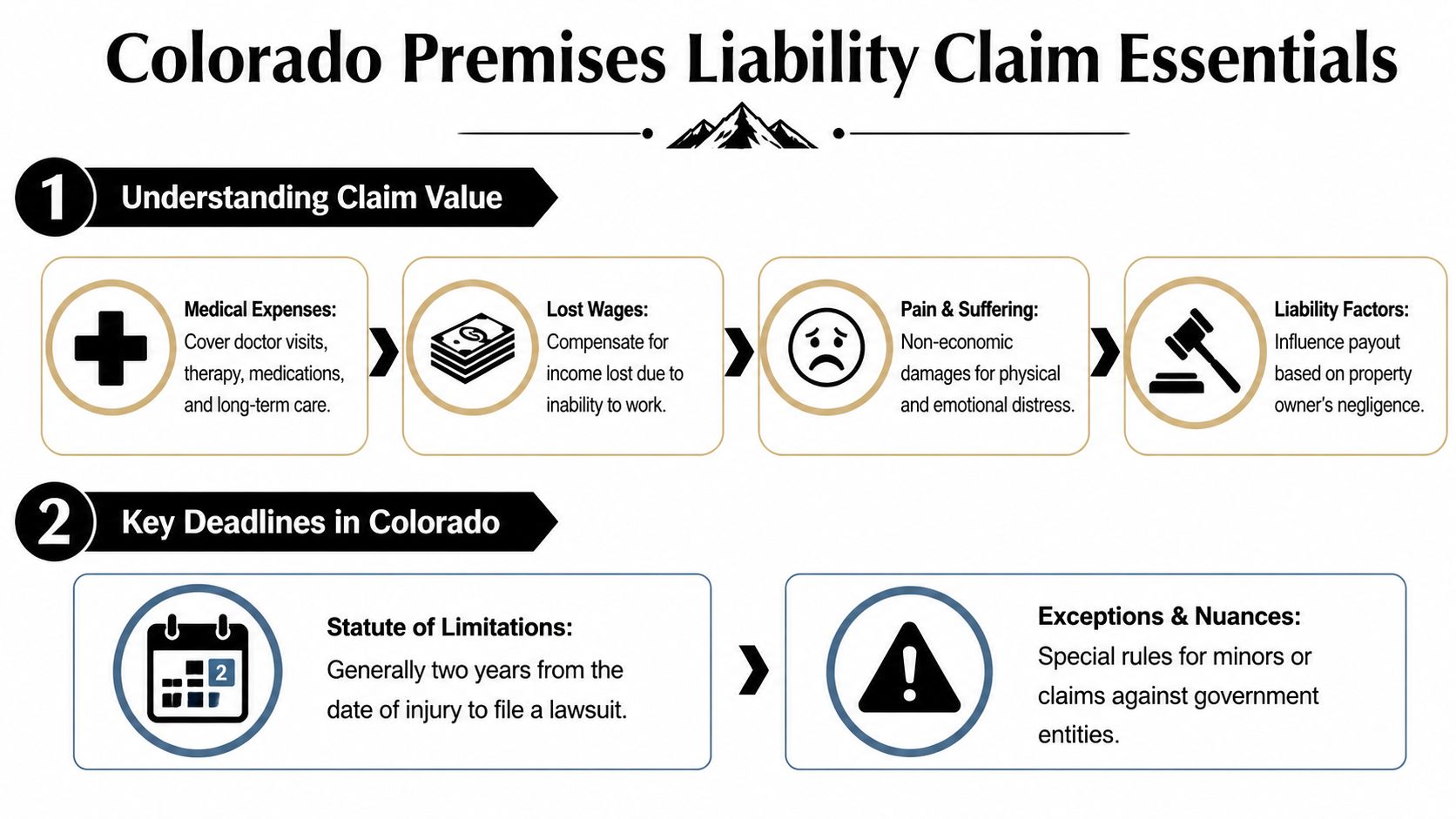
What goes into claim value
Claim value usually starts with two types of loss. One is financial. The other is human.
Financial losses
These are the costs you can often track on paper:
- Medical bills: ER care, imaging, specialist visits, therapy, medications, and expected future treatment
- Lost income: Missed work, reduced hours, lost earning ability, or a job change caused by physical or cognitive limits
- Other expenses: Transportation to appointments, home help, assistive devices, and similar injury-related costs
Human losses
These are harder to measure, but they are no less real:
- Physical pain
- Emotional distress
- Loss of enjoyment of normal activities
- Strain on family relationships
- Changes in mood, memory, sleep, or concentration
Head injuries often create the most confusion here. A person may look fine in the grocery store and still be unable to manage a spreadsheet, drive safely at night, or follow a conversation in a noisy room. Those losses do not always show up in the first urgent care note, which is why early settlement pressure can be so risky.
A fair evaluation often takes time. Doctors may need to see whether symptoms resolve, whether rehabilitation is helping, and whether you need care from neurology, vestibular therapy, pain management, or mental health providers. In serious cases, the value of the claim is tied not only to what happened on the property, but also to how the injury changes your ability to work, parent, rest, and function month after month.
How partial fault can change the outcome
Colorado follows a modified comparative negligence rule. That means the property owner may argue that you share some of the blame. They might say you were distracted, ignored a warning sign, wore unsafe footwear, or chose a route that was obviously dangerous.
A fault argument is a little like slicing a pie. If part of the blame is assigned to you, your share of the recovery can shrink. If too much blame is placed on you under Colorado law, recovery may be barred altogether.
This is one reason injured people should be careful with casual statements. Saying "I should have seen it" may sound polite. In a claim file, it can be used as an admission.
The filing deadline is shorter than many people expect
Colorado gives many injured people two years to file a lawsuit, but deadlines can change depending on the facts. Cases involving a government entity, a minor, or delayed discovery issues can raise different timing questions. You can read more about the Colorado personal injury filing deadline and its exceptions.
The safest approach is simple. Treat the clock as already running.
Waiting creates two separate problems. The legal deadline gets closer, and the proof you need gets weaker. Surveillance footage may be erased. Maintenance conditions change. Witnesses forget details. If you are dealing with a brain injury, delay can also make it harder to connect the fall to later cognitive symptoms because insurers often argue something else caused the problem.
For many injured people, timing affects treatment as much as litigation. If liability is contested, families may struggle to keep appointments, pay for specialist referrals, or document why symptoms interfere with work and home life. That practical pressure can push people to settle before the medical picture is clear. In a serious premises case, patience and early legal action often work together.
How a Dedicated Attorney Manages Your Entire Case
You slip on a wet floor in a Denver apartment building. At first, the problem looks simple. You fell, you are hurt, and the property owner should pay. By the end of the week, the situation often looks very different. You are trying to schedule follow-up care, answer calls from insurance adjusters, miss work, and explain symptoms that may not show up on an X-ray.
That is why full case management matters.
A dedicated attorney does more than file papers. The job is part investigation, part medical coordination, part pressure control. For injured families, that can feel less like hiring someone for a single task and more like bringing in a project manager for a crisis that touched every part of daily life.

The legal work an attorney takes over
Some parts of the case are visible right away. A lawyer gathers evidence, identifies who controlled the property, deals with insurers, and prepares the case for settlement talks or trial if needed.
That usually includes:
- Investigating the scene: collecting photos, videos, incident reports, witness statements, and maintenance records
- Pinpointing all responsible parties: owners, management companies, tenants, vendors, contractors, or security providers
- Handling insurance contact: responding to adjusters, protecting the client from damaging statements, and organizing claim communications
- Building the litigation file: preparing pleadings, preserving evidence, working with experts, and getting the case ready for court if the defense refuses to deal fairly
Those are the parts people expect. They matter, but they are only half the job in a serious premises case.
The part many injured people do not see coming
Injury claims move on one track. Recovery moves on another. They do not always stay in sync.
A person may need imaging, orthopedic care, vestibular therapy, neurology, counseling, or help getting to appointments long before the insurance company accepts responsibility. Bills start arriving even while fault is still being argued. Family members often become schedulers, note-takers, drivers, and advocates overnight.
As noted in Manning Law's discussion of Denver premises liability representation, treatment problems often become part of the full burden of these cases. An experienced attorney helps address those practical issues by organizing records, staying in contact with providers, and watching for liens or reimbursement claims that can reduce what the client ultimately receives at the end.
That support answers questions injured people usually have right away:
- Who pays for treatment now?
- How do I keep getting care if liability is denied?
- What records should I save?
- Will a lien or reimbursement claim take part of my settlement later?
A firm such as Nares Law Group LLC may handle investigation, treatment coordination, negotiation, trial preparation, and settlement work as part of a Colorado injury case. For a family under financial and medical strain, that kind of steady case handling can reduce confusion and help keep the claim tied to the accurate medical picture.
Why coordination matters more when the injury involves the brain
Brain injuries create a special problem. The injury is often real before it is obvious.
A broken bone shows up quickly. A mild or moderate traumatic brain injury may show up as headaches, memory lapses, irritability, light sensitivity, fatigue, or trouble concentrating. To an insurer, those symptoms are easy to question. To a family living with them, they can change work, parenting, and ordinary routines within days.
A strong attorney helps build the proof step by step. That may mean gathering records from neurology, neuropsychology, rehabilitation providers, therapists, employers, and family members who can describe what changed after the incident. It can also mean helping the client stay consistent in treatment so the timeline makes sense on paper, not just at home.
The goal is not only to prove that a dangerous property condition caused a fall or other incident. The goal is also to show what the injury has done to this person's life, what care is still needed, and what obstacles the family is already handling behind the scenes. In a serious premises case, good legal work and good case management have to operate together.
Why Injured Families in Denver Choose Nares Law Group
A parent slips in a poorly maintained entryway, goes to urgent care, and expects the case to be simple. A week later, significant problems start. Follow-up appointments need to be scheduled. Work is missed. Headaches and concentration problems make it hard to keep track of forms, calls, and bills. The legal claim is only one part of what the family is carrying.
That is one reason families are careful about who represents them. Denver has many lawyers handling these cases. Super Lawyers' Denver listings for premises liability plaintiff attorneys show a crowded field and also illustrate how large the gap can be between an insurer's first offer and what a case may be worth after full development and trial work.
Families usually look for a law firm that can do more than send demand letters. They need someone who can explain the law in plain language, keep the case organized, and help the claim reflect what daily life looks like after the injury. That matters even more when the injury involves concussion symptoms or other brain-related problems, because those cases often affect memory, mood, sleep, and work long before an outsider understands what changed.
A good premises liability lawyer works like the coordinator of a complicated recovery process. One part of the job is proving what happened on the property. Another part is making sure the medical story is documented clearly enough that an insurance company, mediator, or jury can follow it. If treatment is scattered, records are incomplete, or symptoms are minimized early, the claim can look smaller on paper than it is in real life.
That practical side is part of Nares Law Group's stated approach. The firm describes its work in terms of client care, trial advocacy, investigation, treatment coordination, negotiation, and litigation. For an injured family, that kind of help can mean fewer missed details, better communication with providers, and a clearer plan at a time when everyday tasks may already feel harder than they should.
Choosing a lawyer is partly about legal skill. It is also about whether the firm understands that recovery after a property injury often involves calendars, records, specialist visits, school concerns, missed paychecks, and stress at home. Families often choose counsel who can handle both sides of that problem with steady, informed guidance.
Frequently Asked Questions about Denver Injury Claims
What if the hazard seemed obvious
That doesn't automatically defeat a claim. Property owners often argue a danger was open and obvious, but the full context matters. Lighting, weather, distractions, crowding, location, and whether there was a safe alternative route can all affect the analysis.
Can I bring a claim if I didn't feel hurt right away
Yes, possibly. Some injuries, especially concussions and soft-tissue injuries, don't feel severe in the first hours. You should seek medical care as soon as symptoms appear so the condition is documented and connected to the incident.
What if I was hurt on public property
Claims involving government entities can involve different procedures and timing rules. Sidewalks, parks, public buildings, and transit-related locations may require faster action and a more careful review of notice requirements.
Do I need a lawyer if the insurance company is already calling
You should be cautious. Early calls often happen before the full injury picture is clear. A lawyer can help you avoid statements that minimize symptoms, confuse fault issues, or lock you into an incomplete version of events.
If you're dealing with an injury on unsafe property and need clear guidance, Nares Law Group LLC offers free consultations for Colorado families. A conversation can help you understand your rights, preserve evidence, and make a plan for medical care, insurance issues, and the next legal steps.