After a fatal car accident, everything seems to happen at once. Emergency responders secure the scene, police open a crash investigation, the medical examiner or coroner steps in to determine cause and manner of death, and insurers are notified. Knowing that order gives you a mental map when the first hours feel completely disorienting.
What Happens In The First Hours After A Crash
Those first hours can feel chaotic. Underneath it, though, there is a structure.
Think of it like gears in one machine. Each part turns the next. If one gear stalls, the rest slow down with it.
If the medical examiner's finding is delayed, for example, the police report may stay open longer. That, in turn, can pause insurance conversations. It is all connected.
Here is how those early stages usually break down:
- Scene response — led by emergency responders. The area is secured and injured people are treated.
- Crash investigation — led by police. Officers document evidence and take statements.
- Death determination — led by the medical examiner or coroner. The official cause and manner of death are confirmed.
- Insurance notification — handled by insurers and adjusters. Claims open while facts are still coming in.
- Family guidance — offered by hospitals, victim advocates, and attorneys. You can get support and next steps.
The infographic below shows how those pieces fit together in those first hours.
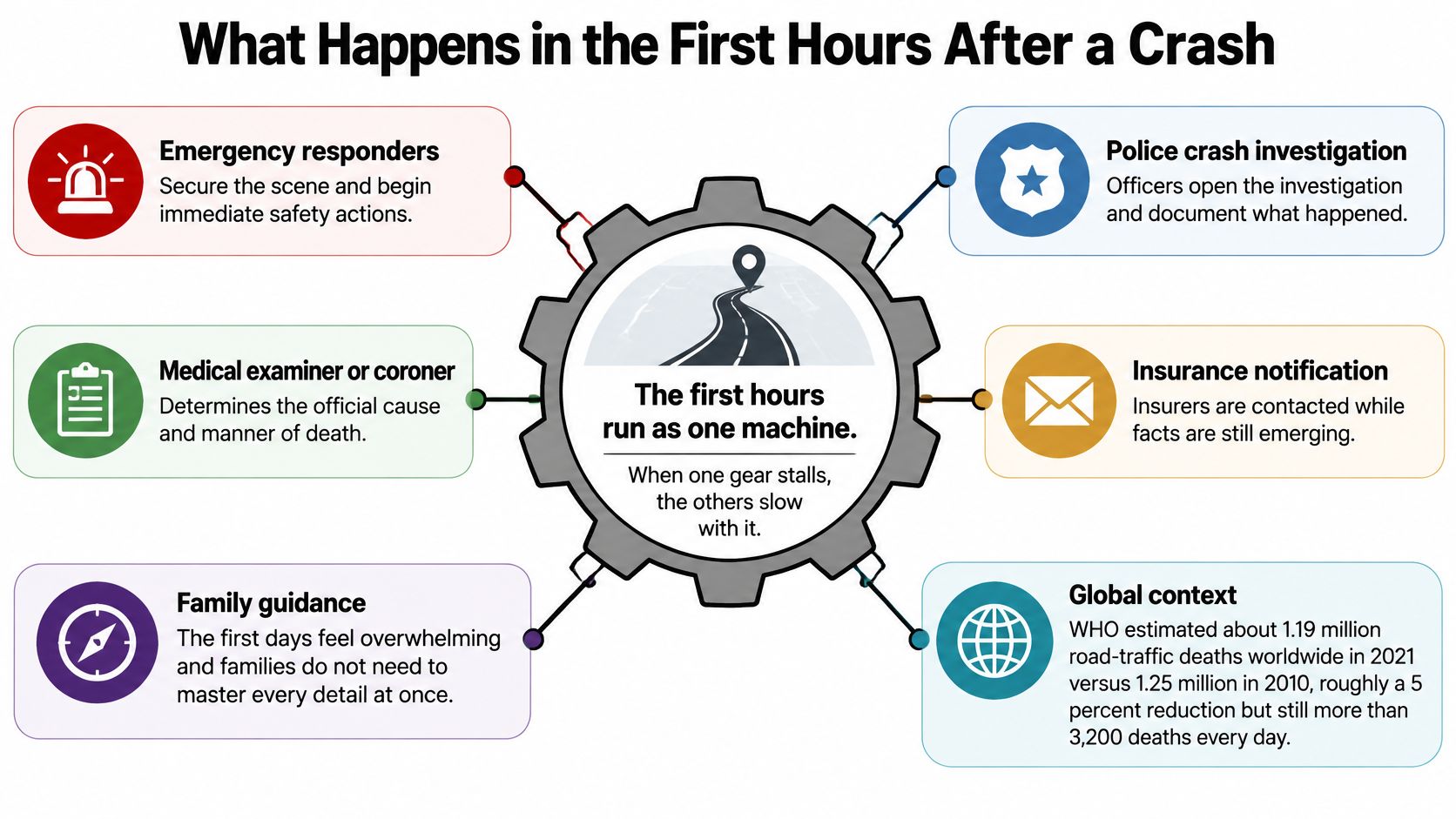
What that picture makes clear is this: no single agency handles everything. Several independent processes run side by side, and it helps to know who leads which one.
Why This Matters Beyond One Family
Fatal crashes are not rare. The World Health Organization estimated about 1.19 million road-traffic deaths worldwide in 2021, down from roughly 1.25 million in 2010. That is a drop of around 5%, yet it still averages more than 3,200 deaths every day. You can read more in the global road-traffic injury findings on who.int.
Because of that scale, these systems are well practiced. Hospitals, police agencies, and insurers have been through this many times, even if your family never has.
The first days feel overwhelming, and you do not need to master every detail at once. A clear mental map is enough to start.
If law enforcement takes someone into custody in the immediate aftermath, families are often thrown into arrest procedures too, including how to get out of jail fast.
This guide walks through each process one by one, starting with the investigation itself.
Understanding what happens after a fatal car accident is a lot like putting together a jigsaw puzzle. Photos, witness stories, and vehicle data are all separate pieces. Investigators have to lay them out and compare them before anything starts to make sense.
How The Investigation Unfolds Step By Step
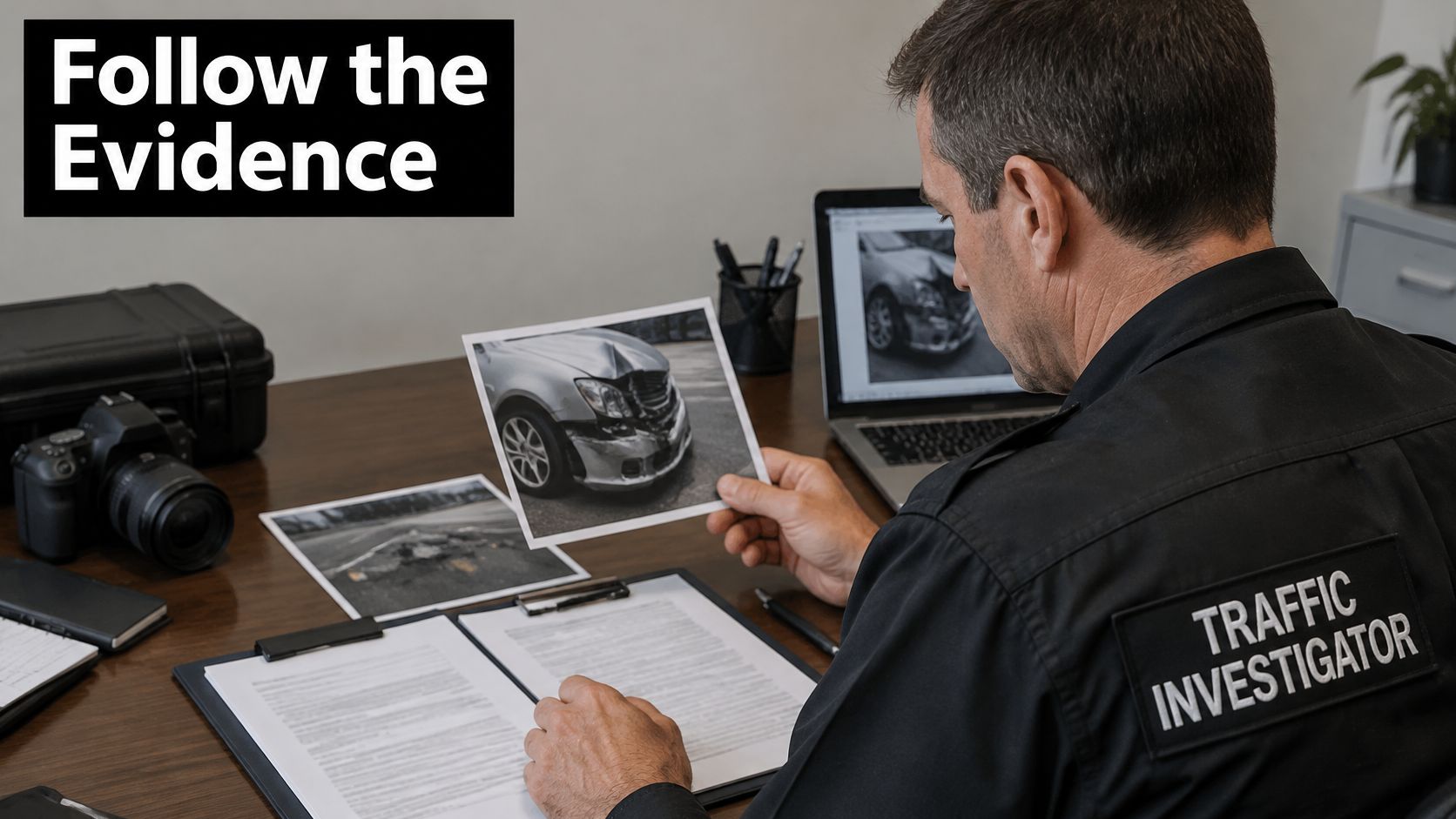
No two crashes follow the exact same timeline. But officers generally start with the physical evidence and work outward from there.
A witness might remember a car speeding up, for instance. Roadway marks and electronic records then help investigators check whether that memory lines up.
- Document the scene. Officers photograph damage, skid marks, debris, road conditions, and where each vehicle came to rest — before any of it changes.
- Identify everyone involved. They confirm which vehicles and occupants were part of the crash and collect contact information from witnesses.
- Collect and compare accounts. Statements are measured against photos, available video, and other evidence, not taken as the full story on their own.
- Examine contributing factors. Investigators look at impairment, speeding, distraction, vehicle defects, and unsafe road conditions.
Together, those pieces can explain both how the collision happened and who may be responsible. The connection between crash reports, witness statements, and vehicle data matters because no single piece answers every question by itself.
How Medical Findings Complete The Picture
Alongside the police work, the medical examiner or coroner determines the cause and manner of death. The cause is the injury or medical condition responsible. The manner describes the circumstances around the death.
Documenting those fatal injuries, for example, can help link the collision to the death in a later civil claim. That finding answers a different question than whether a driver was negligent, though, so it does not establish civil responsibility on its own.
Early evidence often shapes the entire case. Preserving it matters even while investigators are still sorting out what happened.
You do not need to investigate the scene yourself. Just keeping information organized and pointing out possible evidence can keep useful details from slipping through the cracks.
Protect Evidence And Track Updates
Evidence can disappear fast. Vehicles get moved to impound lots. Nearby businesses overwrite camera footage. If you know about possible video, mention it right away.
- Request the report. Ask the investigating agency when it will be available, what ID you need, and how to get supplements. This guide to obtaining a motor vehicle crash report explains the process.
- Keep a contact log. After every call, write down dates, names, report numbers, questions you asked, and updates you were promised.
- Flag preservation concerns. Tell investigators or your attorney about any cameras, witnesses, or vehicles that might hold evidence.
Start one folder today for your report request, contact log, and saved messages. Then ask directly who will give your family the next investigation update.

If you are wondering what happens after a fatal car accident, insurance is usually one of the first shocks. An adjuster will often call within days. The tone is friendly, almost routine.
But what you say in that call sticks.
Think of It as an Early Snapshot
Think of an early statement like a photo taken too soon. The full scene isn't clear yet. The lighting is off. Key details are still out of frame.
And once that photo is printed, you can't really retake it.
A small comment — "I think I'm okay" or "I think he was fine" — can come back months later, quoted out of context to chip away at your claim.
Coverage That May Apply to Your Family
More than one policy can come into play, and they don't all work the same way.
- At-fault driver's liability policy. This covers harm the at-fault driver caused, up to the policy limits.
- Uninsured or underinsured motorist coverage. Your family's own policy can step in when the other driver has no insurance or not nearly enough.
- Policies tied to the vehicle or an employer. Sometimes coverage follows the car itself, or work-related travel, so check both.
Extra Attention for Hit-and-Run and Uninsured Crashes
When the driver takes off or simply has no coverage, your own policy carries a lot more weight. In those cases, uninsured motorist coverage can be the difference between a dead end and a claim that actually moves forward.
Do not sign anything before you understand it. A release can shut the door on future compensation for good.
Practical Steps to Take Right Now
You don't have to do everything at once. Just build a few steady habits.
- Keep every bill. Put medical bills, funeral invoices, and household receipts in one folder.
- Track lost income. Save pay stubs and jot down missed shifts or days off.
- Save funeral receipts. Those costs are often part of a wrongful death claim.
- Pause before any release. Ask exactly what rights you'd be giving up before you agree.
How Nares Law Group Investigates Claims
Nares Law Group LLC investigates these claims by pulling together medical records, accident reports, witness statements, and expert opinions. The team also works with medical and accident reconstruction experts who can explain how and why the crash — and the injuries — happened.
You can read more about how insurers look into these claims in our guide on insurance company investigations.
A free consultation is available for auto accident cases in Colorado, so you can get answers before you sign anything. You don't have to have every response ready today. A few careful steps now, taken calmly, can protect your family down the road.
Two legal tracks can open after a fatal car accident, and that catches many families off guard. Both grow from the same crash, but they lead to different places. Think of two doors into one building. Walking through one does not lock the other.
The Criminal Case Belongs to the State
When someone dies in a crash, a prosecutor may file criminal charges. That case is brought on behalf of the state, not the family. Its purpose is punishment for unlawful conduct, such as vehicular homicide or a DUI-related offense.
Penalties can include fines or time in prison. Because the consequences are serious, the state must meet a very high standard of proof before anyone is convicted.
The Civil Claim Seeks Financial Recovery
A wrongful death claim comes from the family, usually filed through the estate's personal representative. Its purpose is different. It seeks money and accountability for what the family lost, including funeral costs, lost income, and the loss of companionship.
Civil cases rely on many of the same kinds of evidence, such as crash reports, witness statements, and vehicle data that show who was responsible. The bar is lower here. A family can win a civil claim even when no conviction follows, and that is one of the most important things to understand early.
Here is how the two tracks compare side by side.
Criminal Case Versus Civil Claim at a Glance
| Aspect | Criminal Case | Civil Wrongful Death Claim |
|---|---|---|
| Who brings it | The state | The family |
| Main goal | Punishment | Financial recovery |
| Who decides | Judge or jury | Judge or jury |
| Standard of proof | Beyond a reasonable doubt | More likely than not |
| Possible outcomes | Fines or incarceration | Compensation for losses |
Put simply, one case asks what the defendant deserves, and the other asks what the family is owed.
Why Your Civil Claim May Move Forward Alone
Many families pursue a civil claim when no criminal charges are filed at all. It can also continue when the criminal case ends another way, such as a dismissal or an acquittal.
The two cases run on separate tracks, so one outcome does not decide the other. A not-guilty verdict does not end a civil claim, and a lack of charges does not end it either.
If your family is facing this, you do not have to sort it out alone. The Denver-based team at Nares Law Group LLC offers a free consultation for Colorado auto accident cases, and talking through your options can give you a much clearer picture.
Deadlines vary by jurisdiction, and they matter even more when a commercial truck, an uninsured driver, a hit-and-run driver, or several possibly responsible parties are involved.
Protect Evidence and Deadlines Early
Early legal guidance helps protect evidence while the criminal process moves forward. Witness memories fade over time, and vehicle data can be overwritten or lost. Acting sooner gives you the best chance to preserve what matters.
Money can ease the strain a family faces after a crash. It can't bring back the person they lost, though, and it shouldn't be judged as if it could.
Compensation Families May Be Able to Pursue
Think of an insurance policy as a bucket with a set size. A death can cause losses that spill over the top, so the coverage available and the real value of a claim are often two different numbers.
When you look at what happens after a fatal car accident, it helps to split two questions. First, what has the family actually lost? Second, what might coverage pay? Keeping those apart makes it easier to set realistic expectations without forgetting costs that show up months later.

Talk through these categories with an attorney. Whether each one applies, and who is allowed to recover it, depends on the law where the case is filed.
- Funeral and burial expenses, including itemized service and cemetery costs.
- Medical bills incurred before death, which raise questions about who has the legal right to claim them.
- Lost earnings and financial support, meaning the income the person would have contributed.
- Lost household support, like childcare, cooking, and keeping up the home.
- Emotional and relational losses, including grief and the loss of companionship.
A policy limit isn't a measure of a person's life or of the family's total loss.
Show What the Loss Means Over Time
Picture a parent who brought in most of the household income and also handled school pickups, dinners, and the occasional broken faucet. When that parent dies, the family loses far more than a paycheck.
A realistic claim looks at years of lost contributions and what it would cost to replace that help. Those numbers aren't automatic. They depend on assumptions about work, spending, and what the future would have held, and those assumptions need solid support.
Evidence is what ties those losses back to the crash. It turns a list of costs into a story someone else can follow.
- Establish responsibility. Accident reports, vehicle data, and reconstruction opinions help show how the collision happened.
- Document the impact. Medical records, pay stubs, receipts, and expert opinions help explain injuries, expenses, and future losses.
If you're in Colorado, read the firm's guide to the Colorado wrongful death statute with an attorney. Don't assume every category applies just because it appears on a list.
Use Settlement Figures Carefully
Nares Law Group reports resolving a wrongful death case for $1.1 million under policy limits. Still, every case turns on its own facts, so that outcome doesn't predict what another family will recover.
The firm's free wrongful death settlement calculator can help you get your questions in order. Think of it as a starting point, not a promise or a final valuation.
Gather income records, funeral invoices, and medical bills first. Then request a free consultation with Nares Law Group to talk through recoverable losses, available coverage, and what additional evidence your family may need.
Grief, physical pain, and money worries often arrive all at once. Knowing what happens after a fatal car accident means more than learning the legal steps. It also means finding people who can help carry the weight.
Finding Support and Taking the Next Steps
Anyone who was in the vehicle should get a prompt medical evaluation, even if the symptoms seem minor. Concussions and other traumatic brain injuries often take hours or days to show up. Walking away from a crash doesn't always mean walking away unhurt.
Care coordination is what keeps treatment from turning into chaos. Think of it like an air traffic controller for medical appointments, where one person keeps track of who is going where and when. Ask someone to take that role, or at least help you map out who handles what.
- Track appointments in one place, including follow-up visits and referrals.
- Keep medical records and bills together so treatment details and charges are easy to find when you need them.
- Ask for practical help with rides, childcare, or someone to take notes during appointments.
Emotional support deserves a place alongside medical care. Losing someone suddenly is a lot to absorb, and asking for help is a sensible response, not a sign of weakness. If you want professional support, your next steps to booking an appointment with a mental health provider can be a good place to start.
The choices you make in the first few weeks can shape the outcome for years. You don't have to make them alone.
Turn Uncertainty Into a Manageable Plan
The process usually starts with emergency care and an investigation, then moves into insurance conversations that need careful handling. Two tracks tend to run side by side. Criminal proceedings deal with alleged offenses, while civil claims pursue compensation through a separate process.
Depending on applicable law and the evidence, a civil claim may cover funeral expenses, medical bills, lost financial support, and the loss of a loved one's companionship. What is recoverable varies from case to case, so check your eligibility with counsel using the Colorado wrongful death guidance rather than assuming every loss qualifies.
For now, focus on three manageable steps:
- Write down questions about treatment, insurance calls, and deadlines.
- Gather documents such as crash information, policy details, bills, and income records.
- Lean on trusted people to help organize paperwork while you keep the final decisions in your own hands.
A free consultation with Nares Law Group LLC gives you a chance to ask a personal injury attorney questions, go over the facts, and start planning how to pursue the compensation you deserve. It isn't a guarantee of recovery, but it can bring some clarity to a confusing time.
The firm also offers free blogs, videos, webinars, and the Mother Justice podcast, which many families listen to at their own pace.
Bring your questions and any documents you have to a free consultation with Nares Law Group. The firm's goal is to protect the rights of injured families and help them move toward a better future, one practical decision at a time.
Many families find themselves asking the same questions in the days after a crash. Here are short, practical answers to four of the most common ones.
How Soon Should a Family Contact a Lawyer?
Calling a lawyer early is one of the smartest moves a family can make. Evidence like vehicle data and video can disappear fast. Legal deadlines matter too, and they vary from one jurisdiction to another, so an early call keeps anything from slipping through the cracks.
A short first call can set the plan in motion. Bring the crash report number, your insurance cards, and a list of the questions on your mind.
Do We Have to Speak with the Insurance Adjuster?
No. Families are not required to give a recorded statement right away. A quick remark made before anyone knows the facts can easily be misread later. Talking with a lawyer first is often the simplest way to avoid that trap.
Taking time before you speak is a reasonable choice, not a rude one.
If you do end up talking with an adjuster, keep your answers short and stick to what you actually know. Being polite doesn't mean you have to answer every question on the spot.
Can We Pursue a Claim Without Criminal Charges?
Yes. A civil wrongful death claim runs on its own track, with different goals and a different standard of proof. Prosecutors may never file criminal charges, and the civil case can still move forward. The focus here is financial recovery, not punishment.
A civil claim may help cover:
- Funeral and burial costs
- Lost income and household support
- Medical bills incurred before death
What If the Driver Was Uninsured or Fled the Scene?
Other coverage may still apply. Investigators and attorneys often dig deeper than families expect, so don't assume the case is closed just because the other driver is missing.
Start with these steps:
- Check your own auto policy for uninsured motorist protection.
- Ask investigators whether a witness or camera might have captured the other vehicle.
- Save every message and letter you receive.
- Ask a lawyer whether a claim is possible.
You don't have to figure this out by yourself. Ready to talk through your options? Nares Law Group LLC offers a free consultation for Colorado auto accident cases. Visit Nares Law Group to learn more right away.