The call comes before the ambulance reaches the hospital. An adjuster for the trucking company's insurer is polite and quick: sorry about the accident, hope everyone is doing okay, and would you mind giving a recorded statement while the details are fresh? Your spouse is in surgery. The car your teenager was riding in is in a tow yard off the interstate.
Nothing about that call is random. It happens within hours because the carrier's insurer knows the file will be decided by records that exist right now and may not exist next month: the driver's hours log, the engine data, the dash camera loop, the dispatch messages that show whether a delivery schedule pushed the driver past a safe limit.
The questions that decide these cases arrive in a predictable order. Who can be held liable. Which evidence is already at risk. What the federal rules require of a carrier. What a claim is worth and what it costs to pursue. And how to tell a trucking lawyer from a lawyer who occasionally handles a truck case.
Why Truck Crash Claims Need a Specialized Attorney
The numbers aren't close. The National Highway Traffic Safety Administration's crash statistics for 2022 count 5,936 people killed in crashes involving large trucks, a 2% increase from 5,821 deaths in 2021, and an estimated 160,608 people injured in large-truck crashes that year.
Those deaths split in a way that defines the entire practice area. 70% were occupants of other vehicles, compared with 18% large-truck occupants and 11% pedestrians and other nonoccupants. The people who absorb the worst harm are almost never the people with access to the carrier's records.
NHTSA also found that 71% of large trucks involved in fatal crashes had a gross vehicle weight rating above 26,000 pounds, and that 76% of fatal large-truck crashes happened on weekdays, from 6:00 a.m. Monday through 5:59 p.m. Friday. This is ordinary freight moving during ordinary business hours, which is exactly why the paperwork trail is so thick.
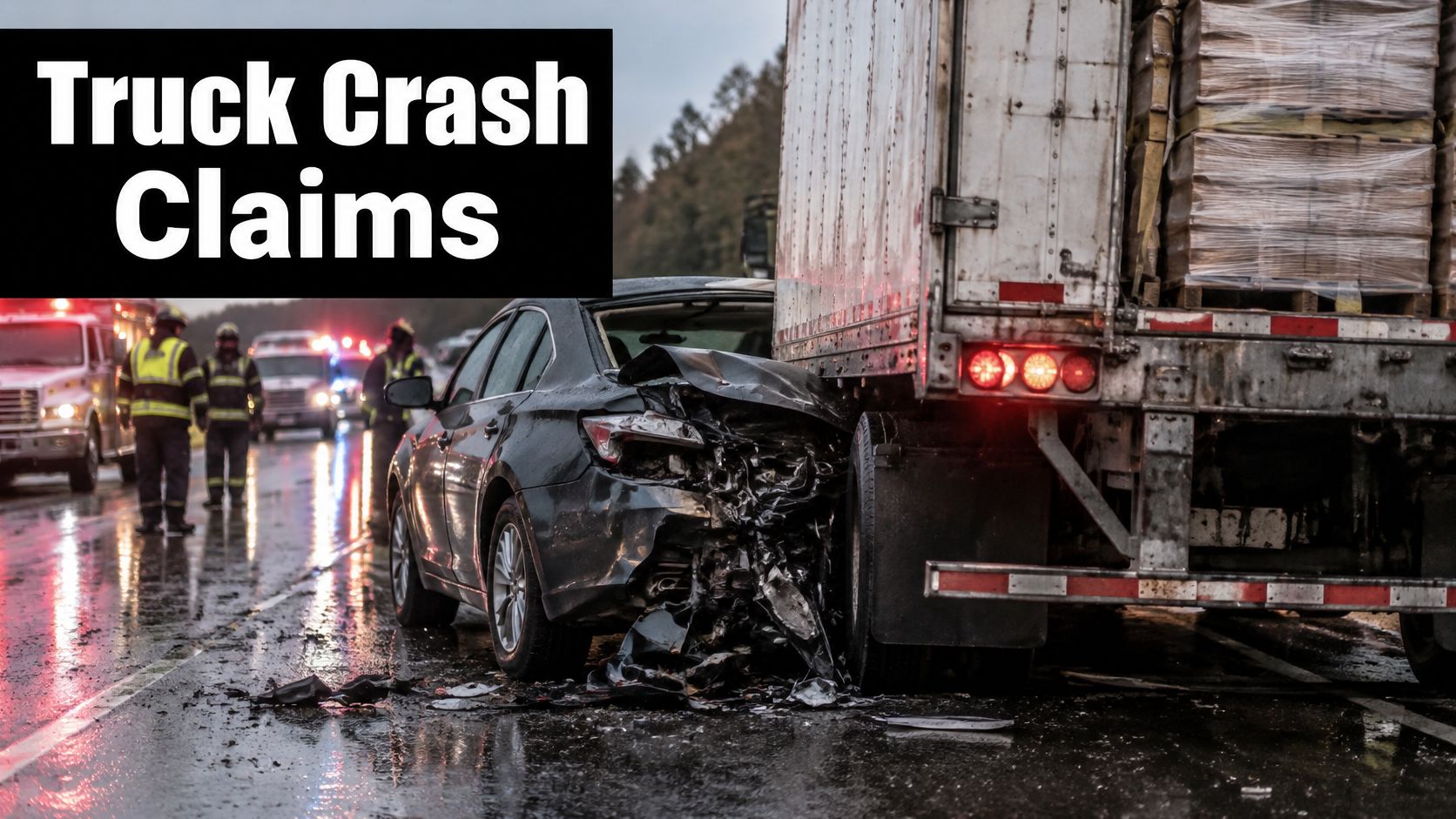
A commercial vehicle accident attorney spends the first week on documents nobody else in the family is thinking about: preservation letters to the carrier, the driver, the shipper and every insurer, plus the driver qualification file, maintenance and inspection history, dispatch records, and the electronic data that shows speed and braking before impact.
What changes with counsel: the file stops being a police report with a photograph of a bumper. It becomes a regulatory record with a timeline, and insurers pay against timelines.
A specialist also brings people. A reconstruction engineer who can read the scene and the vehicle. A medical expert who can tie the injuries to the forces involved. A staff that can track three insurers and four defendants without losing the thread. Families can't evaluate a sudden-emergency story about a car that supposedly cut off a truck. A lawyer with trucking files can, because the records usually show whether that story holds.
Who Can Be Held Liable in a Truck Crash
The first question in every truck file is who was in charge of what. A crash that looks like one negligent driver is usually a chain of commercial relationships, and each link carries its own insurance.
| Party | Why It May Be Liable | Proof to Request |
|---|---|---|
| Driver | Negligent driving, fatigue, distraction or impairment | Hours logs, phone records, citations |
| Motor carrier (employer) | Negligent hiring, supervision or dispatch pressure | Driver qualification file, dispatch records |
| Owner or lessor of the truck | Control over the vehicle and its maintenance | Lease agreement, registration, title |
| Shipper, loader or broker | Improper loading or unrealistic delivery schedules | Bills of lading, loading records, contracts |
| Maintenance provider | Faulty brake, tire or inspection work | Repair invoices, inspection reports |
| Platform or staffing agency | Control over dispatch, routing or driver assignment | App records, routing data, contracts |
| Parts manufacturer | Defective brake or tire components | Product records, recall notices, component history |
Read that table as a list of phone calls, not a list of theories. Each entity holds records the others don't, and each one has a reason to describe the crash as somebody else's fault.
The workforce changed faster than the paperwork
Commercial-auto claims involving gig-related workers rose 96% from 2021 through 2025 and reached 10% of all commercial-auto claims in 2025, according to Verisk figures reported by Insurance Journal, even while total commercial-auto claim volume fell 5% year over year to 1.8 million. Fewer claims overall hasn't meant simpler claims. It has meant one driver can sit inside four contracts at once.
Coverage and control are separate questions
An insurer's first letter often calls the driver an independent contractor and treats the conversation as finished. That label is where the analysis starts. Whether a policy covers a given driver and whether the company that dispatched the load owed a duty to the public are two different legal questions, answered with two different sets of documents.
Control is what a court examines. Who set the delivery window that made a long day necessary? Who chose the route, supplied the vehicle, set the safety scorecard, and could have taken that driver off the schedule? A broker that never touches the truck can still create exposure by pressing a carrier to run a schedule that isn't safe, and it will hold the load tender and the dispatch emails that prove it.
A working rule: if a company could have changed the driver's behavior that day, find out whether it tried.
Before anyone characterizes the relationship for you, collect the documents that describe it. Ownership and lease papers for both tractor and trailer. Dispatch, routing and app records showing who assigned the run. Bills of lading and load tenders with pickup and delivery times. Driver qualification files, including how the driver was screened. Contracts among the platform, broker, carrier and owner-operator. And every policy declaration page that might respond.
Then put it on the record. Send each identified party's insurer a written notice naming every entity involved, including the platform, the broker and the trailer's owner, so nobody can later say they never knew a claim existed. The wider map of truck accident liability is worth reading before you accept any adjuster's summary of who was involved.
Causes and Violations Investigators Check First
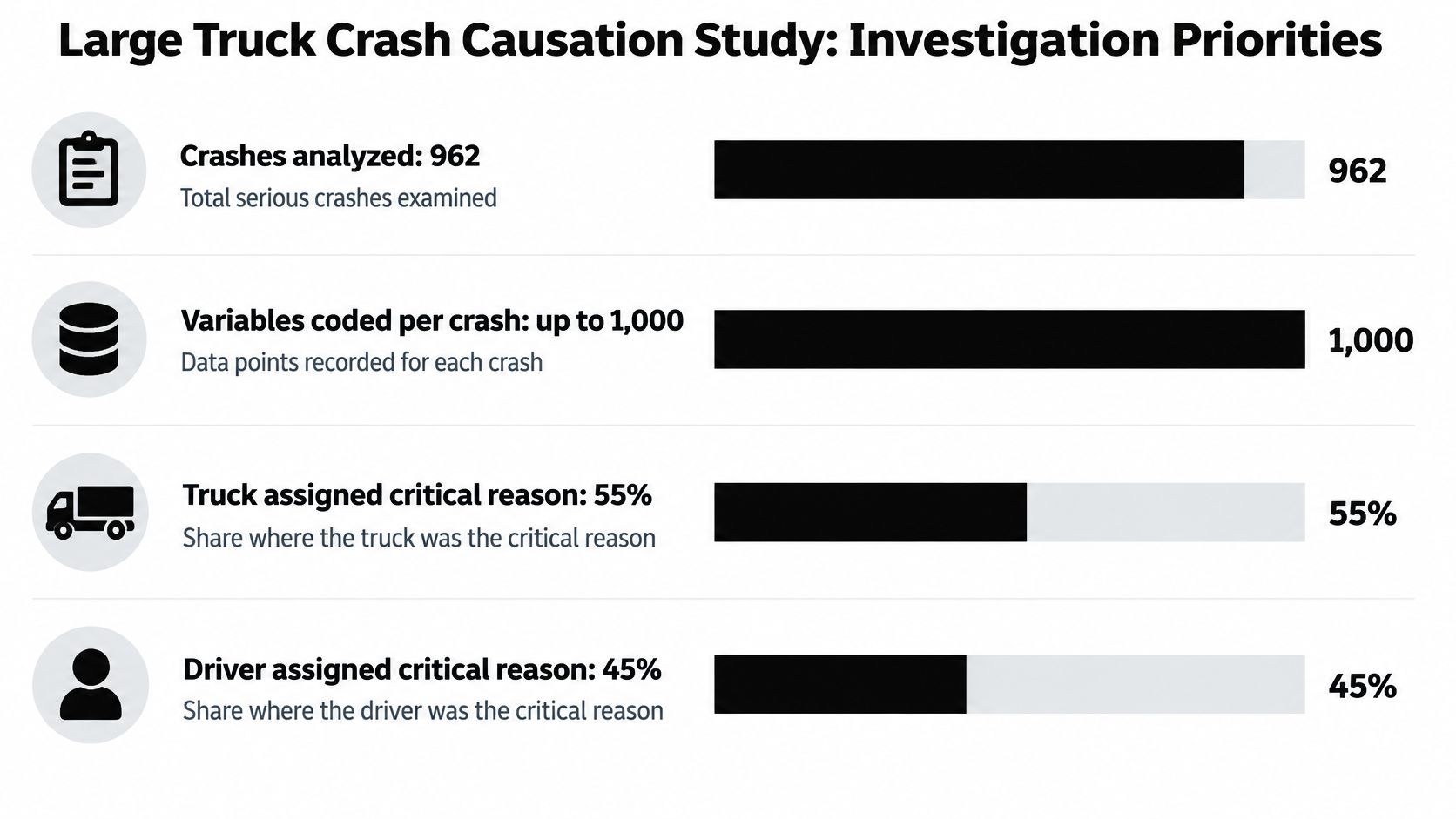
The most detailed federal study of truck crashes still shapes how a serious file gets built. The Large Truck Crash Causation Study from the Federal Motor Carrier Safety Administration and NHTSA examined nearly 1,000 serious injury and fatal crashes and coded as many as 1,000 variables per crash, covering driver condition and behavior, vehicle condition, roadway characteristics, weather, and motor-carrier information.
That last category matters more than families expect. A driver may own the truck and carry an independent-contractor label, yet investigators still coded carrier information because the company behind the load is part of the crash picture whether or not its name is on the door.
Two findings drive most investigations. In the study, investigators assigned the truck the critical reason in 55% of crashes, and driver-related reasons made up 87% of coded reasons, mostly failures to recognize hazards or poor decisions.
That second figure explains why a police report is a starting document rather than a case theory. An officer arriving after the fact sees skid marks and damage, not the six hours before the crash. The records that explain those six hours sit with the carrier and its vendors, which is why the investigation runs on several tracks at once. Each track answers a different question. Logs and dispatch timestamps test fatigue and scheduling pressure. Brake and tire history tests mechanical condition. Cargo and loading documents test whether the load itself contributed. Reconstruction of visibility, traffic control, roadway geometry and stopping distance tests what the driver could see and do.
Ranking what to examine first
The study's analysis brief ranks the vehicle and roadway conditions that show up most often, along with a reported relative risk for each. The FMCSA's LTCCS analysis brief gives a reasonable priority order for early work.
| Factor | Share of Sample | Relative Risk | What to Examine First |
|---|---|---|---|
| Brake problems | About 29% of the relevant truck sample | 2.7 | Adjustment records, linings, drums, tire condition |
| Traveling too fast for conditions | About 23% | 7.7 | Event-data speed, scene marks, weather and traffic records |
| Roadway problems | About 20% | 1.5 | Scene measurements, signage, road design |
Read the risk column carefully. Speed carries the highest figure, but it is also the factor most likely to be argued, because the defense will say the driver was under the posted limit on a dry road. Event data, scene marks and weather records are what settle that argument. Brake condition usually gets resolved by a shop inspection rather than a lawyer's letter.
None of it is proof on its own. The study is explicit that an associated factor does not automatically cause a crash, so an expert has to connect the condition to the collision sequence and to the injury mechanism. A truck with worn brakes that stopped well short of a car that swerved into its lane is a different case from the same truck running a red light.
Testing driver behavior against records
Fatigue gets tested against the hours log and the dispatch timestamps, not against the driver's memory of how tired he felt. Distraction gets tested against phone records and in-cab video. Following distance gets tested against the reconstruction and any nearby surveillance footage. One caution carries through all of this work: an empty box on a crash-coding form means that factor was never examined, not that the truck was sound.
The video below walks through how that mechanical and human evidence gets pulled together after a serious crash.
So ask the question that separates a real investigation from a polite one. Has anyone tested the brakes and the speed before accepting the sudden-emergency explanation?
Evidence to Preserve Before It Disappears
A tractor can be back in service before a family has finished the first hospital week. By then the event buffer may be overwritten, the dash camera looped, and the dispatch thread cleaned up under a retention rule nobody at the scene explained. The early job is to match each system to the question it answers, then find the person or company with the login, the keys, or the contract.
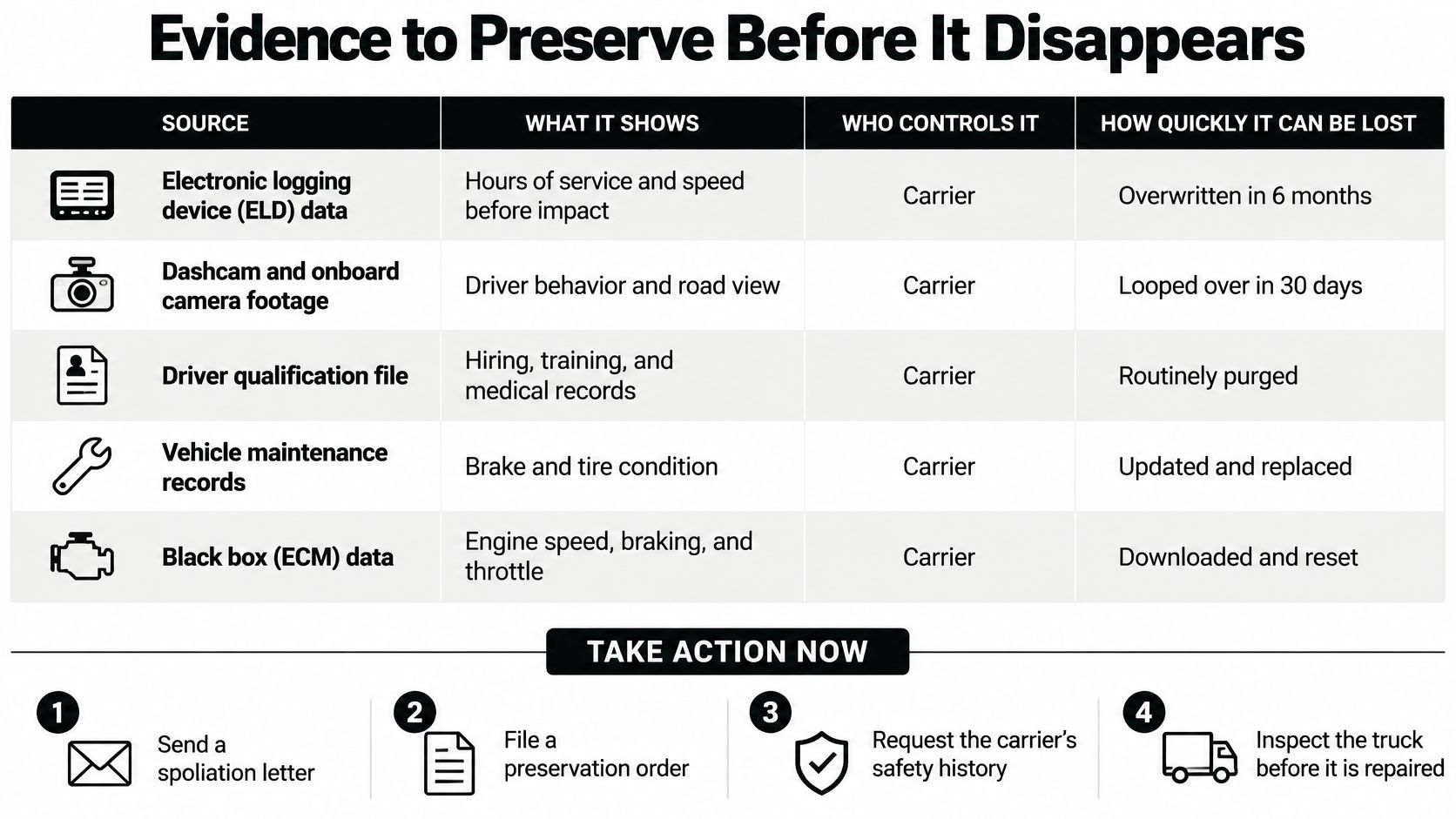
| Evidence Source | Question It Answers | Who Controls It | Overwrite Risk |
|---|---|---|---|
| Electronic logging device | Driving hours and duty status | Motor carrier | Retained for a set period, then purged |
| Event data recorder | Speed, braking and throttle before impact | Vehicle owner or carrier | Overwritten when the vehicle is driven |
| GPS and fleet tracking | Route, location and timing | Motor carrier, platform or vendor | Retention set by contract and account settings |
| Dash camera video | Sequence of events and visibility | Driver, carrier or platform | Often overwritten within days or weeks |
| Dispatch messages | Schedule pressure and route changes | Motor carrier or broker | Kept until the account is cleaned out; request early |
| Maintenance and inspection records | Brake and tire upkeep | Carrier or repair shop | Replaced at the next service cycle |
| Phone records | Distraction at the time of the crash | Driver and carrier | Requires a legal demand or subpoena |
The independent-contractor label does not settle who has to preserve what. Control points matter more: who dispatched the load, who required the camera, whose ELD account generated the log, who paid for the trailer, whose insurance adjuster called first. A platform can hold the route history, a broker can hold the delivery-window messages, and a carrier can still hold the qualification file even when the driver owns the tractor.
The five steps, in order
- Send a written preservation demand within days. Address it to the carrier, the driver, the shipper, the broker, any app or platform involved, and each insurer. Name every record type you want: ELD files, event data, engine downloads, dash camera footage, dispatch messages, GPS history, the driver qualification file, maintenance and inspection records, and phone records. Email plus certified mail, and keep the receipts.
- Get the event data and engine data off the truck before it is repaired or reassigned. Once the tractor goes back into service, the buffer fills with new driving and the crash data is gone. This download has to happen while the vehicle still exists in its damaged state.
- Photograph the tractor, trailer, brakes and tires before anything is altered. Brake adjustment, lining thickness, drum condition, tread depth, sidewall damage, warning indicators. Once a shop pulls the wheels, that record is gone.
- Measure the scene and collect nearby video early. Skid marks, debris, sight lines, signage, signal timing. Business surveillance systems loop on their own schedule, and the owner of a parking lot camera has no duty to preserve your crash for you.
- Gather the police report, witness statements and early medical records as they exist. The first treatment notes establish the injury baseline before anyone starts arguing about what the crash did or did not cause.
What the black box actually holds
Much of what is written about truck data treats the "black box" as a complete reconstruction, and that is misleading. As the truck black box data guide from Wooley Law explains, an electronic logging device generally documents duty-status information and related vehicle-motion data. It may not record speed, braking, steering, or every driver action. Those facts come from the event data recorder, the engine control module, a fleet tracking system, in-cab video, dispatch messages, maintenance records or phone records instead.
Hardware also varies by model year and vendor, so the same fleet can produce uneven evidence. A newer tractor may yield richer pre-crash data than an older one, which is why no one should promise that two trucks will produce comparable downloads.
When the records disagree: ask for the source files, not the summary. A printed log, a screenshot of a tracking map and a video clip can each be accurate and still conflict. The reconstruction expert resolves that by working from raw data with timestamps intact.
Federal and Colorado Rules That Shape Your Claim
Federal rules give you a checklist rather than a verdict. A regulatory violation is evidence of negligence, not automatic liability, so treat each rule as a question the carrier's records have to answer. The federal trucking regulations that govern interstate motor carriers set the baseline, and the carrier's own compliance file is where each rule gets tested.
Driver qualification
The carrier's hiring file shows what it checked before it put that driver on the road: license class and endorsements, medical certification, employment history, and prior violations or disqualifications. When a company puts a driver behind the wheel of an 80,000-pound vehicle, the file is where a pattern of shortcuts shows up.
Hours of service
Driving-time limits and required rest exist to keep fatigue out of the cab. Logs, dispatch timestamps and routing data together show whether the schedule allowed rest, or whether a delivery window made fatigue inevitable. A carrier's own bonus structure and routing software then become evidence.
Maintenance and inspection
Required inspections and repairs leave a paper trail: repair orders, inspection reports, brake work, tire replacements. If the truck in your crash was overdue for service, that shows up in the file. So does the opposite, and it's just as important to know.
Regulation exists because exposure is real even when most trips end safely. The FMCSA's Large Truck and Bus Crash Facts 2022 puts large-truck involvement in fatal crashes at 1.76 per 100 million miles traveled by large trucks in 2022, up about 1% from 1.75. Mileage, operating hours and carrier operations belong in the analysis for exactly that reason.
Colorado deadlines and fault rules
Two clock rules decide a Colorado case before the facts do. A personal injury claim generally must be filed within two years of the injury, and wrongful death claims generally follow a similar window, though the date can shift with the facts and the defendant. If a city, county or state entity may share responsibility, for example for a road defect or a poorly timed signal, written notice generally has to be given within 182 days.
Colorado also applies modified comparative negligence. Recovery is barred if your share of fault reaches 50% or more, and reduced by your percentage below that. A defense that blames your lane change or your speed is a real threat to the claim, not an insult. Write down every date, and identify every government body, the week the crash happens.
Damages, Timelines and What a Case Costs
Damages aren't a single number pulled from a chart. They're built from categories, and each category has its own proof problem.
The two groups of damages
- Economic damages cover past and future medical bills, lost wages, reduced earning capacity and property damage. In a wrongful death case they also include funeral costs and the financial support the family lost.
- Non-economic damages cover pain and suffering, loss of enjoyment of life and emotional harm. Harder to document, and the part insurers contest hardest.
- Punitive damages are rare. They depend on facts that go beyond ordinary negligence, and no one should build a plan around them.
The medical record does most of the work in the economic category. Treatment notes, imaging, surgical reports, therapy records and a treating physician's opinion about the future are what turn a stack of bills into a documented loss. Gaps in treatment get used against you, so continuity matters more than people expect.
Property damage is its own negotiation, and it's where families sign away rights fastest. If the vehicle was repaired rather than totaled, the gap between its value before the crash and its value afterward is a real loss a repair invoice doesn't show. The appraisal side of lost resale value after accident repairs explains how that's documented, and it's worth reading before you sign anything from the property damage adjuster.
How long it takes
No two files move at the same speed, but the phases are predictable.
| Phase | Typical Duration | What Happens |
|---|---|---|
| Investigation and preservation | One to three months | Evidence requests, scene and vehicle inspection |
| Medical treatment to stable recovery | Three to twelve months | Records, treatment costs and prognosis |
| Demand and negotiation | Two to six months | Demand package and insurer response |
| Filing and discovery | Six to eighteen months | Lawsuit, depositions and expert reports |
| Trial or settlement | Twelve to thirty-six months from injury | Trial or final settlement |
The honest version is that treatment drives the timeline more than lawyers do. A case can't be valued until the injury has stabilized, and pressuring a doctor for an early "maximum medical improvement" opinion usually costs more than it saves. Trucking settlements follow the same logic, and how truck accident settlements are valued is a better starting point than a figure borrowed from another family's case.
What the fee actually looks like
Most injury firms work on contingency: a percentage of the recovery instead of an hourly bill, commonly one-third to 40%, with case expenses charged separately. Those expenses are real money. Expert fees, records retrieval, reconstruction, filing fees and deposition costs can run into five figures before a case resolves, and how they're repaid depends on the agreement you sign.
Ask this in writing: how expenses are repaid if the case loses, whether the percentage rises after a lawsuit is filed, and whether the fee is calculated on the total recovery or on what's left after expenses.
A consultation that costs nothing is normal, which means you can compare two or three sets of fee terms before committing to any of them.
How to Choose a Commercial Vehicle Accident Attorney
Four things separate a lawyer who handles trucking from a good injury lawyer who takes a truck case now and then.
- Trucking files as a practice, not a line on a website. Ask how many commercial vehicle cases the firm handles in a year and what those files typically involve. A firm that knows what a driver qualification file contains will say so without prompting.
- A record of trying cases. Insurers price a file by what it would cost to defend it. A firm that has never taken a truck case to verdict gets a different settlement offer than one that has.
- Real expert relationships. Reconstruction, biomechanics, trucking safety practice and medical causation. You want names and a sense of how often those experts testify.
- A plan for multiple defendants and multiple insurers. One carrier's adjuster is a negotiation. Four adjusters, a broker and a platform's risk manager is project management.
Questions to ask, and get answered in writing
- Who will handle my case day to day, and how often will I hear from that person?
- How many truck cases has the firm tried to verdict?
- Which reconstruction and medical experts would you retain in a case like mine?
- How are fees and expenses calculated, and how are expenses repaid if I lose?
- Will you send preservation letters to the carrier, the driver and the insurers this week?
Red flags worth walking away from
Pressure to sign on the first call. No written fee agreement. Any promise of a specific settlement amount before records exist. Vague answers about who is handling the file. And a firm that doesn't mention preservation in the first conversation, because that silence tells you what the next thirty days will look like.
Run the same checklist on Nares Law Group rather than accepting our own description of ourselves. We are a Denver-based firm founded by Kaitlin Nares, licensed in Colorado, Texas and New York, and we co-counsel on trucking and brain injury cases nationally. Our case results include a $1.5 million truck wreck settlement under policy limits, and our trucking resources cover driver qualification files, depositions in truck wreck litigation and trial preparation. Ask who will handle your file, ask about our trial record, and compare the answers with the next firm you call.
Confirm Your Deadline and Book a Free Consultation
Five steps protect a claim in the first week, and none of them require you to know anything about trucking.
- Write down the crash date and pin the filing deadline. Ask a lawyer to confirm the deadline in writing, and flag any government body that could be involved, because notice windows for public entities are far shorter than the injury deadline and can pass without notice.
- Keep everything. Photographs of the vehicles and the scene, the police report, medical bills, pay stubs, and every letter or voicemail from an insurer. Insurance correspondence that feels routine often contains a deadline or a recorded statement request.
- Ask for preservation demands before records are lost. The carrier, the driver and each insurer should receive written notice naming the records you need, and that letter should go out within days, not after the holidays.
- Don't give a recorded statement to the other side's insurer. You aren't required to, and a friendly adjuster's questions are built to lock in a version of events before you've seen the file.
- Book a consultation. A free consultation for auto accident cases in Colorado gives you a factual read on liability, insurance limits and the deadline, and it's a conversation rather than a commitment.
Bring whatever you have, even if it's only the police report and a stack of bills. During a free consultation, a personal injury attorney at Nares Law Group answers your questions and starts putting the case together, and the investigation that follows collects medical records, accident reports, witness statements and expert opinions to establish liability and damages. That work includes identifying every party that shares fault, because a driver labelled an independent contractor can still leave a carrier, a broker or a platform responsible for part of the harm.
The best time to protect a truck crash claim is while the dash camera still holds the footage. The second-best time is this week.
A commercial vehicle crash doesn't wait for you to get organized, and the records that decide the outcome are already on a deletion schedule. Nares Law Group LLC handles every phase of a case, from investigation and medical treatment coordination through negotiation, trial, and settlement, and can explain how it would approach your file during a consultation. If you're in Colorado and not sure where to start, visit Nares Law Group LLC and set up a free consultation before another week of evidence disappears.