You were driving a curve when the trailer beside you swung sideways and filled your lane. The cab slowed, the trailer kept coming, and the whole combination folded like a pocketknife. A police officer may write “jackknife” on the report and stop there. That word describes the shape of the wreck. It does not tell you who started it, and it does not decide whether a jackknife accident attorney can prove a claim.
What a Jackknife Accident Is and Why It Matters
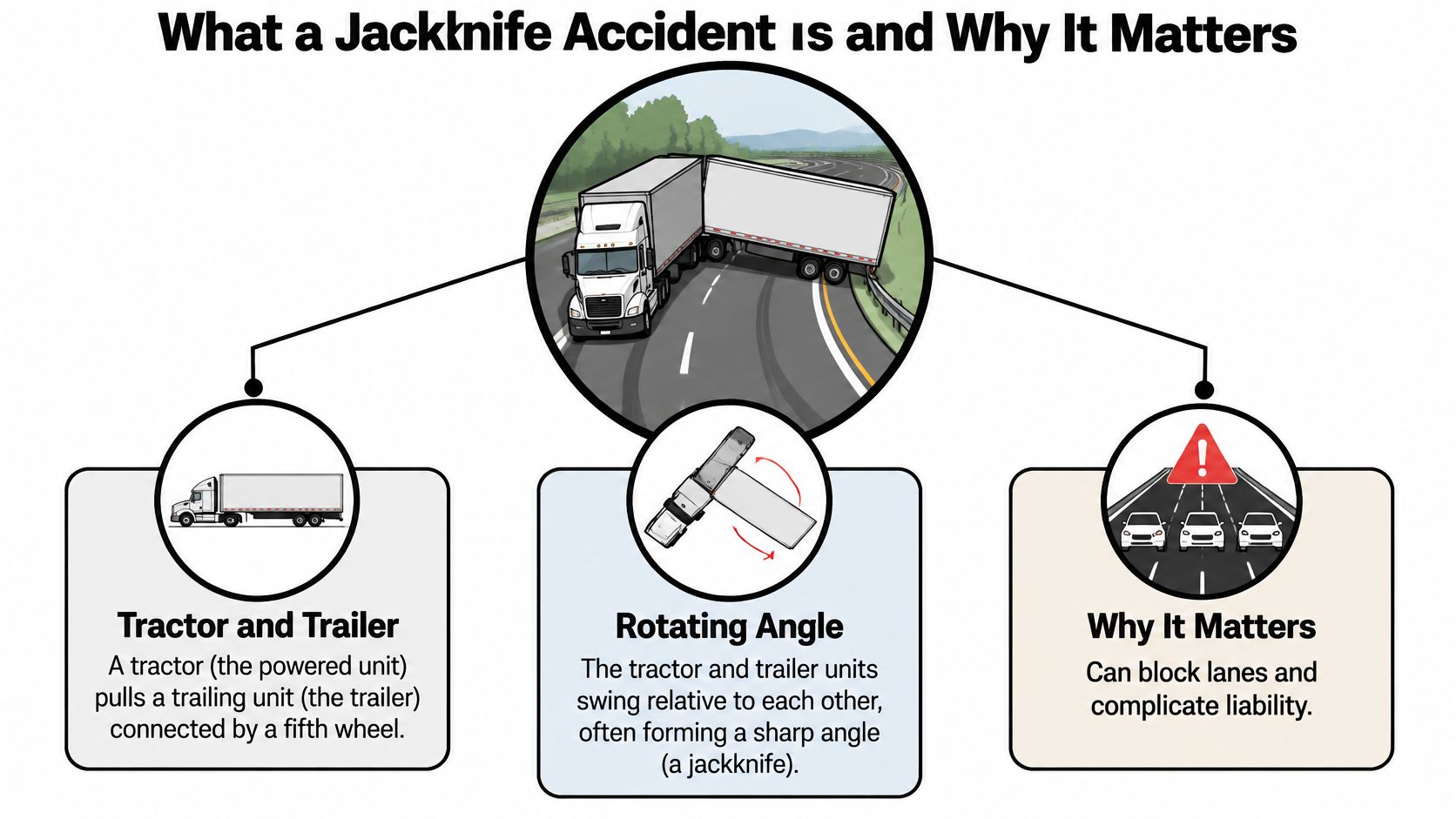
Say a tractor-trailer enters a right-hand curve a little fast. The driver brakes hard, the drive wheels lose grip, and the trailer swings across the lane line like a gate on a loose hinge. Cars that were beside the truck now face the side of a trailer. That is a jackknife: a tractor pulling a trailing unit, with the two units rotating relative to each other.
The fold can be the first thing that goes wrong, or it can be something that happens after another event. In 2019, NHTSA's Fatality Analysis Reporting System, compiled in FMCSA's Large Truck and Bus Crash Facts, recorded 5,005 large trucks in fatal crashes in the United States. 172 of those trucks, or 3.4%, were recorded as jackknifed. Of all large trucks in those fatal crashes, 41 (0.8%) jackknifed as the first event, while 131 (2.6%) jackknifed later. The same federal table recorded approximately 1,000 injury crashes involving jackknifed large trucks that year, about 1.0% of injury crashes involving large trucks. A large truck here means a vehicle with a gross vehicle weight rating above 10,000 pounds, so the count is broader than tractor-semitrailers alone.
Why the order of events decides the claim
If the trailer swing is the first harmful event, the investigation starts with speed, braking, and the truck's own control. If the jackknife comes after a lane departure, an impact, sudden braking, or a rollover, the fold may be a result, not the cause. Treating the folded truck as automatic proof of driver fault is how these cases get lost.
The resting position shows what the truck looked like at the end. It does not show which event came first.
Common Causes of Jackknife Truck Crashes
Hard braking on wet or icy pavement is the sequence I would test first. The tractor slows, the trailer's momentum keeps pushing, and the combination rotates at the fifth wheel. Speed on a curve, an empty or uneven load, worn brakes or tires, and a sudden steering correction can do the same thing, often together.
An NHTSA analysis of fatal large-truck crashes from 1996 through 2000 found the odds of a jackknife on a curved roadway were 86% higher than the odds on a straight roadway. The same analysis found that poor lighting increased jackknife odds by 43%. Later NHTSA fatal-crash research found that higher posted speeds, poor weather, and curved roads significantly increase the odds of both jackknife and rollover events. That research also reported that approximately 10% of combination-truck occupant fatalities were associated with jackknifing, and that more than 90% of those fatalities involved a single-trailer combination vehicle.
Those relationships are historical, and they do not assign fault in your crash. They do tell you which records to demand. Drivers who have drilled the essential combination vehicle driving skills still lose the trailer when friction, load, and brake timing stack up. A single “driver error” label hides that stack.
Match each cause to a record
| Cause | Evidence to request |
|---|---|
| Hard braking on wet or icy pavement | Event data recorder, brake maintenance records, weather data |
| Excessive speed on curves | Event data recorder, posted speed and curve geometry photographs |
| Empty or unevenly loaded trailer | Bills of lading, cargo-loading documents, weigh-station records |
| Worn brakes or tires | Maintenance and inspection files, tire condition photographs, post-crash inspection reports |
| Evasive steering | Witness accounts, dash-camera footage, telematics data |
| Poor lighting or roadway design | Roadway photographs, lighting measurements, road design records |
What works is pairing each theory with a document that can confirm or kill it. What does not work is a cause list with no custodian behind it. Event data can show brake application and speed. A bill of lading can show an empty trailer that was easier to swing. A post-crash inspection can show a brake that was already out of adjustment.
How Liability Is Proven in Jackknife Cases
A folded tractor-trailer is not negligence. It is a position. Plenty of these crashes start with someone else, a bad surface, a mechanical failure, a bad load, or a dispatcher who pushed a late arrival.
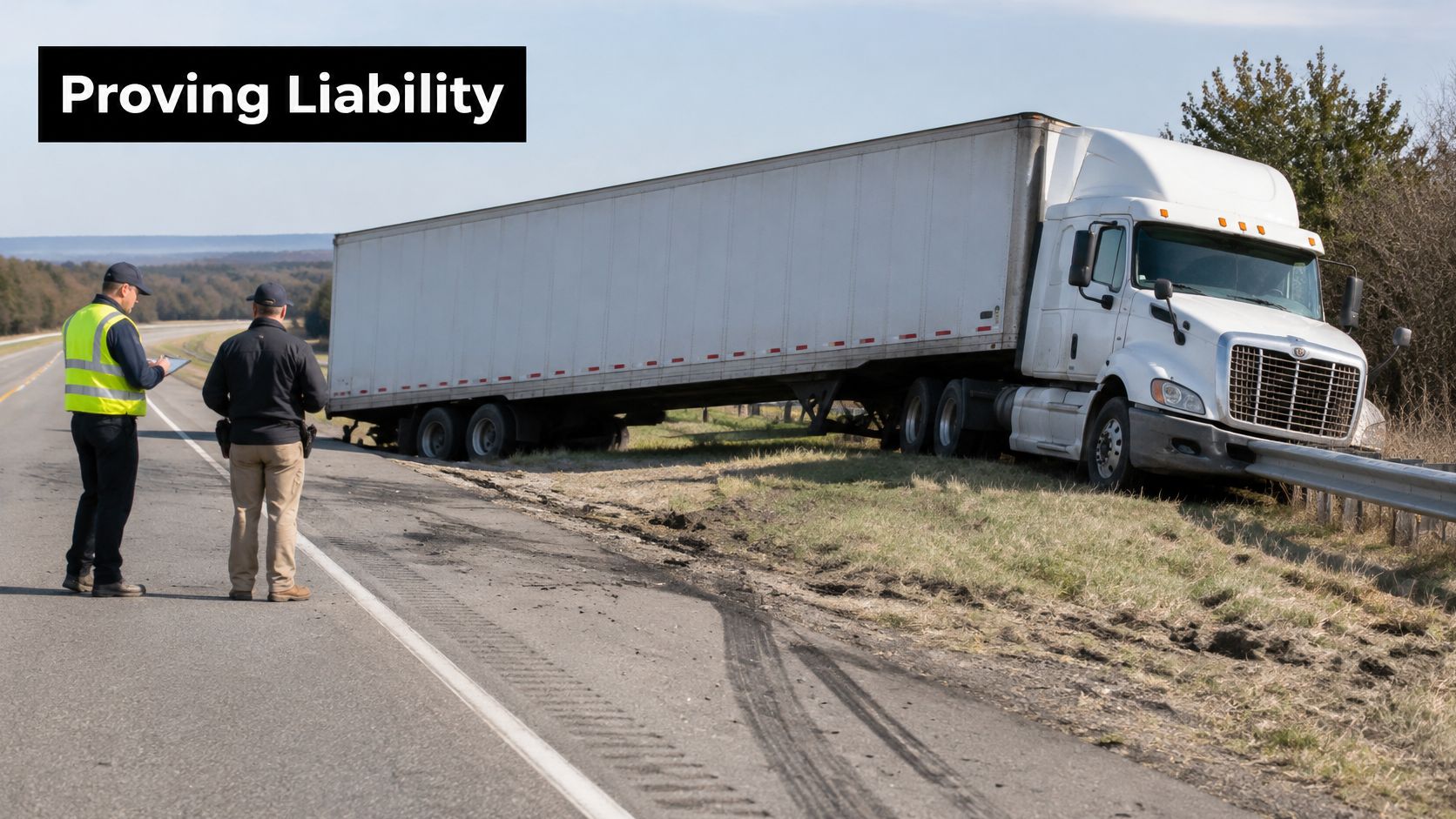
Think of the crash as a line of dominoes. The last tile is the trailer across the lanes. The first tile is the one that matters.
Rebuild the sequence before you name a defendant
- Name the first harmful event. Police coding is a starting point, not a verdict. Tire marks, headings, and electronic data have to agree with that code.
- Split pre-impact cause from post-impact motion. A trailer can swing after it is already hit. That swing can injure people without being the reason the vehicles met.
- Test every starter. Another driver cutting in, a drop-off or curve the road owner should have fixed, a brake or tire defect, a shifted load, or dispatch pressure can each be the first tile.
FMCSA's 2020 large-truck crash table recorded 169 large trucks in fatal crashes that involved jackknifing: 27 as the first event and 142 as a subsequent event. Roughly 84% of those reported jackknife occurrences were subsequent events, not the initial harmful event. The same table recorded jackknifing in approximately 0.9% of injury crashes and 1.2% of property-damage-only crashes, compared with 3.5% of fatal crashes. Those figures do not prove fault. They are a screening rule: find the first harmful event, then separate what happened before impact from how the trailer moved after it.
Who can share responsibility
- The driver, for speed, following distance, braking, or fatigue.
- The carrier, for hiring, training, hours, and dispatch.
- A maintenance contractor, when a missed brake or tire defect is in the file.
- The trailer owner or the cargo shipper, when the unit or the load made the combination unstable.
- A public entity, when roadway design or a known surface defect started the loss of control.
How those parties are pleaded is covered in more detail in our guide to truck accident liability. Reconstruction should reconcile the police code with photographs, witness accounts, and the truck's own data before anyone is blamed.
This short clip shows how quickly a trailer can swing once the wheels lose lateral grip, which is why timing matters more than the final photo.
How to Protect Your Claim in the First 72 Hours
Carrier-held data is the part of the case that disappears first. A module can be overwritten, a camera loop can recycle, and a shop can start repairs. The police report will not hold those files. FMCSA's public crash file contains 59 data elements drawn from state police reports, and the agency notes that crash data is reported by states and may contain multiple records for one event. Recent federal counts also stay provisional while reporting continues, so a fresh online total is not your proof.
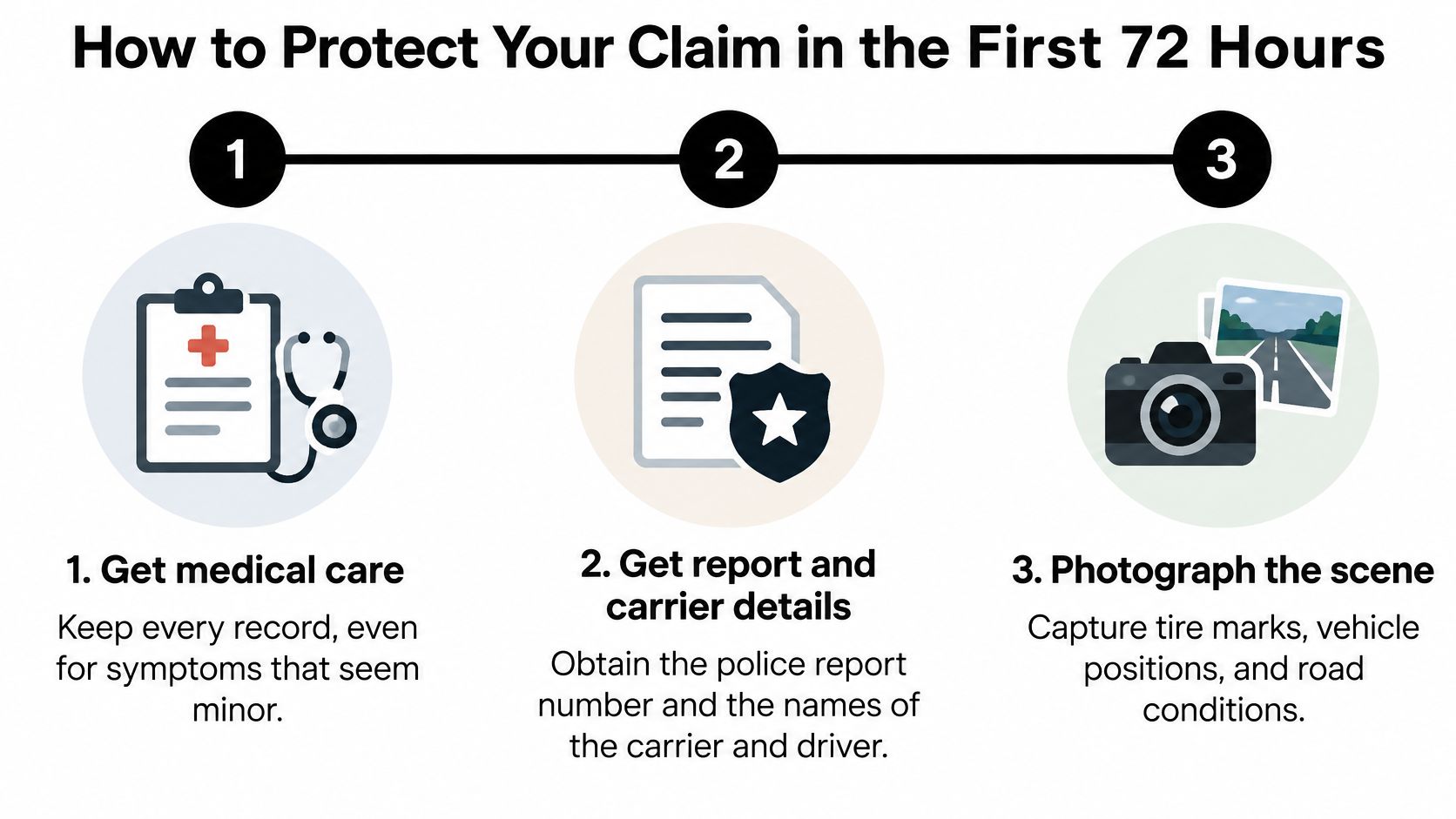
Do these in order
- Get medical care and keep every record. Go even if you feel only stiff. Delayed treatment is the gap insurers use to argue the crash did not cause the injury. Save discharge papers, imaging, and work notes.
- Get the report number and the names. You need the police report number, the driver, and the carrier's legal name, not just the logo on the door. The motor carrier and the trailer owner are often different companies.
- Photograph before the lane reopens. Tire marks, headings, debris, the curve, and the pavement condition change as soon as tow trucks move the combination. Shoot wide, then close.
- Write down witnesses that day. A name and a phone number beat a memory of “someone in a white SUV.” Independent accounts are what you have when the truck's camera is “unavailable.”
- Send a narrow preservation demand. Ask counsel to demand preservation of the tractor, the trailer, maintenance records, dispatch messages, hours-of-service logs, dash-camera footage, telematics, and post-crash inspection reports. A blanket “save everything” letter is easier for a carrier to shrug off.
- Do not give the carrier's insurer a recorded statement yet. Adjusters call while you are still sore and looking for a simple story. Wait until you have spoken with counsel.
Practical rule: If the carrier says the data is gone, the demand letter is what lets you ask when it was lost and who had it.
The My Safety Manager accident response guide is written for the carrier's side of those same first hours. Reading it shows you which files a safety department is trained to pull, which is exactly the list your demand should name. We work with medical and accident reconstruction experts who can testify about both the cause of the crash and the impact of the injury, but they can only use files that still exist.
Damages, Compensation and Colorado Fault Rules
Compensation is the total of what the crash took, reduced by any share of fault that is yours. Build the number from documents, not from a round figure in a demand letter.
What the claim can include
- Medical care, past and future, from the emergency visit through therapy or surgery that is still ahead.
- Lost wages and earning capacity, using pay stubs, tax returns, and a clear work restriction.
- Pain and suffering, and loss of enjoyment of life, tied to specific limits on work, sleep, driving, or family life.
- Property damage to your vehicle and what was in it.
- In a death case, funeral costs and the loss of financial support.
How Colorado splits fault
Colorado uses a modified comparative fault rule. You can recover only if your share of fault is not greater than the combined fault of the defendants. Your damages are then reduced by your percentage.
Say total damages are $400,000 and a jury finds you 20% at fault because you were slightly over the limit in the next lane. The defendants together hold 80%. You are not barred, and the recovery is $320,000. If your share were greater than the defendants' combined share, the claim would be barred. How that percentage is argued is laid out in our page on Colorado comparative negligence.
| Issue | Colorado rule | Practical effect |
|---|---|---|
| Personal injury statute of limitations | Two years from injury | File or toll before the deadline passes |
| Wrongful death statute of limitations | Two years from death | Calendar the date from the date of death |
| Comparative fault | Modified rule; claimant barred if fault exceeds defendants' combined fault | Recovery reduced by claimant's percentage of fault |
| Government defendant claim | Shorter notice requirement under the Colorado Governmental Immunity Act | Notice must be given much earlier than the general deadline |
Deadlines change with the type of claim, and a city or state defendant can require notice long before the two-year mark. Confirm the date that applies to your facts with counsel before you rely on the general rule.
Choosing a Jackknife Accident Attorney and Next Steps
Pick the lawyer by the work the file needs in the first month, not by a settlement number nobody has earned yet.
What I would require before hiring
- Trucking experience against both the driver and the carrier, including cases where the trailer owner is a separate company.
- Reconstruction and medical experts already available, not a promise to “look into experts later.”
- A record of taking truck cases to trial, because some carriers do not move until a trial date exists.
- Written fee terms: the contingency percentage, which costs the firm advances, how those costs are repaid, and what you owe if nothing is recovered.
- A named lawyer on the file, with a real answer about who returns your calls.
- Multistate reach when the carrier sits outside Colorado. We co-counsel trucking and brain injury cases nationally, which matters when the defendant, the data, and the witnesses are in different states.
The firm has represented clients with traumatic brain injuries, concussions, and catastrophic injuries caused by truck accidents. A head injury after a trailer strike is a medical claim and a proof claim at the same time. Our notes on how to choose a truck accident lawyer walk through that hiring decision in more detail.
Questions for a free consultation
Ask who works the file day to day, which evidence is preserved first and by what demand, and what timeline they expect before a demand or a filing. Ask how they will investigate the carrier, the maintenance contractor, and the trailer owner, not only the driver. Ask what costs you pay if the case is lost.
A lawyer who will not put the fee in writing, or who quotes a settlement before reading the records, is a reason to keep looking. During a free consultation, a personal injury attorney at our firm answers those questions, puts the case together, and pursues the compensation you deserve. Bring the report number, medical records, photographs, witness names, and any letter from the insurer. Do it within days. Preservation and Colorado's two-year clock both run from the event.
Can I Still Recover If the Truck Driver Was Not at Fault
Often, yes. A driver who braked for a real emergency, or who lost the trailer on a bad surface, may still leave you with a claim against someone else.
FMCSA's crash-statistics program is built to identify factors associated with large-truck crashes, which is a useful reminder that these events are not a single-fault label.
- Find the first harmful event. If another vehicle's impact or a sudden lane change started the fold, that driver can be liable even though the truck is the wreck everyone photographed.
- List every possible defendant. That list can include the other driver, the carrier, a maintenance contractor, the trailer owner, the shipper, and a public entity responsible for the road.
- Apply Colorado's modified comparative fault rule to the shares you have. You recover only if your fault is not greater than the defendants' combined fault, and the award drops by your percentage. On $400,000 in damages, with you at 30% and the defendants together at 70%, the recovery is $280,000.
- If a government entity might be a defendant, calendar the shorter notice under the Colorado Governmental Immunity Act first. That notice can expire while you are still treating.
Shares and dates are case-specific. Confirm both with counsel before you assume a reaction to an emergency ends the claim.
Nares Law Group LLC investigates jackknife truck wrecks, preserves carrier-held electronic data, and pursues compensation for the injuries those crashes leave behind, including traumatic brain injuries and wrongful death. If you were hurt in Colorado, or your family is dealing with a death after a tractor-trailer folded across your lane, start with a free consultation and bring the report number and your photographs. Visit Nares Law Group LLC to talk through the sequence, the defendants, and the deadlines that apply to your crash.