Yes, lost wages are compensatory economic damages that replace income an injury cost you, not a punishment for the defendant. In Colorado, a wage claim can include both missed earnings during recovery and a documented reduction in your future ability to earn.
You may be looking at a smaller paycheck while rent, groceries, and medical bills still need paying. The difficult part isn't naming the loss. It's showing exactly what you would have earned, why the injury prevented you from earning it, and whether your return to work tells the whole story.
Yes, Lost Wages Are Compensatory Damages
Compensatory damages reimburse an actual loss. When an injury keeps you from working, the missing income is a financial consequence of that injury. You don't need to prove that the person who hurt you deserves punishment to establish a wage-loss claim.
The personal injury guidance from CGH Law Firm identifies lost income within the broader compensation available after an injury. The practical distinction is between money that replaces a measurable loss and money awarded for a different purpose.
Where Lost Wages Fit Among Damage Categories
| Damage category | Purpose | Typical items | How it is proven |
|---|---|---|---|
| Economic compensatory | Replace measurable money lost | Lost wages, lost future earning capacity, medical bills, property repair | Pay stubs, tax records, employer letters, medical bills |
| Noneconomic compensatory | Compensate nonfinancial harm | Pain, suffering, loss of enjoyment, emotional distress | Medical records, testimony, evidence of daily limits |
| Punitive or exemplary | Punish and deter willful or wanton conduct | Penalty connected to qualifying wrongdoing | Evidence satisfying the heightened requirements of applicable law |
Economic damages, sometimes called special damages, have a financial basis that can be checked against records. An adjuster can compare your claimed missed earnings with payroll, schedules, and medical restrictions. That doesn't make every claim simple, but it gives the calculation an objective starting point.
Noneconomic damages are also compensatory. They address harm such as physical pain or losing the ability to enjoy ordinary activities, rather than a missing deposit in your bank account. Having no receipt doesn't make that harm unreal.
For another plain-language explanation of this category, Olson & Sons' guide to economic damages in personal injury cases helps distinguish financial losses from other injury-related harm.
Compensation Isn't a Penalty
Think of the difference between a refund and a fine. A refund restores what a failed product cost you. A fine punishes prohibited conduct. The analogy isn't a complete legal rule, but it explains why repayment and punishment belong in separate categories.
A useful question is whether the missing paycheck would have the same value if the driver had been careless rather than deliberately reckless. If the financial loss stays the same, you're measuring compensation, not punishment.
Practical rule: Ask for wage loss to appear as its own line item in a settlement evaluation, with supporting calculations rather than an unexplained share of the total.
Documentation That Proves Wage Loss
Build a single timeline before assembling a demand: your earnings before the injury, the dates you missed work, each period of medical restrictions, and what happened when you returned. This makes it easier to connect the medical evidence with the employment evidence.
The Legal Information Institute's explanation of compensatory damages identifies lost wages or income as an element courts consider when measuring actual loss. For a Colorado injury claim, the evidence needs to support losses already incurred and future losses that will probably occur, not merely income you hope you would have earned.
Documents That Prove Wage Loss
| Document | What it proves | Common gap |
|---|---|---|
| Recent pay stubs covering representative pay periods | Pre-injury rate, hours, and overtime | Overtime and bonus lines missing |
| W-2s and tax returns covering representative prior years | Annual earnings history and trend | Cash or side income not reported |
| Employer wage verification letter | Position, rate, scheduled hours, and dates missed | Employer gives conclusions without payroll detail |
| Timesheets and shift schedules | Actual shifts missed | Schedules remain only in a phone app |
| Physician off-work and restriction notes | Medical basis for absence and work limits | Unexplained gaps between restriction periods |
| Disability or paid-leave records | Payments from other sources and leave used | Leave isn't separated from the wage calculation |
| Job description and raise or promotion history | Work demands and evidence of advancement | Expectations were never documented |
| Vocational or economist report | Support for future earning-capacity figures | Assumptions aren't tied to medical and employment evidence |
A pay stub proves what you earned, but not why you stopped earning it. A physician's restriction proves a medical limitation, but may not show whether your employer could accommodate it. The strongest documentation connects both sides.
Say your doctor prohibits lifting, but your chart never describes your warehouse duties. Give the physician an accurate job description so the restrictions address the work you perform. Don't ask the doctor to adopt wording that isn't medically justified.
Close Gaps Before They Become Disputes
Request payroll and scheduling records early. Save copies of app-based schedules, attendance messages, and communications about modified duties before your access changes.
- Explain irregular earnings. Identify seasonal slowdowns, unpaid leave, or job changes that make a recent paycheck unrepresentative.
- Keep a dated work log. Record missed shifts, shortened days, symptoms affecting work, and treatment appointments.
- Preserve original records. Keep the underlying statements and messages, not just totals copied into a spreadsheet.
Your own log provides context. It should supplement, not replace, independent records.
How to Calculate Past Lost Wages Step by Step
Calculate the loss by pay period, not by guessing how long recovery felt. A spreadsheet with columns for dates, missed hours, applicable rates, supporting documents, and disputed items makes the total reproducible.
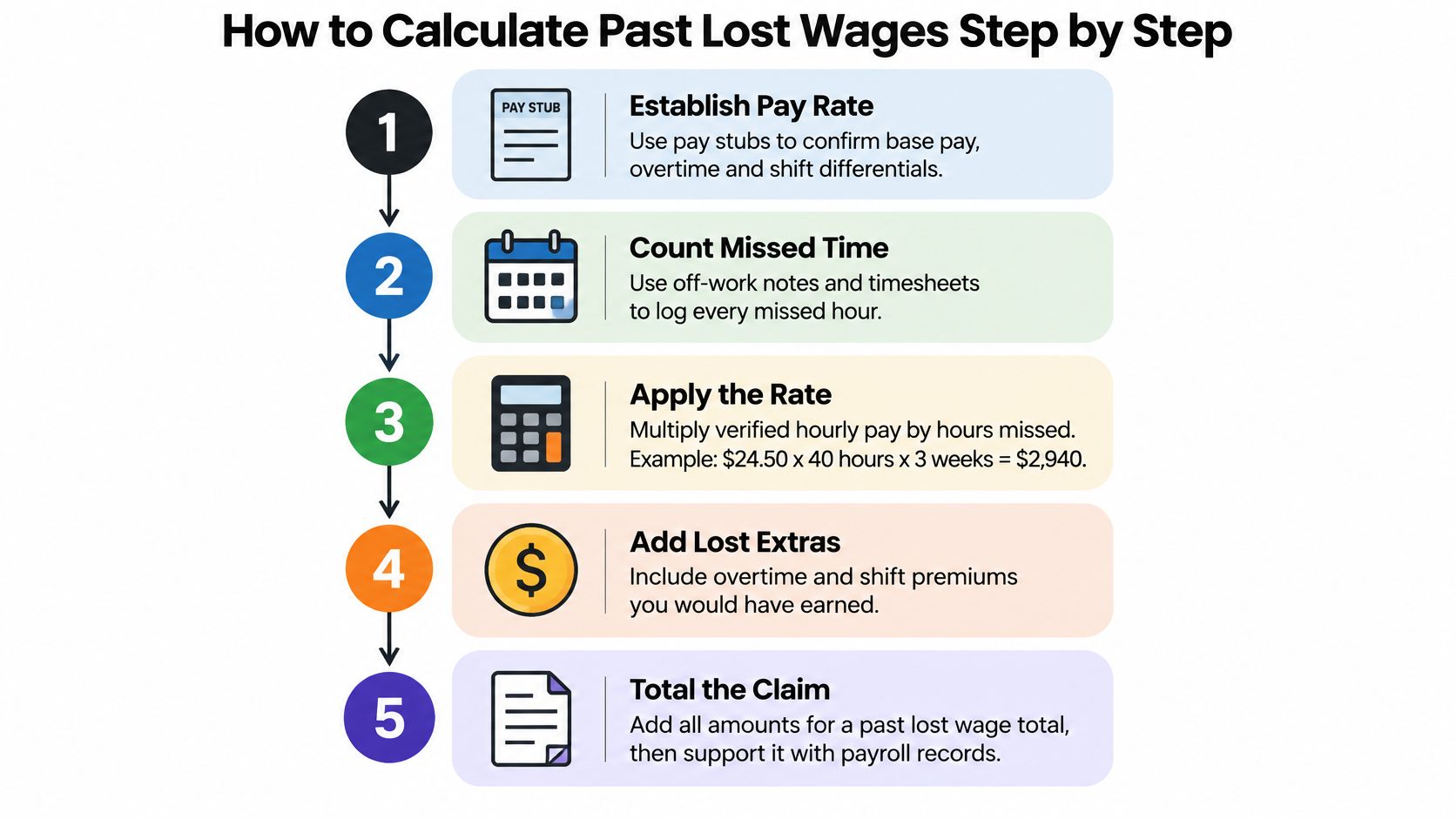
The process graphic provides a visual checklist for organizing the calculation.
Build the Calculation From Payroll
Establish your actual pay rate. Separate base pay, overtime, and shift differentials. Use what payroll shows you earned, not an advertised rate or a coworker's compensation.
Count full shifts and partial shifts missed because of the injury. Match those hours with schedules, attendance records, and the applicable medical restrictions.
Apply the correct rate to each period. If your pay changed during the absence, split the calculation at that change. Don't apply an overtime rate to ordinary hours.
Add supported commissions, bonuses, or scheduled raises. An established compensation formula is stronger evidence than an expectation that business would have been good.
Identify lost employer contributions separately. Retirement contributions or employer-paid benefits may require their own calculation. Check whether the employer stopped providing them.
Include unpaid time for injury-related appointments, testing, and therapy. Don't add appointment hours that already fall within a full shift you've counted.
Choose a clear accounting cutoff. Use the date through which records are available and identify any continuing loss separately. Returning to work or reaching maximum medical improvement doesn't automatically eliminate every later earnings loss.
Worked Example of Past Lost Wages
The following figures are hypothetical assumptions, not average Colorado wages or a prediction of recovery. Assume an employee misses nine weeks, normally works forty base hours and six overtime hours weekly, and loses a documented bonus share.
| Item | Calculation |
|---|---|
| Base wages | $28 × 40 hours × 9 weeks = $10,080 |
| Lost overtime | $42 × 6 hours × 9 weeks = $2,268 |
| Lost bonus share | Assumed documented bonus loss = $1,500 |
| Total past wage loss | $10,080 + $2,268 + $1,500 = $13,848 |
Replace every assumption with your own records. Overtime belongs in the claim only when the evidence supports that you probably would have worked it.
Keep paid leave and disability payments in separate columns so your attorney can evaluate their treatment without counting the same item twice. Self-employed workers should also distinguish business revenue from income remaining after relevant expenses.
The firm's guide to economic damages calculation provides additional context for organizing financial losses.
For an accompanying video resource, use the player below.
Valuing Future Lost Earning Capacity
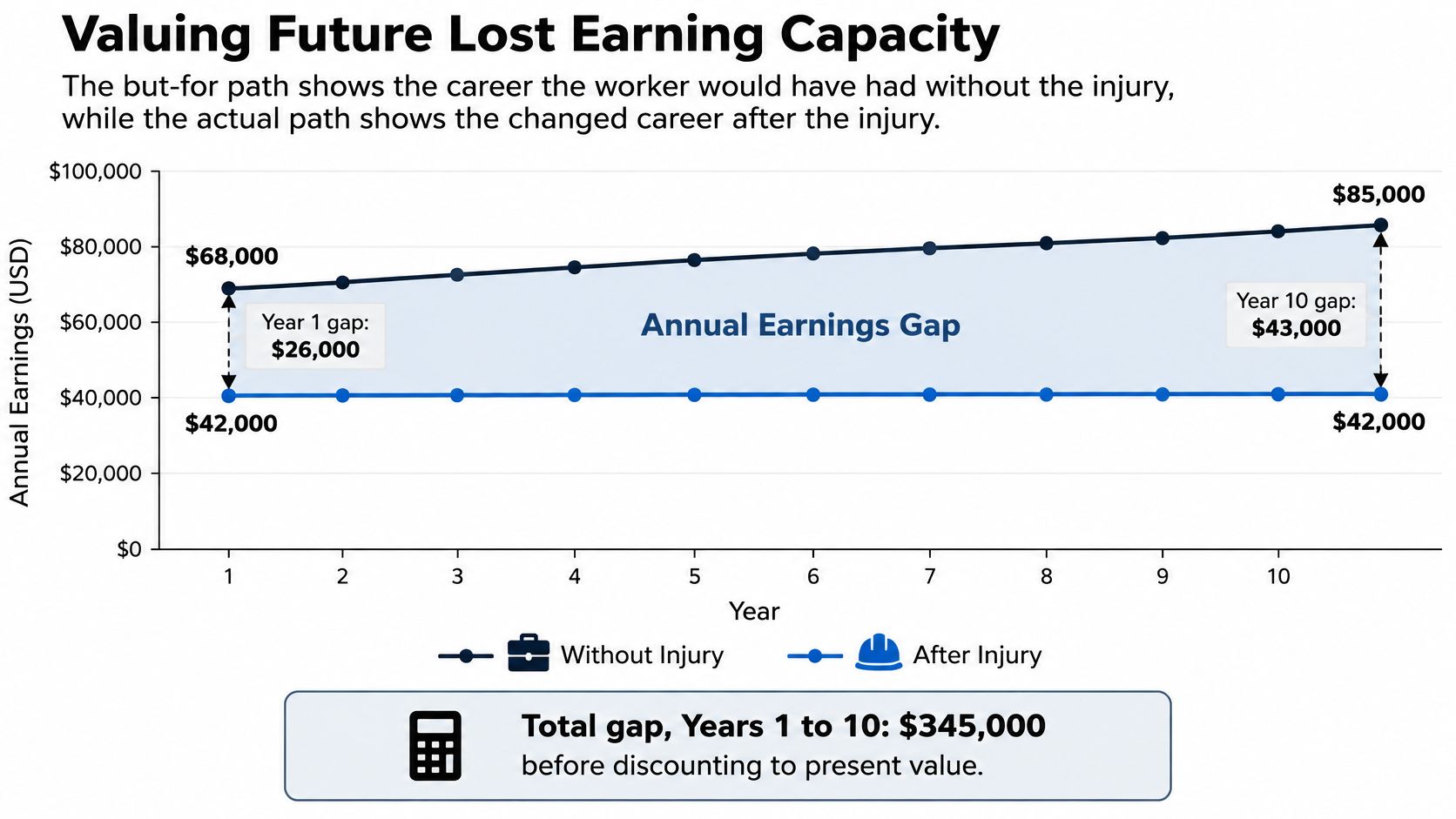
Future earning capacity compares the career you probably would have had without the injury with the work you can realistically perform afterward. The question isn't whether you can earn a paycheck at all. It's whether the injury reduced your earning ability over time.
The Tennessee Bar Association's explanation of economic-loss valuation describes projecting future losses with factors such as wage growth and workforce participation, then applying discount factors to determine present value. That requires more than multiplying today's wages by an assumed retirement date.
The chart illustrates how different career paths can create an earnings gap. Its amounts are hypothetical, not wage benchmarks or a case valuation.
Why Present Value Changes the Total
Present value means the amount needed today to replace income that would otherwise arrive in the future. Because money received now can earn a return, the calculation generally discounts future payments rather than adding them up at face value.
For a hypothetical example, assume a flat annual earnings gap of $20,000 for twenty years, paid at each year's end. Without growth or discounting, the total is $400,000. At an assumed annual discount rate of 3%, its present value is approximately $297,549.
A reader can reproduce that example using:
Present value = annual loss × [1 − (1 + discount rate) raised to the negative number of years] ÷ discount rate.
Those assumptions aren't prescribed rates or court-approved findings. Different payment timing, wage growth, benefits, and employment probabilities produce different results.
Match the Model to Real Work Options
A full return to the same job at the same earning level may leave no continuing wage gap, although any claimed lost advancement needs separate support. A return to part-time work may create a gap based on medically sustainable hours. A permanent move to lower-paid work requires evidence about realistic alternative employment.
Treating clinicians establish medical restrictions. A vocational rehabilitation expert evaluates how those restrictions interact with education, skills, job demands, and available work. An economist can then translate the supported employment scenarios into financial projections.
Ask for assumptions beside the figures they affect:
- Career duration changes how long losses continue.
- Wage growth changes the expected earnings path.
- Employment probability accounts for uncertainty about continued work.
- Discounting changes the current value of later payments.
A transparent model lets both sides test the assumptions instead of arguing over an unexplained total.
Insurer Arguments on Wage Loss and How to Answer Them
An early settlement offer may include a wage figure without showing how the adjuster calculated it. That doesn't tell you whether the insurer included reduced hours, rejected overtime, or treated your first day back as the end of the claim.
Compare the proposed amount with your records before treating it as an accurate valuation. The image below reflects the practical task: checking the offer against the documents, not just looking at the final number.

Common Insurer Arguments on Wage Loss
| Insurer argument | What it really tests | Evidence that answers it |
|---|---|---|
| The doctor never ordered you off work | Medical necessity of each missed day | Contemporaneous off-work notes and treatment logs |
| You could have done light duty | Reasonable efforts to reduce the loss | Employer letter on light-duty availability and restriction notes |
| Your pay history has a gap | Accuracy of the pre-injury baseline | Prior tax returns and an explanation letter |
| Some income was off the books | Actual pre-injury earnings | Invoices, deposits, contracts, payment records, and candid tax review |
| A prior condition caused the lost time | Causation | Records showing function before the crash |
| Future loss is speculative | Reliability of the projection | Vocational assessment and a transparent economic model |
| Your return-to-work date proves full recovery | Ongoing ability to earn | Records of symptoms, failed work attempts, and restrictions |
Answer the Specific Dispute
If the insurer questions medical necessity, identify the restriction covering the disputed absence. If it challenges your baseline, explain why a seasonal layoff or prior unpaid absence shouldn't define ordinary earnings. A larger document dump won't necessarily answer a narrow question.
Be candid about unreported income. Don't alter records or create retroactive invoices. Give your attorney the complete financial picture so legal and tax issues can be addressed accurately.
Mitigation means making reasonable efforts to avoid unnecessary loss. If an employer offers suitable modified work, refusing it without a supported reason can affect the claim. But a theoretical desk job isn't the same as an available position that fits your restrictions.
Record the duties, hours, pay, and physical or cognitive demands of any proposed assignment. Ask your clinician to address an actual mismatch rather than relying on a general statement that light duty was impossible.
Don't accept a wage number without the math. Ask the adjuster to identify the accepted dates, rates, hours, and excluded items in writing.
If someone requests a recorded statement before your medical picture is clear, don't guess about recovery or future work. Clarify the request and seek advice about your obligations before responding.
Colorado Rules and Tax Treatment for Wage Claims
Colorado wage claims require attention to both the injury evidence and the legal rules governing the case. The correct filing deadline depends on the claim, including whether it involves a motor vehicle, another type of injury, or a public entity. Don't assume every Colorado accident follows the same timetable.
Comparative fault can reduce or bar recovery under Colorado law. Damage limits and exemplary-damage requirements also need claim-specific review. A wage calculation should therefore distinguish the supported financial loss from legal adjustments that may affect what the claimant can recover.
Keep Separate Legal Questions Separate
Ask counsel to confirm these issues under current law:
- Filing and notice requirements. Identify the applicable deadline, when it begins, and whether a separate notice is required.
- Fault allocation. Evaluate how disputed responsibility could affect recovery.
- Damage categories. Don't apply a noneconomic-damage limitation automatically to an economic wage-loss item.
- Exemplary damages. Evaluate their separate evidentiary and procedural requirements rather than adding a penalty to payroll calculations.
These questions matter before negotiation, not just before trial. A well-supported wage total doesn't cure a missed filing requirement, and serious misconduct doesn't replace proof of lost income.
Compensatory Doesn't Automatically Mean Tax-Free
Whether lost wages are compensatory damages is different from whether the recovery is taxable. The underlying reason for the payment matters.
The IRS guidance on settlements and judgments explains that damages received because of personal physical injury are generally excluded from gross income under IRC §104(a)(2), including qualifying amounts allocated to lost wages, while previously deducted medical expenses that produced a tax benefit require separate treatment.
That means wage replacement in a qualifying physical-injury case can receive different treatment from back pay in an employment dispute. Lost wages awarded for discrimination or wrongful termination are generally taxable wages. Calling both payments compensation doesn't make their tax treatment identical.
Review the Allocation Before Signing
Punitive damages and interest generally require separate tax analysis. A prior medical deduction may also make part of a recovery taxable. Don't assume that every amount in a settlement follows the treatment of its physical-injury component.
Ask for a clear allocation among medical expenses, wage loss, other compensatory damages, interest, and any punitive component. Settlement wording matters, but labels alone don't change the underlying facts.
Before signing: Have your attorney and tax adviser review the proposed allocation together, particularly if the agreement combines different kinds of payments.
A tax estimate based only on the settlement's headline amount can miss those distinctions.
Confirm Your Wage Claim Before the Deadline
You don't need to finish treatment before protecting your claim. You do need an organized record of what has happened and prompt advice about the deadlines that apply to your circumstances.
Put the Next Actions in Order
Collect the earnings baseline. Download representative pay stubs, tax returns, payroll summaries, and compensation agreements. Preserve records showing variable earnings rather than choosing only your highest-paying period.
Build the past-loss spreadsheet. Assign a supporting document to each entry and flag assumptions that still need confirmation.
Ask about continuing work restrictions. Give treating clinicians accurate job duties and request clarification about functional limits. If future work remains uncertain, discuss whether vocational evaluation is appropriate before projecting a career-long loss.
Confirm the filing deadline with a Colorado injury attorney. The guide to Colorado personal injury statutes of limitations provides context, but your attorney should evaluate the specific claim and any applicable exceptions.
Flag public-entity involvement immediately. A government vehicle, employee, or property may trigger separate notice requirements. Don't wait for an ordinary insurance negotiation to resolve that question.
Arrange a consultation before accepting an offer that releases your injury claim. Ask which wage components remain unsupported and what evidence would resolve them.
Bring pay stubs, tax returns, off-work notes, your employer's contact information, modified-duty communications, and any settlement letter. Include your spreadsheet even if it's unfinished. A clearly identified gap is easier to address than an unsupported assumption hidden inside a total.
Nares Law Group LLC offers free consultations for Colorado injury claims involving missed earnings and reduced future earning capacity. Visit Nares Law Group LLC to request a review of your wage records, work restrictions, and any insurance offer before you sign a release.