You've exchanged insurance information, the car is in the shop, and an adjuster has called asking for a statement. Maybe your injuries seem manageable, or perhaps you're still waiting to learn whether the pain will pass. You want to resolve the claim without handing over a share of the recovery, but a quick check and a signature can close the door on costs you haven't counted yet.
You can handle some claims yourself. But don't treat every claim as a negotiation problem you can solve with persistence. First screen for complexity, then preserve evidence, value the full loss, and stop if the facts or future costs remain uncertain.
Decide Whether Self-Settlement Is Even Realistic
Self-settlement is most realistic when the claim is limited to vehicle damage, fault is clear, and the costs are easy to document. A short-lived injury with completed treatment may also be manageable if the cause, expenses, and available coverage are straightforward. It becomes structurally dangerous when fault is disputed, symptoms are evolving, several drivers or insurers are involved, or a commercial or government vehicle is part of the crash.
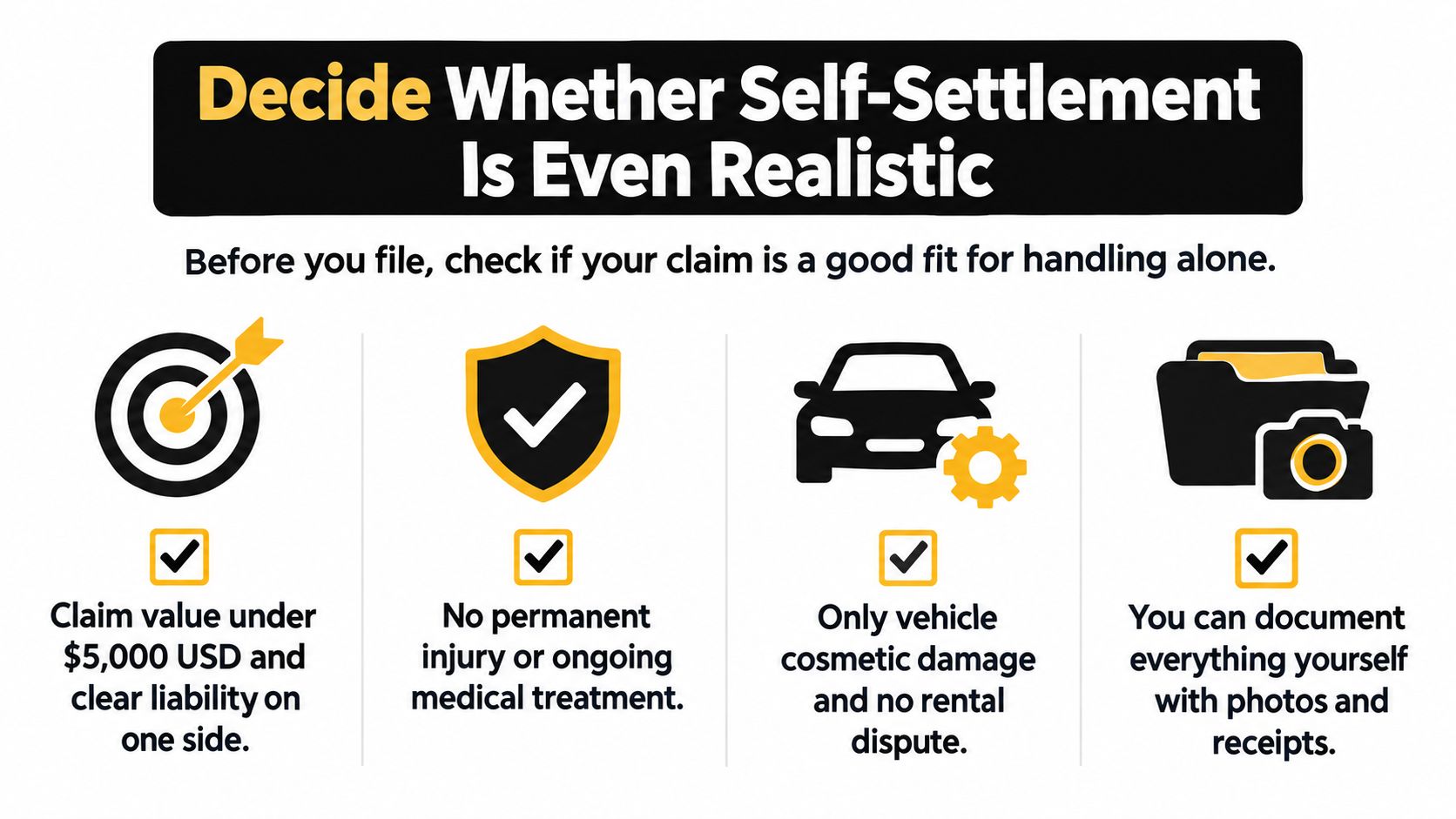
Use that distinction as your first checkpoint. If the claim is property damage only, the repair cost and rental dispute may be the whole fight. If you're claiming bodily injury, the question changes: Can you identify all the harm, including future care, lost income, and potential reimbursement obligations, before signing away the claim?
There's a speed tradeoff, but don't turn it into a promise about what's best for you. An Insurance Research Council analysis of more than 7.4 million auto-injury claims closed with payment from mid-2017 through mid-2022 reported a median closure time of about 210 days for unrepresented claimants and nearly 440 days for represented bodily-injury claimants. The analysis also reported that, after medical costs and legal fees, represented claimants netted about $1.40 per dollar of medical bills compared with $1.80 for unrepresented claimants. Those figures describe the claims in that analysis. They don't prove that handling a claim alone produces a better outcome, especially when injury severity and case complexity differ.
Screening rule: If you can't yet explain what happened, what it cost, what may still happen, and which insurance may apply, don't negotiate a final settlement.
For a claim involving ongoing pain, it may help to understand how persistent symptoms can affect the injury picture. This personal injury claim overview for chronic pain offers background to consider while you're assessing whether treatment has stabilized.
Preserve Evidence in the First Days After the Crash
Your early records become the foundation for every later demand. Start a claim folder, digital or paper, and save original files rather than relying on memory or a stream of texts.
Build the file while details are fresh
Collect the other driver's name, contact information, license plate, and insurance details. Photograph each vehicle and the crash scene before repairs or cleanup, including damage, road conditions, traffic signs, and visible injuries. Get witness names and contact information, and request the crash report when it's available.
If nearby businesses or public agencies may have relevant video, promptly ask how to preserve it. Footage may not remain available, and an informal request doesn't guarantee it will be retained. Keep copies of medical records and bills, repair estimates, towing and rental receipts, wage documentation, and any correspondence from insurers.
The National Association of Insurance Commissioners advises claimants to cooperate with adjusters while keeping notes of conversations, retaining receipts, and documenting temporary repairs. The NAIC's consumer auto insurance guidance also supports keeping copies of correspondence and recording the adjuster's name and statements.
Use a simple evidence inventory
Keep one running chronology. For each contact or event, write the date, who was involved, what was said or decided, and what follow-up is due. Add medical visits, expenses, missed work, repairs, and new symptoms as they occur.
A useful inventory includes:
- Crash evidence: Report, scene and vehicle photographs, witness contacts, and any video-preservation requests.
- Medical records: Visit summaries, bills, treatment instructions, and records that explain how symptoms affect daily activities.
- Financial losses: Receipts, repair and rental documents, wage verification, and records of other out-of-pocket expenses.
- Claim communications: Adjuster name, phone or email notes, letters, submitted documents, and proof of delivery.
Don't alter photos or discard damaged property before documenting it. Send records securely, keep copies of what you provide, and don't sign broad medical authorizations without understanding what records they cover. A neat file won't decide liability by itself, but it makes it harder for an important fact or expense to disappear during negotiations.
Calculate What Your Claim Is Actually Worth
A settlement demand should come from a documented damages calculation, not a number pulled from an online formula. Separate expenses you can prove from harms that require a careful explanation. Don't count the same loss twice, and don't treat an estimate as a bill already paid.
Make a line-item worksheet
Start with past medical bills and reasonably expected future care supported by medical information. Add lost wages, documented out-of-pocket costs, and property damage, including repair, towing, and rental expenses. If the injury affects your ability to earn income over time, don't guess at the loss. That question may require professional records or legal advice before you can make a responsible demand.
Pain, impairment, and lost enjoyment of ordinary activities are harder to calculate because they aren't receipts. Describe what changed, connect it to the medical record where possible, and avoid exaggerating. An insurer may challenge both the cause and the seriousness of these effects, so specific, consistent evidence matters.
| Category | What It Covers | Documentation Needed | Common Trap |
|---|---|---|---|
| Medical care | Bills already incurred and supported expected care | Itemized bills, records, and provider information | Settling before future treatment is understood |
| Lost income | Missed work and supported longer-term earning loss | Employer verification, pay records, and relevant work documentation | Omitting time off or assuming a verbal estimate is enough |
| Out-of-pocket costs | Crash-related expenses beyond medical bills | Receipts and a dated expense log | Forgetting smaller costs or failing to connect them to the crash |
| Property loss | Vehicle damage, towing, rental, and related costs | Repair estimate, invoices, and rental records | Accepting a repair figure without checking what it includes |
| Non-economic harm | Pain, impairment, and disruption to daily life | Medical notes and a consistent account of functional effects | Treating a formula as a substitute for evidence |
For example, if you have documented medical bills, missed wages, repair costs, and rental charges, list each category separately and total only the losses you can support. Add future care only when there's a reasoned basis for expecting it, and explain non-economic harm in plain language rather than attaching an arbitrary multiplier. The worksheet's purpose is to make assumptions visible, not to manufacture precision.
In 2024, claim handling accounted for 65.2% of closed insurance complaints tracked in a national analysis, while unsatisfactory settlements or offers accounted for 12.2%. Those figures show that handling and valuation disputes are common, but they don't tell you what your claim is worth. For a practical breakdown of documenting and organizing damages, see this guide to calculating a personal injury settlement.
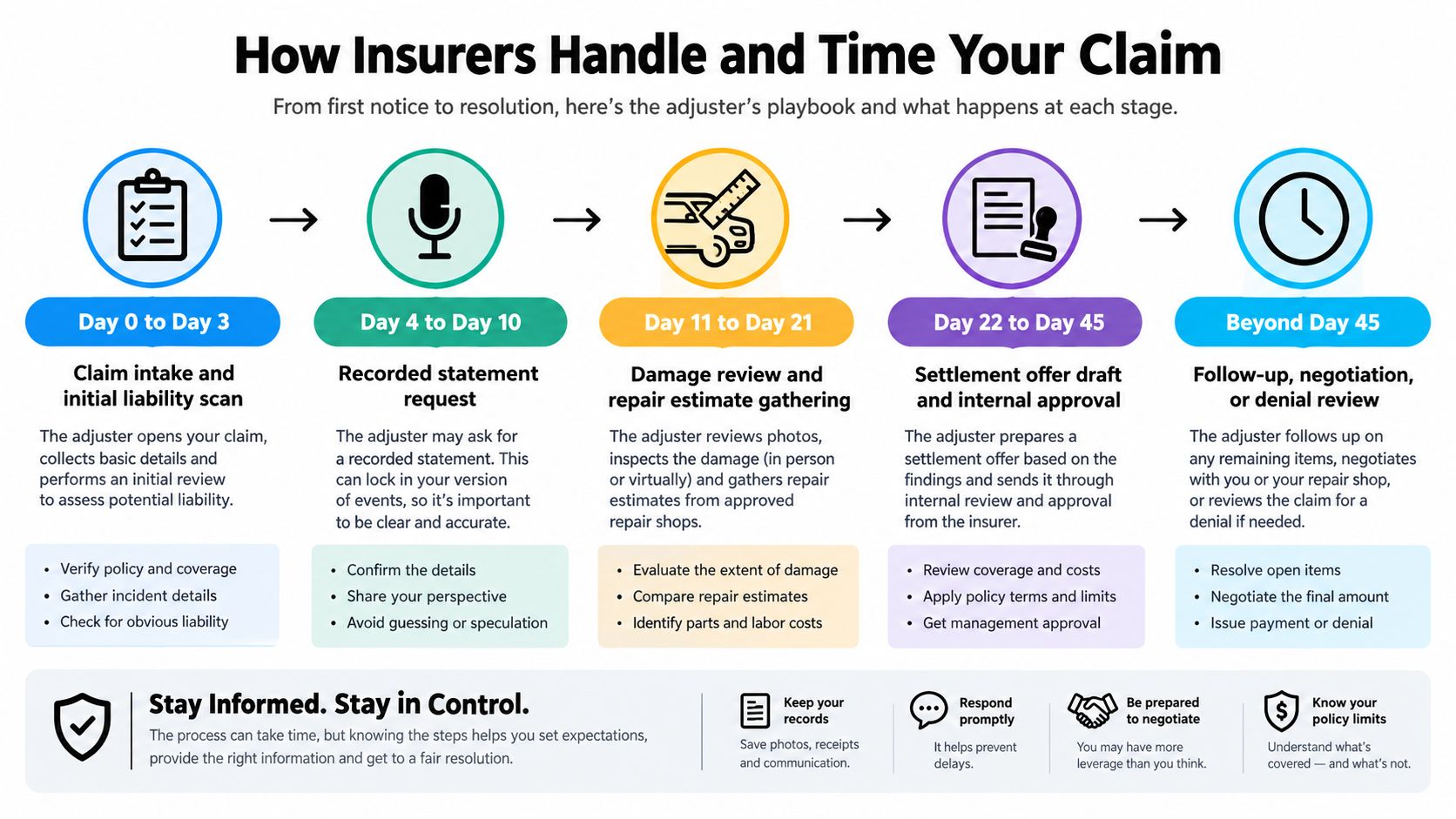
Understand How Insurers Handle and Time Your Claim
An adjuster's job is to investigate the claim and evaluate what the insurer should pay under the available coverage. The adjuster may ask for a recorded statement, medical information, or documentation of your losses. Answer questions accurately, but don't guess about speed, distance, fault, or how badly you'll feel next week. If you don't know, say so.
A recorded statement can lock in an incomplete description before you understand your injuries or the evidence. Broad medical authorization forms can also reach beyond records relevant to the crash. Ask what information the insurer needs, why it's needed, and whether you can provide specific records instead. Keep your communications factual and save the written request and your response.
Track the Colorado claim deadlines
Colorado Revised Statutes section 10-4-642 sets handling timeframes for certain claims. An insurer generally must pay, deny, or settle a clean claim within 30 calendar days after receiving it electronically, or within 45 days if it arrives another way. A claim that isn't clean generally must be handled within 90 days, subject to exceptions. If an incomplete investigation requires more time, the statute permits an extension to as much as 180 days, with a letter explaining the delay due within 30 days and every 30 days afterward. Read the Colorado claim-handling statute for the exact language and exceptions.
These are claim-handling checkpoints, not a guarantee that the insurer will accept your demand or pay the amount you requested. Submit a complete claim, preserve proof of delivery, calendar the applicable dates, and request a written explanation if the insurer says the investigation needs more time. A denial must identify the specific policy provision, condition, or exclusion it relies on.
When you're tracking a claim and its paperwork, a clear process matters as much as a clear message. For a separate example of organized claim steps, this powerchair claim process without stress provides useful process-oriented context, though it addresses a different kind of claim.
Build and Send a Demand Package That Gets Read
Your demand package should make the insurer's review easier, not bury the important evidence under an emotional narrative. Lead with what happened, why you believe the other driver is responsible, what losses followed, and which documents support each point.
Assemble one coherent submission
Include a concise letter and an indexed set of exhibits. The letter should identify the claim, summarize the collision in plain facts, explain the basis for liability, list your damages, and state the amount you're offering to accept to resolve the defined claim. Don't overstate what the crash report proves or claim certainty where the evidence is mixed.
Attach only useful supporting material. A package commonly includes the crash report, relevant photographs, medical records and itemized bills, wage verification, repair estimates, and receipts for related expenses. Put an exhibit label on each attachment and refer to it in the letter, so the adjuster can follow your reasoning without hunting through loose pages.
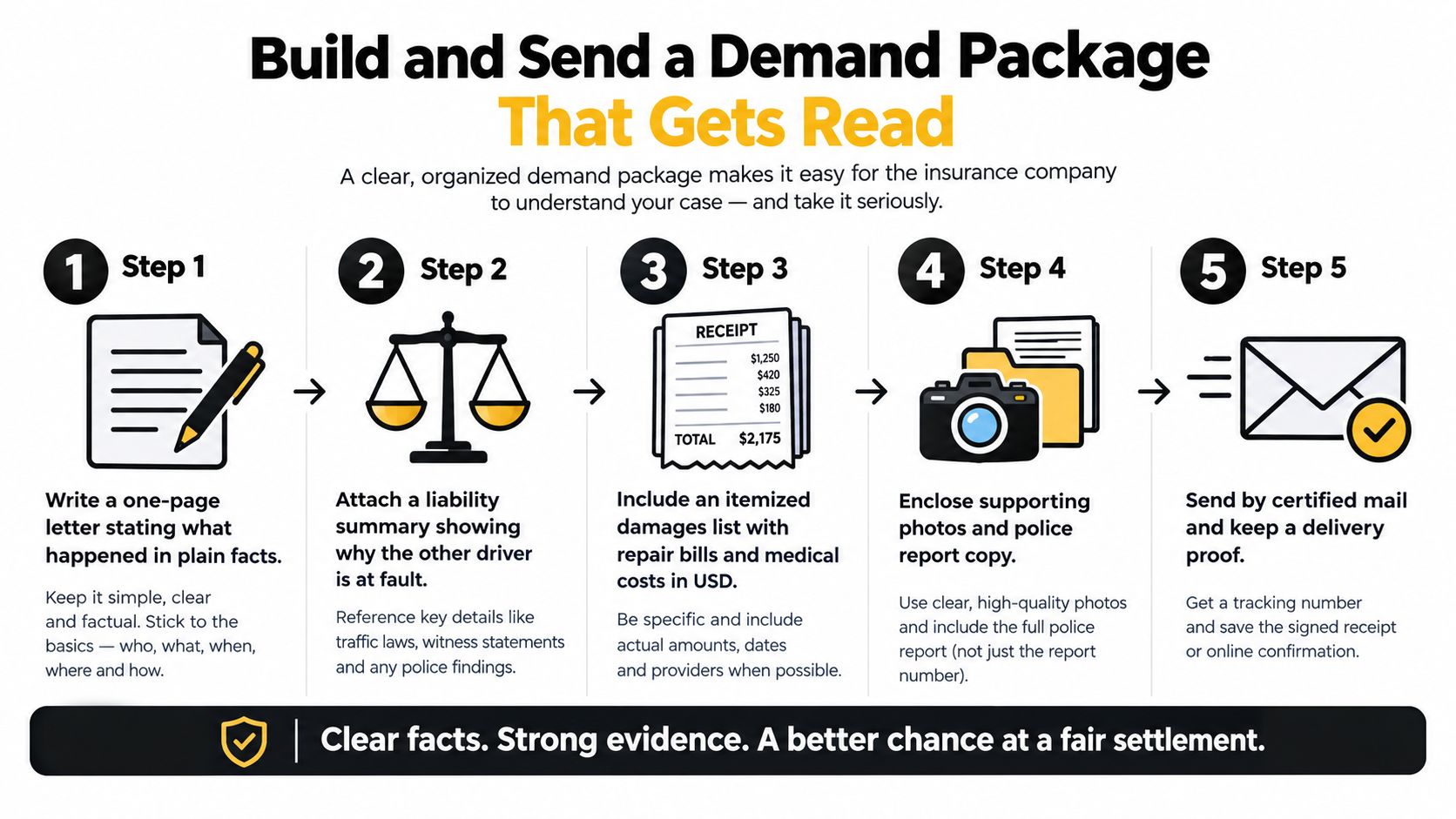
Set a reasonable response deadline and send the package through a method that gives you proof of delivery. Save the exact version you sent, every attachment, and the delivery confirmation. A follow-up should refer to the date sent and ask for a substantive written response, not just confirmation that the insurer has opened a file.
Control what the settlement closes
Make any settlement conditional on a written release that identifies the claims being extinguished. Don't assume a check settles only vehicle damage, or that an adjuster's verbal assurance limits the release. Before signing, clarify medical balances, liens, health-insurance reimbursement rights, future care, and whether other coverage may apply. If those issues remain unresolved, don't accept a broad release as a shortcut to closure.
Professional, concise correspondence helps keep the file readable. If you need a refresher on clear business writing, this guide to crafting better business emails offers practical communication tips. For a more specific look at demand-letter structure, consult this resource on writing a settlement demand letter.
Negotiate Using Anchored Numbers, Not Frustration
A strong negotiation is a documented exchange. “Your offer is unfair” gives the adjuster little to evaluate. “Your offer excludes this itemized bill and these documented wage losses” identifies a concrete issue the insurer must address.

Make every counteroffer explain its math
Compare the insurer's offer with your documented damages. If the adjuster disputes a bill, lost income, or the link between treatment and the collision, ask for the specific reason and the records supporting the insurer's position. Then respond to the disputed point with evidence, not anger.
Don't choose a demand by adding a made-up cushion or aiming for an online multiplier. Start with a defensible amount based on your documented losses and supported non-economic harm. If you're willing to negotiate, decide in advance what you're prepared to accept, while accounting for unpaid medical balances and any other obligations that could reduce what you keep.
Useful response: “Please identify the items you excluded and explain the records or policy language you relied on. I'll review your written explanation and respond with any additional documentation.”
If treatment is still ongoing, don't let an adjuster's description of the injury as minor turn uncertainty into a final valuation. Tell the adjuster you're not ready to resolve the bodily-injury claim while the medical picture remains incomplete. Keep the discussion focused on the current record, and don't promise that you'll never seek further care.
When negotiations stall, ask whether a supervisor can review the valuation and use the insurer's internal complaint or review process. You can also contact the Colorado Division of Insurance about claim handling, though the agency can review compliance and investigate concerns, not negotiate your settlement for you. Keep the tone civil, but don't mistake politeness for agreement.
For a clearer look at how a recorded conversation can shape a claim, watch this explainer before you agree to discuss your case on camera.
A verbal “we'll take care of it” isn't a settlement term. Put important promises, counteroffers, and reasons for reductions in writing, and don't sign a release until its scope matches what you intend to settle.
Recognize When to Stop and Hire an Attorney
Handling a claim alone is not automatically cheaper. The savings disappear if you sign away future medical costs, overlook another source of insurance, or miss a notice deadline that applies to your case. The hardest cases aren't claims with a large number attached. They're claims where key facts or future consequences remain unknown.
Get legal advice before settling if fault is disputed, a commercial or government vehicle is involved, several vehicles or insurers may share responsibility, or you have a serious or evolving injury. Traumatic brain symptoms, surgery, possible permanent impairment, extended wage loss, a fatal crash, or an injured minor are also reasons to stop treating the case as routine. If the available policy limits may not cover the loss, find out what other coverage could apply before signing anything.
Don't sign a global release to solve a problem you haven't identified. A release can extinguish claims beyond the bill or repair dispute you were focused on.
Deadlines don't collapse into one universal date. Colorado examples in a consumer resource note that claims involving government entities can require written notice within 182 days, while bodily-injury, property-damage, wrongful-death, and uninsured-motorist claims may follow different limitation rules. Review that Colorado overview of accident deadlines and claim types carefully, and don't assume an insurance negotiation pauses a legal deadline.
Ask a lawyer to review the deadline, coverage layers, medical balances, and proposed release before you commit. This resource on whether it's worth getting an attorney for a car accident can help you assess when the risk of going alone outweighs the appeal of avoiding legal fees.
If you're weighing a DIY settlement against unresolved injuries, coverage questions, or a release you don't fully understand, Nares Law Group LLC offers free consultations to help identify risks and explain your options. Bring your claim documents and questions, then visit Nares Law Group LLC to request a review before you sign away your rights.