You paid the premium. You reported the accident. You answered the adjuster's questions, attended medical appointments, and submitted the bills. Then the letter arrived: your claim is denied, your injuries aren't related to the crash, or the settlement offer is far below what you need to recover.
That letter can feel like a final judgment. It isn't. An insurer's denial is a position, not a court order. The outcome of an insurance contract dispute usually turns on the policy language, the claim file, the medical record, the timeline, and whether the insurer can defend the way it handled your claim.
The mistake is treating the denial as a conversation you can win by explaining your pain more forcefully. You need a documented case that makes the insurer's interpretation difficult to defend and expensive to maintain.
The Reality of Insurance Contract Disputes
A person can suffer a devastating injury and still receive a carefully worded letter saying the policy doesn't apply. The adjuster may accept that the collision occurred while disputing whether the reported symptoms came from it. The insurer may acknowledge treatment while arguing that the policy limit, applicable coverage, or definition of a covered occurrence doesn't reach the full loss.
That conflict is not unusual. A cross-country study of insurance contract disputes found that the average share of disputed claims was 33% across its sample, with substantial variation among countries, from 5% in Switzerland to 65% in Poland and Turkey. Only 0.12% of those disputed claims became formal legal disputes, according to the underlying study of insurance contract disputes. Most disagreements end through adjustment, negotiation, appraisal, mediation, or other processes before a lawsuit reaches court.
The practical lesson is important. A disputed claim isn't automatically a lawsuit, but it also isn't something you should dismiss as routine paperwork. The insurer is evaluating its exposure while you are trying to pay for treatment, replace lost income, and understand what happened. That imbalance gives the carrier an incentive to test whether you'll accept less than the policy and the facts require.
Practical rule: Treat every denial as evidence that your claim needs a litigation-quality file, not as proof that you aren't entitled to coverage.
Start by separating three questions. What does the policy promise? What facts trigger that promise? And did the insurer investigate those facts fairly before refusing or limiting payment? Those questions are more useful than arguing generally that the claim is “obviously covered.”
Your next move should be disciplined. Preserve the denial letter and every attachment. Request the precise policy provisions the insurer relies on. Ask the adjuster to identify the factual basis for the decision in writing. Don't speculate about fault, minimize your symptoms, or sign a broad release just because the first offer arrives while bills are accumulating.
Insurance contract disputes reward preparation. The carrier may control the claim file at the beginning, but you control your medical records, communications, witness evidence, expense documentation, and the consistency of your account. Build those materials before the insurer's initial position hardens into its litigation narrative.
Why Insurers Deny Valid Injury Claims
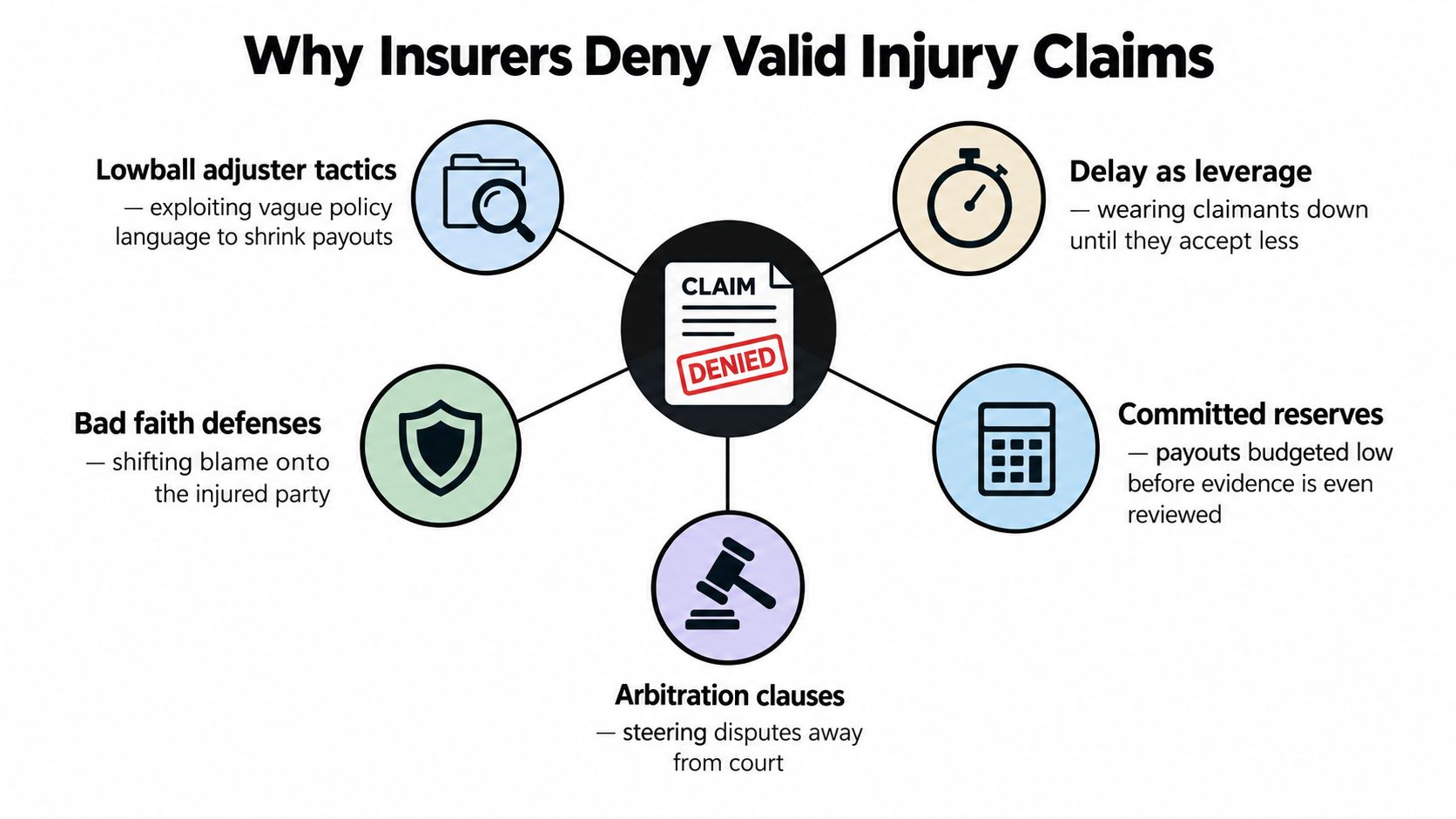
A denial rarely rests on one simple sentence. It usually combines policy interpretation with a factual theory designed to make the loss look outside the coverage grant, unrelated to the accident, too minor to justify the requested compensation, or procedurally defective.
The threshold fight comes first
Many claimants focus on exclusions because the denial letter mentions one. The more consequential question may come earlier: does the loss satisfy the insuring agreement at all? Recent coverage reporting describes insurers increasingly challenging that threshold issue instead of relying only on exclusions. The same reporting identifies recurring disputes over related claims, occurrence counting, and the allocation of policy language across time and conduct in coverage litigation analysis.
That distinction matters in a crash, a construction loss, a business interruption claim, or a professional liability matter. One event may be treated as one occurrence for one policy limit. A series of related acts may be treated as multiple claims under another provision. A symptom that appears after the accident may be characterized as a preexisting condition unless the medical record connects it to the trauma.
Insurers also exploit uncertainty in words such as “arising out of,” “accident,” “occurrence,” “related,” “reasonable,” and “necessary.” The policy may look clear until those terms meet a complicated fact pattern. Your response should force the insurer to identify the exact sentence, definition, and factual assumption supporting its interpretation.
Common denial tactics
- Timeline distortion: The adjuster emphasizes a gap in treatment while ignoring delayed symptoms, changing pain levels, or the time needed to obtain appropriate care.
- Causation attacks: The insurer points to prior medical history without addressing whether the crash aggravated or accelerated the condition.
- Severity minimization: Soft-tissue injuries and traumatic brain injuries can lack dramatic imaging findings, allowing the carrier to argue that the diagnosis doesn't match the claimed limitations.
- Relatedness arguments: The insurer groups separate injuries or losses together to reduce available limits, or separates a connected loss to avoid the relevant coverage.
- Incomplete investigation: The claim decision may overlook witnesses, scene evidence, employment records, or treating-provider opinions that support coverage.
A serious loss can also become entangled with specialized evidence. In a death claim or disputed cause-of-loss investigation, understanding how autopsies aid claim denials can help a family recognize how medical conclusions may be used to challenge causation. That resource is useful for identifying questions to ask, not for replacing an independent review of the records.
Review the insurer's conduct separately from the insurer's conclusion. A carrier can make a defensible mistake after a thorough investigation. Conversely, a plausible-sounding denial can become vulnerable if the adjuster ignored contradictory evidence, shifted explanations, withheld information, or demanded documents without explaining their relevance. Keep a written record and study the insurance company investigation process before you answer substantive questions or authorize broad access to your medical history.
Building an Airtight Evidence File
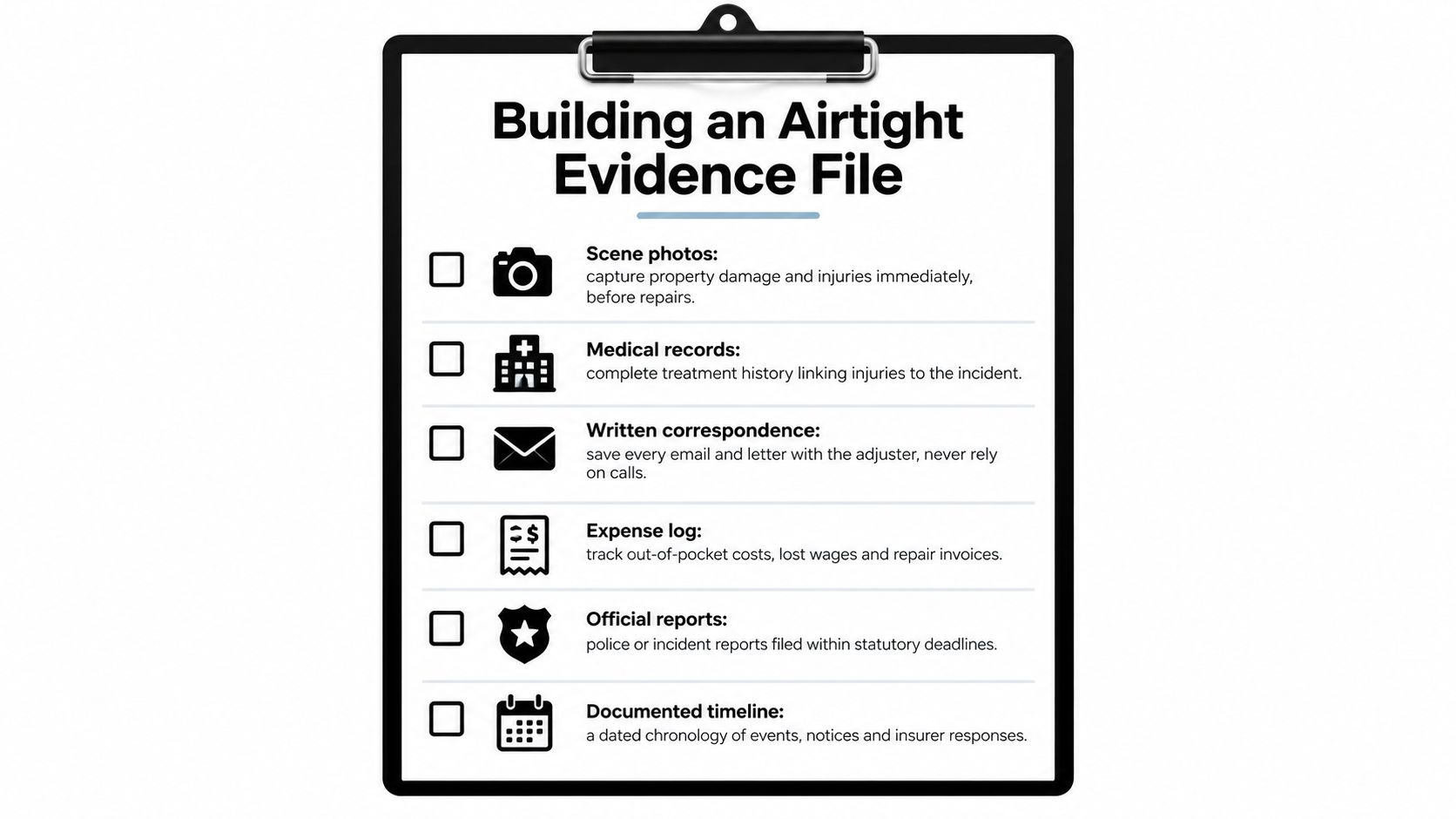
Your evidence file should allow a lawyer, mediator, or jury to understand the loss without relying on your memory alone. Organize it as a chronological record, with the policy and coverage position at the front, followed by incident evidence, medical proof, financial losses, and communications.
Start with the event and the coverage
Save the complete policy, declarations page, endorsements, renewal documents, and every notice related to the claim. Don't rely on a summary from an online account. An endorsement can alter a definition, add a condition, change an exclusion, or affect uninsured and underinsured motorist coverage.
Create a dated incident record while details remain available. Include where the event occurred, what you observed, when symptoms began, who was present, and every notice you gave to an insurer, employer, medical provider, or public agency. Obtain the official crash or incident report, but don't assume it contains the full story. Photographs, vehicle data, property damage, surveillance footage, and witness statements can fill important gaps.
Preserve physical evidence before it disappears. Don't authorize repairs, discard damaged equipment, or alter relevant digital records without considering whether the item may prove impact, defect, severity, or causation. Ask witnesses for written accounts in their own words, including their contact information and what they personally saw.
Connect treatment to the injury
Medical records must do more than show that you attended appointments. They should establish the sequence from the incident to the symptoms, diagnosis, treatment, restrictions, and prognosis. Tell providers accurately what happened, what changed afterward, and which activities you can no longer perform. Don't exaggerate, but don't omit symptoms because they appeared gradually or because the first emergency evaluation was limited.
Request complete records, including emergency notes, imaging, specialist assessments, therapy notes, prescriptions, work restrictions, and billing statements. A traumatic brain injury or spinal condition may require careful documentation of cognitive problems, sleep disruption, headaches, balance issues, pain, and functional changes. The carrier will look for inconsistencies. Your best protection is a consistent, medically supported account.
Build a damages ledger as treatment continues:
- Economic losses: Record medical charges, co-pays, medication costs, transportation, replacement services, property damage, and other out-of-pocket expenses.
- Income effects: Preserve pay records, employer communications, missed-work documentation, reduced-duty notices, and evidence of lost opportunities.
- Future needs: Ask appropriate medical professionals to explain ongoing treatment, rehabilitation, restrictions, or assistance the injury may require.
- Life impact: Keep a private daily log describing pain, sleep, household limitations, family responsibilities, recreation, and cognitive or emotional effects.
The ledger isn't a diary written for sympathy. It is a contemporaneous record that helps connect the injury to measurable consequences.
Use written correspondence whenever possible. After a phone call, send a brief email confirming what was discussed and what the adjuster requested. Label files by date and category, back them up securely, and never edit an original photograph or document without preserving the original version.
Here is a short video that can help you think through the practical organization of an insurance claim file:
Before sending a demand, compare every factual statement against the records. A single inaccurate date can give an adjuster an argument about credibility. A complete, internally consistent file makes it harder to reduce a serious injury to a few bills and a conclusory medical note.
Leveraging Bad Faith and Legal Standards
A denied claim and a bad-faith claim are related, but they aren't the same case. The coverage dispute asks whether the policy requires payment. Bad faith examines the insurer's conduct, including whether it had a reasonable basis, investigated fairly, handled evidence fairly, and communicated its position consistently.
That difference changes strategy. Don't accuse the adjuster of bad faith merely because the carrier disagrees with you. Instead, preserve the facts that may support the accusation: unexplained delays, shifting denial reasons, ignored medical opinions, selective use of records, failure to interview obvious witnesses, or a refusal to explain how the policy language applies.
Contract damages and extra-contractual leverage
Empirical work involving closed first-party auto claims from more than 60 insurers across 38 jurisdictions found that states permitting tort actions for insurer bad faith were associated with significantly higher claim payments. A separate analysis of first-party automobile claims from 38 states also found a positive correlation between a bad-faith remedy and higher settlement payments, as described in the study of bad-faith remedies and settlement payments.
The point isn't that mentioning bad faith automatically increases an offer. It doesn't. The advantage comes from proving that the insurer faced credible exposure beyond the underlying contract amount. A well-supported bad-faith theory can force the carrier to evaluate the claim-handling process, not just its preferred valuation of your injury.
Remedies vary sharply by state and by the type of claim. Some jurisdictions permit statutory remedies, interest, attorney fees, or punitive damages in appropriate circumstances. Others impose demanding standards, distinguish first-party from third-party claims, or limit recovery through procedural rules. Colorado, Texas, and New York don't offer a single interchangeable rulebook, so online generalizations are dangerous.
A coverage disagreement may be resolved by policy interpretation. A reckless investigation can create a separate problem for the insurer.
Build the record before making the accusation
Request the insurer's written coverage position and identify every reason given. Compare the first explanation with later explanations. Preserve requests for documents, responses, unanswered correspondence, reservation-of-rights letters, payment calculations, and any material the carrier says it relied on.
Use legal research carefully. Tools offering case law insights from AI can help locate decisions and surface issues for discussion, but they aren't a substitute for jurisdiction-specific legal analysis, procedural advice, or review by a licensed attorney. The controlling question is always how the applicable law treats the particular policy, claim type, conduct, and requested remedy.
Don't threaten a bad-faith action before you know the legal elements and the evidence available. A premature accusation can harden the insurer's posture and distract from the coverage record. A precise demand, tied to policy language, medical proof, claim-file conduct, and applicable law, gives your counsel a stronger platform for negotiation or litigation.
Navigating the Claims and Litigation Timeline
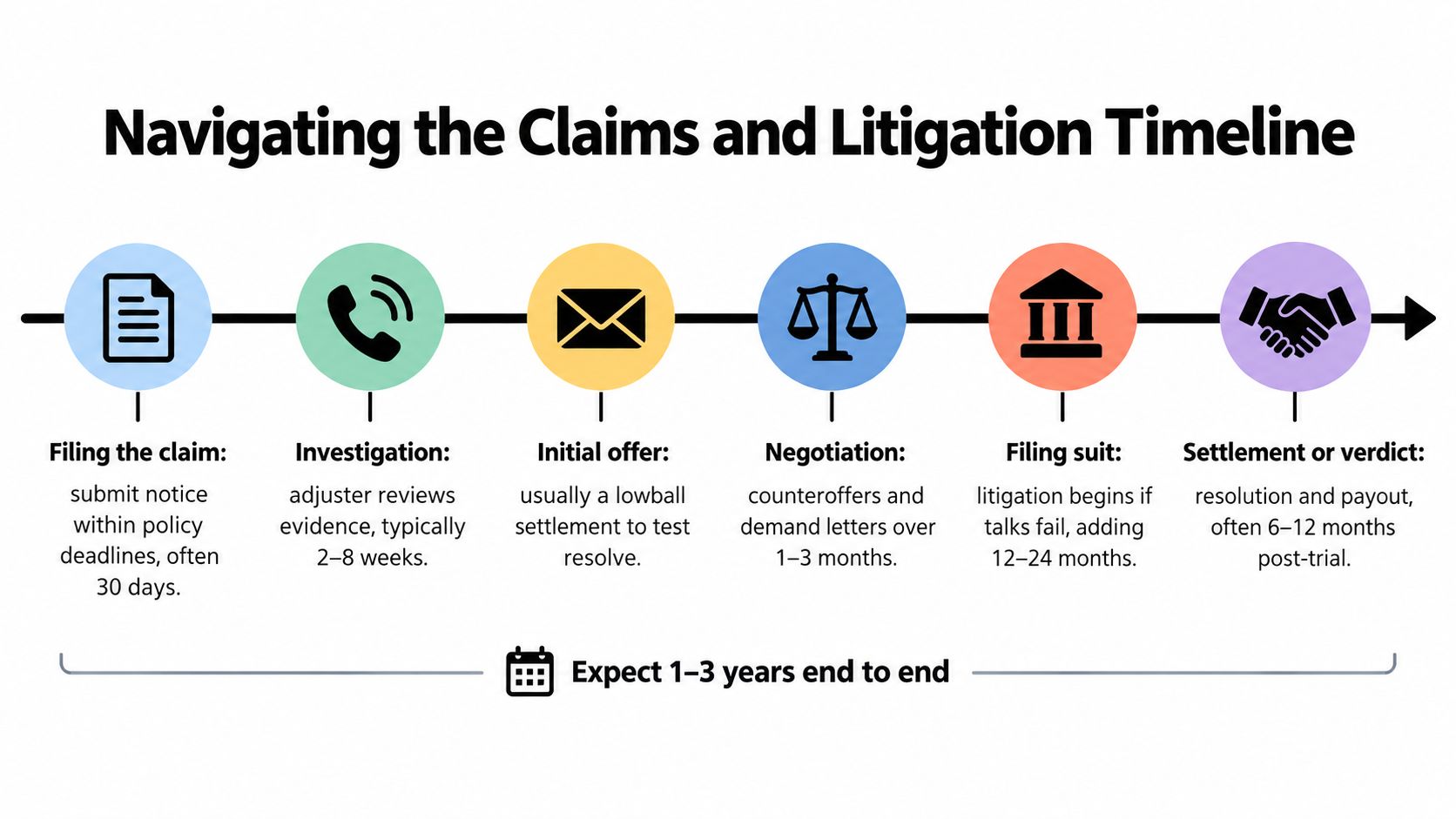
A disputed claim moves through several possible tracks, and each track serves a different purpose. An internal appeal asks the insurer to reconsider its own decision. A regulatory complaint brings the department of insurance into the picture. A civil lawsuit creates discovery powers, judicial deadlines, and the possibility of a binding judgment.
Choose the forum based on the problem
An internal appeal is often the least expensive first step, particularly when the denial rests on missing records, an incorrect date, or a misunderstanding that can be corrected. Send a focused packet. Include the relevant policy text, a concise chronology, medical support, disputed calculations, and a specific request for reconsideration. Don't send an unorganized document dump.
A complaint to the state insurance department can create regulatory attention and may reveal whether the carrier followed applicable claims-handling requirements. It generally isn't a substitute for a lawsuit, doesn't decide every coverage question, and may not recover the full value of an injury. It can still be useful when the insurer refuses to explain its position or fails to respond appropriately.
Litigation becomes necessary when the carrier won't pay a defensible value, the coverage issue requires court interpretation, evidence must be compelled, or the limitations deadline is approaching. The complaint begins the case, but discovery is where the parties test the insurer's interpretation, claim file, witnesses, experts, and damages evidence. Mediation can resolve the case without trial, but it works best when your file demonstrates that you can prove the claim.
| Avenue | Best use | Main limitation |
|---|---|---|
| Internal appeal | Correcting factual errors and supplying overlooked documents | The insurer remains the decision-maker |
| Regulatory complaint | Raising claims-handling concerns and seeking an agency response | The agency may not determine full private damages |
| Civil litigation | Obtaining discovery and pursuing a binding remedy | It requires time, cost, preparation, and procedural compliance |
Never let negotiations distract you from the statute of limitations. The deadline may differ for personal injury, breach of contract, uninsured motorist benefits, and statutory claims. The policy may also impose notice and proof requirements. Get the deadlines evaluated by counsel early, then calendar them in writing.
For practical guidance on preserving your position and organizing a challenge, review this resource on how to dispute an insurance claim. The right path depends on the policy, the state, the injury, the available evidence, and whether the insurer is negotiating in good faith.
When to Bring in a Trial-Tested Attorney
You don't need a lawyer for every minor disagreement. You do need one when the insurer has a legal team, a disputed coverage interpretation, substantial medical exposure, or a strategy designed to make you prove the case while you are still recovering.
Bring in counsel promptly if the adjuster asks for a recorded statement before you've reviewed the policy and facts. The same is true if the carrier requests a broad medical authorization, disputes causation, blames a preexisting condition, questions a traumatic brain injury, offers a release before treatment is complete, or says your damages exceed the available coverage. A denial involving a truck collision, wrongful death, serious brain injury, or disputed UM or UIM benefits should not be handled as a routine customer-service problem.
Recognize the inflection point
The clearest warning signs include:
- A shifting explanation: The insurer gives one reason for denial and later relies on another.
- A compressed settlement window: The adjuster pressures you to accept before the medical picture or future losses are known.
- A policy-language dispute: The carrier argues over occurrence, related claims, exclusions, limits, or whether the loss falls within the coverage grant.
- A credibility attack: The insurer uses a treatment gap, prior condition, or ordinary symptom fluctuation to reject the entire injury.
- A serious imbalance: The opposing carrier has assigned counsel, claims specialists, medical reviewers, and litigation experience while you are managing pain and bills alone.
A trial lawyer changes the workflow. Counsel can preserve evidence, control communications, analyze every applicable policy, coordinate medical documentation, calculate future losses, retain accident reconstruction or medical experts, and prepare the case for a jury rather than an adjuster's spreadsheet. That preparation often improves negotiations because the insurer sees a claimant who can prove the facts and survive a denial.
Contingency representation can also change access to the process. In an appropriate case, the law firm advances litigation expenses and receives a fee only if the matter produces a recovery, subject to the written fee agreement. Ask what costs are advanced, how expenses are handled, whether co-counsel may be involved, and who makes settlement decisions.
Law firms also use administrative support to manage records, calendars, medical bills, and communications. If you're evaluating staffing models, information about the cost of hiring legal virtual assistants may explain how firms organize routine work, but administrative help isn't a substitute for legal judgment or trial preparation.
For injured people confronting a serious denial, an insurance dispute attorney should review the policy and claim file before you sign a release or make a recorded statement. The best time to involve counsel is before an avoidable admission, missed deadline, or incomplete demand narrows your options.
Securing Your Future and Holding Insurers Accountable
Insurance contract disputes are won through control of the record. Preserve the policy. Document the event. Connect treatment to the injury. Track every economic and personal consequence. Demand a written explanation that identifies the policy language and facts supporting the denial.
Then evaluate the insurer's conduct on its own terms. A carrier may dispute value without acting unlawfully, but it can't erase contradictory evidence, change its rationale without explanation, or use delay to pressure an exhausted claimant without creating risk. The claim file should show what the insurer knew, when it knew it, and why it made each decision.
Commercial coverage litigation reinforces the stakes. In 2024, more than 3,000 business liability coverage lawsuits were filed in U.S. federal district courts, the highest annual count since 2010, while more than 650 business-interruption coverage suits were filed, a level more than 50% above any year from 2009 to 2019, according to Lex Machina's analysis of insurance coverage disputes. Those figures concern commercial claims, but they illustrate the broader point: policy wording becomes decisive when losses are large and the parties disagree about what the contract covers.
You don't have to accept confusion as the price of making a claim. Get the denial reviewed, protect the deadlines, and escalate when the evidence and law justify it.
Nares Law Group LLC helps injured people evaluate denied or undervalued insurance claims, document medical and financial losses, and pursue compensation after motor vehicle crashes, truck wrecks, traumatic brain injuries, and wrongful death. Visit Nares Law Group LLC to request a free consultation and discuss your insurance contract dispute with a dedicated legal team.