You're sitting at the kitchen table with medical bills arriving, work already missed, and an insurance letter that says your claim is denied or worth far less than the injury demands. The adjuster may sound certain, but a denial is a position, not a court judgment. The practical question is how to dispute an insurance claim without losing time, evidence, or negotiating power.
After years of handling injury claims in Colorado, the pattern is familiar. People often send an emotional email, repeat the same facts, and wait for the insurer to reconsider. That rarely changes the file. A stronger approach identifies the exact reason for the decision, answers it with organized proof, creates a documented deadline, and escalates when the insurer keeps delaying instead of deciding.
Why Insurance Claims Get Denied After an Injury
After a crash, an adjuster may initially sound helpful. Then the insurer receives medical records, a police report, or a demand for payment, and the position changes. The carrier may say the injury was preexisting, the treatment wasn't caused by the collision, the policy doesn't cover the loss, or the documentation doesn't establish the amount claimed. You're left wondering whether the decision is final.
It usually isn't. Insurance disputes are common enough that regulators in multiple markets formally track complaints, claim outcomes, and challenges to insurer decisions. Australia's MoneySmart comparison tool, for example, presents dispute rates per 100,000 lives insured alongside claim acceptance rates and claim duration, allowing consumers to compare insurers using standardized information (Australian MoneySmart life insurance claims comparison tool). Michigan's insurance regulator also tracks complaints involving auto, health, life, and homeowners insurance. In Hong Kong, the Insurance Complaints Bureau recorded 782 cases in 2017, with 559 remaining after jurisdictional screening, and identified disputes involving policy terms, non-disclosure, exclusions, indemnity amounts, and policy conditions as major categories (MoneySmart's claims comparison resource).

The reason matters more than the tone
Common dispute categories include:
- Coverage interpretation: The insurer says the policy excludes the loss or defines it differently.
- Causation: The carrier argues the crash didn't cause the injury or that another condition explains the symptoms.
- Non-disclosure or inaccurate information: The insurer relies on information it says was omitted or misstated.
- Excluded items: Specific treatment, property damage, or losses are treated as outside the policy.
- Valuation: The insurer accepts some responsibility but disputes the amount of medical expense, wage loss, or other damages.
Don't start by arguing that the insurer is unfair. First, identify the sentence that explains why it says no. The carrier's stated reason determines what evidence can move the decision.
An insurer's investigation can also shape the outcome before you ever receive a denial, so preserve communications and understand what information has been requested through resources such as this insurance company investigation guide. Your job is to replace a vague rejection with a precise disagreement that can be reviewed by a supervisor, regulator, or attorney.
How to Read Your Denial Letter and Find Your Next Step
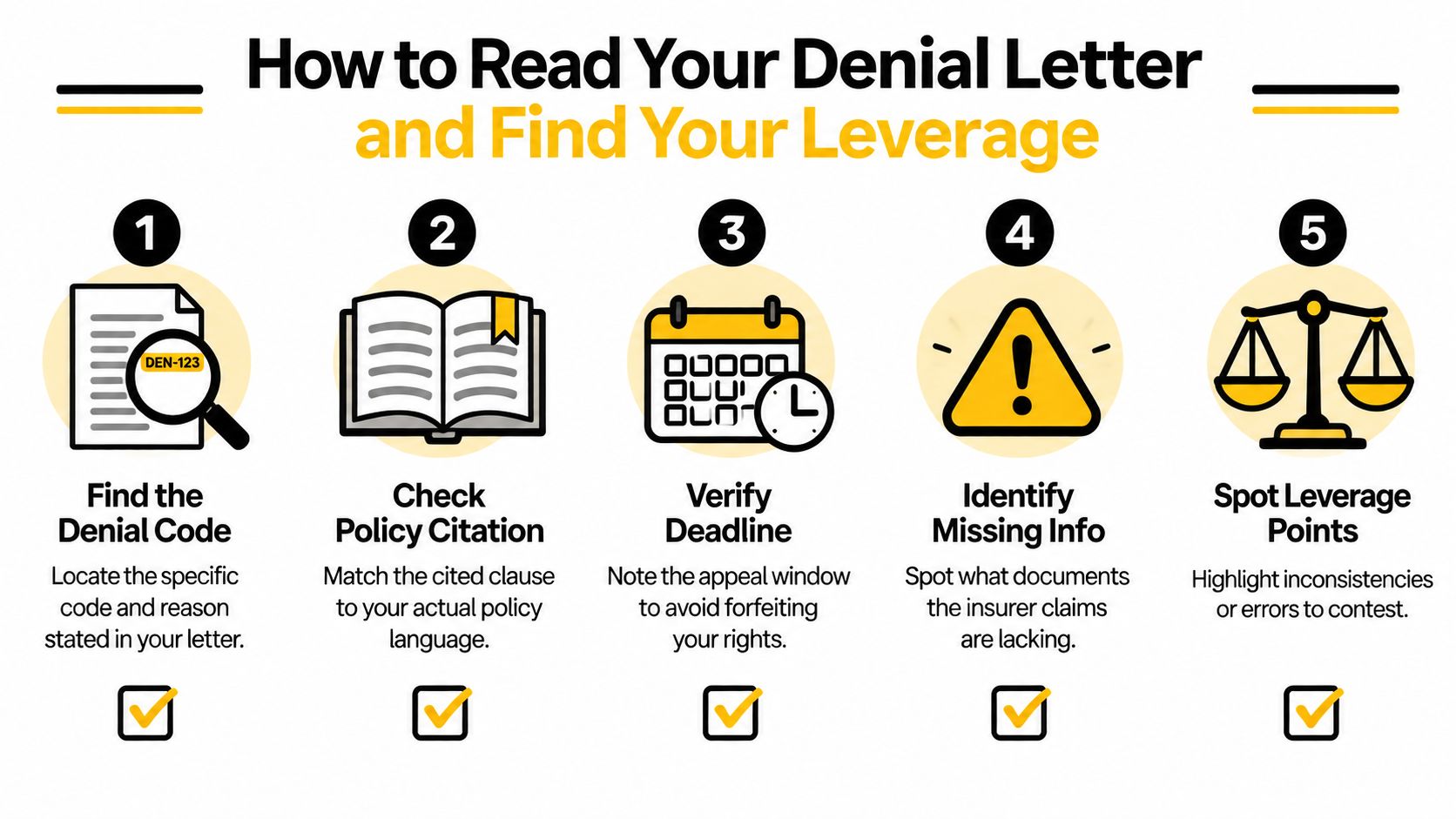
A denial letter can arrive while medical bills are mounting and the appeal clock is already running. Read it with a highlighter and a calendar beside you. Treat it as a working document that identifies the insurer's theory, the policy language it relies on, and the information it says is missing.
Confirm the claim number, denial date, and coverage line first. Then locate the denial code or stated reason. If the letter says only “insufficient evidence,” review the surrounding paragraphs, attachments, explanation of benefits, and adjuster notes. Those materials often show which fact or record the insurer believes is lacking.
Build a one-page dispute map
Use five columns:
- Stated reason: Copy the insurer's wording accurately.
- Policy provision: Record the section, definition, exclusion, or endorsement cited.
- Factual assumption: State what the insurer believes happened.
- Contrary evidence: List the record, photograph, witness, bill, or expert opinion that addresses that assumption.
- Deadline and requested action: Note the appeal date and whether you want payment, reconsideration, correction, or a written explanation.
The map separates three different disputes. A coverage interpretation dispute turns on policy language and definitions. A factual dispute requires proof about the crash, injury, treatment, or responsibility. A valuation dispute requires support for the amount, including itemized bills, wage records, repair estimates, or medical documentation.
Practical rule: Send a document because it answers a stated reason for denial, not merely because it relates to the accident.
Request the complete policy, declarations, endorsements, and relevant claim materials if you do not have them. If the dispute involves a medical provider's eligibility, billing information, or coverage verification, an insurance verification service may help organize the administrative record. It does not replace legal analysis of coverage or causation. The denial's deadline still controls, so preserve your challenge in writing before that date and make the insurer respond to a defined basis for review.
Gathering Evidence That Directly Answers the Denial
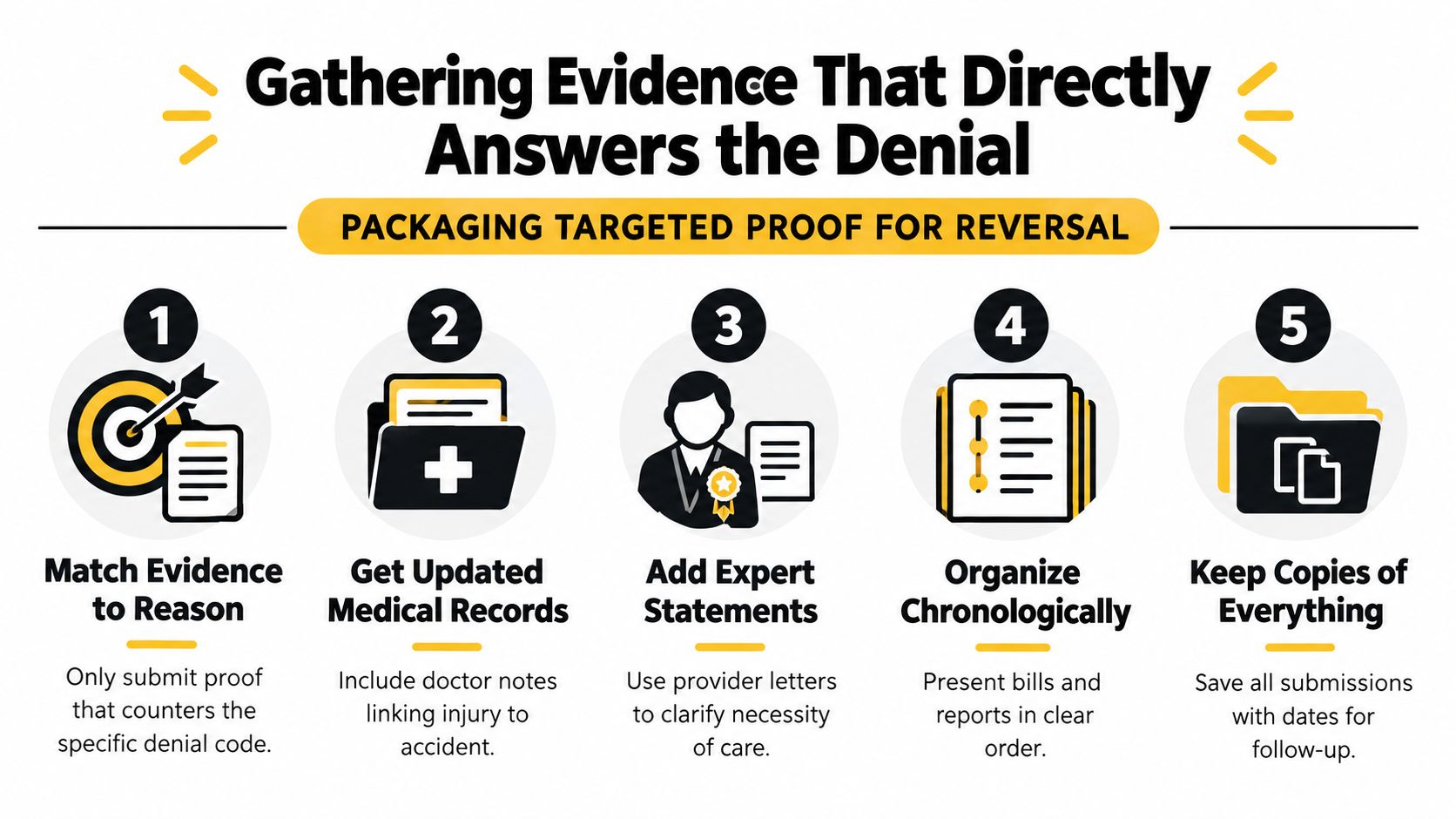
A thick file isn't automatically a strong file. Adjusters need to see why each document defeats the stated reason for denial. Sending the same records again with a more forceful subject line usually doesn't work. The better method is to create an indexed packet that lets the reviewer match each argument to proof.
Match the packet to the insurer's theory
If the insurer says the injury wasn't caused by the crash, collect the first medical presentation, diagnostic testing, treatment notes, and a focused provider statement explaining the relationship between the collision and the condition. If the carrier claims treatment wasn't necessary, ask the treating provider to address diagnosis, symptoms, objective findings, recommended care, and why the care relates to the accident.
For a liability disagreement, use the police report, photographs, vehicle damage, witness information, available video, and a clear chronology. For lost income, gather employer verification, payroll records, tax materials, schedules, and a physician's restrictions. For a low valuation, organize itemized bills, repair estimates, invoices, and records showing the effect of the injury on daily activities.
Package evidence so a reviewer can act
A useful packet often follows this order:
- Cover page: Claim number, policyholder, loss date, denial date, and requested result.
- Issue chart: Each denial reason paired with your response.
- Chronology: Crash, symptoms, treatment, work restrictions, and communications in date order.
- Medical section: Records and a targeted causation or necessity letter.
- Loss section: Bills, wage documentation, photographs, estimates, and functional limitations.
- Communication log: Calls, emails, requests for records, and delivery confirmations.
Keep the original records and submit copies unless the insurer specifically requires otherwise. Learn the basics of admissibility of documentary evidence, especially when records may later be used in litigation. A document's existence isn't enough. Its source, completeness, accuracy, and connection to the disputed issue can all matter.
Colorado injury claims also benefit from consistent treatment and honest reporting. Tell providers how symptoms affect sleep, driving, lifting, concentration, household tasks, and work. Don't exaggerate, but don't minimize the injury because you're trying to sound tough. A clean medical and functional record gives the insurer less room to characterize the claim as unsupported.
For help obtaining records, use this practical guide on how to obtain medical records. Request complete files, not only billing summaries, and keep a dated copy of everything sent.
Writing a Dispute Letter That Gets a Real Review
A dispute letter should be short enough to read quickly and detailed enough to preserve the issue. It isn't a personal essay, a threat, or a transcript of every frustrating conversation. It should identify the decision, explain the error, connect the correction to the policy, and list the evidence enclosed.

Use this structure:
Re: Formal appeal of claim [claim number], policy [policy number], loss date [date]
I appeal the denial dated [date]. The letter states that [accurately summarize or quote the reason]. That conclusion is incorrect because [state the specific factual or policy error]. The enclosed documents address this issue as follows: [list each document and what it proves]. Please reopen the claim, complete a written review, and provide a written decision identifying the policy basis for any continued denial.
Add the sender's contact information, the claim number on every page, and a numbered exhibit list. If the denial doesn't explain the basis clearly, request the written rationale before or alongside the appeal. Don't let a phone representative's informal explanation replace the formal record.
Keep the language firm and usable
Use phrases such as:
- “The cited exclusion does not apply because…”
- “The enclosed record directly addresses…”
- “Please identify the specific policy language supporting your position.”
- “Please confirm receipt and provide the applicable decision timeline.”
Avoid insults, accusations you can't prove, and statements that create unnecessary admissions. “You're stealing from me” gives the reviewer nothing to analyze. “Your letter does not address the attached physician statement” identifies a correctable failure.
Submit through the method required by the policy or plan. Keep the complete submission, attachments, delivery confirmation, portal receipt, and screenshots. A well-organized settlement demand letter can be useful in a bodily injury claim, but an appeal should still track the insurer's denial reason rather than state a settlement number.
A recorded delivery trail matters because deadlines and receipt disputes can become separate issues. This video offers another practical explanation of the communication and documentation process:
Timelines Appeals and What to Do When the Insurer Delays
The dispute process should produce decisions, not an endless cycle of “send one more document.” Start with the insurer's written appeal procedure and the deadline printed in the denial or plan materials. For a health claim, determine whether the next step is an internal appeal, an external review, or both. For an auto injury claim in Colorado, preserve the liability and damages record while requesting a clear written position from the responsible carrier.
Under-appealing is a serious practical problem. In U.S. ACA marketplace plans, insurers denied 19% of in-network claims in 2024, while consumers appealed fewer than 1% of those denials. When appeals were filed, insurers upheld 66% of them, and external appeals represented 4% of upheld internal appeals (Claims Journal reporting on ACA claim denials and appeals). The lesson isn't that every appeal succeeds. It's that many denials never receive a substantive challenge.
Use a written escalation ladder
- Request the rationale: Ask for the exact policy basis, factual assumptions, missing documents, and appeal deadline.
- File the internal appeal: Submit the targeted packet before the deadline and keep proof of receipt.
- Ask for a status date: Request confirmation of who is reviewing the file and when a written decision will issue.
- Escalate externally: Use the appropriate state regulator, external review process, ombudsman, or contractual procedure for the policy type.
- Consult counsel: Consider legal advice before signing a release, accepting a final settlement, or allowing a limitation period to approach.
Log every call with the date, representative, subject, promise, and next action. After a call, send a short email confirming what was discussed. If the insurer keeps requesting documents, ask why each item is necessary, whether the file is otherwise complete, and what decision will follow receipt.
Delay can become the dispute itself. Ireland's Financial Services and Pensions Ombudsman reported 2,142 insurance complaints in 2025, including 553 claims-handling complaints and 481 claim-rejection complaints. The same report states that 41% of closed complaints were resolved through mediation (Kennedys' discussion of the 2025 FSPO complaint data). Mediation can help, but it shouldn't become a substitute for a clear coverage position. Ask for a defined process, preserve the paper trail, and escalate through the available complaint channel when the carrier won't provide one.
When to Handle the Dispute Yourself and When to Call an Attorney
A straightforward valuation disagreement may be manageable when the coverage is clear, the injury is well documented, and the insurer explains exactly what it needs. A targeted packet with medical records, wage support, photographs, and a focused explanation can resolve an administrative problem without litigation.
Get legal advice sooner when the insurer disputes causation, relies on an exclusion, raises comparative fault, involves multiple policies, or requests a broad recorded statement or release. Complex coverage disputes are becoming more technical. Lex Machina's 2025 Insurance Litigation Report identified more than 3,000 business-liability coverage lawsuits and over 3,500 homeowners-policy disputes filed in 2024, while also noting continuing disputes involving business interruption and emerging AI and ESG liabilities (Lex Machina's 2025 Insurance Litigation Report). Generic appeal templates won't resolve a policy interpretation fight.
A Colorado personal injury attorney can investigate the crash, coordinate medical records, evaluate causation, calculate losses, negotiate with carriers, and prepare the case for litigation when negotiation fails. Nares Law Group LLC handles those phases for injured people and families, including cases involving motor vehicle crashes, truck wrecks, traumatic brain injuries, and wrongful death. A consultation can help determine whether the insurer's position is a documentation problem, a negotiation position, or a dispute requiring formal legal action.
Appealing is worth serious consideration. A New York study linked to JAMA found that the share of insurance denials overturned after appeal rose from 38% in 2019 to almost 53% in 2025, showing why the first answer shouldn't automatically control the final outcome (Healthcare Dive's report on the New York insurance-denial study). The right next step is the one that protects your deadline and creates influence.
If an insurer has denied, delayed, or undervalued your Colorado injury claim, Nares Law Group LLC can review the denial, organize the evidence, and help pursue a documented decision. Visit the firm to request a consultation before signing a release or letting an appeal deadline pass.