Three days after an adjuster promised a settlement figure, the phone rings. You're still in a neck brace, medical bills are arriving, and you've started counting on that money to replace missed wages. The same adjuster now says the offer is off the table. Same crash, same injuries, same claim, different answer.
So, can an insurance company rescind a settlement offer? Sometimes, but “rescission” is often the wrong word. The legal answer depends on whether the insurer merely withdrew an open offer, whether you accepted it, and whether anyone signed a release. Those moments carry different rules, different evidence, and different risks.
Claims now move through increasingly complex intake systems, so keeping every communication organized matters. A resource on AI for insurance claim intake can help explain how claim information is collected and processed, but technology doesn't decide whether a settlement became binding. Contract formation does.
When the Insurer Calls Back to Take Back an Offer
The adjuster's call can feel like a broken promise. You may have postponed treatment decisions, told your employer you expected funds, or declined another option because the insurer represented that the claim was close to resolution. When that number disappears, the financial pressure becomes immediate.
The first question isn't whether the adjuster acted unfairly. It's what exactly happened before the call. Did the insurer send a written offer with conditions? Did you accept it before the withdrawal? Did the adjuster require a signed release? Did you sign one? Each answer places the claim at a different legal point.
The offer may not be the settlement
In many major U.S. jurisdictions, an insurer's offer generally remains revocable until the claimant accepts it. A settlement is ordinarily treated as a contract requiring an offer, acceptance, and a signed release before it becomes binding. Florida's civil settlement statute allows an offer to be withdrawn in writing before written acceptance is filed, and the withdrawal makes the offer void. Courts and practitioner summaries in New York and Missouri describe the same basic distinction, before acceptance, withdrawal is generally possible; after acceptance and a release, enforcement is usually available. (JRJ Law explains the limited ability to rescind an accident settlement.)
That doesn't mean an insurer gets unlimited freedom to manipulate the process. It means a promised figure may still be only a proposal. A phone call saying “we can offer this amount” isn't automatically the same as a completed contract.
Practical rule: Treat every settlement conversation as unfinished until the acceptance terms and release requirements are clear in writing.
The rest of the analysis turns on three facts: timing, acceptance, and legal grounds. Before acceptance, the insurer may be able to withdraw. After acceptance, the insurer usually needs a recognized contract defense to undo the deal. After a signed release, the agreement is much harder to attack, and a change of mind isn't enough.
Rescission Versus Withdrawal and the Three Gates of a Settlement
Withdrawal means pulling back an offer before the other side accepts it. Rescission means unwinding an agreement that has already been accepted or completed. Insurers and claimants often use the words interchangeably, but that shortcut creates dangerous confusion.
The difference is similar to a dinner reservation and a signed lease. A restaurant may cancel or change an unconfirmed reservation before the meal. A signed lease creates enforceable obligations, and one party can't declare it gone because the bargain later feels inconvenient.
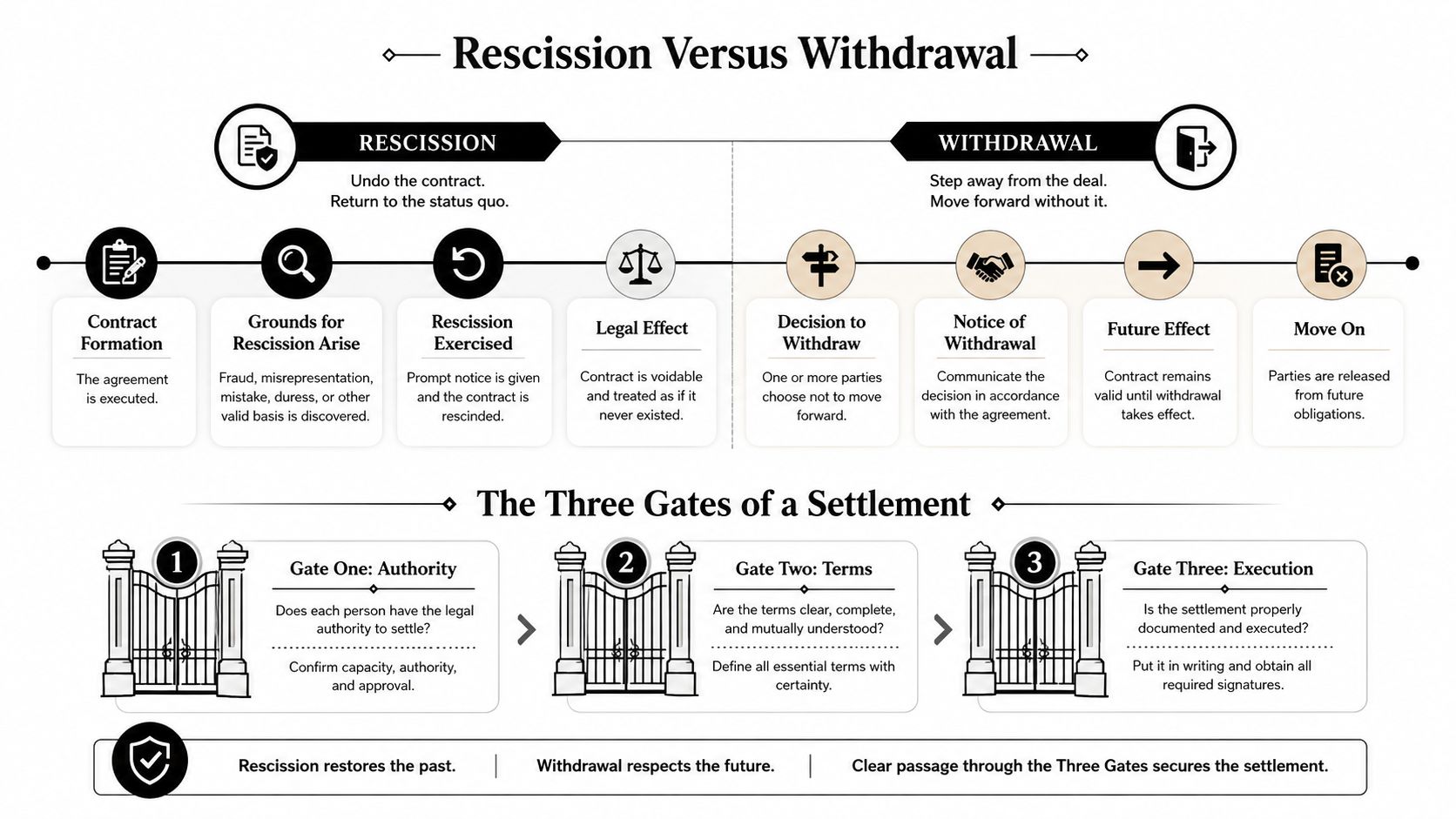
Gate one is the open offer
An open offer is the least protected stage. If you haven't accepted according to the offer's terms, the insurer can generally revoke it before acceptance becomes effective. The offer letter may set a response period, require a signed release, or condition payment on specific paperwork. Those terms matter.
Do not assume that silence accepts an offer. Do not assume that telling an adjuster “that works” completes the agreement. Ask what acceptance requires and preserve the answer.
Gate two is acceptance without a completed release
Acceptance can create a binding agreement before the formal release is signed, depending on the jurisdiction and the parties' communications. A signed acceptance, written confirmation, oral agreement followed by conduct, or partial performance may support contract formation. The insurer's next move is no longer ordinary withdrawal. It is an attempt to undo an agreement.
A lawyer evaluating the claim will examine emails, letters, recorded calls where lawful, draft releases, payment instructions, and whether either side acted as though the bargain was complete. The answer depends on the governing state law and the exact language used.
For a plain explanation of the documents and obligations involved, review this guide to what a settlement agreement includes.
Gate three is a signed release
A signed release closes the door more firmly. The claimant typically gives up claims in exchange for payment, and the insurer gains finality. Rescission at this point usually requires fraud, duress, mutual mistake, or a specific statute that allows the release to be voided.
That is why you shouldn't sign a release while treatment is incomplete or while the language is unclear. The document may waive claims broader than the accident itself, including related parties, liens, and future damages.
Grounds an Insurer Can Use to Rescind After Acceptance
Once acceptance has occurred, the insurer can't rescind because a supervisor dislikes the amount or a new valuation makes the claim less attractive. The insurer must identify a recognized legal ground and support it with evidence.
Fraud or material misrepresentation
Fraud requires more than an inaccurate estimate. The insurer may allege that the claimant concealed a prior injury, falsified treatment, staged damage, or made a material statement known to be false. The alleged misrepresentation must matter to the bargain, and the insurer must prove the facts under the applicable legal standard.
That makes medical history and claim disclosures critical. A prior injury isn't automatically fraud. The relevant questions include what was disclosed, what was asked, whether the omission was intentional, and whether the information affected the settlement decision.
Mutual mistake
Mutual mistake exists when both sides relied on a fundamental fact that turned out to be wrong. It isn't enough for one party to misunderstand the value of the claim. Both parties must have shared the mistaken assumption, and the mistake must be serious enough to undermine the agreement.
A clerical error can support relief when the evidence shows both sides intended a different term. But an insurer's internal typing mistake doesn't automatically become a mutual mistake. The written offer, negotiations, payment records, and surrounding conduct all matter.
Duress or coercion
Duress means the agreement resulted from wrongful pressure that deprived a person of a meaningful choice. A claimant's financial stress, by itself, usually isn't enough. Settlement negotiations are pressured, and insurers know that injured people need money.
The allegation becomes more serious when the evidence shows threats, improper coercion, incapacity, or pressure directed at someone who couldn't understand the transaction. Medication, severe cognitive impairment, and lack of meaningful consent may matter, but the facts must be specific.
Statutory voiding periods
Some statutes create a short right to rescind a completed release. Virginia gives certain unrepresented personal-injury claimants a right to rescind a release until midnight of the third business day after execution when the crash occurred within 30 days of the injury, with repayment of settlement proceeds. Maryland allows certain unrepresented claimants who sign a release within 30 days of an accident to void it within 60 days by written notice and repayment. (Rice Law discusses Maryland release rescission rules.)
These statutes are exceptions, not general permission to reopen a bad bargain. Investigating the claim also matters, particularly when the insurer alleges concealment or inconsistent records. A detailed resource on an insurance company investigation can help claimants understand why adjusters request records and statements.
How Colorado, Texas, and New York Handle Rescission
Colorado, Texas, and New York share the basic contract distinction between an unaccepted offer and a completed settlement, but the practical result depends on the documents, communications, and any statute that applies to the specific transaction. There is no universal cooling-off rule that lets an injured claimant casually undo a signed release.
Colorado claims require careful attention to whether acceptance occurred under the offer's stated terms and whether a release or payment condition remained outstanding. Certain settlement-payment rules may create a seven-day revocation period in defined circumstances, but that rule isn't a blanket right for every personal-injury release. A claimant should identify the statute and transaction before relying on it.
Texas generally treats settlement agreements as contracts. Written agreements are easier to prove, but oral agreements may matter when the parties reached definite terms and their conduct supports acceptance. A party challenging a release typically needs a recognized contract defense, such as fraud, mutual mistake, or duress. The insurer can't undo the bargain merely because later evaluation produces a lower internal value.
New York likewise distinguishes revocation before acceptance from rescission after agreement. New York courts and practitioner summaries describe the ordinary rule that an insurer may withdraw before acceptance, while acceptance followed by a release usually creates an enforceable settlement. Common-law defenses remain central, and a minor clerical error won't automatically erase an agreement unless it proves a material mistake or prevents the parties from identifying what they agreed to.
| Factor | Colorado | Texas | New York |
|---|---|---|---|
| Open offer | Generally revocable before effective acceptance | Generally revocable before acceptance | Generally revocable before acceptance |
| Accepted offer | Enforceability depends on definite terms and conduct | Contract principles govern, with evidence of agreement controlling | Contract principles and the parties' communications control |
| Signed release | Usually enforceable unless a recognized defense or statute applies | Usually enforceable unless fraud, mistake, duress, or another valid defense is proven | Usually enforceable under common-law contract defenses |
| Cooling-off rules | Certain settlement-payment situations may involve a statutory revocation period | No universal personal-injury cooling-off rule should be assumed | No universal personal-injury cooling-off rule should be assumed |
| Practical focus | Identify the statute, acceptance terms, and payment conditions | Prove definite agreement and a valid ground to undo it | Prove the agreement and a recognized common-law defense |
The practical answer is local. A claimant in Denver, Dallas, or New York City should not rely on a general internet rule when a release is already signed.
Three Real-World Scenarios That Bring Rescission to Life
A concealed prior condition appears
A claimant signs a release after telling the insurer the crash caused all current symptoms. Later, the insurer obtains records showing the claimant had previously reported the same condition and deliberately denied it during negotiations. The insurer alleges fraud or material misrepresentation, not mere regret.
The likely outcome depends on proof. Consistent records, direct questions, intentional answers, and a clear connection between the omission and the settlement strengthen the insurer's position. An ambiguous medical history or an honest misunderstanding weakens it. The lesson is simple, disclose relevant history accurately and keep copies of what the insurer asked.
The release contains a numerical error
A negotiator and claimant agree to a payment amount, but the release states $8,500 while the check is issued for $85,000. Before acceptance, the insurer may withdraw or correct the mistaken offer. After a completed agreement, the party seeking relief may invoke mutual mistake or reformation, but the outcome depends on evidence of the intended bargain.
The error doesn't automatically decide the case. Emails, drafts, approval records, and the parties' conduct may show whether everyone understood the intended amount. A unilateral clerical mistake isn't always enough to rescind a contract.
New imaging reveals a worse injury
A claimant settles based on the medical information available at signing. Later imaging reveals a more serious injury and a need for treatment that no one anticipated. The claimant wants to undo the settlement, but the insurer didn't conceal the imaging and didn't pressure the claimant.
That is usually a poor rescission case. A settlement allocates the risk that later information may change the value of the claim. New medical evidence may justify refusing an offer before acceptance, but it normally doesn't create a right to unwind a signed release without fraud, duress, mutual mistake, or a statute.
Language errors can compound the problem when claimants review policies or releases in a language they don't fully understand. Using accurate insurance document translation can help ensure the actual terms are understood before anyone accepts or signs.
The Myth That an Insurer Cannot Change Its Mind
The statement “the insurer can't change its mind” is too broad to protect anyone. Before acceptance, the insurer can generally withdraw an offer. That is withdrawal, and it doesn't require the insurer to prove fraud or mistake because the contract may not exist yet.
The opposite statement is also wrong. An insurer can't freely undo an accepted settlement just because the reserve changed, a manager disagrees, or the adjuster wishes the claim had settled for less. After acceptance, and especially after a signed release, the insurer needs a legally recognized basis.
Regret is not rescission
A change in valuation isn't fraud. A later medical development isn't automatically mutual mistake. A claimant rejecting a low offer isn't duress. Courts look at the formation and integrity of the agreement, not at which side now considers the bargain unfavorable.
That distinction gives both sides an advantage. If the offer was never accepted, the claimant may have lost that particular proposal but can continue the claim or negotiate further. If the insurer tries to retreat after acceptance, the claimant may have an enforcement argument, depending on the evidence and state law.
Adjusters sometimes use vague phrases such as “we need to reconsider” or “the authority changed.” Those statements may describe an internal decision, but they don't identify a legal basis for rescission. Demand clarity in writing rather than arguing on the phone.
The real test: An insurer may change its position before a contract forms. It may not erase a completed bargain without satisfying the legal test for rescission.
The useful question isn't “can they change their mind?” Ask instead, what was accepted, what was signed, and what recognized ground supports undoing it?
What to Do When an Insurer Rescinds or Withdraws Your Offer
Treat the first notice as evidence. A withdrawn offer can become important in later negotiations or litigation, and a disputed acceptance may turn on the exact sequence of calls, emails, drafts, and signatures.
Preserve the record immediately
Save the call log, voicemail, emails, text messages, offer letter, draft release, acceptance, and payment documents in one folder. Keep timestamps intact. Don't edit screenshots or forward messages in a way that strips the original context.
Then respond in writing. Ask the insurer to identify whether it is withdrawing an unaccepted offer or rescinding an accepted settlement. Require the company to state the specific legal ground, such as alleged fraud, mutual mistake, duress, or a statutory right.
Don't create a second problem
Avoid signing a revised release, accepting a replacement offer, or returning settlement funds before independent legal review. A new document may contain broader waiver language, lien provisions, confidentiality terms, or conditions that change your position.
Bring the complete file to counsel:
- Original demand package: Include medical records, bills, wage information, photographs, and supporting correspondence.
- Offer and acceptance evidence: Provide every version of the offer, your response, and any message discussing conditions.
- Release documents: Include unsigned drafts, executed copies, and payment instructions.
- New evidence: Request the records the insurer relies on if it alleges fraud, a mistake, or changed medical facts.
Calendar every deadline in the insurer's letter, but don't assume the deadline is legally valid merely because it appears in bold. Statutory rescission periods can be short and can require written notice and repayment of funds. Ontario, for example, gives an insured person only two business days to rescind certain accident-benefits settlements after the required signing event, with consequences that include voiding the release, repayment, and continuation of the benefits claim. (The Illinois State Bar Association discusses settlement rescission periods and consequences.)
Contact a personal injury attorney before making a substantive response, particularly if a release has been signed. Post-execution remedies are narrow, and an impulsive email can damage an otherwise viable enforcement or rescission argument.
The Bottom Line on Holding Onto Your Settlement
An insurer can withdraw an unaccepted offer in many jurisdictions. After acceptance, rescission requires a recognized ground such as fraud, mutual mistake, duress, or a statute. After a fully executed release, finality becomes the central rule, and only narrow exceptions usually remain.
The popular belief that insurers can never change their minds is wrong. The accurate rule is narrower and more useful: an insurer can't abandon a binding settlement merely because it regrets the deal, but it may challenge the agreement when the legal requirements for rescission are met.
Document everything, demand the stated ground, and don't sign or refund money without review. Also check whether liens, including a medical lien on a settlement, affect the amount you can keep.
Nares Law Group LLC helps injured people evaluate settlement offers, document insurer withdrawals, and challenge defective or improperly rescinded agreements in Colorado, Texas, and New York. Visit Nares Law Group LLC before you accept, sign a release, or return settlement funds so the legal consequences are clear.