You're on a Colorado jobsite, you hear a sharp crack overhead, and then the load starts to swing. Someone yells. Dust hangs in the air. A worker is down, the crane is still live, and everyone nearby is trying to decide whether to run in, call 911, or keep the whole thing from turning into a second disaster.
That moment is where a crane case starts. It's also where the legal fight starts, whether anyone admits it or not. The first calls, the first statements, the first photos, and the first repairs can decide whether you have a clean liability case or a mess of missing evidence and finger-pointing.
A crane accident attorney is not just there to file papers after the fact. Their job is to lock down the facts before the scene changes, identify every responsible party, and build the case as a forensic engineering problem from day one. That's how you protect the claim, and that's how you get past the noise.
A Scene You Never Want to Live Through
The strap snaps, the load shifts, and the operator knows immediately that something has gone wrong. Below, a worker gets hit by falling material or struck as the load whips out of line. In the seconds after impact, nobody is thinking about statutes, insurance layers, or preservation letters. They're thinking about breathing, bleeding, and whether the next collapse is coming.
That's exactly why the legal decisions made in the first hours matter so much. The crane may be shut down, but the company will already be moving people, equipment, and paperwork. A supervisor may want a statement. An insurer may want a recorded interview. Someone will start cleaning, repairing, or staging the area for the next shift.
Practical rule: If you're hurt, say as little as possible beyond the basic facts needed for emergency response and medical care.
The wrong sentence can travel farther than the wrecked rigging. “I'm okay” gets used against you. “I might have messed up” gets amplified. Even a well-meant apology can be turned into a liability argument later.
The better move is simple. Get medical care, report the incident through the proper channel, and make sure someone is preserving the scene. If you're the family member or coworker trying to help, your job is to start documenting, not speculating. The value of the claim often turns on what gets saved before the crane is moved and the site changes.
What a Crane Accident Attorney Actually Does
A competent crane accident attorney does not start with a speech. They start with evidence. The first job is to identify the mechanism of failure, whether that means overload, rigging error, ground-condition failure, defective equipment, or bad lift planning, because crane cases live or die on technical facts, not slogans. Federal crane rules under OSHA 29 CFR 1926 Subpart CC control operator certification, pre-shift inspections, load-chart compliance, and ground conditions, so the file has to answer those questions early.
The work is technical, not cosmetic
The lawyer should be chasing the load chart, the lift plan, inspection logs, maintenance records, rigging specs, and the operating history of the machine. That's not busywork. It's how you prove where the chain broke, who had control over the risk, and whether someone ignored a safety duty that should have stopped the incident.
The right case team also brings in the right experts. In crane litigation, that often means rigging professionals, forensic engineers, and people who can reconstruct the lift sequence from the physical evidence. Sources focused on crane litigation emphasize that attorneys and experts rebuild incidents through engineering specs, maintenance records, and operating procedures, not just witness recollection (crane litigation and engineering reconstruction).
The attorney has to run multiple claim tracks
A serious case usually has three lanes moving at once. Workers' compensation covers the injured employee's own employer in the background. A third-party negligence claim targets whoever else helped cause the wreck, often a general contractor, subcontractor, or property owner. A product liability claim may target the crane or rigging manufacturer if a design or component defect played a role.
That split matters because each theory needs different proof. A general personal injury shop may know the broad outlines. A crane-litigation lawyer has to be comfortable cross-examining a crane operator, a lift director, an OSHA inspector, and the people who signed off on the site plan. If the attorney can't speak the language of rigging, load limits, and inspection records, they're underprepared.
Who Can Be Held Liable for a Crane Accident
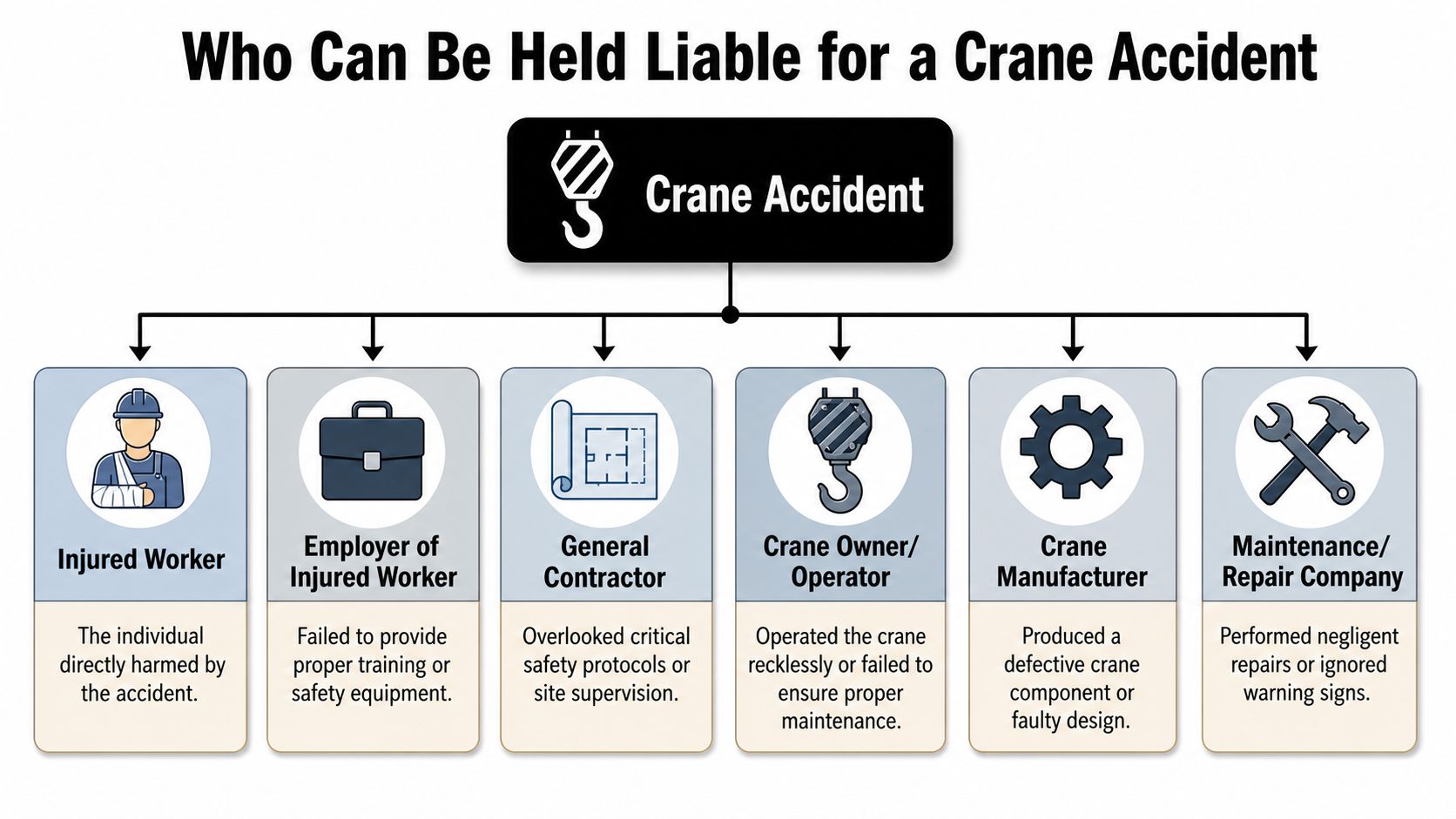
Crane cases usually have more than one plausible defendant because crane failures rarely come from one clean mistake. The fault trail often runs through the lift plan, the rigging, the ground conditions, the equipment, and the supervision. OSHA-linked summaries describe crane accidents as heavily driven by human error and recurring hazards such as power line contact and struck-by incidents, which is exactly why these cases have to be treated as forensic engineering problems from the start (crane accident statistics and cause breakdowns).
The defendants usually stack up
The injured worker's employer may be responsible for poor training, bad supervision, or unsafe site practices, even if workers' comp limits the direct tort claim. The general contractor may have failed to coordinate the lift, control access, or enforce site-wide safety rules. A property owner can be in the case if it controlled premises safety or directed dangerous work conditions.
The crane operator's employer may also be exposed if it hired an unqualified operator, ignored inspection problems, or pushed a lift that should have been stopped. The subcontractor that rigged the load or gave the signal can be liable if it used the wrong gear, miscommunicated, or handled the lift in a careless way. The manufacturer belongs in the case if a component failed because of a design or production defect. The inspection or repair company can also be a defendant if it signed off on faulty equipment or missed warning signs that should have grounded the crane.
Those are not abstract categories. They are the people and companies whose decisions determine whether a lift stays controlled or turns into a collapse, a strike, or an electrocution.
Direct liability means a party did something negligent itself. Vicarious liability means an employer can be responsible for what its employee did on the job.
That distinction matters in depositions and settlement talks. If the operator exceeded the machine's limits, the operator's employer may be in play. If the contractor set up the lift under bad ground conditions, that contractor may be in play too. The job is to trace every unsafe decision back to the company that made it, then decide which claims can survive under Colorado law and which ones are blocked by workers' compensation rules.
How Workers' Comp and Third-Party Claims Work Together
Colorado crane cases often split cleanly into two tracks. Workers' compensation is usually the injured employee's exclusive remedy against the direct employer, which means you don't sue your own employer in ordinary negligence for the same injury. In exchange, comp provides medical and wage benefits without having to prove fault.
The civil case is where the money often gets real. If a third party helped cause the incident, such as a general contractor, property owner, subcontractor, equipment maker, or separate maintenance company, the injured worker can pursue that tort claim while still collecting workers' comp from the employer. That's the combination many people miss, and it's often the difference between a limited benefits case and a full recovery case.
Colorado also has a lien problem that has to be handled correctly. The workers' comp carrier may have a reimbursement claim out of a third-party settlement, but that lien must be reduced by its share of attorney fees and costs. If the lawyer ignores that math, the client can walk away with less than they should. For a plain-English overview of prevention and site-risk thinking in the construction setting, the Australian construction risk guide is a useful outside resource.
Different victims, different legal paths
If the injured person wasn't a worker at all, workers' comp usually drops out of the picture. A passerby, delivery driver, neighboring trade worker, or pedestrian may have a straight personal injury claim instead. That matters because crane incidents don't just harm one trade crew. They often create a wider ring of victims and a wider set of responsible parties.
The core question is simple. Is this a workers' comp case only, a workers' comp plus third-party case, or a pure civil claim? Get that answer early, because it changes the evidence, the deadline, and the settlement advantage.
Evidence You Need and Why the First 24 Hours Matter
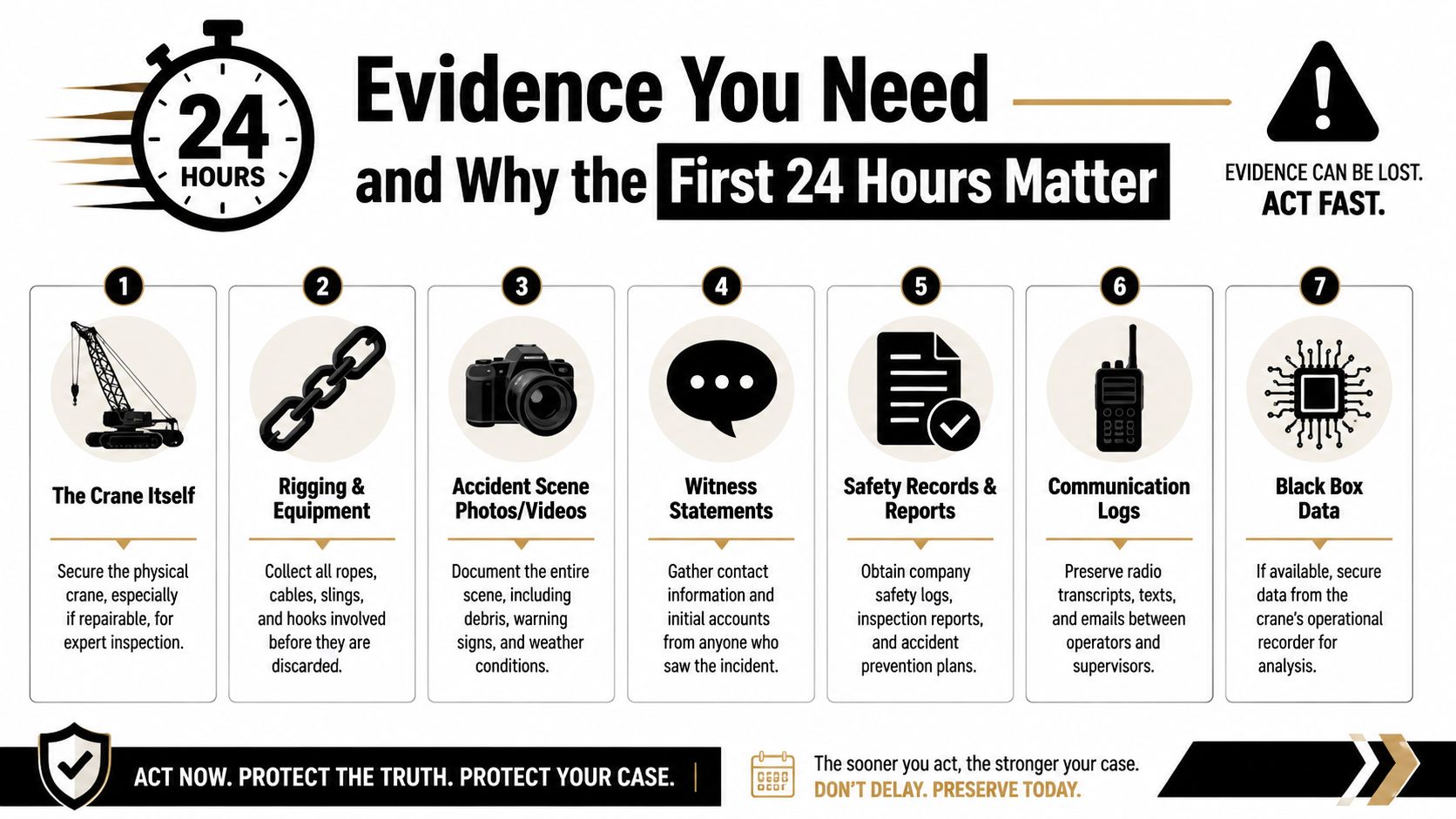
The first 24 hours are about preserving what can disappear. Specialized crane-litigation teams report mobilizing experts to the scene within 24 hours to document rigging, crane configuration, and regulatory compliance before evidence degrades (crane rigging litigation and rapid investigation). That benchmark is not fluff. It's the standard.
What has to be saved
Start with the crane itself, especially if it can be inspected before repair. Save the rigging and equipment. That includes cables, slings, hooks, shackles, and any load-bearing hardware that was in use when the accident happened.
The next bucket is documentary evidence. Keep the load chart, the lift plan, inspection and maintenance logs, incident reports, radio traffic, texts, and emails between supervisors and operators. OSHA-related records, especially operator certification records under 29 CFR Subpart CC, matter because they speak to whether the people running the lift were qualified and whether the company kept the required paperwork.
What a family member can do fast
- Take scene photos: Capture the crane position, debris field, warning signs, weather, and access points before anyone moves equipment.
- Get witness names now: People disappear fast on a busy site, and memories fade even faster.
- Save messages and call logs: Texts, radio notes, and supervisor instructions can show who controlled the lift.
- Keep every medical record: Use the internal guide on how to obtain medical records so treatment documentation stays complete.
The equipment can be repaired, repositioned, or scrapped within days. Site conditions can also change as the next phase of construction starts. If you need to share documents with counsel but want sensitive details handled carefully, a secure PDF redaction guide is worth using before anything is circulated.
Colorado Statutes of Limitations and Filing Deadlines
Colorado deadlines don't forgive confusion. The workers' comp claim, the personal injury claim, and the wrongful death claim each run on their own clock, and missing one can kill part of the case even when the facts are strong.
The three clocks that matter
For workers' compensation, notice to the employer should happen as soon as practicable, and the claim must be filed within two years under Colorado law. Don't treat that as a soft target. If the employer never gets proper notice, benefits can be at risk even when the injury is obvious.
For a third-party personal injury suit, Colorado's general statute of limitations for personal injury actions is also two years from the date of injury. That means the civil complaint against the contractor, owner, manufacturer, or other non-employer has its own filing deadline, separate from the comp process. The practical deadline discussion in Colorado is laid out in the firm's statute of limitations guide.
For wrongful death, the clock is generally two years from the date of death. That difference matters in cases where the person survives the initial incident for a period of time before passing away. The claim belongs to the family, but the filing date still controls everything.
Don't miss tolling issues
The discovery rule and special tolling rules can extend or alter deadlines in narrow situations, including latent injuries and cases involving minors. Don't guess on tolling. Get it checked against the facts and the medical timeline.
If you're unsure which filing deadline applies, assume the shortest one and move first.
That's the safest approach because there's no prize for waiting until the final month to sort out jurisdiction, evidence, and party alignment. File the case you can file, preserve the one you may need, and keep the timeline under control.
Damages You Can Recover in a Crane Injury Case
A crane injury case starts with the injury bill, and it rarely stops there. The economic fallout is often severe because these cases involve crushed limbs, traumatic brain injuries, spinal damage, or fatal incidents that shut down a family's income overnight. Earlier reporting in the article already showed how expensive crane incidents can be in practice, and that reality is why insurers study these claims closely.
The main damage buckets
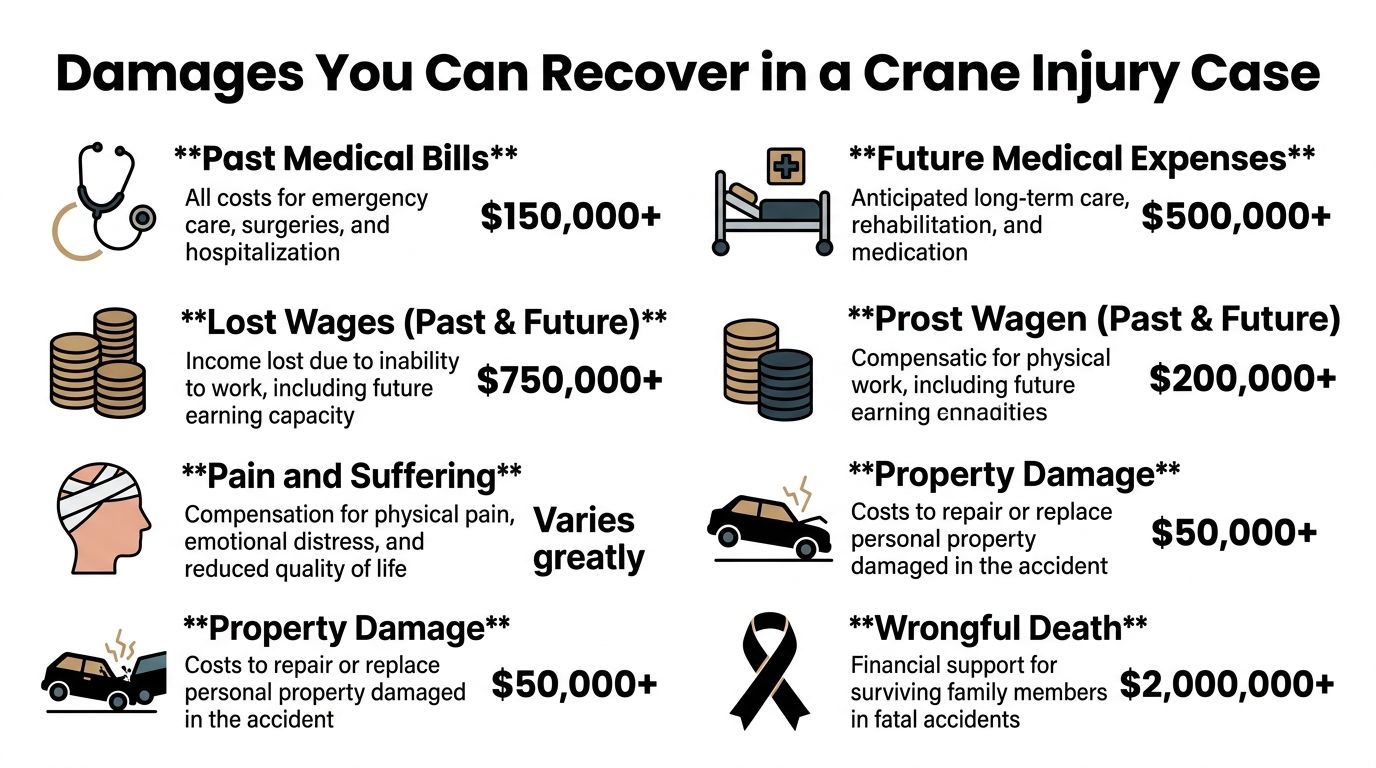
Economic damages are the bills and losses you can document. That includes emergency care, surgery, hospitalization, rehabilitation, medication, and future treatment. It also includes lost wages, reduced earning capacity, vocational retraining, and life-care planning when the injury permanently changes the person's ability to do the same work.
Non-economic damages cover pain and suffering, emotional distress, and loss of enjoyment of life. A spouse may also bring a loss of consortium claim when the injury changes the marriage itself. Those damages are not abstract. In catastrophic crane cases, they often carry as much weight as the medical records.
A proper case also tracks future loss, not just the invoices that have already arrived. If the injured worker cannot return to heavy labor, a forensic economist and the treating physicians need to show the full path of lost earning capacity, future care, and the practical limits on daily life. That is where the case becomes a damages proof problem, not just a billing exercise.
Wrongful death changes the math
When a crane death occurs, the family may seek funeral and burial expenses, lost financial support, and the loss of companionship and guidance. The legal claim is different from an injury case, but the damage picture is often broader because the family has lost both income and relationship.
Punitive damages are uncommon and require egregious conduct. If a contractor knowingly ignored a major safety risk or a manufacturer pushed a clearly dangerous product, punitive exposure can become an issue, but it is not something to assume. Use the evidence to prove reckless conduct before you talk about punitive recovery.
How Attorneys Get Paid and Your Questions Answered
Most crane injury cases are handled on a contingency fee. The lawyer gets paid only if there is a recovery, and the fee comes out of the settlement or verdict, not your pocket up front. Case costs, including experts, depositions, records, and filing fees, are usually advanced during the case and reimbursed from the recovery under the fee agreement. If you want the fee structure explained in plain English, start with a contingency fee explanation before you sign anything.
Get the numbers in writing. Ask for the fee percentage, how costs are deducted, and what happens if one claim settles before another. In a serious crane case with experts and multiple defendants, the financial terms should be clear before the first deposition starts.
Workers' compensation fee disputes work differently. Those fees are typically controlled by statute and are not the same as a civil contingency arrangement. Don't mix the two systems, because the comp lawyer's fee structure tells you nothing about the third-party lawsuit.
Quick answers to the questions people ask most
If the injured worker is undocumented, that does not erase the underlying injury claim. The case still rises or falls on the facts, the medical proof, and the liability evidence, not immigration status.
If the worker died before any lawsuit was filed, the wrongful death claim can still be pursued by the proper party. The filing deadline and who has authority to sue need to be checked immediately, because those two issues control whether the case can be filed at all.
Can you sue your own employer? Usually no, because workers' comp exclusivity blocks the ordinary negligence claim. Narrow exceptions can exist, including intentional injury or unusual ownership and control issues, but those are fact-specific and not the rule.
How long does a crane case take? It depends on the number of defendants, the severity of the injury, and how fast the evidence gets preserved. Cases with strong liability and clean records move faster. Cases with missing logs, disputed rigging, or bad repairs take longer because the engineering work has to be done right, and the failure sequence has to be proved with care.
If you want straight answers about a crane injury, a fatal lift, or a dispute over who controlled the site, contact Nares Law Group LLC for a free consultation. They're Denver-based, licensed in Colorado, and they handle serious injury and wrongful death work with the kind of trial preparation crane cases demand.
If you're dealing with a crane injury case in Colorado, Nares Law Group LLC can help you move fast, preserve the evidence, and sort out workers' comp versus third-party liability before the record gets messy. Visit Nares Law Group LLC to talk through your options and get a clear next step from a Colorado-licensed team that knows how to handle serious injury claims.