The call usually comes before the tow truck leaves. You're on the shoulder with a blanket around your shoulders, or in a hospital bed with your phone propped on the tray table, and a number you don't recognize turns out to be an adjuster for the company that owns the tractor-trailer. She's friendly. She asks how you're feeling, then asks whether you'd give a quick recorded statement while the details are still fresh.
Nothing in that call is neutral. The carrier already has a claims team and a safety director reviewing what its driver did, and the records that would answer the important questions about speed, hours on duty, brake repairs, and dispatch pressure sit on servers the company controls and can overwrite on a routine schedule.
That's the part most "truck wreck attorney near me" pages leave out. The decision in front of you in the first days isn't mainly about which lawyer has the friendlier ad. It's about who starts preserving evidence before it's gone.
Criteria for Choosing a Local Truck Wreck Attorney
By the third day you own a folder. It holds the crash report, a discharge summary with instructions you half remember, three business cards from lawyers who called you, and a stack of envelopes with hospital logos on them. You open a browser, type the phrase everyone types, and get a page of results that all promise the same thing.
A car crash is usually two drivers and two policies. A truck crash pulls in a commercial carrier, a driver qualification file, maintenance and inspection records, dispatch logs, and often a broker and a shipper. The lawyer who handles fender benders well may never have requested an electronic logging-device export in his career, and that gap shows up months later when the data is gone.
Six criteria separate firms that try truck cases from firms that market to them. Use the same six on every lawyer you interview.
| Criterion | What to Look For | Question to Ask |
|---|---|---|
| Truck case experience | Recent commercial carrier cases, not only car accidents; examples involving a carrier's hiring, training, or maintenance | How many truck wreck cases have you taken to settlement or trial in the last three years? |
| Licensing and local courts | An active license in the state where the crash happened and real familiarity with the courthouse in that county | Are you licensed in the state where my crash happened? |
| Investigation resources | Access to accident reconstruction and medical experts who can testify about cause and injury | Which experts do you use to explain trucking causes and injury impact? |
| Brain and catastrophic injury work | Documented experience with traumatic brain injury and severe injury claims | Have you handled brain injury claims arising from truck crashes? |
| Fee structure | A written contingency agreement stating the percentage and who pays case costs if the case loses | What percentage do you take, and what costs would I owe if we lose? |
| Communication | A named lawyer who owns your file and a set schedule for updates | Who handles my file day to day, and how often will I hear from you? |
Before any consultation, confirm the lawyer's license in your state bar's public directory. It takes five minutes and catches the out-of-state call centers that advertise into markets they can't file in. Then check whether the firm appears in the county where your crash happened, because a lawyer who has never walked into that courthouse is learning on your case.
One more thing worth knowing before you weigh rankings. Firms compete hard for this exact search, and a breakdown of local SEO tactics from ThroughTheGrapevine.ai shows how much of page one is bought rather than earned. Position in results tells you who markets well, not who has tried a truck case.
What the answers should sound like: specifics. A number of truck cases, a named reconstructing engineer, a stated update schedule. Vague confidence is the tell.
Walk away from guaranteed dollar amounts, pressure to sign in the parking lot, no written fee agreement, and any lawyer who never once mentions the carrier's logs, inspection file, or dash camera.
Then run the same six questions past three firms and write the answers side by side. The comparison does the work an ad can't.
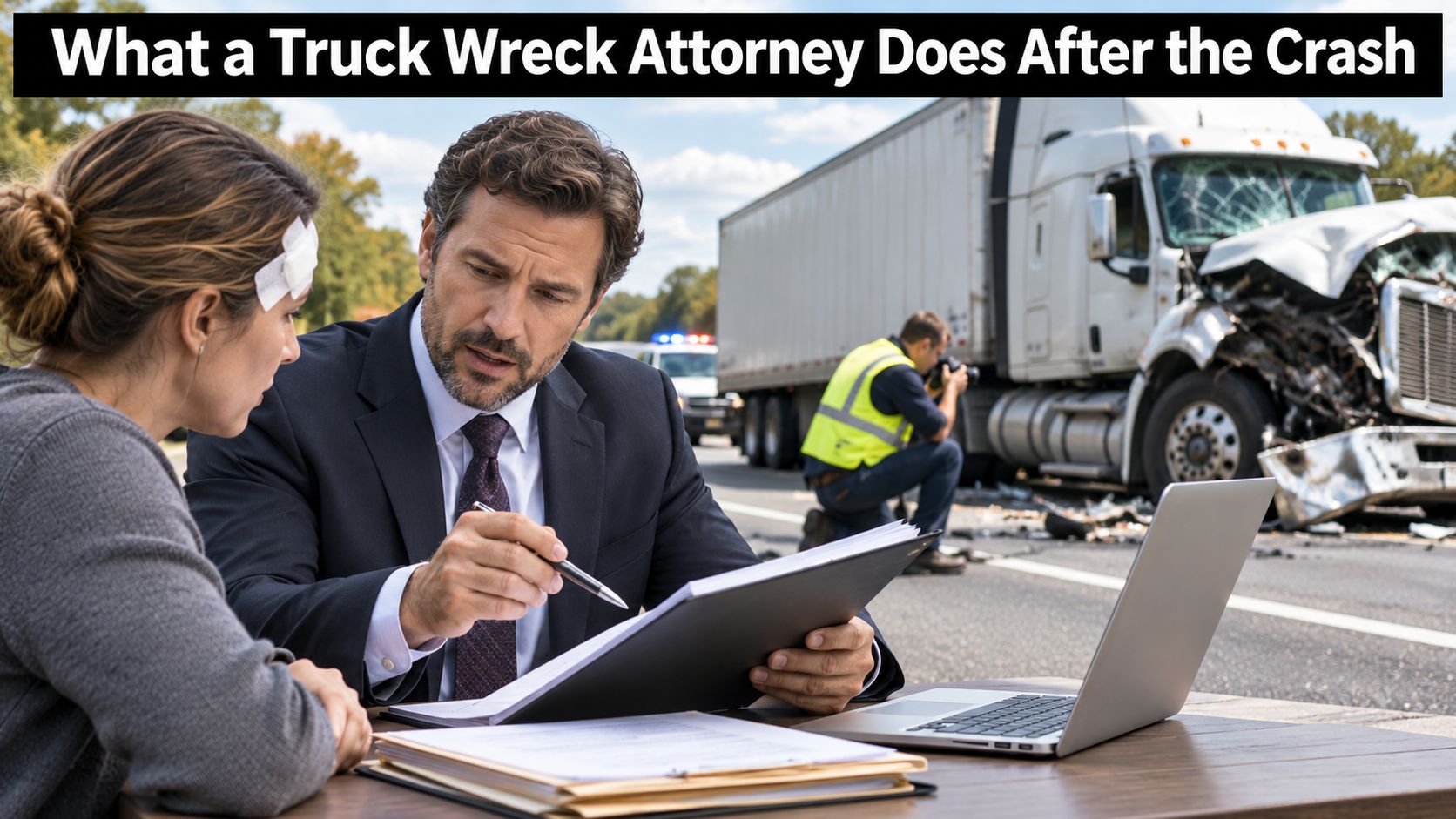
What a Truck Wreck Attorney Does After the Crash
The work starts against a clock that began at impact. A truck crash is a regulated transportation event with a logbook, a dispatch office, a maintenance file, and a safety department standing behind the carrier, and nearly all of that evidence sits on systems the carrier controls. What gets decided in the first week often determines what the case can prove a year later.
The stakes justify handling it differently from a car claim. The Federal Motor Carrier Safety Administration's crash data overview reported 5,476 fatal crashes involving large trucks or buses in 2022, and of the 6,139 people killed, about 82% were outside the commercial vehicles. Those were passengers, pedestrians, and other road users, not truck occupants.
The five phases, in order
- Investigation. The attorney collects medical records, accident reports, witness statements, and expert opinions until liability and damages are documented rather than assumed.
- Preservation demands. Written letters go to the carrier, broker, shipper, and maintenance provider directing them to hold electronic logs, onboard computer data, dash-camera footage, inspection reports, and repair histories.
- Insurance negotiation. Every policy that might respond gets identified: the carrier's commercial auto coverage, excess layers, and any broker or shipper coverage, not just the driver's limits.
- Litigation. If a fair offer doesn't come, a suit gets filed and the case moves under a court's scheduling order and discovery deadlines.
- Settlement or trial. The claim resolves only with your informed consent, after you've seen the numbers and the risks in plain terms.
Step two is the one injured people never see coming, and it's the step a truck attorney runs first. A car lawyer can request records months out and lose little. Here, waiting hands the other side control over what survives.
Here's how that sequence looks when a case is running properly, from first meeting through preservation letters and expert retention.
Reconstruction often decides the case. Underride and override details are easy for a police narrative to miss, because a responding officer records what was visible at the scene, not impact geometry. A lawyer needs scene photographs at full resolution, event data recorder output where it exists, trailer and guard inspection records, and an independent reconstruction that measures crush, speed, roadway grade, and impact angle.
Federal rules then fill in the paper. Our guide to federal trucking regulations covers the retention rules that decide which records a carrier must still have and which it may have lawfully destroyed.
At a first meeting, expect questions more than promises: what happened, when, who treated you, what you've missed at work, and what the adjuster has already said. You should leave with an outline of the claim, realistic options, and a timeline built around your treatment, not a sales script.
First-Week Evidence Steps After a Truck Crash
Most of the evidence in a truck case isn't in your hands. It lives on a carrier's server, written continuously by an electronic logging device, an onboard computer, and a dash camera, and carriers clear or overwrite routine data on ordinary schedules unless someone tells them to stop.
The window is short and it differs by system. Electronic logging-device records are generally required for most commercial motor carriers, and some crash-related electronic data can vanish sooner once the vehicle goes back into service.
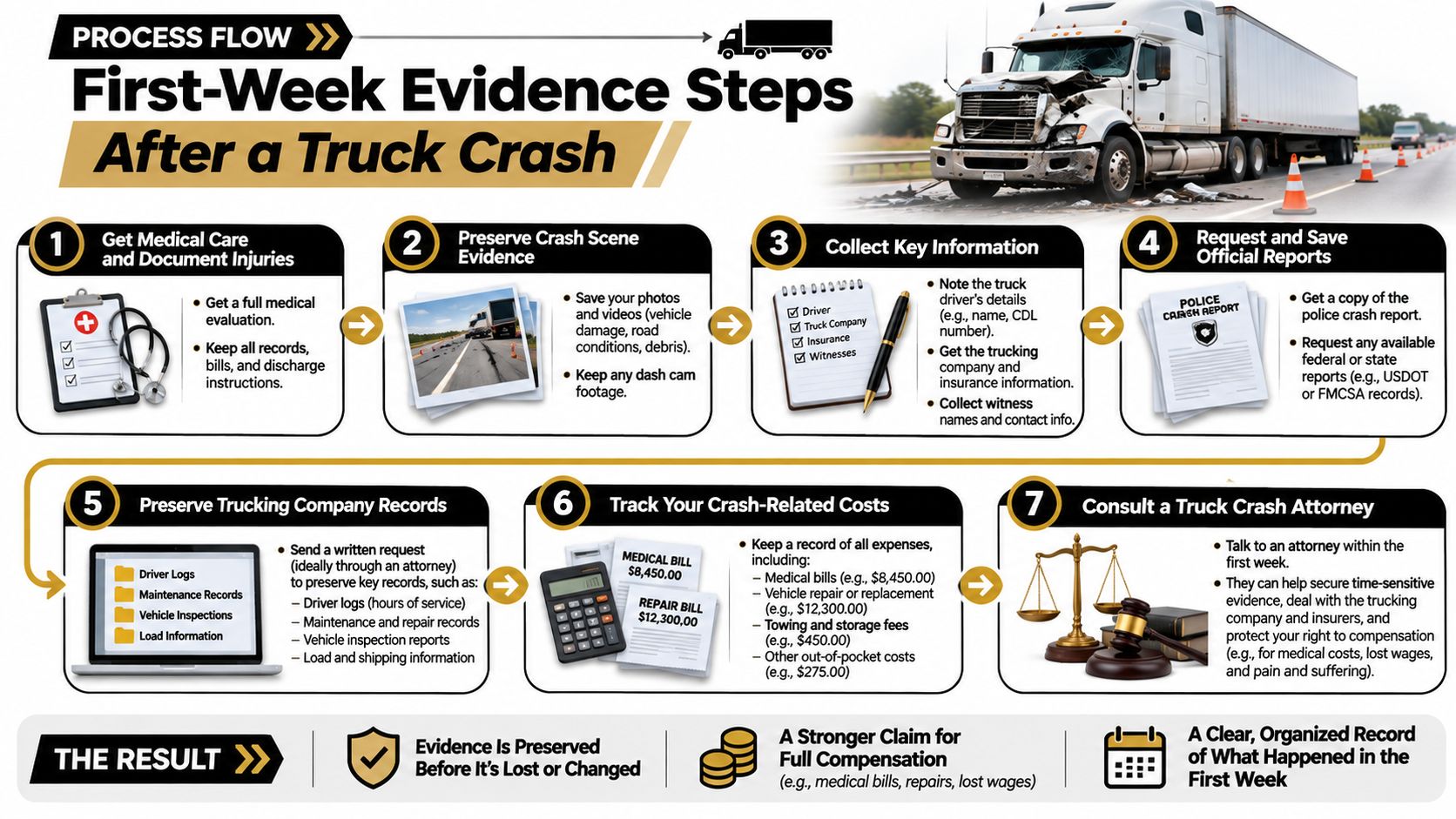
- Photograph everything while it's still there. The tractor, the trailer, the underride guard, the lighting and reflective tape, the cargo, the road surface, and your own vehicle from every angle. Phone photos taken at the scene routinely show things that no later inspection can recover.
- Write down the carrier name, DOT number, driver name, and both plate numbers. The tractor and trailer often carry different plates and sometimes different owners. Miss the trailer plate and you may lose the entity that maintained the equipment.
- Keep the police report number and every witness name and phone number. Witnesses move, change numbers, and forget details. Two lines in your notes can be worth more than a year of argument later.
- Ask the carrier in writing to preserve electronic logs, GPS data, dash-camera footage, and maintenance records. Send it by email or certified mail so there's a timestamp. A phone request to a dispatcher proves nothing.
- Save medical bills, visit notes, and wage records starting the day of the crash. Gaps in the record get used against you. A folder with every visit and every pay stub closes that door.
- Don't give a recorded statement to the other insurer yet. Adjusters are trained to ask open questions early, when you don't know your injuries or your rights. "I'd rather not record anything today" is a complete sentence.
- Get a truck wreck attorney to send formal preservation demands. A lawyer's letter carries weight a victim's email doesn't, and it can reach the broker, shipper, and maintenance provider that a victim wouldn't know to contact.
Courts have backed that urgency. A federal court order described in this analysis of black box data in truck accident litigation directed preservation of electronic logs and related records for seven days before and after the collision and suspended ordinary destruction policies once litigation was reasonably anticipated.
A preservation letter is a request, not a key. It tells the carrier what to hold. It doesn't force production.
Access still requires formal discovery, subpoenas, or a court order if a carrier stalls, and some defendants produce far less than they should. Preservation buys the chance to fight over the data. It doesn't hand it to you.
Who Can Be Held Responsible in a Truck Crash
The police report names a driver. Start there, but do not treat it as the full defendant list. In a truck crash, the person behind the wheel may be only one link in a chain that includes the carrier, broker, loader, maintenance provider, trailer owner, and sometimes a manufacturer or roadway entity. The evidence clock matters here. Carriers often control the electronic logs, dispatch messages, inspection records, and qualification files that identify that chain.
Who employed the driver changes the case. An employee driver can point to the motor carrier under respondeat superior. A leased operator can bring a lease agreement and possibly two companies with control over the same seat. An independent contractor raises questions about hiring, supervision, and training that a lawyer has to answer with the qualification file.
| Party | What It Controls | Records to Request |
|---|---|---|
| Driver | Driving conduct, rest and logs, impairment or distraction | Electronic logs, trip records, prior duty periods, post-crash statements |
| Motor carrier | Hiring, supervision, training, dispatch policy, safety practices | Driver qualification file, safety and inspection history, dispatch messages, personnel files |
| Freight broker | Carrier selection and delivery pressure | Broker-carrier contracts, load assignment and timing records |
| Shipper or loader | Cargo loading, weight distribution, securement | Loading records, bills of lading, securement documentation |
| Maintenance provider | Brakes, tires, lighting, underride guards, repairs | Repair histories, inspection reports, work orders |
| Trailer owner | Trailer condition and equipment | Equipment registration, trailer inspection records |
| Manufacturer or roadway entity | Product design or road conditions that contributed to harm | Design files, maintenance records, road condition and incident reports |
The practical question is control. Who had the ability to set the schedule, choose the carrier, load the freight, require repairs, or decide whether a driver was fit to take the assignment? A party with control usually has records. Those records can sit with several companies, and each one may move at a different speed. That is why truck accident liability needs to be examined early, while the carrier still has the records that explain the crash.
The questions a lawyer asks in the first two weeks
- Who hired the driver, and was the qualification file complete when the hiring happened?
- Who controlled dispatch and scheduling, and did the delivery appointment create time pressure the driver admits to?
- Who loaded and secured the cargo, and does the bill of lading match the weight on the trailer?
- Who maintained the tractor and trailer, and when was the last documented brake inspection?
- Were hours-of-service, inspection, or maintenance rules violated, and is there an out-of-service history on this carrier?
These questions are different from a ordinary car case because a trucking claim often turns on records held by companies that were not at the scene. A car case may center on two drivers and one police report. A truck case can turn on dispatch pressure, a missed inspection, a loading error, or a maintenance decision made days before the collision.
FMCSA's public crash reporting identified 165,606 large-truck and bus crashes, 4,579 fatalities, and 86,357 injuries, with the agency noting that the newest-year figures remain provisional.
A settlement with the truck's insurer can close one policy and leave other responsible parties, and your future medical costs, untouched.
That risk is real when a carrier adjuster offers a quick check. Insurance layers, including excess coverage, broker coverage, and cargo-related coverage, need to be mapped before anyone signs a release. The police report's initial fault line is a starting point, not a completed investigation.
How Legal Help Changes Truck Claim Outcomes
A driver's paper log shows a rest break outside Amarillo. The GPS trace shows the truck moving at highway speed through the same two hours, and fuel receipts place it sixty miles east of where the log says it sat. That gap is what changes a case.
FMCSA's Large Truck Crash Causation Study analyzed nearly 1,000 injury and fatal large-truck crashes across more than 1,000 coded variables covering driver, vehicle, roadway, and environmental conditions, and it cautions that reported hours-of-service violations may be incomplete or biased. Fatigue has to be proven with objective evidence, never assumed. Hours-of-service violations remain an industry-wide compliance problem, which is why the logs deserve scrutiny in every truck case, not just the ones where a driver admits to being tired.
Three levers that move a truck claim
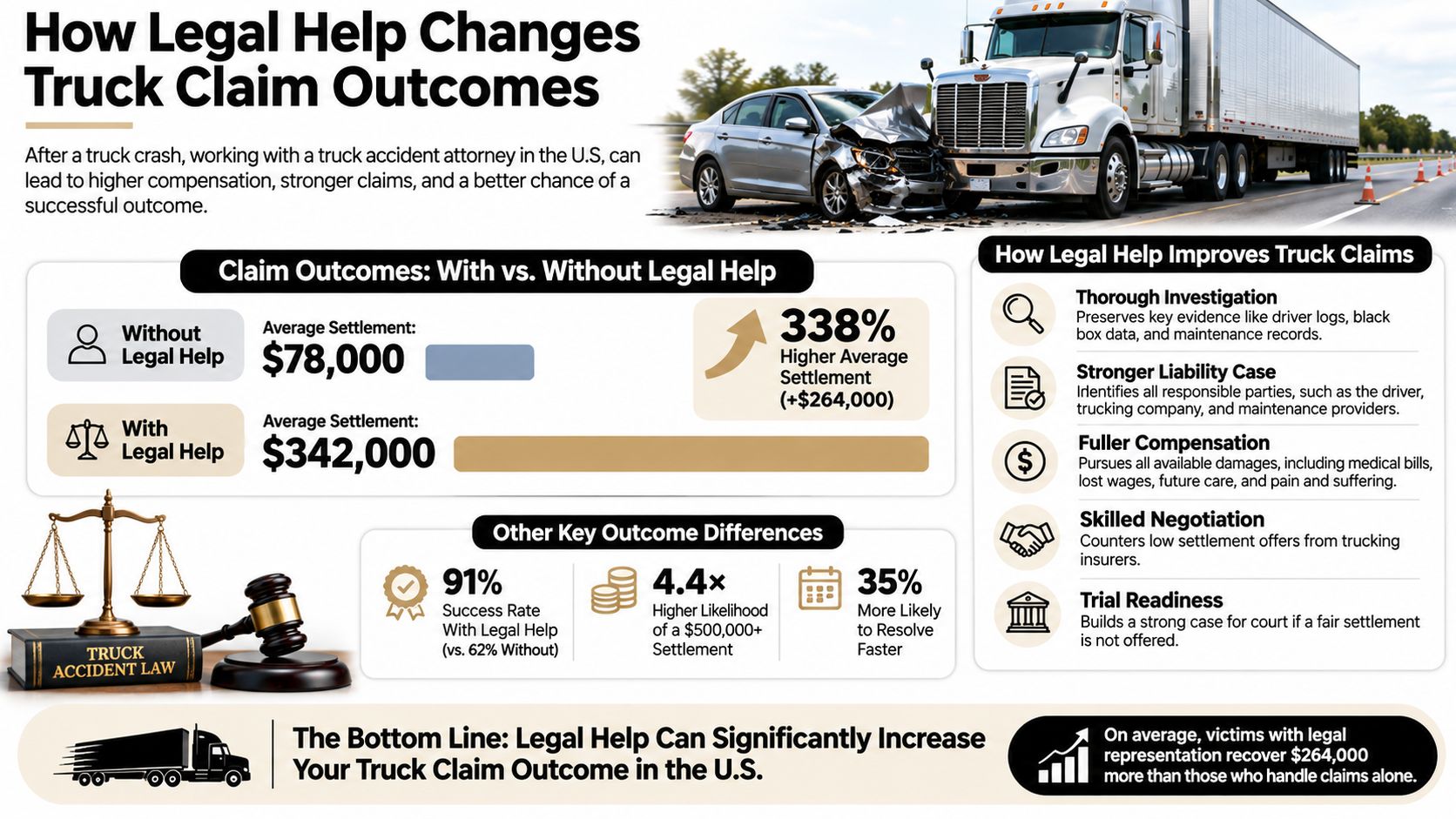
- Line up the logs against real travel time. Fuel timestamps, toll records, GPS pings, and dispatch messages show where the truck was. Read together, they surface the contradictions a paper log hides, and those contradictions support negligence findings that an unexamined file would never produce.
- Press for preservation and discovery, by name. ELD exports, onboard-computer data, dash-camera footage, inspection records, repair histories, and personnel files each need a specific request with a deadline attached. A vague demand for all records gives the carrier room to produce only what helps it.
- Build the damages record while treatment continues. Medical records, imaging, wage documentation, and expert opinions on future care and earning capacity convert a serious injury into a figure a jury can work with. That record also shapes what a truck accident settlement can realistically include, because damages nobody documented rarely get paid.
National crash data does not establish liability in any single collision. What it shows is that compliance is uneven across the industry, and a case-specific comparison of logs, dispatch pressure, and actual travel timing is what shifts how negligence, punitive exposure, and settlement value get evaluated. The carrier controls most of that evidence from day one, so the earlier it gets preserved, the more of it survives.
No lawyer can promise an outcome, and I won't. Results track the facts, the insurance available, and the quality of the evidence that survives. Our firm's truck wreck results include a $1.5 million settlement under policy limits and a $1.25 million truck wreck settlement, and cases like those start with records somebody else would have let disappear.
Mistakes That Weaken a Truck Injury Claim
The costliest errors are ordinary ones, made in the first month, often with good intentions. Each has a fix that takes minutes.
- Accepting a number before treatment ends. An offer made in week three can't account for surgery you don't know you need yet. Keep a treatment log and ask for any offer in writing so the figure and the date are on record.
- Skipping appointments so gaps appear in the chart. Insurers read gaps as evidence the injury wasn't serious. See the doctor promptly and follow the plan even when you feel better, and tell your lawyer if you can't afford a visit, because that's solvable.
- Posting about the crash or a weekend hike. Defense firms pull social media and use a photo of you carrying groceries to argue you're fine. Pause posting and ask family not to tag you or mention your case.
- Treating the carrier's adjuster as a neutral helper. The adjuster works for the insurer and is building a file that protects the company. Once you have counsel, route every call and email through the lawyer.
- Letting a filing deadline slide past. Time limits vary by state, and some claims carry shorter windows than the main injury claim. Ask the lawyer at the first consultation to confirm the deadline for the state where the crash happened and put it in writing.
One habit prevents most of this: write down what happened while your memory is fresh, and keep a copy of every letter, email, and message you receive.
Two paragraphs in a notebook about what you felt that day will outlast a perfect recollection five months from now.
Schedule a Free Consultation Before Evidence Is Lost
The decision in front of you is smaller than it feels. One call tells you whether you have a truck claim worth pursuing, what the deadlines are, and whether preservation letters need to go out this week.
In that meeting, a lawyer at our firm answers your questions, starts assembling the case, and explains how the compensation claim works. Bring the folder. You'll walk through the crash facts, the documents you have, and the same six criteria covered earlier, and you'll leave with next steps and a realistic timeline rather than a promise.
What to bring
- Your notes from comparing firms, including the answers you got to the six questions.
- A written timeline of the crash, each medical visit, and each day of missed work.
- One folder with everything from your first week, photos, the police report number, witness names, carrier and DOT details, and your preservation requests.
If you're not ready to talk to a person yet, four free settlement calculators on our site, covering wrongful death, brain injury, truck accidents, and motor vehicle accidents, give you a rough starting range to react to. Treat any online estimate as a starting point, never as a prediction.
Scheduling is simple. Call the office or use the website, and a free consultation gets set up, no cost and no obligation. The carrier's records retention schedule keeps running whether or not you call anyone.
Nares Law Group LLC handles truck wreck cases from Denver and co-counsels complex trucking and brain injury matters nationally, and our practice covers motor vehicle crashes, truck wrecks, brain injuries, wrongful death, and personal injury. If a commercial truck put you in the hospital, bring the crash report, your discharge papers, and your questions to a free consultation, and we'll tell you what the evidence supports. Visit Nares Law Group LLC to schedule that conversation and get preservation demands moving before the records you need are gone.