The tow yard is calling about your loved one's pickup. A hospital envelope sits unopened beside the funeral paperwork. An insurance adjuster wants a statement, and your family hasn't even agreed on who should return the call.
You don't need to solve the whole case today. But a wrongful death lawsuit in Texas involves more than a distant filing deadline. Who can act, which claim belongs to the estate, and whether the crash evidence still exists can matter while the family is still arranging the funeral.
Who May Sue and Which Deadlines Control the Case
Say your brother dies after a highway collision. You've handled his appointments, helped with his bills, and become the person everyone calls. You assume you can bring the lawsuit, and that the filing clock started when the wreck happened.
Those assumptions can lead the family in the wrong direction. Texas doesn't give every grieving relative a wrongful death claim, and the ordinary wrongful death deadline runs from death rather than automatically from the collision.
The family list comes before the filing
As the GoSuits explanation of Texas wrongful death beneficiaries describes, recovery is limited to the surviving spouse, children, and parents, who may file together or through one or more beneficiaries acting for all; if none files within three calendar months after death, the executor or administrator generally must bring the action unless every eligible beneficiary requests otherwise.
A sibling's closeness, caregiving, or financial dependence doesn't put that sibling on the statutory list. Neither does being a grandparent or an unmarried partner, based on that relationship alone. Step-relatives shouldn't assume that a family label establishes the legal parent-child relationship needed for a claim.
The filing deadline is a separate question. Under Texas Civil Practice and Remedies Code Section 16.003(b), suit ordinarily must be brought within two years after the date of death; Section 16.062 can suspend certain limitations periods for up to twelve months, but an executor's or administrator's earlier qualification can end that suspension, and families shouldn't assume it applies to their wrongful death claim.
Who may file and which Texas clocks apply
| Rule | What Texas law says | The limit families miss |
|---|---|---|
| Who may recover | Surviving spouse, children, and parents only | Siblings, grandparents, and other relatives are excluded |
| How they file | Together, or one or more for all eligible beneficiaries | One case can cover the whole statutory group |
| Three-month mark | If no beneficiary files within three calendar months, the executor or administrator generally must sue | Unless every eligible beneficiary requests otherwise |
| Two-year deadline | Suit within two years after accrual, and accrual is the date of death | Not automatically two years from the crash |
| Possible twelve-month suspension | Death can suspend limitations in specified cases | It doesn't apply to every estate or claim |
The handoff isn't an extension
The estate representative's duty to act doesn't mean the family loses its rights at that milestone. It also doesn't give everyone permission to postpone the investigation. It addresses who must protect the claim, not a fresh deadline for gathering proof.
Practical rule: Put the death date, the estate representative's appointment date, and any filing activity on the same calendar. Don't treat probate and the injury case as unrelated paperwork.
Our guide to the wrongful death lawsuit statute of limitations provides additional context for that deadline discussion.
Before anyone signs a release, make a complete inventory of the surviving spouse, every child, and each surviving parent. Include contact information, supporting relationship documents, and any disagreement about legal status. The relative answering the phone isn't necessarily the person authorized to resolve everyone's claim.
The Family Claim Beside the Estate Survival Claim
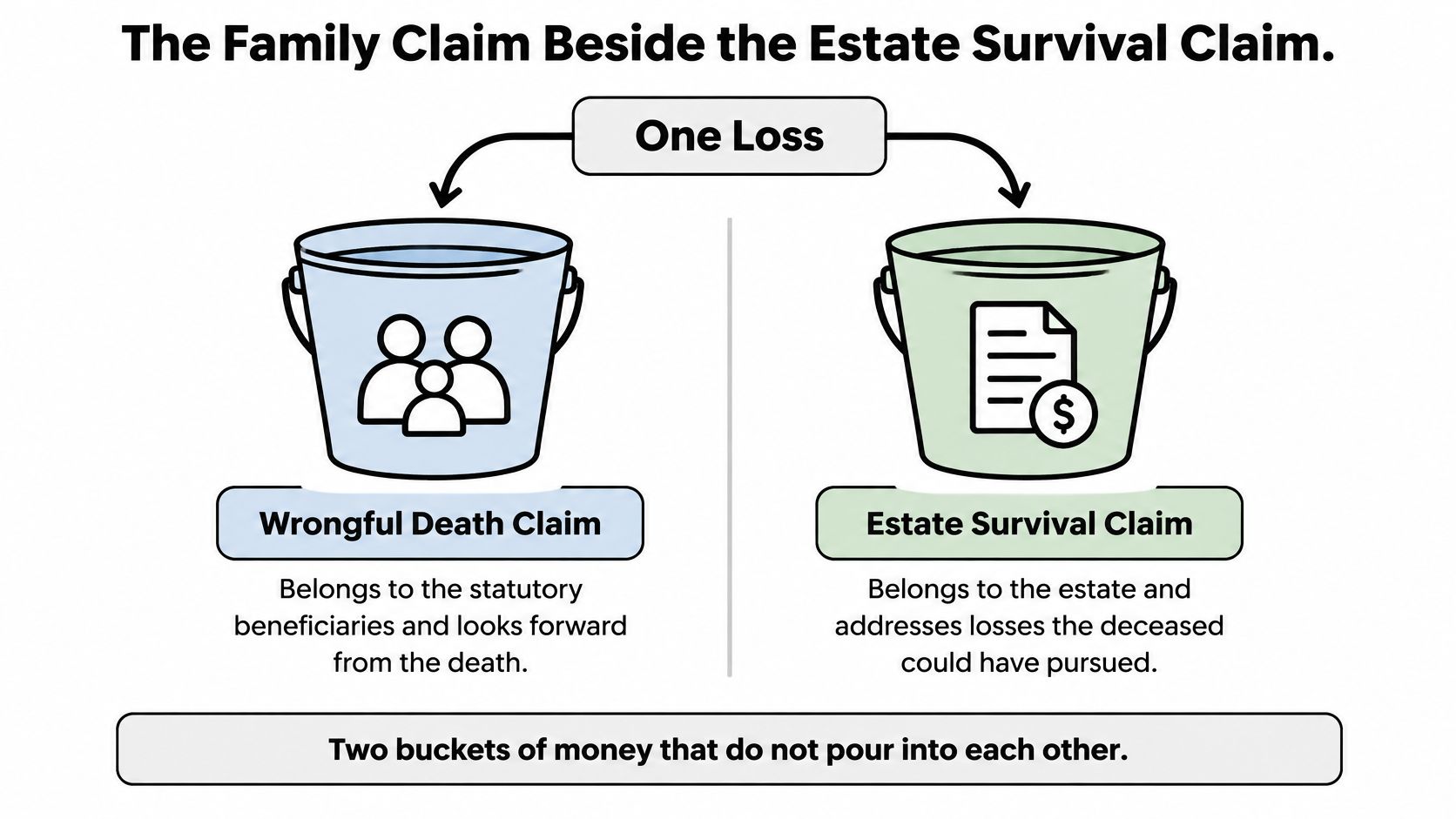
Think of the loss as leaving two separate buckets on the kitchen table. One holds what the family lost because the person died. The other holds the injuries and expenses the person experienced before death. The money doesn't pour from one bucket into the other.
Chapter 71 of the Texas Civil Practice and Remedies Code recognizes both wrongful death and survival claims, making the distinction important even when lawyers pursue them through the same litigation.
The visual below separates those claims by whose losses they address.
Separate losses need separate authority
Say a father survives the collision long enough to receive hospital treatment, then dies. His medical records may help establish his own injuries and conscious suffering. His daughter's account of losing his daily care describes a different injury, one she experiences because he is gone.
Wrongful death claim versus survival claim
| Question | Wrongful death claim | Survival claim |
|---|---|---|
| Whose claim | Statutory beneficiaries | The estate, ordinarily through the proper representative |
| Time it covers | Harm the family suffers because of the death | Harm the person suffered before death |
| Typical losses | Mental anguish, companionship, financial support, inheritance | Conscious pain, medical bills, earnings lost before death |
| Common mix-up | Treating every bill as a family damage | Putting pre-death pain into the relatives' claim |
The distinction changes more than the labels on a demand letter. It affects who has authority to negotiate, what a release should cover, and who ultimately receives the proceeds. Someone authorized to speak for the estate doesn't automatically have authority to settle every beneficiary's personal loss.
For families sorting through estate paperwork, the Law Office of Bryan Fagan, PLLC's resource, Texas Estates Code explained plainly, offers useful context for understanding estate administration alongside the injury claims.
Ask what each signature would settle
A will, an existing probate case, unpaid debts, or a child's involvement can complicate settlement authority. Start with a concrete question: Is this signature resolving a beneficiary's claim, the estate's claim, or both?
Texas also requires a jury to allocate a wrongful death award among eligible claimants by shares stated in the verdict, as reflected in Chapter 71's beneficiary and allocation provisions. One relative's prominence in family discussions doesn't turn the award into that person's money to distribute informally.
Keep the medical chronology and the family's accounts separate from the beginning. That makes it easier to identify the proper claimant without overlooking either kind of harm.
Losses a Texas Family Can Ask to Recover
The first financial shock may be ordinary: rent is due, but the paycheck that covered it won't arrive. Then the family realizes how much unpaid work disappeared too. Someone handled school pickups, prepared meals, repaired the car, or stayed home with a child.
Pecuniary loss concerns financial support and services. Pay stubs help, but so does a clear account of who did what in the household. A job title alone won't explain the full contribution.
Put household losses into recognizable categories
Loss of companionship and society concerns the relationship itself. Mental anguish concerns the surviving person's emotional injury. They aren't interchangeable, and neither becomes clear merely by attaching a family photograph to a claim.
Losses a Texas family can ask to recover
| Loss | Bucket | What it is |
|---|---|---|
| Pecuniary loss | Family wrongful death | Financial support and services, shown through wages, tax records, rent, or childcare |
| Loss of companionship and society | Family wrongful death | The relationship itself, not a receipt |
| Mental anguish | Family wrongful death | Emotional suffering personal to the spouse, child, or parent |
| Loss of inheritance | Family wrongful death | Assets the person would likely have accumulated and left |
| Funeral costs | Often the family claim | Funeral and burial expenses, with attention to who paid or owes them |
| Final hospital bills and pre-death pay | Survival claim | Treatment expenses and earnings lost before death |
| Exemplary damages | Separate and not automatic | Damages requiring qualifying misconduct, such as gross negligence |
| What can be collected | Insurance and assets | Our wrongful death case settled for $1.1 million under policy limits |
Loss of inheritance needs more than the expectation that a parent would someday leave money. The claim calls for a grounded account of likely earnings, spending, savings, and what would probably have remained.
Funeral expenses also require careful accounting. Keep the contract, invoices, payment records, and the name of the person legally responsible. Don't place the same expense in competing demands without resolving how it should be claimed.
A loss and a collectible recovery aren't the same
Our $1.1 million wrongful death settlement under policy limits illustrates a practical distinction: available coverage can constrain settlement even when a family's harm is profound. Past results don't predict another family's outcome, and exemplary damages aren't an automatic addition to an ordinary negligence claim.
A useful damages file explains the person's role in the household. It doesn't try to turn grief into a price list.
Our guide to how much you can sue for wrongful death discusses the difference between claimed losses and potential recovery.
Support for grief is a separate need, not just a litigation task. The Be Your Best Self grief counseling resource from Be Your Best Self & Thrive Counseling, PLLC may help families consider support options while they gather pay records, dependency evidence, and a simple account of daily life before the death.
Proof That Can Vanish While the Family Grieves
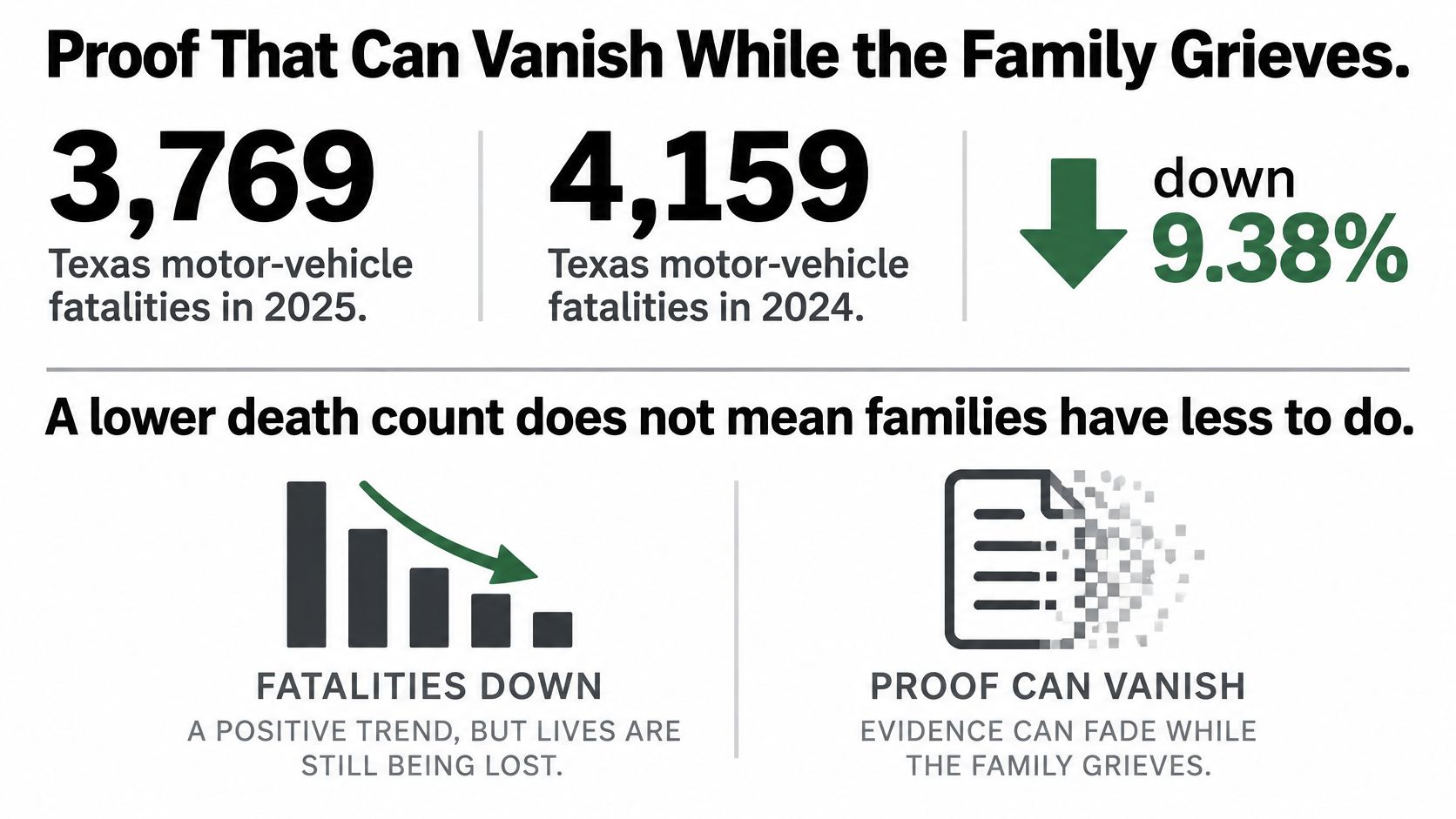
A lower statewide death count doesn't make your family's investigation less urgent. The Texas Department of Transportation's 2025 crash facts report recorded 3,769 Texas motor-vehicle fatalities in 2025, down 9.38% from 4,159 in 2024.
Those figures count reported crash deaths. They don't establish negligence, available insurance, or what a particular family can recover. A nighttime collision on an unlit road still requires someone to reconstruct what happened.
The comparison below pairs that statewide improvement with the family's immediate concern: preserving proof.
The scene can change before anyone calls a lawyer
Say the tow yard releases the pickup for salvage. A nearby store's camera system records over the approach to the intersection. A trucking company continues cycling electronic records through its normal retention system.
None of those events requires the family's permission. Evidence may disappear before anyone understands that it matters.
Evidence that disappears after a fatal crash
| Source | What it can show | How it disappears |
|---|---|---|
| Event-data recorder | Available speed, braking, and belt-use information near impact | Module data lost or altered, or vehicle released, repaired, or destroyed |
| Dashcam and telematics | Location, driving activity, and available time records | Company systems cycle or auto-delete |
| Surveillance video | The approach, signal, or premises condition | Stores and public agencies retain footage only temporarily |
| 911 and dispatch | Call timing and initial reports | Recordings age out under retention practices |
| Driver logs and maintenance | Hours-of-service information and truck condition | Carrier records aren't retained indefinitely |
| Phone and messages | Potential evidence of location, communications, or attention | Devices are replaced, reset, or accounts closed |
Not every vehicle records the same information. A phone's location record doesn't necessarily establish who was looking at it, and a video angle may hide the traffic signal. Preservation protects possible proof; analysis determines what it proves.
Make the request specific
A useful preservation request identifies the collision, vehicles, people, and record categories. For a commercial truck, that may include the tractor and trailer, onboard systems, dispatch communications, driver records, inspection material, and maintenance files. A vague request to save everything can leave important systems unidentified.
Preservation insight: A letter can ask someone to stop deleting a file. It can't restore footage that was already overwritten.
Don't reset the deceased person's phone, discard damaged equipment, or authorize vehicle disposal without discussing the evidence implications. Preserve original files and their metadata rather than relying only on screenshots forwarded through family messages.
Our guide to how to prove wrongful death explains how individual records fit into a broader liability case. The objective is a supported account of the collision, not a pile of files treated as automatic proof of fault.
How a Claim Moves from Death to Filing
A family member may arrive at the first legal meeting carrying a grocery bag of envelopes. That's a workable starting point. The task is to turn those papers into a clear record of dates, authority, evidence, and losses.
This visual shows the initial preparation tasks, not a reason to delay an urgent preservation request.
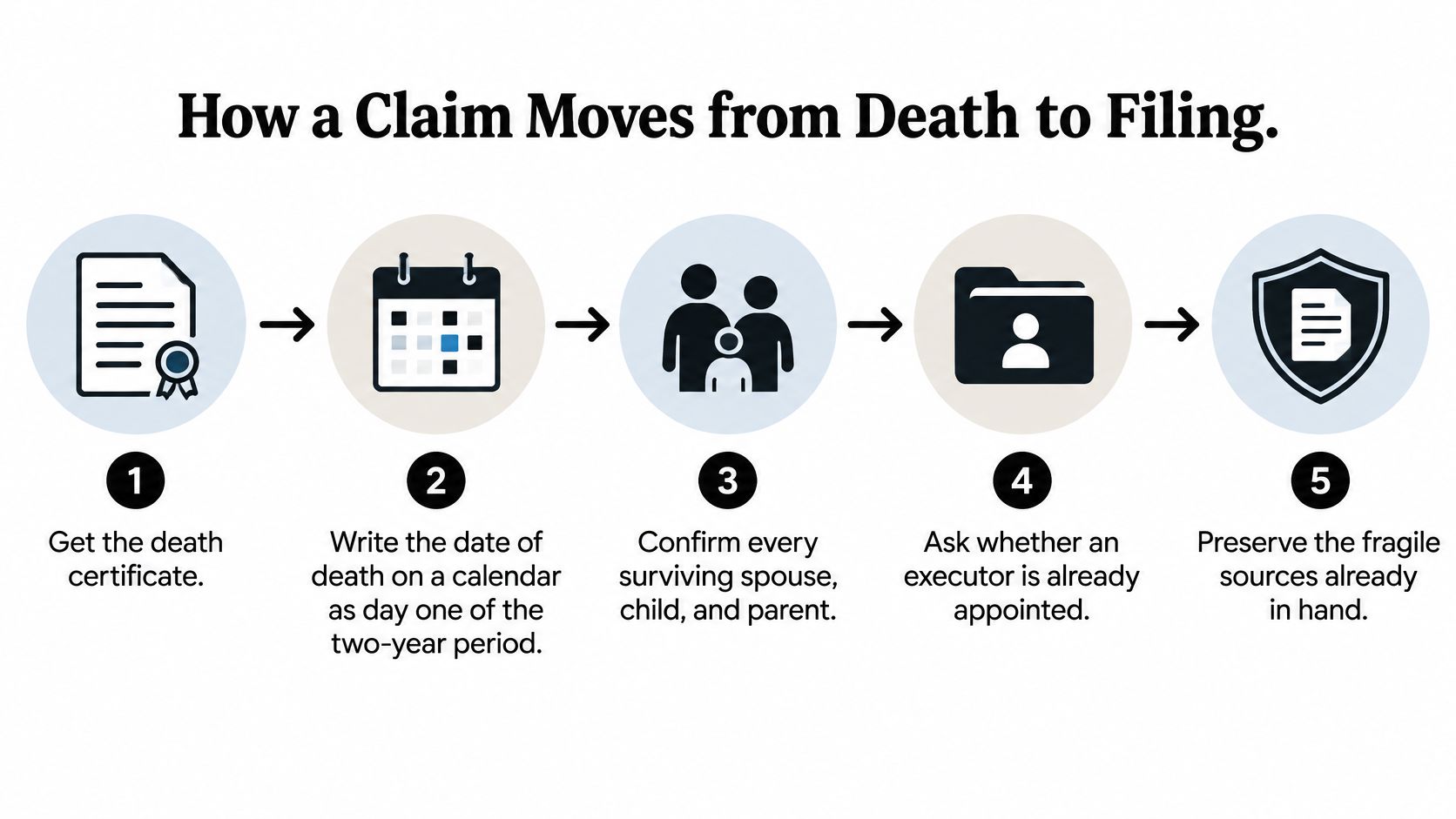
Build the file without waiting for perfect paperwork
Get the death certificate and record the dates. Keep the collision date, death date, and any estate appointment date distinct. If the certificate isn't available yet, tell counsel what you know rather than postponing contact.
Prepare the family inventory. Write down the people who may have beneficiary rights, their contact details, and any minors. Note uncertain relationships instead of trying to resolve them through family assumptions.
Find the estate paperwork. Locate any will, probate filing, and appointment order. Being named in a will isn't the same as showing that someone has qualified to act for the estate.
Resolve who will file. Counsel should assess the estate representative's responsibility if beneficiaries haven't acted. Put that decision in writing so everyone knows who is protecting the case.
Preserve evidence immediately. This task may need to happen before the others are complete. Don't wait for a funeral, a finished probate inventory, or a final crash report before identifying the vehicle and electronic records.
Open separate loss folders. Keep the family's financial and relationship evidence apart from the deceased person's treatment, suffering, and pre-death earnings records. Label uncertain expenses for review rather than guessing.
Create a usable chronology. Collect wage records, tax documents, relationship proof, and medical information. List the facilities that provided treatment and the witnesses who observed the collision or the person's condition afterward.
File in the proper court. Counsel must evaluate defendants, venue, applicable law, and the deadline for each claim. An out-of-state collision needs attention before assuming Texas rules answer every filing question.
Pause before signing away a claim
One of the costliest avoidable mistakes is signing a broad release while authority remains unsettled. A document described as payment for funeral expenses may contain language addressing much more. Send the entire document for review, including attachments and signature pages.
A recorded statement also deserves preparation. You can identify the caller, preserve the correspondence, and arrange a response without guessing about speed, fault, or medical events you didn't witness.
For additional context while organizing your questions, you can watch the following video.
The preparation stage should produce a complaint supported by an identifiable filing strategy. It shouldn't become an endless search for every possible document while the deadline approaches.
When Family Conflict or State Lines Change the Case
Suppose the surviving spouse wants to settle, an adult child wants more investigation, and a parent hasn't received any paperwork. The disagreement isn't solved by choosing the loudest person as the family representative. Counsel needs to identify each claim, each decision-maker, and any conflict between them.
If probate is open, obtain the actual appointment documents. The appointed representative may have responsibilities that another relative doesn't, but that appointment doesn't erase the beneficiaries' individual wrongful death rights.
Match authority to the decision
- An estate without an appointed representative. Counsel should determine whether administration is needed and who can properly pursue the survival claim. Don't assume either that probate is always required or that any heir can sign.
- A child's proposed settlement. A parent's participation doesn't necessarily complete the process. Court approval may be needed to bind the child, and conflicting interests require separate attention.
- Competing settlement instructions. Ask for a written explanation of who is represented, whose approval is required, and how proceeds would be allocated.
Estate debts create another reason to keep the recoveries distinct. Wrongful death damages aren't automatically available to pay the deceased person's creditors merely because a survival claim is being settled at the same time. Any liens, repayment demands, or estate obligations need their own analysis.
A state line changes the questions
Say a Texas resident dies after a truck collision during an interstate trip. The family's home address alone doesn't determine where to file or which state's law governs. Counsel needs the collision location, the involved parties, and the relevant business connections.
Texas permits certain claims involving injuries or deaths outside the state only when statutory conditions are satisfied. Don't assume that selecting a Texas lawyer settles the choice-of-law or venue question.
Before approving a settlement, ask who must sign, whether a child or estate needs additional protection, and whether another state's law affects the claim.
Those questions turn a family disagreement into specific issues that can be addressed before a release is circulated.
Protect the Claim in the First Weeks
You can be grieving and still take a small protective step. Put the essential papers together, identify who is handling communications, and avoid allowing an unanswered insurance letter to become the family's only plan.
The goal isn't to prepare a trial from the kitchen table. It's to bring enough information to a lawyer that urgent decisions don't get lost among funeral arrangements.
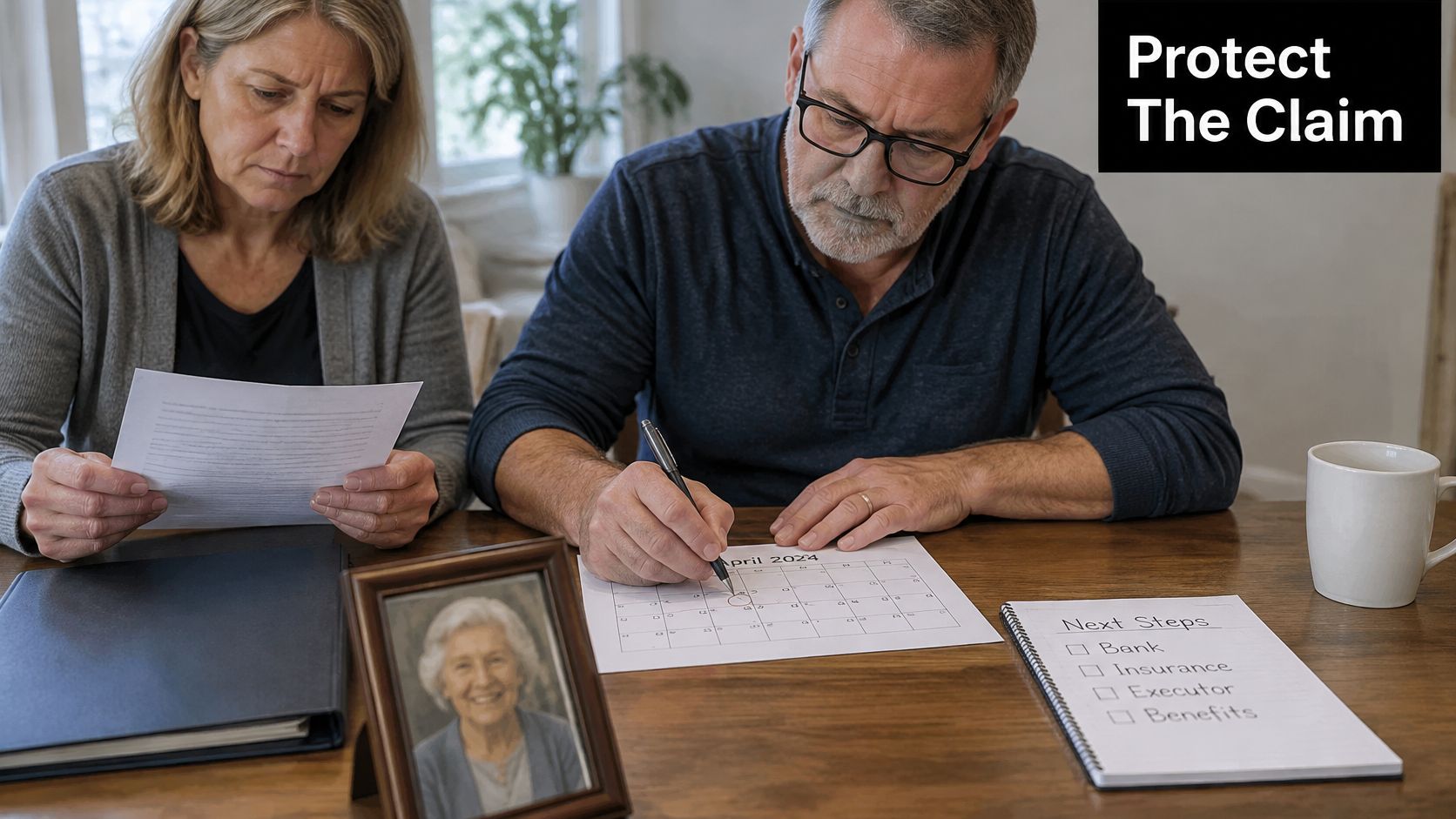
Bring the papers that answer immediate questions
- Identity and authority. Bring the death certificate if available, beneficiary list, will, and probate appointment papers.
- Dates and communications. Include your calendar, insurance correspondence, proposed releases, and contact information for investigators.
- Evidence locations. Identify the tow yard, nearby cameras, involved trucking company, and the person holding the phone.
- Separate loss records. Keep household support documents apart from final treatment bills and pre-death wage information.
Led by Kaitlin Nares, our firm is licensed in Texas and handles wrongful death claims arising from motor vehicle and truck crashes. We can help families address the legal questions without asking them to guess which documents matter.
Don't wait until the file feels complete. A missing certificate can be obtained; an overwritten recording may be gone. The useful next step is a focused conversation while there's still time to protect both the claim and its supporting proof.
Nares Law Group LLC offers a free consultation to answer questions about a Texas wrongful death claim and discuss preparing the case for compensation. Bring your dates, family list, estate papers, and evidence concerns so we can identify the decisions that need attention. Visit Nares Law Group LLC to arrange that conversation before a release is signed or fragile proof disappears.