Choosing the right personal injury attorney is the single most important decision you will make after an accident. It’s not about finding just any lawyer—it's about finding a specialized, trial-ready advocate who understands what you’re up against. This choice is what stands between you and the insurance company’s playbook, ensuring your recovery remains the only priority.
Your First Steps After an Injury
The aftermath of a serious accident is chaos. You're dealing with doctors, mechanics, and a ringing phone. Insurance adjusters are calling, and the pressure is immediate and intense. In the middle of all that, you have to decide who will represent you. That one choice will shape everything that comes next.
Not all attorneys have the right experience. The lawyer who drafted your will is not the right person to handle a complex trucking accident involving federal regulations. An attorney who has never dealt with a traumatic brain injury (TBI) won’t know how to prove its devastating, lifelong impact. You need a legal partner who acts as both a shield and a strategist, protecting you from insurance carriers whose only goal is to pay as little as possible.
Why Your Choice of Attorney Matters Immediately
The clock starts ticking the moment an accident happens. Evidence is fragile and can vanish within days. An experienced personal injury firm knows this and moves with urgency.
- Preserving Evidence: They send investigators to the crash site, pull traffic and surveillance camera footage before it’s overwritten, and talk to witnesses while memories are still clear.
- Controlling Communication: They immediately take over all contact with the insurance companies. This stops you from accidentally giving a recorded statement that can be twisted and used to deny your claim.
- Coordinating Medical Care: A truly client-focused firm, like Nares Law Group, can also help coordinate your medical care. We make sure you’re seeing the right specialists and that every injury is properly documented from day one.
The right advocate doesn’t just show up to react—they start building your case the second you hire them. Their job is to bring back a sense of order and control, freeing you to focus on healing while they manage the legal fight.
This is the difference between an adequate lawyer and a real advocate. While you are in doctor's offices and physical therapy, your attorney is laying the foundation for your case. That work includes getting the official incident report, a critical document that establishes the basic facts. For help with this, see our guide on how to obtain an incident report. This kind of strategic partnership is essential for getting the full and fair compensation you need for medical bills, lost income, and your pain and suffering.
Finding an Attorney Who Specializes in Your Case
Personal injury law is not one-size-fits-all. The lawyer who handles a simple fender bender is rarely equipped for the brutal reality of a commercial trucking crash or the deep complexities of a wrongful death claim.
Choosing a lawyer who lives and breathes your specific type of case is the single most important decision you’ll make. It’s like seeing a heart surgeon for open-heart surgery instead of your family doctor. You need a specialist, not a generalist.
Think about it this way: a wreck with a semi-truck isn't just a bigger car accident. It’s a completely different legal battlefield. These cases are tangled in a web of federal regulations from the Federal Motor Carrier Safety Administration (FMCSA), with critical evidence hidden in driver logs, black box data, and confusing corporate structures designed to deflect blame. A general practitioner might not even know what to ask for. A specialist knows exactly where to find it and how to use it against them.
Matching Your Case to the Right Expertise
Different injuries and accidents demand entirely different legal game plans. When a lawyer has deep experience in one specific niche, they have a massive head start in building your case.
Here are a few common specializations and why they are so critical:
- Commercial Trucking Accidents: These cases often have multiple defendants, from the driver and the trucking company to the broker and the cargo loader. A specialist understands how to untangle the liability and use federal laws to expose driver fatigue, shoddy maintenance, or corporate negligence.
- Traumatic Brain Injuries (TBI): Proving the true, lifelong cost of a TBI is a sophisticated process. An experienced TBI lawyer knows how to work with top neurologists, life care planners, and economists to show the full extent of cognitive damage, future medical needs, and lost earning potential—harms that are often invisible right after the injury.
- Wrongful Death: These are the most emotionally devastating cases imaginable, and they require both compassion and ferocious advocacy. A specialist helps families find a measure of justice by calculating the complete financial and emotional losses, providing some stability for a future that was stolen from them.
The Danger of a "Jack-of-All-Trades" Firm
Hiring a lawyer who doesn't specialize in your type of case can be a disaster. They can miss key evidence, dramatically underestimate the long-term cost of your injuries, or simply get steamrolled by the massive legal teams that big insurance companies and corporate defendants employ.
Choosing a generalist for a complex injury case is like showing up to a gunfight with a pocketknife. Insurance adjusters can spot an inexperienced attorney from a mile away and will exploit that weakness with lowball settlement offers.
With a projected 164,559 personal injury lawyers in the market by 2026 and an industry generating over $61.7 billion in revenue, you have a lot of choices. But true expertise is rare. This saturation means you have to be incredibly selective to find a proven advocate in high-stakes areas like trucking accidents or traumatic brain injuries.
This infographic shows the crucial first steps after an injury, highlighting that finding the right legal partner is a top priority.
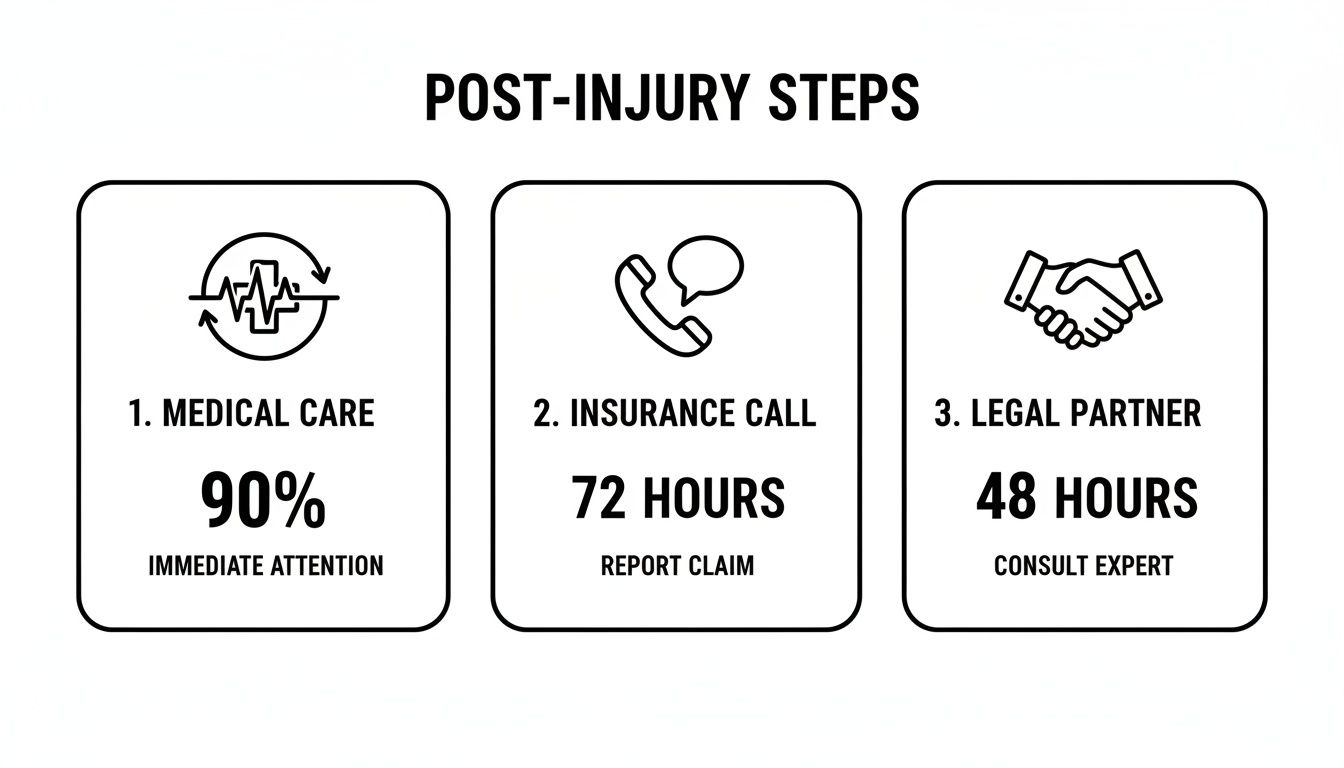
As you can see, seeking legal advice isn’t something you do later. It’s a core part of protecting yourself from the very beginning, right alongside getting medical care.
A firm like Nares Law Group, with its sharp focus on catastrophic injuries and licenses in key states like Colorado, Texas, and New York, shows the power of specialization. This focused knowledge provides a deep understanding of the laws and trial tactics that win these tough, high-value cases. Sometimes, the best strategy involves co-counseling with specialized lawyers to combine local insight with world-class trial skills.
Your goal is simple: find an attorney who has won cases just like yours, time and time again. Their track record isn’t just a number—it’s the best proof you have that they can secure the future you and your family deserve. Don’t settle for a jack-of-all-trades. Demand a master of the one that will define your future.
Why Trial Experience Matters for Your Settlement
You’ve probably heard the statistic: over 95% of personal injury cases settle out of court. It’s a number that gets thrown around a lot, and it’s dangerously misleading.
It makes it sound like trial skills don’t matter. But after years of fighting for my clients, I can tell you the exact opposite is true. An attorney’s reputation for winning in the courtroom is the single most powerful tool you have to get a fair settlement without going to court.
Insurance companies are not in the business of doing what’s right. They are corporations built to maximize profit by minimizing what they pay you. They have entire systems designed to evaluate your claim, and a big part of that evaluation is sizing up the lawyer you just hired.
They know who will fold and who will fight. If you want to get what you rightfully deserve, you need a lawyer who is ready, willing, and able to go to trial.
The Two Types of Personal Injury Lawyers
In my world, there are really only two kinds of personal injury attorneys: those who process claims and those who build cases for a jury. The difference between them will have a massive impact on your final recovery.
Settlement Mills: These law firms are all about volume. They take on a huge number of cases and aim to settle them as quickly as possible, even if it means leaving money on the table. Their business model depends on avoiding the cost and effort of a real fight.
Trial-Focused Firms: Firms like ours prepare every single case as if it's going to trial. This isn't just a slogan; it’s a completely different approach that starts from day one.
Insurance adjusters have a name for the first group. They know those lawyers will almost always advise their client to accept a low offer because they simply don't have the experience, the resources, or the stomach for a courtroom battle. When an adjuster sees that kind of lawyer on a file, their first offer is almost always lower. They’re betting the lawyer will blink first.
How a Trial-Ready Approach Forces a Better Offer
When an attorney prepares every case for a potential trial, it sends a powerful message to the insurance company: we are serious, and we are not going away.
This strategy starts with a deep and immediate investigation. We don’t just wait for the police report. We hire accident reconstruction experts, pull black box data from commercial trucks before it’s erased, and find and interview witnesses while the details are still fresh in their minds.
It also means bringing in top-tier expert witnesses from the very beginning. We work with neurologists who can explain the lifelong impact of a brain injury, economists who can calculate every dollar of lost future income, and life care planners who can create a roadmap of your future medical needs and its costs.
When an insurance company sees your attorney is already spending significant time and money to build an airtight case with credible, respected experts, they know a lowball offer isn't just insulting—it's a losing move for them. That preparation forces them to the table to negotiate in good faith.
This intense, early preparation is the foundation of a strong claim. It shows the insurer that you have the evidence to prove every dollar you are demanding. It's not about being aggressive; it's about being so thoroughly prepared that going to trial becomes a much bigger risk for them than it is for you.
If you're interested in how this strategy gives clients an edge, you can read more in our article about why other firms co-counsel with a trial lawyer to maximize case value.
Beyond the Settlement Check
Hiring a trial lawyer is about more than the final number on a check. It’s about knowing you have a true advocate who won’t get pushed around when things get hard.
An attorney with a proven track record in court has the confidence and skill to give you honest advice. They can tell you when an offer is truly fair and when you should hold the line, because they know they have what it takes to win that fight for you.
You don’t hire a trial lawyer because you want to go to court. You hire one so you have the strength and credibility to make sure you never have to. It's the ultimate insurance policy for your own claim.
Understanding Legal Fees and Client Agreements

Let’s talk about money. It’s often the most intimidating part of hiring a lawyer, but it shouldn’t be a mystery. Most legitimate personal injury firms work on a system designed to give you access to top-tier legal help without paying a dollar out of pocket.
This is called a contingency fee. Simply put, our fee is contingent on winning your case. If we don’t get you a settlement or a trial verdict, you owe us nothing for our time. No retainer, no hourly bills.
This "no fee unless you win" model is the standard for a reason. It means our success is tied directly to yours, giving us every incentive to secure the highest possible compensation for you. More importantly, it ensures everyone can afford to fight back against a powerful insurance company, no matter their financial situation.
Decoding the Contingency Fee Percentage
You'll typically see contingency fees ranging from 33% to 40% of the total amount recovered. The specific percentage isn't random; it reflects the amount of work and risk involved in your case, especially depending on when it resolves.
A case that settles before a lawsuit is ever filed requires less work than one that goes all the way to a jury. For that reason, the fee is usually lower, around 33.3%, if we can resolve it in the pre-litigation stage.
If the insurance company refuses to make a fair offer and we have to file a lawsuit, the work escalates significantly. The case will involve depositions, extensive legal motions, and potentially a full-blown trial. To account for that massive increase in time and resources, the fee typically shifts to 40%.
Any good attorney will walk you through this clearly in your first meeting and put it all in a written agreement for you to review.
The Most Important Question to Ask About Case Costs
The fee is only one part of the financial picture. Building a strong personal injury case costs money. These are known as case costs, and your law firm fronts these expenses on your behalf.
Common case costs might include:
- Fees to get your medical records and the official police report
- Court filing fees
- Hiring court reporters for depositions
- Paying expert witnesses, like accident reconstructionists or specialized doctors
These costs can add up, running from a few hundred dollars to tens of thousands in a complex injury case. At the end of the case, the firm is reimbursed for these advanced costs out of your settlement.
Crucial Takeaway: You must ask whether case costs are deducted before or after the attorney's percentage is calculated. This one detail can make a massive difference in the money you actually put in your pocket.
Let's break down how this works with a real-world example. Say you have a $100,000 settlement, $10,000 in case costs, and a 33.3% attorney fee. The math changes everything.
A transparent breakdown is the only way to see how a firm’s policy impacts your bottom line.
How Case Costs Affect Your Settlement
| Calculation Method | Attorney A (Costs Deducted Before Fee) | Attorney B (Costs Deducted After Fee) |
|---|---|---|
| Gross Settlement | $100,000 | $100,000 |
| Attorney's Fee | $30,000 (33.3% of $90,000) | $33,333 (33.3% of $100,000) |
| Case Costs | $10,000 | $10,000 |
| Your Net Recovery | $60,000 | $56,667 |
As you can see, the exact same case results in a $3,333 difference to you, all based on the firm's accounting method.
A client-first firm believes your recovery should always be the priority. At Nares Law Group, we always deduct case costs before calculating our fee because it is the fair and right way to do business.
This isn’t just a detail in the fine print; it's a reflection of a law firm's entire philosophy. Insist on a clear explanation and make sure you understand every line of the fee agreement before signing. A lawyer who values your trust will welcome your questions and want you to feel completely confident in your partnership.
How to Prepare for Your Initial Consultation

That first meeting with a potential lawyer isn’t just about them sizing up your case. It’s your interview, too. You’re deciding who you can trust to fight for you during one of the most difficult times of your life.
This is your chance to see if their expertise, personality, and approach are the right fit. Walking in prepared gives you control. It turns a simple chat into a real evaluation, so you can make a decision with confidence.
Most reputable firms, including Nares Law Group, offer this first meeting for free. There’s no financial risk in taking the time to find the right advocate. The goal is to leave knowing exactly what it would be like to work with that attorney. Are they a true partner, or just another case file?
Documents to Bring for an Effective Meeting
To get a real, substantive analysis of your case, an attorney needs more than just a story. They need documents. Bringing everything you have allows them to spot strengths and challenges from the very beginning.
Try to organize these items in a folder before you arrive:
- The Official Police or Incident Report: This is the foundation. It provides the undisputed, basic facts of what happened.
- Photos and Videos: Bring any pictures or videos you have of the scene, vehicle damage, and your injuries. Visual evidence is incredibly powerful.
- Medical Records and Bills: Gather everything you can find—from the first ER visit to prescriptions, physical therapy notes, and follow-up appointments.
- Insurance Company Correspondence: Any letters, emails, or denial notices you’ve received are crucial. This shows the attorney what arguments the insurance company is already trying to make.
- Your Personal Notes: If you've been keeping a journal about your pain, symptoms, or how the injury affects your day-to-day life, bring it. This personal account fills in the gaps that official records miss.
Showing up organized does more than save time. It shows you’re serious and allows the conversation to go beyond fact-gathering and straight into strategy.
Questions That Reveal More Than Just Experience
Everyone knows to ask about fees and years of experience. But the most telling questions dig deeper. They uncover how the firm actually operates and how they treat their clients day-to-day.
Your questions should be designed to uncover what the day-to-day partnership will look like. Are you going to be a priority or just another case file? The answers to these questions will tell you.
Try asking a few of these to get past the surface-level pitch:
Who will be my primary point of contact at the firm? Will you be speaking with the attorney you’re meeting now, or will your case be passed to a paralegal or case manager? There's no wrong answer, but you deserve to know.
How often can I expect to receive updates, and what do they look like? This question sets clear communication expectations from the start.
Based on what you know so far, what do you see as the biggest challenges in my case? An attorney who gives you an honest, thoughtful answer is a strategic thinker. Someone who only tells you what you want to hear might not be prepared for a real fight.
Can you walk me through your process if the insurance company makes a low settlement offer? This reveals their negotiation style and their willingness to go to court if necessary. You want a fighter, not just a settler.
What is your philosophy on client care? This is an open-ended question that lets them show you what they value. Do they talk about compassion, transparency, and partnership, or does the conversation immediately turn back to the money?
This initial consultation is your opportunity to hire a partner, not just a service provider. By preparing your documents and asking the right questions, you can choose an attorney with the skills and character to guide you toward the best possible outcome.
Red Flags to Watch For When Hiring an Attorney
Choosing the wrong attorney can feel almost as damaging as the accident itself. You’re putting your future in someone else’s hands, and that requires absolute trust. So, how do you spot the warning signs?
Start by listening to your gut. Your intuition is one of the most powerful tools you have. If a meeting feels off, if the person across from you makes you uneasy, pay attention to that feeling. It’s often right.
Be immediately wary of any attorney who makes a guarantee about your case’s outcome. No ethical, experienced lawyer can promise a specific dollar amount or a surefire win. The legal process is simply too unpredictable.
An honest advocate will give you a confident strategy and a realistic assessment of the challenges. They won't sell you a false promise. Anyone who guarantees a result is either dangerously inexperienced or flat-out lying to get you to sign.
The same goes for high-pressure tactics. If you feel cornered or rushed to sign a contract on the spot, that's your cue to walk away. A reputable attorney wants you to be certain about your choice. They will give you the time and space you need to review their agreement and feel completely comfortable.
Communication and Professionalism
Pay close attention to how they communicate from the very first phone call. If an attorney or their staff is hard to reach before you've hired them, they will likely be impossible to get ahold of once they have your case.
This isn't just about being busy; it often points to a chaotic, disorganized practice. As you sit in that initial consultation, ask yourself:
- Does the office feel calm and professional, or is it frantic?
- Is the attorney actually listening, or are they just waiting for their turn to talk?
- Do I feel like my story is being heard and respected, or am I being dismissed?
If you walk out of a consultation feeling more confused, anxious, or unheard than when you walked in, that is your signal to keep looking. This is a partnership. Trust and clear, respectful communication are the foundation.
At Nares Law Group, we build that foundation from day one. We ensure you understand the road ahead and feel like a respected partner, not just another case file.
What a Great Advocate Looks Like
In sharp contrast to these red flags, a great advocate has clear, positive traits. They don’t just talk; they listen with compassion. They think strategically but communicate with honesty, setting realistic expectations from the start.
A strong attorney will discuss the potential weaknesses in your case just as openly as they discuss its strengths. They aren't trying to sell you—they're trying to prepare you.
Ultimately, everything comes down to trust. You’re hiring a professional to protect your future during one of the most vulnerable times of your life. Don’t compromise. Find someone who earns that trust with their actions, not just their words.
Your First Questions After an Injury
After an accident, your mind is probably racing with questions. It’s a confusing and overwhelming time. Getting clear, straightforward answers about the legal process is the first step toward getting your life back on track.
Here’s what you need to know.
How Soon Should I Talk to a Lawyer?
The simple answer? As soon as you can. The first few days after an accident are critical.
Key evidence, like security footage from a nearby business, can be erased on a weekly loop. The memories of witnesses start to fade almost immediately. On top of that, strict legal deadlines called statutes of limitations limit how long you have to file a claim. Miss that window, and you lose your rights forever.
Contacting an attorney early also puts a shield between you and the insurance companies. Adjusters are trained to get you on a recorded call and ask leading questions designed to weaken your case. Once you have a lawyer, they handle all communication, protecting you from these tactics while they get to work building your claim.
What if I Can't Afford to Hire an Attorney?
This is the biggest worry for most people, and it should never be a barrier to getting help. Reputable personal injury firms, including Nares Law Group, work on a contingency fee basis.
You pay absolutely nothing upfront. No retainers, no hourly bills.
A contingency fee simply means our fee is a percentage of what we recover for you. If we don't win your case, you owe us nothing for our work. This model ensures that everyone has access to top-tier legal help, no matter their financial situation.
Does Hiring a Lawyer Mean I Have to Go to Court?
It’s highly unlikely. The reality is that over 95% of personal injury cases settle without ever seeing the inside of a courtroom.
But here’s the crucial part: the quality of that settlement offer depends entirely on the insurance company’s respect for your lawyer. They keep detailed records on which attorneys actually go to trial and which ones always settle for less.
When they know your lawyer is not afraid to face a jury and has a track record of winning, their settlement offers become much more serious. Hiring a trial-tested attorney is your best leverage for getting a fair offer at the negotiating table.
At Nares Law Group LLC, we are trial lawyers. That preparation is what allows us to secure the outcome you deserve, whether through a strategic settlement or a verdict in court.
If you have questions about your injury, let's talk. Schedule a free, no-obligation consultation with our team today and get the clarity you need to move forward.
Composed with Outrank app