The funeral arrangements may still be unfinished. Medical bills are arriving, relatives are asking what happened, and an insurance adjuster wants to talk. You may be wondering whether you should return that call or speak with a lawyer first.
If you're asking, how does a wrongful death lawsuit work, start with a quieter question: who has legal authority to act, and what deadlines need attention? In a Colorado case, those answers deserve attention before anyone discusses a settlement or signs paperwork.
How Wrongful Death Law Works as a Statutory Claim
Can we even sue? That's often the first question after a fatal crash. A family may have strong reasons to believe someone acted carelessly, but the legal answer depends on more than what happened at the scene.
Wrongful death is a statutory civil claim, meaning the legislature defines the right to bring it. English common law generally didn't allow relatives to recover for another person's death until the Fatal Accidents Act 1846, which took effect in August 1846, allowed a personal representative to pursue specified relatives' financial losses. That model helped shape modern wrongful-death statutes, as explained in the history of the Fatal Accidents Act.
Why the governing state matters
Consider a family whose relative lived in Colorado but died during a trip elsewhere. They shouldn't assume that either the home address or the crash location settles every legal question. Counsel needs to identify the governing law before advising who can sue and what compensation may be available.
The statute supplies boundaries that an insurance conversation can't replace:
- Filing authority: Which person may bring the lawsuit?
- Beneficiaries: Which relatives may receive compensation?
- Recoverable losses: What harm does the law recognize?
- Procedural requirements: Which deadlines and related rules apply?
Those distinctions explain why advice from a relative's lawsuit in another state may not fit your situation. A similar fatal crash can involve different filing rights and damages under a different statute.
Accountability still requires proof
A tragic outcome alone doesn't establish liability. A negligence-based claim generally requires proof of a legal duty, a breach of that duty, a connection between the breach and the death, and compensable losses. The practical task is turning what the family suspects into evidence that supports each requirement.
You don't need to decide immediately whether you're emotionally ready for litigation. You do need enough information to avoid losing the ability to decide later. For support separate from legal decisions, DeTalks' resource on coping with different kinds of loss offers a place to begin thinking about grief without making the lawsuit the center of family life.
Who Can File and Why the Estate Matters
Being the closest relative and having authority to file aren't necessarily the same thing. Neither is being named in a will the same as qualifying for compensation under a wrongful-death statute.
In many jurisdictions, an estate's personal representative brings the claim, while statutory beneficiaries receive the recovery. That representative may be an executor or a court-appointed administrator. The distinction between the person managing the claim and the people benefiting from it is described in this discussion of wrongful-death filing authority and estate administration.
Separate the legal roles
For a Colorado matter, don't import another state's representative requirement without checking Colorado law. Counsel should evaluate the wrongful-death filing rules and any estate-related claims separately. The estate may matter substantially without being the proper plaintiff for every claim.
| Role | Question to resolve |
|---|---|
| Person seeking to file | Does the governing statute authorize this person to sue? |
| Personal representative | Has someone been appointed to act for the estate where necessary? |
| Statutory beneficiary | Who may receive compensation under the applicable law? |
| Family contact | Who will organize information and communicate with counsel? |
A useful starting point is understanding who can sue for wrongful death. Bring the family relationships and available estate paperwork to that discussion rather than assuming that one relative can sign for everyone.
When family circumstances complicate authority
No will, disagreements among relatives, or children from different relationships can make the initial review more involved. Counsel needs a complete family picture, including relatives who aren't participating in the first consultation. Leaving someone out because relationships are strained doesn't resolve their possible legal interest.
Also distinguish a wrongful-death claim from a survival claim. The former generally addresses survivors' losses; the latter may preserve claims the deceased person could have pursued before dying. Ask which claims belong to which plaintiff and whether probate action is needed to pursue them.
Practical rule: Resolve who may act before asking anyone to approve a settlement.
Government involvement adds a separate concern. Claims involving cities, states, or public agencies can require written notice substantially earlier than the ordinary lawsuit deadline. Tell counsel immediately if a public vehicle, public employee, or public agency may be involved, even if you're unsure whether that party caused the death.
Colorado Deadlines and Early Warning Dates
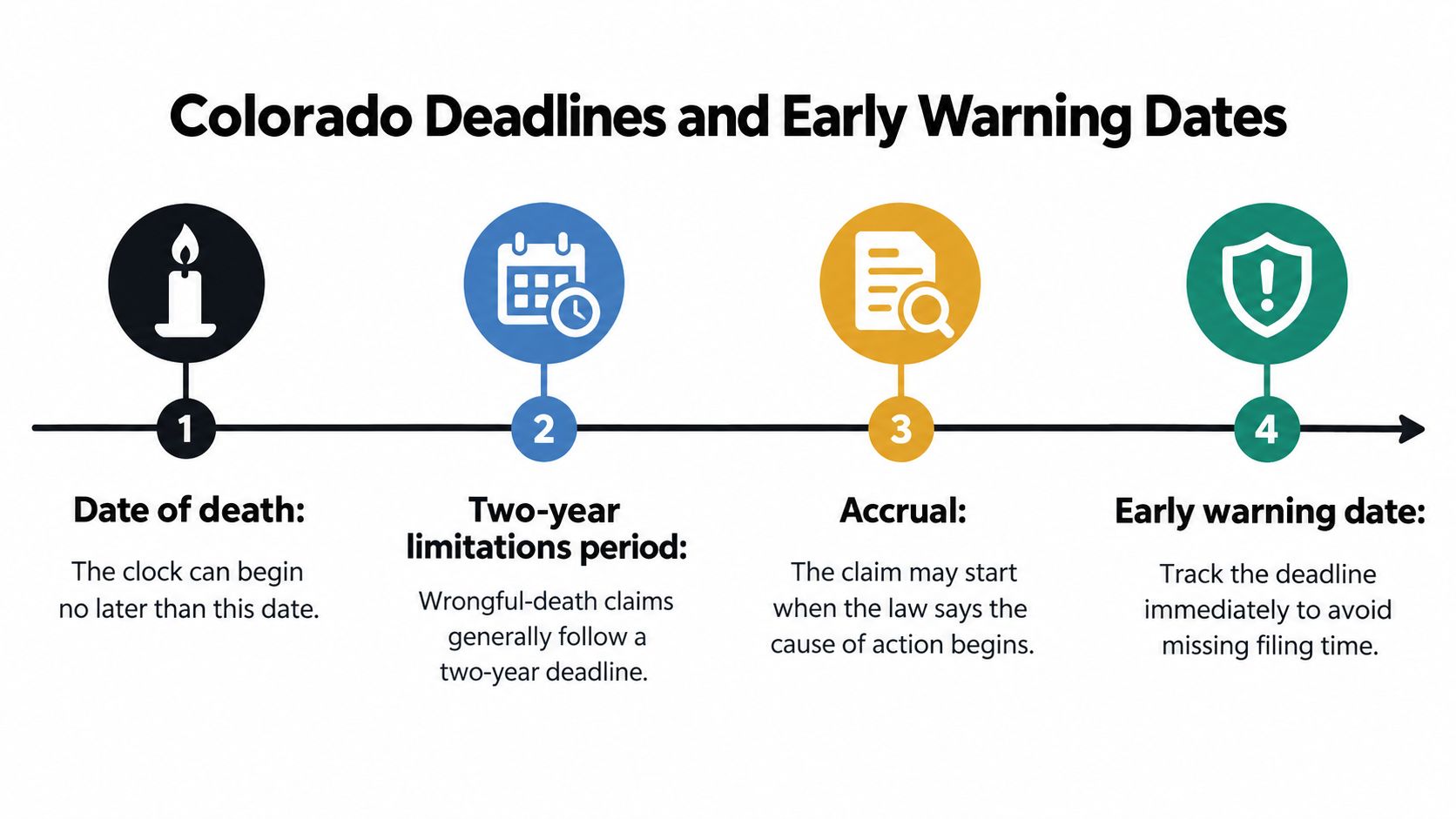
Colorado wrongful-death claims generally follow a two-year limitations period, with accrual beginning no later than the date of death. Certain accrual questions can involve when an injury or alleged negligence became known or reasonably discoverable; counsel must also address the election between specified statutory causes of action rather than seek duplicative recovery under both, under Colorado's wrongful-death damages and limitations provisions.
That's a starting rule, not a reason to mark a distant date and wait. The filing deadline, a possible government notice requirement, and the time needed to identify the authorized claimant belong on the same working calendar.
This timeline highlights the dates to flag for legal review.
Build the calendar from documents
Use records rather than memory wherever possible. Counsel should review the sequence of the injury, medical care, death, discovery of relevant information, and any estate appointment before giving a deadline opinion.
- Immediately after the death: Record the death date and the date of the underlying incident. Save any notices already received.
- During the initial legal review: Identify potential defendants and flag government involvement. Ask counsel to determine the earliest applicable notice or filing requirement.
- As estate issues are addressed: Record appointment dates and outstanding probate tasks. Don't assume estate administration postpones the lawsuit deadline.
- Before negotiations become prolonged: Confirm who is tracking each deadline and what must be filed or delivered to preserve the claim.
Don't plan around a possible exception
Families sometimes focus on when they first learned that something went wrong. That information can matter, but it shouldn't become a self-calculated extension. Accrual is a legal determination, not merely the date a family felt certain enough to call an attorney.
Ask for the earliest plausible deadline, not just the latest arguable one.
The election requirement also deserves an early explanation. Ask counsel which statutory route fits the claim, what choosing it means, and whether that choice affects the damages analysis. Those decisions should follow a review of the facts, not happen hurriedly because the filing date is approaching.
Investigating the Crash and Preserving Evidence
A useful investigation connects evidence to a legal question. Counsel needs to establish what the defendant did, why it violated a duty, how it caused the fatal injury, and which losses followed.
Reviewing scene photographs with counsel can help the family identify missing information without having to reconstruct the crash alone.

Secure records and identify evidence holders
Counsel should promptly obtain medical and autopsy records, police reports, employment and tax records, insurance policies, photographs, electronic evidence, and witness information. Preservation demands are particularly important for vehicle telemetry, surveillance footage, maintenance files, and electronic logs that may be overwritten, as outlined in Justia's state-by-state wrongful-death litigation overview.
Each group of records serves a different purpose:
- Medical and autopsy records: Help evaluate the connection between the incident, injuries, treatment, and death.
- Reports, photographs, and witness information: Help reconstruct events and identify disagreements about what happened.
- Vehicle and business records: May help investigate vehicle operation, maintenance, or work-related conduct.
- Financial and insurance documents: Support the loss analysis and identify potential coverage.
Requesting evidence isn't the same as preserving it. Counsel should consider who holds the material and whether a specific preservation demand is needed. A request for an accident report doesn't necessarily protect a nearby business's surveillance recording.
Make intake useful without demanding perfect answers
A family rarely arrives with a complete file. Start with what you have and distinguish firsthand knowledge from information someone else provided. If you don't know whether a truck driver was working, for example, say so rather than trying to fill the gap.
For a sense of how lawyers organize these conversations, Lighthouse Legal's guide to what to ask prospective injury clients provides intake context. Families can use it to prepare, not as a requirement to investigate the case themselves.
If a video format is easier to review with relatives, keep the case-specific questions beside you as you watch.
Keep a shared evidence folder with counsel using an agreed secure method. Note each document's source and date, preserve originals, and avoid editing original photographs or recordings. A focused wrongful-death investigation should account for death-specific filing and damages rules rather than treat the matter as a routine injury claim.
Filing the Complaint Through Settlement or Trial
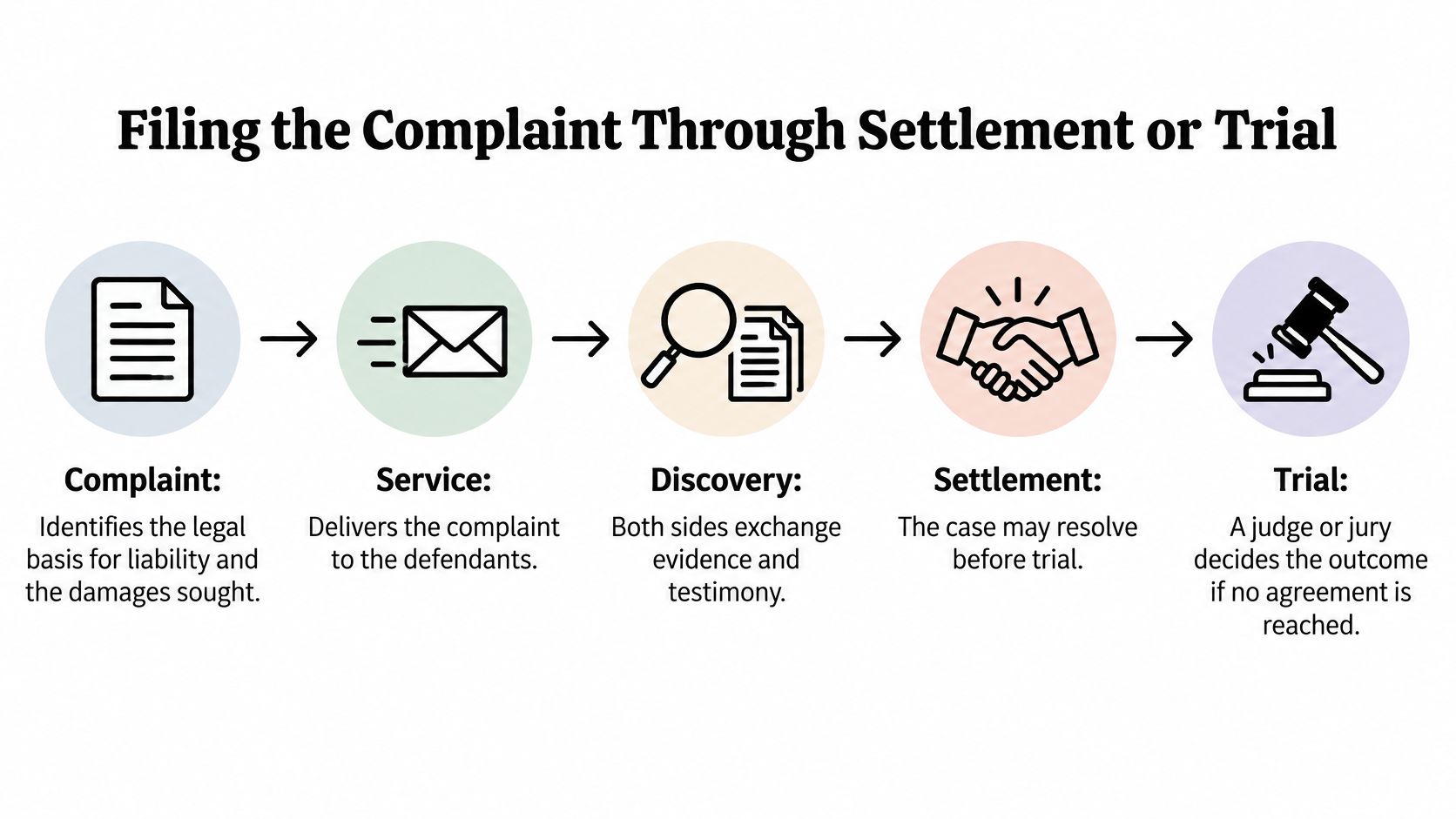
The complaint turns the investigation into formal allegations. It identifies the legal basis for holding the defendants responsible and the damages sought. Service follows, then discovery, settlement discussions, and trial if the parties don't resolve the case.
Filing isn't proof that the allegations are established. It begins the court process through which the parties develop, challenge, and present their evidence.
The process below shows the main stages, although negotiation can occur alongside the other work.
Discovery should answer disputed questions
During discovery, each side exchanges records and testimony. The work should address actual disputes: whether a driver acted negligently, whether another event contributed to the death, or whether the claimed financial losses are supported.
Ask counsel what remains uncertain and which evidence could change the evaluation. A case with strong crash evidence but an unresolved medical-causation question requires a different approach from one in which responsibility is clear but future support losses are disputed.
Settlement deserves reassessment at meaningful milestones:
- Liability investigation: Is there enough evidence to identify responsible parties and evaluate defenses?
- Expert disclosures: Do qualified opinions support causation and the damages model?
- Discovery completion: Have important documents and testimony changed either side's position?
- Mediation and motion rulings: Have negotiations or rulings on potentially case-ending motions narrowed the remaining risks?
Prepare for trial without treating it as inevitable
Historical Bureau of Justice Statistics data covering tort cases in the 75 largest U.S. counties found that about 3% reached a trial verdict, and plaintiffs won roughly half of those trials, according to the BJS report on tort cases in large counties. These are broad tort benchmarks, not wrongful-death success rates, current predictions, or a way to value your family's claim.
The sensible approach is to prepare evidence for trial while remaining willing to settle on informed terms. Trial preparation and negotiation aren't competing strategies when both depend on a well-supported account of liability and loss.
A policy-limit offer is information about a proposed payment, not proof that every source of recovery has been identified.
Before accepting an early offer, counsel should confirm beneficiaries, liens and medical claims, future losses, other potential defendants, and available excess coverage. The comparison should include the likely recovery, liability risk, collectability, litigation expense, delay, and the possibility of an adverse verdict.
A headline verdict from an unrelated lawsuit doesn't answer those questions. Neither does an adjuster's assurance that the offer is the most convenient way to finish the matter.
Recoverable Damages Families Can Claim
A damages analysis should explain what the family lost and how the law permits those losses to be measured. It shouldn't begin with a target settlement figure and work backward.
As reflected in the statutory framework and litigation overview discussed above, common economic categories include medical and funeral expenses, lost income, lost financial support, and lost household services. Noneconomic losses, such as companionship or guidance, depend on the governing law.
Wrongful Death Damages by Category
| Damage Category | What It Covers | Evidence That Supports It |
|---|---|---|
| Medical expenses | Recoverable expenses associated with the fatal injury | Medical records, itemized bills, payment records |
| Funeral expenses | Recoverable funeral and related expenses | Invoices, receipts, service agreements |
| Lost income and financial support | Financial contributions the deceased would have provided | Tax returns, earnings records, employment benefits, expert analysis |
| Lost household services | Work and assistance the deceased provided at home | Family accounts, task descriptions, replacement-service records, valuation analysis |
| Noneconomic losses where permitted | Loss of companionship or guidance | Specific accounts of the relationship and the support provided |
| Pre-death losses where permitted through an appropriate claim | Losses associated with the deceased person's surviving claims | Medical evidence and claim-specific supporting records |
Make the assumptions visible
Future-loss calculations may require life-expectancy and earnings analysis, valuation of benefits, and an assessment of household services. Ask which assumptions the lawyer or expert is using and what evidence supports them. A credible model acknowledges uncertainty rather than presenting every future contribution as guaranteed.
Describe unpaid work concretely. For example, explain who handled childcare, transportation, cooking, or household maintenance and how those responsibilities have changed. That gives counsel something more useful than a general statement that the deceased did everything.
For punitive damages, ask whether the governing law permits a claim addressing egregious conduct and what proof would be required. Don't include a punitive recovery in the family's financial plans before counsel confirms its legal and evidentiary basis.
The wrongful-death damages analysis should also address allocation among beneficiaries and applicable limits. The overall claim value and the amount ultimately available to a particular person aren't interchangeable.
Legal valuation is separate from emotional support. Families seeking resources for adolescents after a loss can consider Katy Teen & Family Counseling grief therapy while discussing appropriate care with their own providers. You don't need to turn every expression of grief into evidence for the lawsuit.
Choosing Counsel and Taking the Next Step
Choose counsel based on how the lawyer would handle the difficult parts of your case, not just whether the consultation feels reassuring. Ask who will resolve filing authority, investigate the death, evaluate medical causation, and communicate with the family.
A generalist may be a sensible choice when the lawyer can explain the relevant rules and has access to the resources the case requires. A firm with wrongful-death and trial experience may be better suited to disputed crash reconstruction, complex medical evidence, or several potential defendants. The label matters less than a specific, credible plan.
Compare the proposed work
Ask prospective counsel to explain the approach in plain language. You should leave understanding the immediate tasks even if nobody can responsibly estimate the outcome yet.
- Investigation: Who sends preservation demands, obtains records, and evaluates the need for experts?
- Court preparation: Who would handle depositions, contested motions, and trial if settlement fails?
- Family communication: Who is your contact, and how will the firm explain periods when there's little visible progress?
- Decision-making: How will counsel explain offers, expenses, unresolved risks, and the consequences of signing a release?
Be cautious about confident valuations offered before the lawyer reviews meaningful records. A useful consultation identifies missing information and priorities rather than promising a result.
Bring what you already have
You don't need a finished investigation before seeking advice. Bring available estate documents, medical paperwork, insurance correspondence, incident information, and the names of close surviving relatives. If documents are missing, identify who may have them.
Write down your questions beforehand, including anything an insurer has asked you to sign. Ask counsel which decisions need attention now and which can wait while the family gathers information.
The immediate objective isn't to commit to a trial or accept a settlement. It's to make an informed choice without surrendering rights through a missed deadline, an unresolved authority issue, or a release you don't understand.
Nares Law Group LLC is a Denver-based personal injury firm licensed in Colorado, Texas, and New York that offers free consultations and handles investigation, medical treatment coordination, negotiation, trial, and settlement. Write down the date of death, gather the estate and medical paperwork already on hand, and visit Nares Law Group LLC to schedule a consultation about filing authority and governing deadlines before signing a settlement or release.