You wake up after the crash thinking the worst part is the bruise. Then your ankle is still puffy weeks later, your foot feels half asleep, and the swelling doesn't match the healing you expected. That's when a lot of people start asking the same uneasy question, can nerve damage cause swelling?
The short answer is yes, but usually not in the simple way people expect. Nerve injury more often shows up beside swelling, or helps trigger it indirectly through poor muscle pumping, inflammation, or circulation problems, especially after trauma. When swelling lingers after numbness, tingling, weakness, or a crushing injury, the pattern deserves a real medical look, not guesswork.
The Swelling That Follows an Injury
A client comes in after a Denver fender-bender. The bruising on the forearm has faded, but the hand still feels tight, clumsy, and oddly swollen by the end of the day. Another person tells a different story, a fall down icy steps, a leg that wouldn't stop throbbing, and toes that felt numb even while the calf stayed puffy. Those are the kinds of moments when the question lands hard, because the body is healing in one visible way and misfiring in another.
Nerve symptoms can be easy to miss when swelling is already in the picture. Pain gets blamed on the bruise, numbness gets blamed on “sleeping on it wrong,” and the edema gets treated like a separate issue. But after accidents, nerve damage and swelling often travel together, not because the nerve is making tissue balloon on its own, but because the whole limb has been disrupted.
Practical rule: If swelling appears with numbness, tingling, weakness, or a change in skin temperature, treat it as more than ordinary soreness.
That matters after crashes, falls, and crush injuries, because trauma can set off several problems at once. A nerve can be stretched, compressed, or bruised, while the surrounding soft tissue inflames and holds fluid. The result is a limb that looks injured, feels wrong, and doesn't follow the usual recovery timeline.
Mayo Clinic notes that peripheral nerves can be damaged by an accident, fall, or sports injury that stretches, compresses, crushes, or cuts them, and that early diagnosis can prevent complications and permanent damage (Mayo Clinic peripheral nerve injuries). That's why a swollen, numb limb after trauma shouldn't be brushed off as routine healing.
How Nerve Damage Causes Swelling
A driver opens a car door after a crash and notices the foot is already puffing up, while the toes feel strange, almost disconnected. A fall on an icy step can leave the same kind of clue, a swollen ankle paired with tingling, warmth, or weakness. In those moments, the swelling is not always just bruising or ordinary inflammation. It can reflect how the injured nerve is changing the way the limb moves and responds.
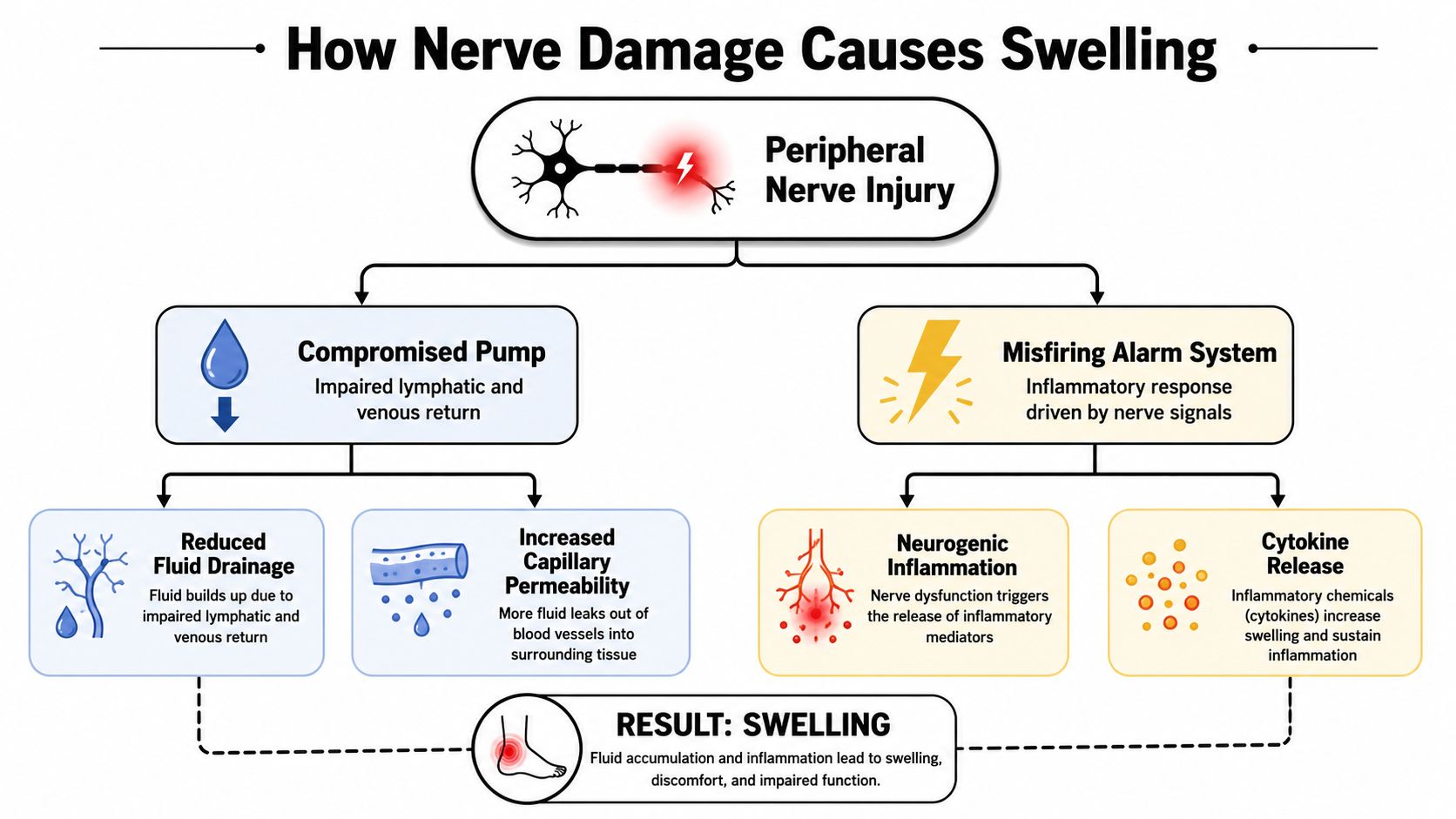
The cleanest way to understand this is through two mechanisms, a compromised muscle pump and neurogenic inflammation. When a nerve is injured, the muscles it controls may stop contracting well enough to move fluid back out of the limb. That is one reason swelling often settles in the lower leg, ankle, and foot, where gravity already makes drainage harder.
The pump slows down
Peripheral nerve injury can weaken the muscle pump that keeps blood and fluid moving. In a leg, that means the calf and foot do not squeeze and release the way they should, so fluid lingers longer than it should. Physio-pedia specifically notes this mechanism in distal limb injuries, including sciatic nerve damage (Complications with Peripheral Nerve Injury).
The alarm system misfires
A second pathway is more inflammatory than mechanical. Activated cutaneous nerves can release mediators that trigger neurogenic inflammation, which can show up as erythema, warmth, tenderness, and swelling. That helps explain why a limb can feel hot and irritated even when the nerve injury started deeper inside, or when the visible bruising does not seem severe enough to match the amount of puffiness.
A client with posterior ankle pain may describe exactly that mix, a sore, irritated area that also feels tight by the end of the day. For people trying to find relief for posterior ankle discomfort, the swelling can seem confusing because it does not follow the usual pattern of a simple soft-tissue strain.
What makes this clinically messy
Swelling from nerve injury is usually secondary, not the primary event. Doctors still have to think about venous, lymphatic, cardiac, renal, and medication-related edema, especially if swelling is bilateral or keeps coming back. A nerve issue may be part of the story, but it is rarely the whole story.
A swollen limb with nerve symptoms is a clue, not a final answer. The cause might be compression, inflammation, poor circulation, or something entirely separate from the nerve itself.
That is why people often describe the sensation as tightness, heaviness, or pressure rather than classic pain. The nerve problem alters movement and sensation, and the swelling reflects what the rest of the limb is doing in response.
Spotting Nerve-Related Swelling Symptoms
Not every swollen ankle means a nerve problem. Some swelling is mechanical, some is vascular, and some comes from systemic illness. The trick is to look at the pattern, because nerve-related swelling often comes with numbness, tingling, weakness, or a recent injury, while other edema tends to behave differently.
| Feature | Nerve-Related Swelling | Venous/Cardiac Edema |
|---|---|---|
| Usual pattern | Often follows trauma or nerve compression | Often develops without a clear injury |
| Sensation | Numbness, tingling, burning, weakness | Usually heaviness or tightness, less sensory change |
| Location | Often one limb or one side | Often bilateral or more generalized |
| Skin feel | Can be warm, tender, or irritated | May be puffy, tight, or dependent |
| Timing | May appear after the injury or later as nerves settle | Often persistent or related to standing, sitting, or systemic illness |
That pattern matters because Mayo Clinic and NIDDK both point to nerve damage as an indirect contributor, not always the primary cause. NIDDK notes that diabetes-related nerve damage affects the feet and legs and can lead to serious foot problems, while Cleveland Clinic notes that about 30% of neuropathy cases are due to diabetes, making diabetic neuropathy a major cause of nerve-related symptoms (Mayo Clinic peripheral nerve injuries).
If you're trying to sort out whether your swelling fits a nerve pattern, the foot and ankle are often the first places to look. A resource on find relief for posterior ankle discomfort can help you think through local pain patterns, but it doesn't replace an exam when numbness or weakness is part of the picture.
The biggest clue is change. When swelling arrives with altered feeling, reduced strength, or a limb that just doesn't work the same way after trauma, it deserves attention. If the swelling is bilateral, persistent, or disconnected from the injury site, doctors have to widen the search beyond nerves alone.
Swelling After Car Accidents and Falls
A truck driver catches his forearm in a metal edge during a loading-yard collision. At first, it looks like a bad bruise. A week later, the hand is still swollen, the fingers feel clumsy, and the ring finger barely registers temperature changes. That's not unusual in the world of trauma, because nerve injury and soft-tissue swelling often show up together after impact.
In a different case, someone falls hard on the hip and lands with a jolt that stretches the leg. The visible bruise fades, but the lower leg stays heavy and puffy. If the sciatic nerve was irritated or compressed, the limb can lose some of its normal muscle-pump action, and the swelling can linger longer than the patient expects.
The trauma data back up that this isn't rare. A large U.S. study published in 2022 found that among more than 1.2 million patients with employer-sponsored health plans, peripheral nerve injury diagnoses appeared in 0.33% at the first emergency department visit, increased to 1.3% to 1.6% within 90 days, and reached 2.3% within 2 years (2022 trauma analysis). That timing matters, because a nerve problem may not be obvious right away.
A third pattern shows up in whiplash-type injuries and complicated pain syndromes. The arm or leg looks swollen, feels hypersensitive, and seems to react to touch, temperature, or movement in ways that don't match the original bruise. The swelling may be part of a broader nerve and inflammation picture rather than a simple soft-tissue strain.
What these stories have in common is timing and mismatch. The injury seems like it should have improved, but the limb keeps behaving as if the body missed a step. When that happens after a crash or fall, the safest move is to document the change and get evaluated before the nerve issue becomes harder to untangle.
How Doctors Diagnose Nerve and Swelling Issues
A good clinic visit starts with the basics, and the basics matter more than people think. The examiner looks at sensation, strength, reflexes, and limb size, then compares both sides of the body. A swollen limb that also has altered sensation tells a different story than one that only looks puffy.
What usually happens first
The doctor asks when the swelling began, whether it changed after the injury, and whether numbness or tingling came first. Then they check for weak movement, painful areas, and signs that a nerve may be compressed or stretched. If the story points toward nerve injury, more testing comes next.
The testing often includes nerve conduction studies or imaging such as ultrasound or MRI when compression is suspected. That step matters because a trapped nerve, a deep soft-tissue injury, or a broader inflammatory problem can look similar from the outside. A physical exam alone may not show how far the injury reaches.
Why timing matters
Mayo Clinic's warning about early diagnosis is especially important here, because nerve injuries can become harder to treat when they're ignored. Delays can mean longer recovery, more persistent symptoms, and more confusion about what caused what.
For patients trying to organize their records, one practical resource is neurological tests for brain damage. Even though the topic is broader than peripheral nerve injury, it shows the kind of documentation and testing framework that helps connect symptoms to medical findings.
The cleanest clinic notes are the ones that connect the dots. If swelling, numbness, weakness, and an accident all appear in the same timeline, the chart should reflect that sequence clearly. That record can guide treatment and make later conversations with insurers far easier.
Treatment Paths and Urgent Warning Signs
Treatment depends on what's driving the swelling. If nerve damage has reduced the muscle pump, physical therapy and movement can help restore circulation. If the pain is neuropathic, medication may be used to calm nerve firing. If edema is prominent, compression and elevation may be part of the plan, and more specialized care may be needed when the pattern fits complex regional pain syndrome.
The key is not to assume every swollen limb needs the same response. A nerve-related problem can sit beside venous or lymphatic disease, and sometimes the swelling points to a heart, kidney, or medication issue instead. Higher-quality sources are blunt about this, ordinary peripheral neuropathy usually does not directly cause swelling, and the swelling often points to something else, such as autonomic neuropathy, reduced muscle-pump activity, venous or lymphatic disease, heart or kidney problems, or medication side effects (Neuropathy Resource swelling guide).
Urgent signs deserve emergency care: one-sided swelling, hot-red swelling, or sudden shortness of breath can mean a blood clot, infection, heart failure, or Charcot foot in a diabetic patient.
Those red flags are especially important because they're easy to miss when you're focused on the nerve pain. A leg that suddenly changes color or temperature, or swelling that comes with breathing trouble, needs faster evaluation than routine follow-up. Don't wait to see whether it settles on its own.
For milder but persistent symptoms, call a doctor sooner rather than later. Early treatment protects function, and it also gives you a cleaner medical timeline if the injury turns into a claim. Waiting until everything is severe usually makes both recovery and documentation harder.
Documenting Nerve Injuries for Legal Claims
Swelling that changes over time is useful evidence, if you save it. Take photos in the same light when possible, and keep them in order so the progression is obvious. A picture from the day of the injury, another from a few days later, and one from the following week can show a pattern that memory alone won't capture.
Keep every ER note, urgent care note, discharge instruction, imaging result, and specialist report. Ask for any nerve study reports and make sure the diagnosis language is preserved exactly as written. If a doctor mentions compression, numbness, weakness, or suspected neuropathy, that phrasing can matter later.
A symptom journal helps too. Write down when the swelling worsens, what activities trigger it, and whether numbness or tingling changes at the same time. A simple log can show consistency, and consistency is often what ties the medical picture together in an injury file.
For a practical organizing framework, medical record organization is worth reviewing. Good records don't create a claim by themselves, but they make the medical story much easier to prove.
Your Next Steps After Nerve-Related Swelling
The main takeaway is simple. Nerve damage usually doesn't cause swelling directly, but it can contribute to edema through movement changes, inflammation, and related medical problems. When swelling appears with numbness, tingling, weakness, or a recent accident, the pattern deserves prompt medical attention.
Check for red flags, especially one-sided swelling, hot-red swelling, or sudden shortness of breath. Those signs can point to something much more serious than a lingering bruise. If the swelling stays, worsens, or keeps returning, make sure the exam includes both the nerve issue and the broader causes of edema.
If you're sorting out what to do after a crash, steps to take after car accident can help you think through the next practical moves. Protecting your health and protecting your documentation usually go hand in hand.
If your swelling started after an accident and came with numbness, tingling, or weakness, Nares Law Group LLC can help you understand how the medical pieces fit together and how to preserve the evidence that matters. Visit Nares Law Group LLC to learn more about your options and get help building a clear path forward.