A few days after the crash, the bruises may be fading. The CT scan may have sounded reassuring. Friends may expect you to be getting back to normal.
But you keep losing words mid-sentence. You walk into a room and forget why. A simple phone call feels like too much. You sleep and still wake up exhausted. Bright lights bother you. Noise feels sharp. Paperwork that used to take ten minutes now takes an hour, or you give up halfway through.
That experience is frightening because it’s invisible. Other people can’t see it, and sometimes standard scans don’t clearly show it. That gap can leave injured people feeling dismissed, confused, or even ashamed.
There is a medical explanation for this kind of wide-ranging brain change. It’s called diffuse cerebral dysfunction. When doctors use that term, they’re describing a problem that affects brain function across multiple systems, not just one small spot. For many crash victims and families, hearing those words can be the first step toward understanding why daily life suddenly feels so hard.
The Invisible Injury After the Crash
You might be sitting at the kitchen table with unopened mail, trying to remember whether you already called the insurance adjuster. Your spouse may notice you asking the same question twice. Your child may say, gently, “You don’t seem like yourself.”
That doesn’t mean you’re lazy, exaggerating, or “just stressed.” It means your brain may be struggling to process, organize, and react the way it did before the collision.
When symptoms don’t match what others expect
After a motor vehicle crash, many people expect a brain injury to look dramatic. They picture a skull fracture, a visible wound, or a person who was obviously unconscious. Real life often looks different.
Diffuse cerebral dysfunction can show up as:
- Mental fog that makes reading, planning, or multitasking feel impossible
- Memory slips such as forgetting appointments, names, or what someone just said
- Fatigue that doesn’t improve much with rest
- Emotional changes like irritability, anxiety, or feeling overwhelmed by ordinary tasks
- Sensory overload from noise, screens, traffic, or crowded places
These problems often come and go. That inconsistency can confuse families. One hour, the injured person seems almost normal. The next, they can’t follow a conversation.
You can have a real brain injury and still look “fine” from the outside.
The name for the pattern
“Diffuse” means spread out. “Cerebral” refers to the brain. “Dysfunction” means the brain isn’t working the way it should.
So diffuse cerebral dysfunction means a broad disturbance in brain function. It’s different from an injury in one neat location. That’s why the symptoms can touch attention, memory, sleep, mood, balance, and stamina all at once.
Some families feel relief when they hear a medical term for what’s happening. A name doesn’t solve everything, but it helps replace self-doubt with clarity. It also gives you language to use with doctors, employers, schools, and insurers.
What Is Diffuse Cerebral Dysfunction
A family may hear this diagnosis after a crash and still wonder what it means. The person they love can speak, walk, and even look normal for stretches of the day. Then they miss simple details, lose their place in a conversation, or shut down in a noisy grocery store.
That mismatch is often the hardest part to understand.
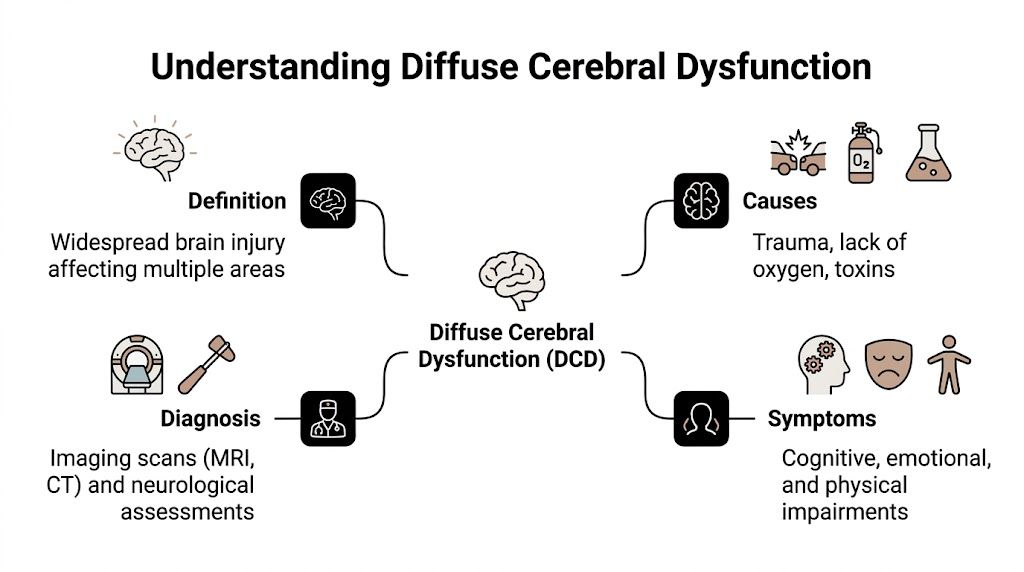
Diffuse cerebral dysfunction means the brain is having trouble working as a connected system. “Diffuse” means spread out. “Cerebral” refers to the brain. “Dysfunction” means the brain is not performing normally.
The key idea is broad disruption, not one neat injury in one neat spot.
A city comparison helps here. If one bridge closes, traffic backs up in a single area. That resembles a focal brain injury, where one damaged location causes a more localized set of problems. If traffic lights fail across many neighborhoods at once, delays show up all over the city. Some intersections move. Others stall. The pattern looks inconsistent, but the larger traffic system is what is failing.
Why “diffuse” matters
Doctors use this term because the problem often affects communication across multiple brain networks. Attention, memory, sleep, mood, balance, and mental stamina can all be affected together because the brain relies on coordination between regions, not isolated parts working alone.
That is why symptoms can seem unrelated at first.
A person may have trouble focusing in the morning, become dizzy in a busy store, forget a conversation at lunch, and feel unusually irritable by evening. These can all come from the same injury pattern. Families sometimes mistake that scatter for exaggeration or stress alone. In reality, widespread dysfunction often creates a scattered-looking set of problems.
What can go wrong inside the brain
Diffuse cerebral dysfunction is a functional description, not one single injury type. It tells you the brain is struggling across a broad network. It does not always tell you the exact microscopic reason.
In some cases, delicate nerve fibers are stretched or disrupted. In others, the brain is dealing with metabolic stress, changes in blood flow, inflammation, oxygen-related injury, or several of these at once. The common result is slower, less efficient signaling.
A useful modern explanation comes from the MIT Press article on hub overload and failure. The brain depends on high-traffic hubs to route information efficiently. When those hubs are overloaded or disrupted, problems can spread beyond the original point of injury. That can show up as brain fog, slowed processing, and trouble switching between tasks.
This matters for more than medical vocabulary. It helps explain why an injured person may need broader care, careful documentation, and patience during recovery. It also helps families describe the injury clearly to doctors, employers, schools, and insurance adjusters.
Why symptoms can feel inconsistent
Diffuse brain injuries often fluctuate. A person may look capable during a short, quiet conversation, then struggle badly after an hour of paperwork, screen time, or traffic noise.
That does not mean the injury is gone.
It usually means the brain can compensate for a while, then tires out. Many families describe this as having a limited mental battery. Once that battery drains, thinking becomes slower, emotions become harder to regulate, and ordinary tasks take much more effort.
Common points of confusion
Three misunderstandings come up often.
First, families may assume a brain injury requires a direct hit to the head. A widespread brain injury can happen from violent motion alone.
Second, people may expect symptoms to stay the same every day. Diffuse dysfunction often gets worse with fatigue, pain, stress, or sensory overload.
Third, a normal-looking scan may be treated as proof that nothing serious happened. Many diffuse injuries involve functional or microscopic disruption that standard imaging may not show clearly.
What this means in everyday life
This diagnosis often explains why life suddenly feels less reliable. The injured person still has the same goals, values, and personality at their core. What changes is the brain’s ability to carry out tasks smoothly and consistently.
That can look like:
- At work you understand the assignment but cannot keep the steps organized
- At home you start a routine task and lose track halfway through
- In conversation you hear the words but cannot hold onto them long enough to respond
- In public light, noise, and motion feel harder to filter out
- With paperwork or insurance calls you know the information matters but cannot process it quickly enough to protect yourself without help
That last point deserves attention. When diffuse cerebral dysfunction follows an accident, the medical issue and the legal issue often overlap. Clear records, early evaluation, and careful symptom tracking can make a real difference in both treatment and compensation.
How Accidents Cause Widespread Brain Injury
A family leaves the crash scene relieved that there was no bleeding, no skull fracture, and no obvious head wound. Two days later, the injured person cannot follow a simple conversation, loses track of basic tasks, and feels overwhelmed by noise and motion. That is often how a widespread brain injury enters real life, initially subtly, then all at once.
The brain is soft tissue suspended in fluid inside a hard skull. In a violent collision, the car can stop in an instant while the brain keeps moving for a split second. That movement can stretch and shear delicate connections across many areas at the same time.
Why the motion itself can injure the brain
Two kinds of force cause much of the trouble.
One is sudden speed change. A body is thrown forward, backward, or sideways, then stopped. The other is rotation. If the head twists sharply, different parts of the brain move at slightly different speeds. That creates strain in the wiring that allows brain cells to communicate.
A useful comparison is a bowl of gelatin in a sealed container. If you shake it straight back and forth, it shifts. If you twist the container, it distorts more unevenly. The brain reacts in a similar way during a crash, especially when the force is fast and rotational.
That helps explain a confusing fact for many families. A person may talk at the scene, answer questions, and still have a serious injury developing beneath the surface.
What doctors mean by diffuse axonal injury
One well-known pattern is diffuse axonal injury. Doctors use that term when trauma stretches or tears axons, the long fibers that carry messages between brain cells. If those fibers are damaged in many places, the brain can still look intact from the outside while communication inside the system becomes slower, less reliable, or disconnected.
This type of injury is strongly associated with high-force crashes, especially those involving rapid deceleration and rotation. It is also a recognized cause of long-term disability after traumatic brain injury. In practical terms, that means the injury is not just a momentary jolt. It can affect memory, attention, speed of thinking, balance, mood, and the ability to manage daily responsibilities for months or longer.
For a family trying to protect both health and legal rights, that distinction matters. An injury can be serious even when it is microscopic.
Why symptoms can seem delayed or uneven
Widespread brain injury does not always announce itself in a dramatic way. The person may seem mostly normal for a short period, then struggle once the brain is asked to do more. A quiet ride home may feel manageable. A grocery store, a work email, or an insurance call may suddenly expose how much processing ability has been lost.
That pattern does not mean the symptoms are exaggerated. It often means the brain is using extra effort to do tasks that used to be automatic.
One day may also look better than the next. Fatigue, pain, poor sleep, stress, and sensory overload can all make the deficits more obvious. Families often describe this as inconsistency. In medical terms, it is often a sign that the brain's communication networks were disrupted across multiple regions.
Why this section matters after an accident
Understanding how the injury happened helps with more than education. It helps families explain the problem clearly to doctors, employers, and insurers. If the crash involved violent stopping, whipping, or rotation of the head and neck, those details belong in the medical record because they support the mechanism of injury.
It also helps to ask early about neurological tests for brain damage when symptoms affect memory, concentration, speech, balance, or tolerance for light and noise. Good documentation connects the physics of the crash to the problems showing up at home, at work, and during treatment.
That paper trail can support proper care. It can also protect a claim for compensation if an insurer tries to treat an invisible brain injury as a minor event.
Diagnosing an Injury You Cannot See
The call with the insurance adjuster lasts ten minutes. Afterward, your loved one lies down in a dark room for two hours because the conversation brought on a headache, confusion, and a wave of exhaustion. Later, the scan report says “normal.”
Families often feel trapped in that contradiction. The person who was in the crash is plainly struggling, but the first records may not show a dramatic image. Diffuse cerebral dysfunction often lives in that gap between what a picture shows and how a brain is working.
Why a normal scan does not close the case
CT scans and standard MRI scans are good at finding urgent structural problems, such as bleeding, swelling, or a large lesion. They answer an important question first. Is there a visible emergency that needs immediate treatment?
A second question is different. Is the brain functioning normally across attention, memory, processing speed, sleep, mood, and stamina?
That question may stay open even when imaging looks reassuring.
A useful comparison is a house after a storm. The walls may still be standing, but the wiring inside can be damaged. Lights flicker. Appliances fail. Rooms stop working the way they should. Brain imaging can sometimes show the walls. It may miss parts of the wiring problem.
Diagnosis starts with the story and the pattern
Doctors often begin by listening closely to what changed after the crash and how those changes show up in ordinary life.
They may ask about:
- Attention problems, such as losing track during conversation or missing steps in a task
- Memory changes, such as repeating questions or forgetting recent information
- Slower processing, where replies come later and decisions take more effort
- Sleep disruption, including sleeping poorly at night and crashing during the day
- Mood or behavior changes that were not present before the injury
The bedside exam matters too. A clinician may test orientation, recall, concentration, language, balance, reflexes, eye movements, and response speed. None of this is “just talking.” It is part of building a clinical record that connects symptoms to brain function.
That record also matters outside the exam room. If the medical chart clearly describes what changed, it becomes easier to request the right care, explain work limits, and push back if an insurer treats the injury like a minor strain.
EEG can show brain function in real time
An electroencephalogram, or EEG, records the brain’s electrical activity. It does not replace imaging. It answers a different question.
If CT or MRI is like taking a still photograph, EEG is closer to listening to the brain’s rhythm while it is trying to work.
One finding doctors may look for is diffuse slowing. That means brain wave activity is slower than expected across broad areas, which can support a concern that the brain is not operating at its usual speed or efficiency. The BioSource Software discussion of diffuse slowing on EEG gives a plain-language overview of why that pattern can matter clinically.
For families, the value is often simple. EEG can provide objective support for symptoms that are easy for outsiders to dismiss.
Practical point: If symptoms are widespread, persistent, and interfering with daily life, ask whether testing that measures brain function, including EEG, should be part of the workup.
If you want a plain-language overview of how doctors document these problems, this guide to neurological tests for brain damage can help you prepare for appointments.
How chart language maps onto daily life
Medical language can sound abstract. Families usually need it translated into concrete terms.
| Clinical Sign | What It Can Feel Like Day to Day |
|---|---|
| Diffuse slowing on EEG | Thoughts feel delayed, and simple tasks take much longer |
| Background slowing | Reading one paragraph takes several tries because the thread keeps slipping |
| Reduced responsiveness | Noise, quick questions, or changes in routine feel hard to process fast enough |
| Cognitive impairment on bedside testing | You know what needs to be done but cannot organize the steps clearly |
| Global dysfunction | Problems show up in several areas at once, such as focus, memory, fatigue, and mood |
This translation matters for medical care. It also matters for legal protection. A chart that says “slowed processing” may sound minor until it is tied to missed bills, unsafe driving, forgotten conversations, or the inability to finish a work shift.
Questions to ask at the next appointment
Clear questions often lead to better records.
Consider asking:
- Could these symptoms fit diffuse cerebral dysfunction after the crash?
- What tests look at brain function, not only brain structure?
- Would formal neuropsychological testing help document the changes?
- How will these findings be written in the medical chart?
- What follow-up is appropriate if symptoms continue or get worse?
What makes a diagnosis stronger
The clearest diagnosis usually comes from pieces that fit together.
That may include the crash history, the symptom timeline, bedside neurological findings, cognitive evaluation, EEG results when appropriate, and notes from therapists or specialists who see how the problems affect daily life.
Taken together, those records do more than name an invisible injury. They help show what care is needed and preserve evidence if you later have to prove that the harm was real.
Navigating Recovery and Long-Term Management
Recovery from diffuse cerebral dysfunction rarely feels linear. Some mornings are better. Some errands go well. Then one overfull day can leave you wiped out, confused, or emotionally raw.
That pattern doesn’t mean you’re failing. It often means your brain is still healing and needs a steadier rhythm.

Treatment is usually layered
There usually isn’t one single fix. Care often involves a mix of therapies that support different parts of daily function.
A person may need cognitive rehabilitation for memory and attention, occupational therapy for routines and task management, and physical therapy for balance, coordination, or dizziness. Sleep support, mental health care, and careful medication review may also matter.
The right plan depends on the person in front of you. A parent trying to care for children has different daily demands than a truck driver, a teacher, or a college student.
Pacing protects recovery
One of the most important skills is pacing.
Many people fall into a cycle that families recognize immediately. On a good day, they push hard to catch up on chores, work, appointments, and messages. Then they crash. The next day brings headaches, confusion, irritability, or extreme fatigue.
Pacing means doing less than you think you can do, on purpose, so your brain doesn’t get overwhelmed. It can feel unnatural at first, especially for capable people who are used to pushing through.
Helpful pacing habits often include:
- Shorter activity blocks instead of long stretches of concentration
- Planned rest breaks before symptoms spike
- Reduced multitasking so the brain handles one demand at a time
- Consistent routines for sleep, meals, therapy, and medication
- Symptom tracking to learn what triggers setbacks
Recovery often improves when people stop measuring progress by one “good day” and start measuring it by stability over time.
Rehabilitation is practical, not abstract
Good therapy should connect directly to real life.
Cognitive work may focus on calendars, alarms, note systems, and strategies for attention. Occupational therapy may help someone manage cooking, errands, or returning to work in a modified way. Physical therapy may target tolerance for motion, posture, or balance.
For people exploring options, this resource on cognitive therapy after TBI gives a useful overview of how treatment can support memory, concentration, and daily function.
A short visual explanation can also help families understand the rhythm of rehabilitation:
The social side of healing
Brain injuries don’t happen in a vacuum. A person’s recovery is affected by whether they can get to appointments, whether they have stable housing, whether their job is flexible, and whether their family understands what’s happening.
That isn’t just common sense. Research on social determinants of health in neurology notes that factors such as ethnocultural identity and housing stability are often overlooked, even though they can shape recovery and legal outcomes for underserved patients, as discussed in the PMC article on social determinants and neurological inequities.
For families, this means the struggle isn’t always “just the injury.” It may also be transportation, money, language barriers, childcare, or a workplace that expects instant recovery.
What support can look like at home
Loved ones often want to help but don’t know how.
Here are a few ways support becomes useful:
- Lower the noise load. Quiet spaces, reduced screen glare, and fewer competing demands can help.
- Write things down. Shared calendars, whiteboards, and simple checklists reduce memory pressure.
- Keep instructions short. One step at a time usually works better than a long explanation.
- Believe the fatigue. Mental exhaustion from brain injury is real, even when the person looks physically okay.
Healing is often slow, but slow doesn’t mean hopeless. It means the brain needs time, structure, and the right kind of support.
How to Protect Your Rights After a TBI Diagnosis
The week after a crash often feels upside down. One doctor says rest. Another orders follow-up testing. An insurance adjuster calls before you have words for what is happening in your own head.
That is when rights can start slipping away.
With diffuse cerebral dysfunction, the problem is often not whether the injury is real. The problem is whether the record shows it clearly enough for doctors, insurers, employers, and, if needed, a jury to understand. Brain injuries that affect attention, memory, processing speed, and fatigue can look mild from the outside while disrupting nearly every part of daily life.

Build a record that shows the whole injury
Medical charts matter, but they are only snapshots. A ten-minute visit may miss what happens over the other twenty-three hours of the day.
A simple daily log can fill that gap. Write down headaches, mental fog, overstimulation in stores, trouble following conversations, missed bills, forgotten appointments, sleep disruption, and the point in the day when your brain seems to shut down. Include practical details. Could you drive safely? Finish a work task? Help your child with homework? Follow a recipe?
Those details turn an invisible injury into a visible pattern.
If a family member notices changes, their observations can help too. They may see repeated questions, slower thinking, mood shifts, or the need for far more rest than before the crash. That outside view often matters because brain injury can make self-reporting harder.
Ask for clear, specific medical language
Words in the chart have consequences. “Patient doing okay” can sound harmless, but it does not explain whether “okay” means fully recovered or barely managing.
Ask your providers to describe what they observe and what you cannot do. The record is stronger when it connects the accident to the start of symptoms, explains how those symptoms affect work and home life, and includes any exam findings, cognitive testing results, or EEG findings that support the diagnosis.
This matters for treatment as much as for a legal claim. Earlier in the article, we noted that diffuse dysfunction may not show up neatly on routine imaging. Doctors often rely on the full picture instead: history, examination, symptom pattern, and objective testing when available. If that full picture is scattered across vague notes, other people may wrongly assume nothing serious happened.
Be careful with insurer conversations
Insurance companies often look for short, simple statements they can place in a file. Brain injuries rarely fit into short, simple statements.
A person might say, “I’m better,” and mean, “I made it through breakfast without getting overwhelmed.” An adjuster may record that as recovery. That is why concrete language helps. “I can handle one task at a time for about fifteen minutes before I lose focus” says far more than “I’m fine” or “I’m improving.”
If calls feel confusing, ask for communication in writing or have someone you trust present. After a TBI, word-finding problems, fatigue, and memory gaps can make even routine conversations risky.
Get legal help early enough to preserve the story
A good lawyer in these cases does more than submit forms. They help organize the timeline, gather the right records, identify missing documentation, and connect the diagnosis to the losses that follow, including missed work, reduced earning ability, treatment costs, and the daily limits that do not show up on an X-ray.
If you want a clearer sense of what that process looks like, this page on a traumatic brain injury law firm explains the kinds of proof and practical issues that often come up after a serious crash.
Early legal guidance can also protect you from small mistakes that grow into big problems later. Missing records, poorly described symptoms, or casual statements to insurers can weaken a claim long before a case is formally disputed.
Do not wait for perfect certainty
Families often hold off because they hope symptoms will pass. That hope is understandable.
But brain injury cases are easier to prove when the timeline is fresh, follow-up care is consistent, and the record shows what changed after the accident. You do not need to know exactly how recovery will unfold before you start protecting your health and your legal rights. You only need to start documenting what is happening now.
Finding Clarity and Hope on the Path Forward
Diffuse cerebral dysfunction can turn life upside down in a way that’s hard to explain to anyone who hasn’t lived it. The symptoms are broad. The testing can feel confusing. The recovery path may be uneven.
But there is a path.
When you understand what diffuse cerebral dysfunction means, the fog starts to lift a little. You can ask better medical questions. You can seek the right testing. You can build a treatment plan that fits real life instead of forcing yourself to “push through” an injury that needs care.
You can also protect the practical side of recovery. Good documentation, clear medical records, and timely legal guidance help make sure an invisible injury is taken seriously.
Most of all, you don’t have to measure healing by how fast you return to your old pace. Progress may look like fewer crashes after activity, better routines, clearer notes, stronger support, and more days when your brain feels manageable. That’s real progress.
If you or someone you love is dealing with post-crash brain fog, memory changes, or a diagnosis of diffuse cerebral dysfunction, Nares Law Group LLC offers compassionate guidance for injured families navigating traumatic brain injury claims. Their team helps clients understand the medical evidence, protect their rights, and pursue compensation that reflects the full impact of a life-changing injury.