A premises liability settlement might be roughly $10,000 for a minor injury, while catastrophic injuries or wrongful death can produce seven-figure or higher outcomes. There is no meaningful single average because injury severity, liability clarity, comparative fault, and available insurance limits control the result.
You may be sitting at home with a swollen ankle, a stack of medical bills, and an insurance adjuster asking for a recorded statement. Or you may be facing surgery after a fall that left you unable to work. The question sounds simple, but “How much is my premises liability case worth?” rarely has a simple answer.
Reported data illustrates why. NYC claims data for fiscal year 2023 showed an average personal injury settlement and judgment of $134,656 across 13,227 claims, totaling $1.45 billion. Those claims weren't limited to slip and falls, so the figure isn't a Colorado premises liability average. Independent verdict research reported a median award of $98,160, which is much lower than the mean and shows how a smaller number of very large outcomes can pull an average upward. (NYC premises liability settlement analysis)
The useful question isn't “What's the average?” It's “What damages can I prove, how clearly can I establish fault, what percentage of responsibility might be assigned to me, and how much insurance is available?”
What Premises Liability Settlement Amounts Really Mean
A visitor leaves a grocery store with a torn rotator cuff after slipping on an unmarked spill. At another property, a failed balcony railing causes a spinal fracture. Both incidents may support premises liability claims, yet their settlement values can differ sharply because the medical course, future limitations, wage loss, notice evidence, property records, and insurance coverage are not the same.
Premises liability outcomes usually form bands rather than a dependable average. Reported summaries place results from roughly $10,000 for minor injuries to well over $2 million for catastrophic injuries, permanent harm, or wrongful death. Severity and permanence often carry substantial weight, while liability proof, comparative fault, and policy limits can move the value in either direction. (Premises liability settlement factors and ranges)
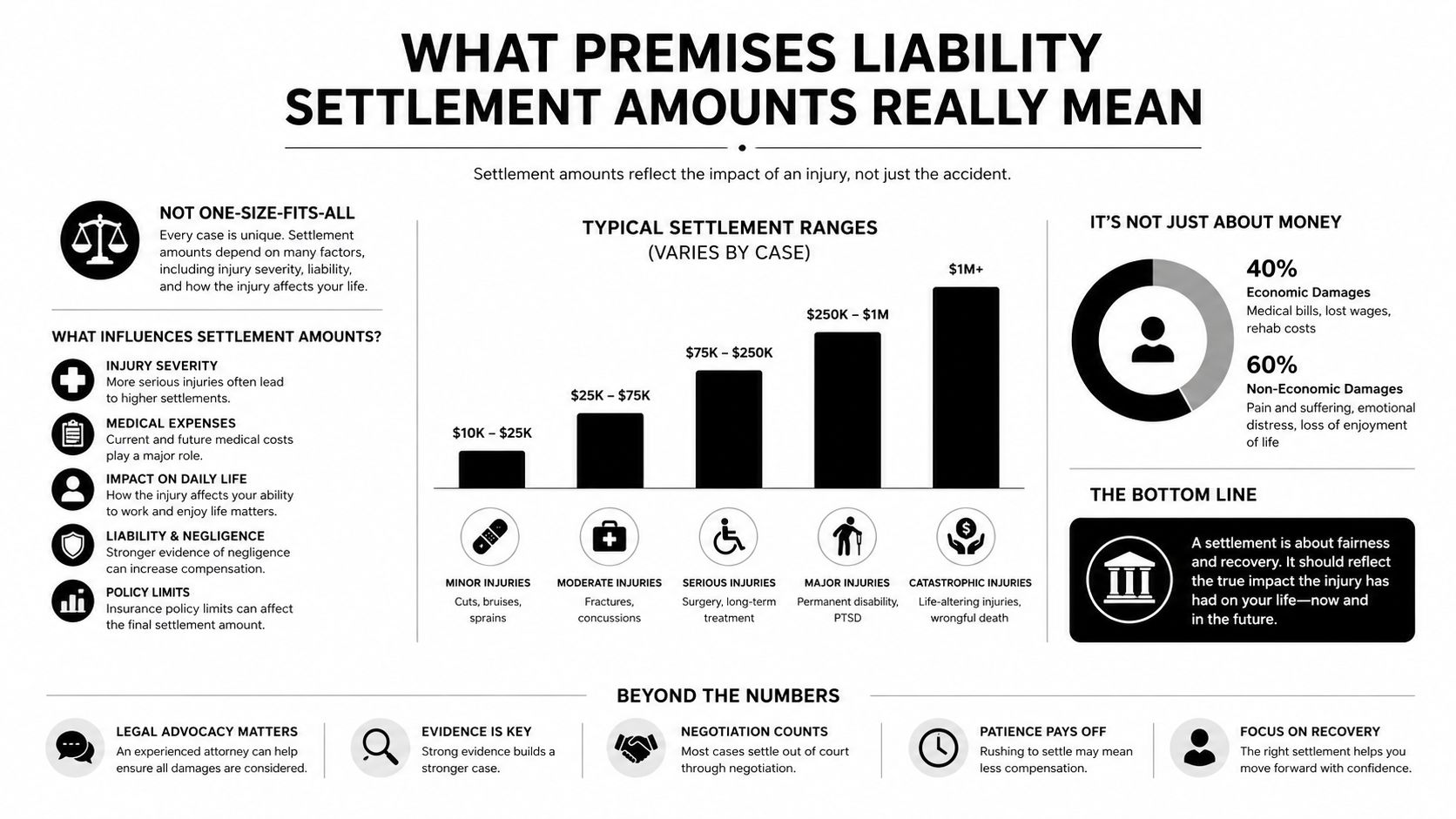
A modest soft-tissue claim may resolve near the lower end when treatment is brief and the property owner disputes responsibility. A surgical injury may reach six figures when records document extensive care, lost income, and lasting impairment. Catastrophic harm can exceed the primary policy, making it necessary to investigate umbrella coverage and other layers in the insurance tower.
Practical rule: Treat every number as a starting point, not a promise. The evidence file determines whether a claim belongs near the bottom, middle, or top of a reported band.
A verdict and a settlement also measure different things. A verdict is a jury's decision after trial. A settlement is a negotiated transfer of risk, commonly reduced to account for disputed liability, litigation expense, delay, collectability, and the possibility of losing at trial. Historical verdict research reported an overall mean award of $562,441 and a median of $92,611, with awards ranging from $1 to $102,714,734. The wide spread makes verdict research useful for context, but it cannot predict one person's settlement. (Historical premises liability verdict research)
A resource describing common premises liability claims involving unsafe property conditions can help clarify how falls, structural hazards, and maintenance failures fit within this area of law.
The Building Blocks of Every Settlement
A settlement is built from a damages stack, not a single pain-and-suffering figure. The stack starts with losses that can be documented through records, then adds losses that require medical, employment, or economic proof.
Economic damages create the floor
Past medical bills may include emergency care, imaging, surgery, prescriptions, rehabilitation, and follow-up treatment. Future medical expenses require more than a doctor's general statement that care “may” be needed. A life care planner and treating physicians may need to identify expected surgeries, injections, therapy, equipment, home assistance, or other care, while an economist may calculate the financial value of future needs.
Lost wages are often established through payroll records, tax documents, timekeeping records, and an employer letter. A serious injury may also reduce future earning capacity, particularly when the person can't return to the same occupation, work the same hours, or perform the same physical tasks.
Non-economic harm gives the file human meaning
Pain and suffering includes physical discomfort, sleep disruption, emotional distress, loss of enjoyment of life, and limitations on ordinary activities. A spouse may also have a consortium claim where the facts and applicable law support one. There isn't a receipt for these losses, so the strongest proof often comes from a consistent treatment timeline, testimony from family and coworkers, medical records, and a clear description of how daily life changed.
For a practical discussion of documenting and evaluating pain-related losses, see this guide to calculating pain and suffering damages.
Punitive damages are exceptional
Punitive damages aren't a routine part of a premises case. In Colorado, they require clear and convincing evidence of willful and wanton conduct, making them a potential point of negotiation only when the property owner's conduct rises well above ordinary carelessness.
Liens and subrogation can reduce what reaches your bank account. Medicare, Medicaid, an ERISA health plan, or a workers' compensation carrier may assert repayment rights. The gross settlement therefore isn't the same as your net recovery.
| Damage Category | What It Covers | Documentation Used | Typical Range |
|---|---|---|---|
| Economic damages | Past and future medical care, lost wages, reduced earning capacity | Medical records, bills, wage records, employer letters, expert projections | Case-specific |
| Non-economic damages | Pain, emotional distress, disability, disfigurement, lost enjoyment of life | Treatment timeline, physician opinions, testimony, daily-impact evidence | Case-specific |
| Punitive damages | Exceptional willful and wanton conduct | Conduct records, internal communications, prior notice, witness and expert testimony | Not a baseline recovery |
| Liens and subrogation | Reimbursement claims that reduce the gross recovery | Benefit statements, lien letters, plan terms, repayment correspondence | Depends on asserted liens |
The quality of documentation converts an injury into a claim that an adjuster, defense lawyer, mediator, or jury can evaluate. Missing records create room to argue that treatment was unnecessary, wage loss is overstated, or future care is speculative.
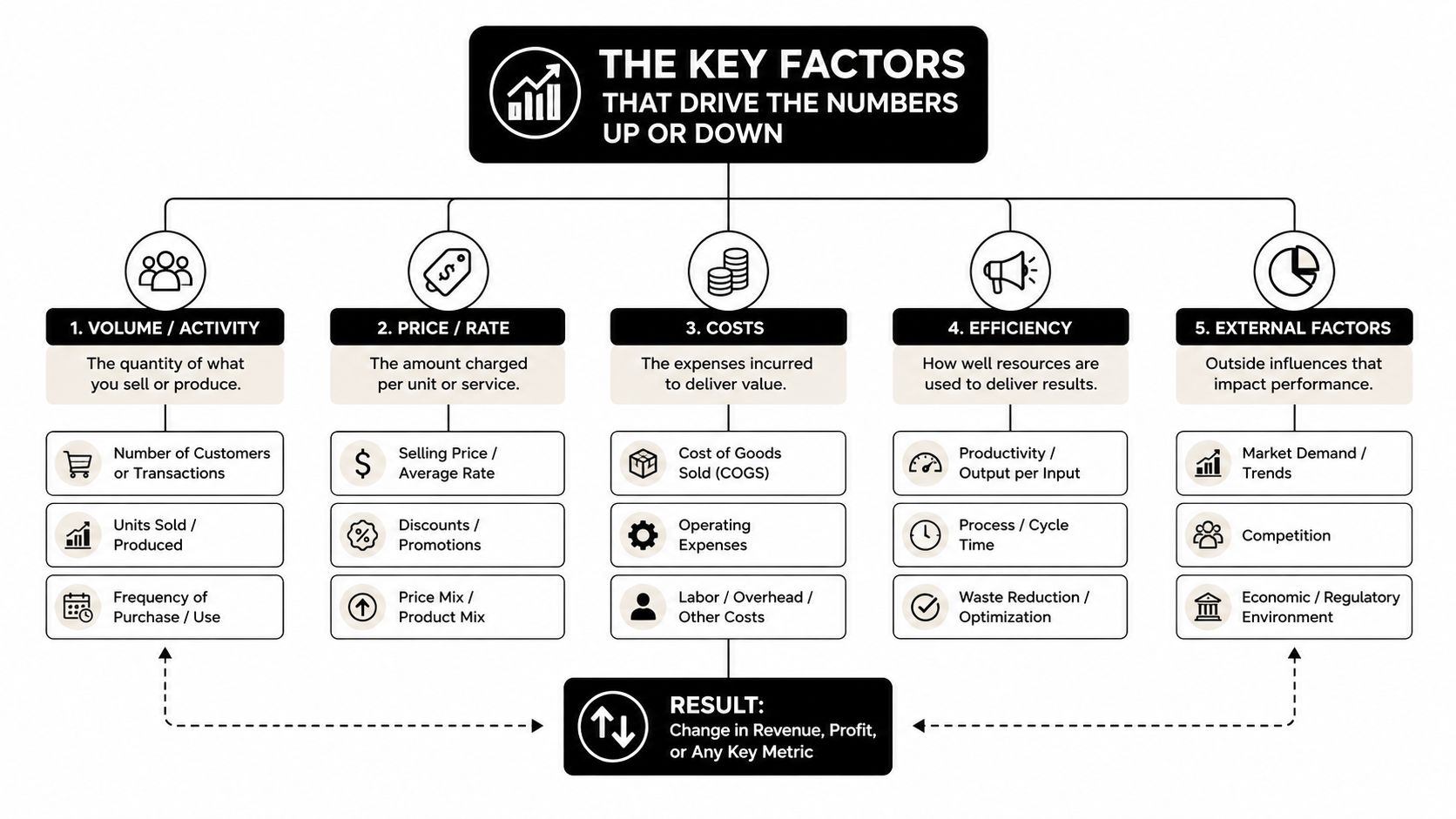
The Key Factors That Drive the Numbers Up or Down
The strongest valuation analysis ranks the evidence by significance. Not every fact deserves equal attention.
Injury severity and permanence come first
A short recovery with no lasting limitation is evaluated differently from a fracture requiring surgery, a spinal injury, a traumatic brain injury, paralysis, or death. The important questions are practical: Can you work as before? Do you need ongoing care? Can you perform household tasks, exercise, sleep, or participate in family life? The longer the medical course and the more permanent the impairment, the more substantial the damages stack becomes.
Liability proof determines whether severity matters
A devastating injury doesn't guarantee a strong recovery if the owner can plausibly deny notice or argue that the condition wasn't dangerous. Surveillance footage, incident reports, photographs, maintenance logs, prior complaints, inspection records, witnesses, and code evidence can establish what happened and whether the owner knew, or should have known, about the hazard.
Colorado's modified comparative fault rule makes this issue especially important. Under C.R.S. § 13-21-111, a plaintiff who is 50% or more at fault is barred from recovery. Below that threshold, the recovery is reduced in proportion to the assigned fault. A defense argument that you ignored a warning, entered a restricted area, or failed to watch where you were walking can therefore have direct financial consequences.
Insurance limits define collectability
A strong claim still needs a collectible source. Commercial general liability coverage, umbrella coverage, homeowner's insurance, additional insured policies, and excess layers may all matter. Reported premises liability ranges commonly identify commercial general liability limits of $1 million to $5 million, though the actual policy, exclusions, number of claimants, and available assets must be confirmed in the specific case. (Premises liability settlement calculator and policy-limit discussion)
Venue and credibility also affect risk. Defense counsel evaluates how a local jury may view property-owner responsibility, negligent security, snow and ice conditions, and the plaintiff's conduct. Adjusters examine gaps in treatment, social media posts, inconsistent accounts, and pre-existing conditions. A defense medical examination may challenge causation, but an aggravated pre-existing condition can still support damages for the worsening caused by the incident.
Typical Settlement Ranges by Premises Scenario
Scenario matters because it often predicts the type of evidence, injury pattern, and insurance response involved. It doesn't replace an individualized damages analysis.
The figures below are illustrative bands drawn from reported premises liability summaries and verdict research, not guaranteed outcomes. A broken hip with clear notice and surgery may be valued very differently from a similar fracture where the owner disputes the hazard or the claimant has substantial comparative fault.
| Scenario | Typical Injury | Settlement Range |
|---|---|---|
| Wet-floor slip and fall | Sprain, bruise, soft-tissue injury, or more serious joint injury | Roughly $10,000 for minor harm, with higher value when treatment, disability, or liability proof is substantial. (Settlement range discussion) |
| Icy walkway accident | Fracture, back injury, head injury, or aggravation of a prior condition | Case-specific, driven by snow and ice duties, notice, weather records, treatment, and fault allocation. |
| Defective stairs or railing | Fracture, torn ligament, spinal injury, or traumatic brain injury | Case-specific, with structural records, code evidence, prior complaints, and permanence often controlling value. |
| Swimming pool injury | Drowning-related harm, brain injury, spinal injury, or death | Catastrophic or wrongful-death claims can reach seven figures or more, depending on proof, damages, and coverage. (Settlement range discussion) |
| Elevator or escalator malfunction | Fractures, crush injuries, nerve damage, or psychological trauma | Case-specific, influenced by maintenance contracts, inspection records, and injury permanence. |
| Dog bite | Scarring, nerve injury, infection, or emotional trauma | Case-specific, with visible scarring, treatment, ownership evidence, and available coverage affecting valuation. |
| Negligent security assault | Gunshot wound, stabbing, brain injury, spinal injury, or wrongful death | High-value outcomes are possible where foreseeability, security failures, and catastrophic harm are strongly established. |
| Toxic exposure or mold | Respiratory symptoms, illness, or long-term impairment | Case-specific, requiring reliable exposure, medical causation, and property-condition evidence. |
One historical study found that median awards differed by property type, including $250,000 for industrial property owners, $125,000 for recreational facilities, $114,726 for government property, $95,883 for service establishments, $82,500 for retail stores, and $75,000 for residential property owners. Those figures describe verdict research, not promised settlement results, but they show why the property's risk profile can influence valuation. (Property-type premises liability verdict research)
A case moves toward the upper end when the injury is permanent, the hazard is well documented, the owner's notice is clear, comparative fault is limited, and the insurance tower can support the claim. It moves down when causation is disputed, treatment is inconsistent, evidence is missing, or coverage is inadequate.
How Insurance Companies Pressure These Numbers
Insurance negotiations are sequenced. The first offer is often designed to establish an anchor before the full medical picture is available, not to measure the claim's final value. Accepting it can release claims before future treatment, wage loss, liens, and permanent restrictions are understood.
An adjuster may request a recorded statement and ask questions that sound routine. Small wording choices can later be presented as an admission that you felt fine, saw the hazard, or contributed to the accident. You generally shouldn't give a recorded statement before understanding your rights and, where represented, consulting counsel.
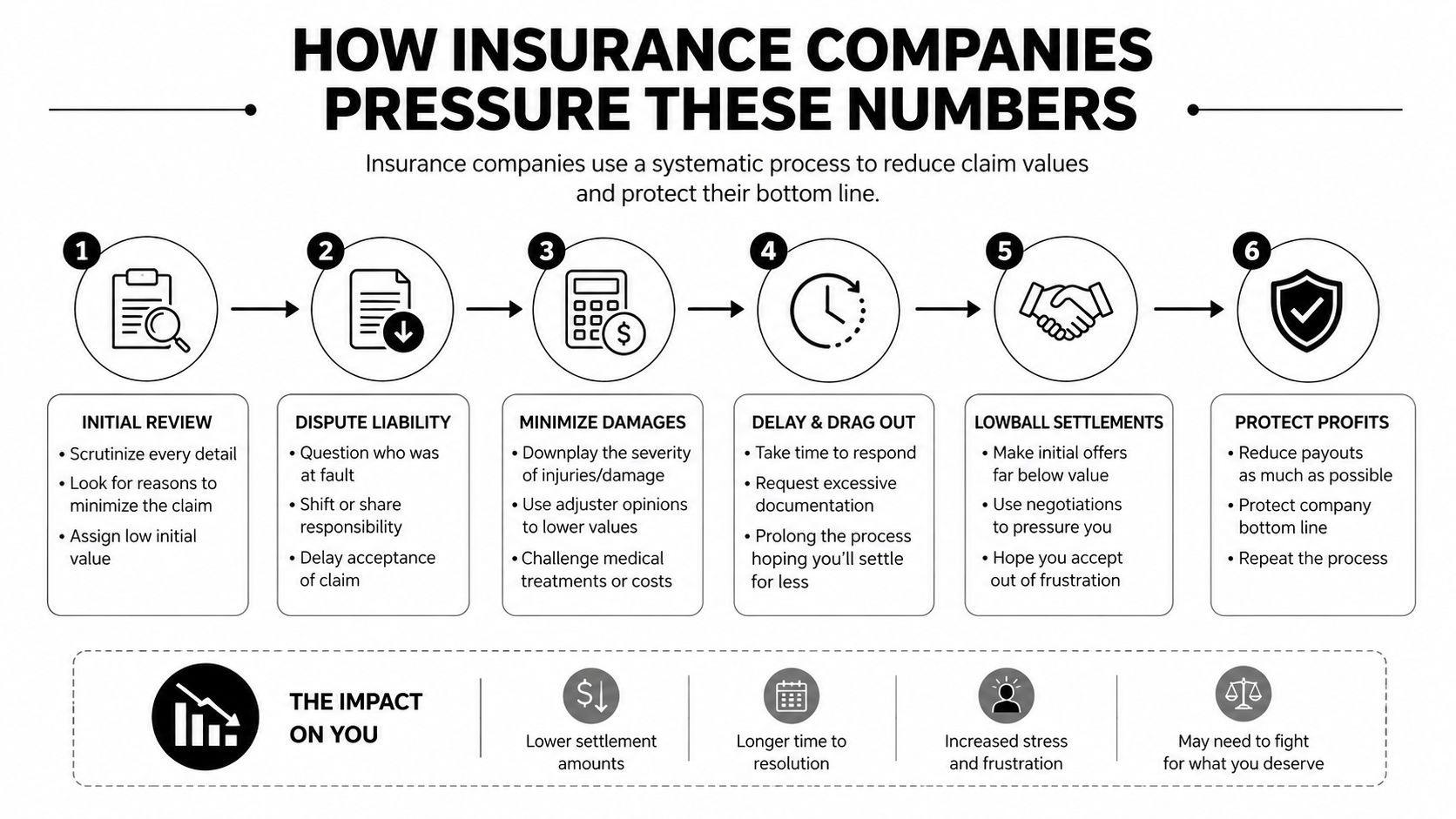
Surveillance and social media review are common ways insurers test whether your claimed limitations match your activities. Delay can create pressure when medical bills arrive, but financial stress shouldn't force a premature release. A demand package should explain liability, medical treatment, wage loss, future care, non-economic harm, and applicable insurance coverage.
Negotiation principle: The demand becomes stronger when it answers the adjuster's likely defenses before the insurer has to invent them.
A defense medical examination may challenge the connection between the incident and your current condition. Your lawyer can use treating-doctor opinions, medical chronology, diagnostic imaging, and expert testimony to address those challenges. If multiple injured people seek payment from the same policy, policy-limit pressure becomes a distribution problem, making early coverage investigation critical.
For a clearer explanation of how available coverage affects recovery, review this guide to insurance policy limits.
Mediation can be useful after the evidence has matured. It gives both sides a structured setting to evaluate risk, but it works best when the damages package is organized and the insurer understands that you're prepared to continue toward trial if necessary.
Colorado Considerations and Local Averages
Colorado changes the valuation discussion in several important ways. Comparative fault under C.R.S. § 13-21-111 can eliminate recovery at 50% or more fault, while a lower finding reduces the award proportionally. That makes photographs, witness accounts, warning-sign evidence, footwear and weather documentation, and the exact location of the hazard especially important in a Colorado claim.
Snow and ice cases require close attention to the condition, timing, notice, property use, weather history, inspection practices, and the responsibilities assigned to owners, tenants, contractors, or property managers. A commercial property may also involve maintenance contracts and recurring inspection duties that don't exist in the same form at a private residence.
Venue matters, but it shouldn't be treated as a shortcut to a dollar figure. A Denver jury may assess a large commercial operation differently from a jury in El Paso, Adams, Arapahoe, or Pueblo County. Defense lawyers consider local attitudes toward property maintenance, security obligations, business responsibility, and the credibility of a plaintiff's account. The facts of the incident still matter more than a county label.
Colorado also has statutory limits that may apply to some categories of damages or defendants. Whether a cap applies depends on the claim, defendant, legal theory, and current law, so the issue requires case-specific review rather than a generic percentage or dollar prediction.
There isn't a reliable statewide Colorado average that can tell you what an individual claim is worth. National data provides useful anchors, but the final Colorado evaluation should focus on the damages stack, proof of notice, comparative fault, policy limits, liens, and the venue in which a lawsuit would proceed. A reported verdict may show what a jury once awarded, while an insurer may settle for less to eliminate trial risk or for more when the evidence threatens an unusually large judgment.
Mistakes That Quietly Shrink a Settlement
A claim can lose strength through ordinary actions that seem harmless. Posting a photo that conflicts with your injury account, telling an adjuster you're “doing fine,” or accepting a check before treatment ends can give the defense material to dispute severity and causation.
Preserve the evidence before it disappears
Surveillance footage may be overwritten. A store may clean the spill, repair the stair, remove the broken railing, or change the lighting. Take photographs and video if you can do so safely, request the incident report, identify witnesses, and write down what happened while your memory is fresh.
Do not assume the property owner will preserve everything voluntarily. A formal preservation request may be necessary, particularly when video, maintenance logs, access-control records, or electronic complaints could establish notice.
Protect your credibility
Keep social media private, but understand that privacy settings don't guarantee that a post won't become relevant in litigation. Don't exaggerate symptoms, speculate about fault, or provide a recorded statement without preparation. Route substantive insurer communications through counsel when possible.
Medical treatment should be consistent with medical advice. If you miss care because of transportation, cost, work, or another genuine barrier, document the reason and communicate with the provider. A gap doesn't automatically defeat a claim, but an unexplained gap gives the defense an argument.
Watch deadlines and liens
Missing a statutory filing deadline can end a claim regardless of injury severity. Public-entity claims may involve additional notice requirements, and Colorado deadlines can vary by defendant and legal theory.
A settlement also needs a lien plan. Before signing a release, determine who may seek reimbursement and whether the claimed amount can be challenged or reduced. This medical lien guide explains why the gross offer isn't the same as the amount you keep.
Putting It All Together and Frequently Asked Questions
A practical valuation formula looks like this: documented severity multiplied by liability clarity, reduced by comparative fault, and limited by collectible insurance. The damages stack supplies the substance, while evidence and coverage determine how much pressure the claim can create.
How long does a premises case take? The timeline depends on medical recovery, evidence collection, disputed liability, liens, and negotiations. A claim shouldn't be settled before doctors can reasonably address future care and permanency.
Will the case go to trial? Not necessarily. Many claims resolve through negotiation or mediation, but a credible willingness to try the case can affect how an insurer evaluates risk.
When do punitive damages matter? Only when the evidence may satisfy Colorado's heightened standard for willful and wanton conduct. Ordinary negligence isn't enough.
How do medical liens affect the recovery? A lien or subrogation claim may reduce the net payment after settlement. It should be investigated and negotiated before final distribution.
What should a Colorado attorney do first? Counsel should preserve evidence, identify every potentially responsible party and policy, coordinate the medical record, evaluate comparative fault, calculate present and future losses, and communicate with insurers so you don't weaken your own claim.
Don't chase a generic average. Build the evidence file early, resist a rushed low offer, and make the insurer evaluate the complete damages stack against the cost and risk of continued litigation.
Nares Law Group LLC evaluates premises liability claims by investigating property conditions, coordinating medical documentation, assessing insurance coverage, and pursuing compensation for medical expenses, lost income, and long-term effects on quality of life. Visit Nares Law Group LLC to review its Colorado injury resources and request a consultation about the evidence and settlement pressures affecting your claim.