A fall rarely feels dramatic at first. It feels confusing. One second you're walking through a store, apartment entry, sidewalk, or parking lot. The next, you're on the ground, people are staring, your heart is racing, and you're trying to decide whether you're hurt or just shaken.
Then the practical worries hit. Should you report it? What if your pain gets worse tonight? Who pays for the urgent care visit, the missed work, the follow-up imaging, or the weeks of limping through daily life? If the fall happened because someone didn't fix a hazard, talking with a denver slip and fall attorney isn't about being confrontational. It's about getting your footing back, physically and financially.
The Moments After a Fall in Denver
A lot of people downplay what happened in the first hour. They feel embarrassed. They stand up too fast. They tell the manager they're “probably fine.” Then they go home and realize their wrist is swelling, their back is tightening, or they can't remember the exact moment their head hit the floor.
That reaction is human. After a sudden fall, your brain is trying to do too many jobs at once. It's scanning for pain, processing embarrassment, and trying to keep the day moving. Many injured people don't understand how serious things are until later, when the adrenaline wears off.

Why this feels bigger than “just a fall”
A fall can disrupt much more than your body. It can make you afraid to walk on stairs. It can turn a simple grocery trip into a stressful event. It can force you to miss work, cancel plans, or depend on family members for rides and basic tasks.
That's one reason these cases matter. In Denver, premises liability claims surged by approximately 23% starting in 2020, with slip and fall accidents accounting for about 65% of all such filings. The average settlement for these cases now hovers around $47,000, according to Denver slip and fall case data from Genco Injury Attorneys. Those numbers reflect something important. These incidents are common, and the financial stakes are real.
Practical rule: If you fell and something feels off, trust your body before your embarrassment.
The first questions most people ask
After a fall, people usually circle around the same questions:
- Was this my fault? Many hazards are easy to miss in real time, especially when they blend into the floor, sidewalk, or entryway.
- Do I need medical care right away? If you hit your head, feel dizzy, have sharp pain, swelling, numbness, or trouble bearing weight, don't wait.
- Should I talk to the insurance company? You should be careful. Early conversations can shape the whole claim.
- Do I really need legal help? If the injury affects your health, income, or daily life, it's worth getting guidance.
What clients want isn't a fight. They want stability. They want someone to explain what happens next, what paperwork matters, and how to avoid mistakes while they're already overwhelmed.
A good legal guide helps bring order back to a chaotic moment. That can mean preserving evidence before it disappears, handling insurer calls, and helping you understand whether the property owner had a duty to keep the area reasonably safe. It can also mean something less technical, but just as important. It gives you room to heal without carrying the whole burden alone.
Understanding Premises Liability in Colorado
Premises liability is the area of law that deals with injuries caused by unsafe property conditions. In plain English, it asks a simple question: when someone controls a place, what did they need to do to keep that place reasonably safe?
One way to think about it is the host analogy. If you invite people into your space, your responsibilities change depending on why they're there. A store owner inviting customers in to spend money usually has more responsibility than a homeowner dealing with a person who entered without permission.
The three visitor categories
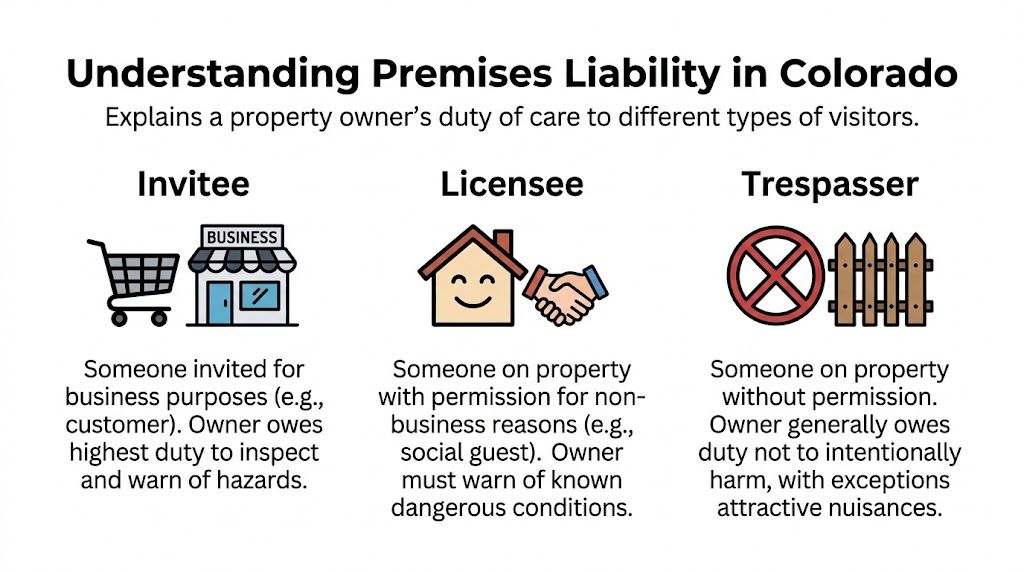
Colorado's Premises Liability Act, C.R.S. § 13-21-115, divides injured people into three categories. Under Colorado premises liability guidance, a property owner's duty depends on whether you are an invitee, licensee, or trespasser, and your rights can change significantly based on that classification.
Here's what those categories usually mean in real life:
| Visitor status | Plain-language meaning | Common example | General duty owed |
|---|---|---|---|
| Invitee | You were there for the owner's business purpose | Customer in a store, tenant using common areas | Highest duty to inspect and address hazards |
| Licensee | You had permission, but not for business reasons | Social guest at a home | Duty to warn about dangers the owner knows about |
| Trespasser | You were there without permission | Person entering a restricted area uninvited | More limited duty, with exceptions |
Why invitee status matters so much
If you slipped in a grocery store, restaurant, hotel, office lobby, or apartment complex common area, you may fall into the invitee category. That matters because owners generally must take reasonable steps to inspect for hazards and either fix them or warn people about them.
When a business welcomes you in, it doesn't get to ignore a spill, leave a broken stair unattended, or pretend an icy entrance isn't its problem. The law expects active care, not passive hope.
For many injured people, confusion often starts. They assume they must prove the owner “meant” for someone to get hurt. That's not the issue. The question is usually whether the owner knew, or should have known, about the danger and failed to respond reasonably.
Licensees and trespassers are treated differently
If you were visiting a friend's house for dinner, you may be a licensee. In that situation, the owner's obligations are narrower. The focus often turns to whether they knew about a dangerous condition and failed to warn you.
Trespasser cases are more limited, but not always simple. The law still has exceptions and fact-specific issues. A child wandering into a hazardous area, for example, raises different concerns than an adult intentionally entering somewhere they shouldn't be.
A slip and fall case often turns less on the fall itself and more on your legal status at the property and what the owner knew about the hazard.
What comparative negligence means
Colorado also uses modified comparative negligence. Under the same Colorado premises liability overview, an injured person can still recover damages even if they were partly at fault, as long as their fault is not 50% or greater.
Insurance companies often push hard. They may argue you were distracted, wearing the wrong shoes, moving too quickly, or “should have seen” the hazard. Sometimes that argument has no real substance. Sometimes it has a little. Either way, the point is to reduce what they pay.
A simple example helps. If someone slips on a clear liquid in a store aisle with no warning sign, the store may still be responsible even if the person was looking at items on a shelf. Shoppers look at shelves. That's normal. Property owners still have to keep walkways reasonably safe.
The core idea to remember
There's no need to memorize statutes. What's important is one clear takeaway. A slip and fall claim in Colorado usually begins with two questions:
- Why were you on the property?
- What did the owner need to do because you were there?
If you can answer those questions, the rest of the case starts to make more sense. And once the legal category is clear, the next issue becomes evidence. What caused the fall, and how do you prove it before the scene changes?
Common Causes and Crucial Evidence
The most useful way to think about evidence is this: every hazard leaves a trail. The problem is that the trail fades fast. Spills get cleaned. Snow melts. video gets overwritten. Witnesses leave. Managers forget details they seemed certain about an hour earlier.
That's why the first steps after a fall matter so much.

Match the hazard to the proof
Different hazards call for different evidence. If you gather the right proof early, your case becomes much easier to understand and explain.
Wet floors or fresh spills. Take wide photos and close-ups. Include the liquid, the surrounding area, and any missing warning signs. Ask whether an incident report was made, and get names of anyone who saw the fall or the condition before it happened.
Snow and ice at entrances or walkways. Photograph the exact patch where you fell, nearby untreated areas, and the path people were expected to use. Your shoes may matter too, so don't throw them away or wash them immediately.
Uneven pavement, broken stairs, or damaged flooring. Capture the defect from several angles. A ruler or everyday object in the frame can help show size and depth. If there was poor lighting, take photos that show visibility conditions.
Obstacles in walkways. If merchandise, cords, boxes, or cleaning equipment caused the fall, document placement and spacing. A common defense is that the object was “open and obvious,” so scene detail matters.
If you can safely do it, document the condition before anyone fixes, cleans, moves, or explains it away.
What people often forget to save
Photos matter, but they aren't the whole file. Some of the most important evidence sounds ordinary:
- Incident reports
- Witness names and phone numbers
- Medical records from the same day or next day
- Clothing and shoes worn during the fall
- Texts sent right after the accident
- Receipts or location records showing why you were there
If a manager or insurer wants a recorded statement, slow down. Accuracy matters, but so do legal and privacy rules. Before you record conversations yourself, it helps to understand call recording laws and ethics, especially if you're trying to preserve what was said after the incident.
A less obvious Denver hazard
Not every case involves a classic grocery-store spill. An emerging concern in Denver involves sidewalk clutter and micromobility devices. According to reporting on Denver e-scooter and micromobility slip claims, claims tied to these hazards have seen a 25% rise since 2025, and these incidents can lead to more severe traumatic brain injuries than traditional slips while still producing lower insurance payouts without specialized legal arguments.
That matters because these cases can look minor at first glance. A person trips over a poorly parked scooter or is forced into an uneven path around sidewalk clutter. But the injury can be serious, especially if the person strikes their head.
A simple evidence checklist
For a practical walkthrough of what investigators look for, this guide on how to investigate a premises liability case is a helpful next read.
You can also use this short checklist right away:
- Get medical care first. Your health comes before documentation.
- Photograph the scene early. Wide shots and close-ups both matter.
- Report the incident. Ask who took the report and how to obtain it.
- Identify witnesses. Don't rely on memory later.
- Preserve your items. Shoes and clothing can become part of the evidence.
- Avoid detailed insurer conversations too soon. Early misstatements can create problems.
A short explainer can also help you think through fault and documentation after a fall:
Evidence is really about control. When you preserve it quickly, you make it harder for the story to shift later. That's often the difference between a vague claim and a strong one.
Navigating the Legal Process and Your Compensation
The legal process feels intimidating mostly because people can't see the path ahead. They picture a courtroom right away, or they assume one wrong move will ruin everything. In reality, most cases move through a sequence of manageable steps.
A claim is less like a sudden showdown and more like building a file, piece by piece, until the facts are clear enough to demand fair payment.
Step one begins with health and documentation
The first priority is medical care. That doesn't just protect your body. It creates a timeline. When you get evaluated promptly, your records connect the fall to the symptoms before an insurance company has room to argue that something else caused them.
After that, the incident should be reported to the property owner, manager, or business. If there's a written report, ask for a copy or at least confirm that one exists. Keep your own notes too. Write down where you were, what you saw, what you felt, and who spoke with you.
Early medical records often become the backbone of the claim because they capture the injury before the story gets contested.
The first call with an attorney
A consultation usually focuses on a few practical issues. Where did the fall happen? What caused it? What injuries are showing up? Is there photo evidence, a witness, or a report? Has any insurance adjuster already called?
This stage is often a relief for clients because it turns a swirl of worries into a checklist. An attorney can explain what not to say, what documents to gather, and what deadlines might apply. If you want a broader overview of the filing path, this guide on how to file a personal injury claim lays out the process in plain language.
Investigation and demand
Once representation begins, the legal team usually gathers records, preserves evidence, and looks for proof that the property owner had notice of the hazard or failed to inspect and fix it. That can include photographs, incident reports, witness statements, medical records, and, when available, surveillance footage.
When the injuries and losses are documented well enough, the attorney typically prepares a demand package for the insurer. This is the formal explanation of what happened, why the insured party is responsible, and what compensation is being sought.
A demand package usually ties together several threads:
| Part of the claim | What it helps show |
|---|---|
| Medical records | The nature of the injury and treatment needed |
| Bills and expenses | What the injury has cost financially |
| Wage information | Income lost during recovery |
| Photos and witness statements | How the hazard looked and how the fall happened |
| Narrative of daily impact | How the injury changed normal life |
Negotiation and possible litigation
Once the insurer receives the demand, negotiation begins. Sometimes the response is reasonable. Sometimes it isn't. Many insurers start by minimizing the injury or arguing that you caused your own fall.
That doesn't mean the case is weak. It often means the insurer is testing how prepared the other side is.
If negotiations stall, the next step may be filing a lawsuit. That starts litigation, which can include written questions, document exchange, depositions, expert review, and mediation. Filing suit doesn't mean trial is guaranteed. It means the case is being pushed into a more formal process where evidence must be taken seriously.
What compensation may include
People often hear the word damages and think it means punishment. In injury law, damages are the categories of harm the law can compensate.
They usually fall into two broad groups:
Economic damages. These are the concrete financial losses, such as medical bills, future treatment costs, lost wages, and reduced earning ability if the injury affects your work long term.
Non-economic damages. These cover the human impact that doesn't arrive in a neat invoice, such as pain, stress, loss of mobility, sleep disruption, and the ways the injury changed your routine or independence.
For some people, the hardest part of a fall isn't the emergency room bill. It's not being able to lift a child, drive comfortably, work a physical job, or trust their balance in public. Those effects are real, and they belong in the case.
The emotional side of the process
A legal claim can feel cold from the outside. Forms, records, deadlines, calls. But for an injured person, the process is often about something warmer and more basic. Rebuilding a sense of safety.
A good claim process should reduce chaos, not add to it. You should understand where the case stands, what the next step is, and why it matters. You shouldn't feel like you're carrying the insurer's pressure alone while also trying to heal.
That's often what people are really looking for when they search for a denver slip and fall attorney. Not just legal knowledge. Calm, structure, and someone who can carry the complicated part while they focus on recovery.
The Nares Law Group Approach to Slip and Fall Cases
Some slip and fall cases are straightforward. Many aren't. A property owner may deny notice. A business may say the hazard was obvious. An insurer may argue your shoes, your pace, or your attention caused the whole event. Those defenses are common because they can sound plausible in a short phone call.
A more disciplined response looks beyond the surface and tests the scene itself.

Building the case from the ground up
According to technical guidance on Denver slip and fall litigation, to prove negligence, certified safety engineers are often retained within 72 hours to perform scientific testing, including use of a tribometer to measure floor slipperiness against ANSI and OSHA standards. The same source notes that this type of evidence can lead to significantly higher settlements and verdicts, sometimes multiplying initial offers by 3 to 5 times.
That kind of work changes the conversation. Instead of arguing in abstract terms about whether a floor “seemed slippery,” the case can rely on measured conditions, scene analysis, and expert interpretation. That's especially valuable when the insurer is trying to shift blame onto the injured person.
What a high-touch approach looks like
When a law firm handles these cases with care, the work usually includes several layers at once:
Fast evidence preservation. The team moves early for photos, reports, surveillance requests, and witness contact before details disappear.
Technical investigation. In the right case, engineers or safety experts can examine the walking surface, maintenance practices, and causation issues.
Medical coordination. Slip and fall injuries often involve more than bruises. Head injuries, orthopedic trauma, and lingering symptoms may require organized follow-up care.
Insurance buffering. The client doesn't need to field every pressure-filled call or decode every letter from the carrier.
The strongest cases often combine scene evidence and medical evidence so the story makes sense from both directions, how the fall happened and what it changed afterward.
Why the human side matters
Technical evidence is important, but people don't experience injuries as spreadsheets. They experience them as missed paychecks, headaches, canceled plans, poor sleep, and anxiety about the future.
That's why communication matters. Clients need to know what's happening, what's being requested, and what the strategy is. They also need help translating medical treatment into legal proof without feeling reduced to paperwork.
Nares Law Group LLC is a Denver personal injury firm that handles investigation, treatment coordination, negotiation, trial preparation, and settlement work in injury cases, including premises liability matters. For some injured people, educational resources can help them feel less isolated during that process. For example, local communication teams such as a Denver podcast agency sometimes help professionals package complex topics into more understandable audio content, which can be useful when people prefer listening over reading during recovery.
Reclaiming control
The legal value of a slip and fall case doesn't come only from the injury. It comes from proving responsibility clearly and documenting the full impact carefully. That takes methodical work.
For the client, though, the deeper value is often peace of mind. Someone is preserving the evidence. Someone is watching the deadlines. Someone is pushing back when the insurer tries to shrink the claim into a quick, incomplete payment.
That shift matters. After a fall, you can feel like events are happening to you. A careful legal strategy helps reverse that feeling. It turns a stressful situation into a managed process with a guide beside you.
Take the First Step Toward Your Recovery Today
A serious fall can make life feel smaller overnight. You may start measuring every movement. Every stair. Every errand. Every bill. That shrinking feeling is one of the hardest parts of an injury.
The way forward usually starts with one simple move. Ask questions early. Get clarity before the insurance company defines the story for you. The right guidance can help you protect evidence, understand your rights, and make decisions from a place of steadiness instead of panic.
You don't have to know today whether your case will settle or go to court. You don't have to calculate its full value by yourself. And you don't have to carry every call, form, and deadline while you're trying to recover.
What you do need is a clear next step.
If you were hurt on unsafe property in Denver, reaching out for a confidential case evaluation can help you understand your options without adding financial pressure. Many personal injury firms, including this one, work on a contingency fee basis, which means no fee unless you win.
A conversation can give you more than legal information. It can give you a plan. And after a fall, a plan is often the first real sign that life is starting to come back under your control.
Frequently Asked Questions About Denver Slip and Fall Claims
People usually have a second wave of questions after the immediate shock wears off. They've seen the doctor, maybe missed some work, and now they're wondering what happens if the facts are messy. That's normal. Slip and fall cases often involve uncertainty at the start.
For law firms, answering those concerns clearly is part of good client care. Resources like LegalRev's insights on client FAQs reflect how important it is to address the questions people are often too stressed to ask out loud.
What if I was partly at fault
That doesn't automatically end your case. Colorado follows a modified comparative negligence rule, which means fault can be shared. The key issue is how much responsibility each side carries.
In practical terms, insurance companies often try to exaggerate your share of blame. They may say you should have noticed the spill, the ice, or the uneven surface. A careful investigation helps test whether that argument holds up.
How much does it cost to hire a lawyer
Many personal injury lawyers handle slip and fall cases on a contingency fee basis. That usually means you don't pay attorney fees up front, and the fee is collected only if money is recovered for you.
This structure matters because it lets injured people get help without adding another bill during a difficult period.
How long do I have to file a claim
Colorado slip and fall claims are generally subject to a 2-year statute of limitations, based on the verified legal framework provided earlier. Deadlines can become more complicated depending on where the incident happened and who owns the property.
The safest approach is not to wait. Evidence fades long before the filing deadline arrives.
Will I have to go to court
Not necessarily. Many cases resolve through investigation and negotiation. But trial readiness still matters because insurers tend to take claims more seriously when they know the injured person's legal team can prepare the case fully if settlement talks fail.
A good attorney prepares as if trial is possible, even while working toward a fair resolution outside the courtroom.
Most clients don't want a courtroom battle. They want a fair result without being pressured into a rushed, low-value settlement.
What if I didn't feel hurt right away
That happens often. Adrenaline can mask pain for hours or even longer. Some injuries, especially head, neck, back, and soft tissue injuries, become clearer after the initial shock passes.
You should still get medical attention as soon as symptoms appear. Prompt care protects both your health and the timeline of your claim.
Should I talk to the insurance adjuster
You should be cautious. Adjusters may sound friendly, but their job is to evaluate the claim for the insurer. A recorded statement given too early can lock you into incomplete facts before you know the full extent of your injuries.
If you've already been contacted, that doesn't mean you've ruined your case. It means you should slow down and get advice before saying more.
What if the hazard is already gone
That's common. Spills are cleaned. Ice melts. Objects are moved. Repairs get made. A case can still be viable if other evidence exists, such as witness accounts, incident reports, surveillance footage, medical records, or photos taken soon after the fall.
This is one reason acting quickly matters so much.
What kinds of injuries matter in a claim
A claim isn't limited to dramatic injuries. Broken bones and head injuries clearly matter, but so do injuries that interfere with work, sleep, movement, and daily routines. The legal question is whether the fall caused harm that can be documented and connected to your losses.
If your life changed after the incident, it's worth having the situation reviewed.
If you were injured and need answers, Nares Law Group LLC offers free, confidential case evaluations for people dealing with the aftermath of serious accidents in Colorado. If the firm takes your case, representation is provided on a contingency fee basis, so there's no fee unless you win.