You're in the worst part of a truck crash claim right now. The bills are landing, your body doesn't feel normal, and somebody from the trucking company's insurer is probably already hinting that a quick check would “take care of things.” It won't. A truck accident settlement is built on evidence, strategic positioning, and timing, and if you let the wrong records disappear early, you can cripple the value of the claim before the fight even starts.
Why Truck Accident Claims Are Not Ordinary Car Wrecks
A truck case starts the moment the impact happens, but the damage often shows up later, in the ER, in physical therapy, and in the first phone calls from insurance. If you're hearing a fast offer before you've even finished a proper medical workup, that's not generosity. That's the carrier trying to buy uncertainty cheaply.
The crash is bigger, and so is the exposure
Federal safety data cited in trucking-settlement discussions show why these claims are different. In 2019, large trucks caused approximately 510,000 crashes, and about 119,000 of them, roughly 23%, resulted in injury or death (Brown & Crouppen). In 2021, a separate FMCSA-based summary said 1% of truck collisions were fatal and 22% caused injuries (Brown & Crouppen). That kind of harm profile is why truck claims regularly move far beyond ordinary passenger-car cases.
The other difference is the defendant. You're not dealing with a distracted driver in a personal auto policy. You're dealing with a commercial operation that may have dispatch records, maintenance logs, driver qualification files, and multiple insurance layers. If you want a practical example of the paper trail carriers keep, look at a resource on managing driver documents and then think about how much of that can help or hurt your claim.
The legal fight is corporate, not casual
Commercial trucking cases often turn on federal compliance, not just basic fault. Hours-of-service issues matter, and a helpful overview of that subject is available in this discussion of hours of service violation. If the driver was fatigued, the carrier may have ignored the warning signs, and that changes settlement dynamics fast.
Practical rule: treat the insurer like an adversary from day one. Their adjuster is not there to explain your rights, they're there to minimize payout.
The first mistake injured people make is assuming “truck accident” is just a bigger version of a fender-bender. It isn't. It's a commercial-liability case with higher stakes, more records, and a much stronger reason for the defense to move fast before evidence hardens against them.
How the Truck Accident Settlement Process Works
The process is simple in theory and ruthless in practice. A crash happens, the evidence window opens, the demand package goes out, and then the case either settles or heads into litigation. The part injured people miss is the first 14 days, because telematics, ELD logs, and ECM diagnostics can be overwritten or lost if nobody moves fast to lock them down.
The first days decide what can still be proven
Preservation letters come first. Not polite requests. If you wait, the trucking company controls the records, the truck, and the story. Forensic downloads can lock down speed, braking, route data, and hours-of-service compliance, and that information can then be checked against toll scans and weigh-station timestamps to test whether the driver's account holds up.
That is why the claim file needs medical records, photos, witness statements, police reports, and the electronic evidence side by side. A demand package without those pieces is just a letter asking for money. A demand package with them forces the insurer to deal with facts it cannot easily spin away.
The timing traps are what hurt people most. Delayed treatment gives the defense an opening to argue the injury was minor or unrelated. Missed scene photos, lost dashcam footage, and an unfrozen truck data set can cut the value of the case before anyone starts talking numbers. If the carrier sees a sloppy file, it knows you are negotiating from weakness.
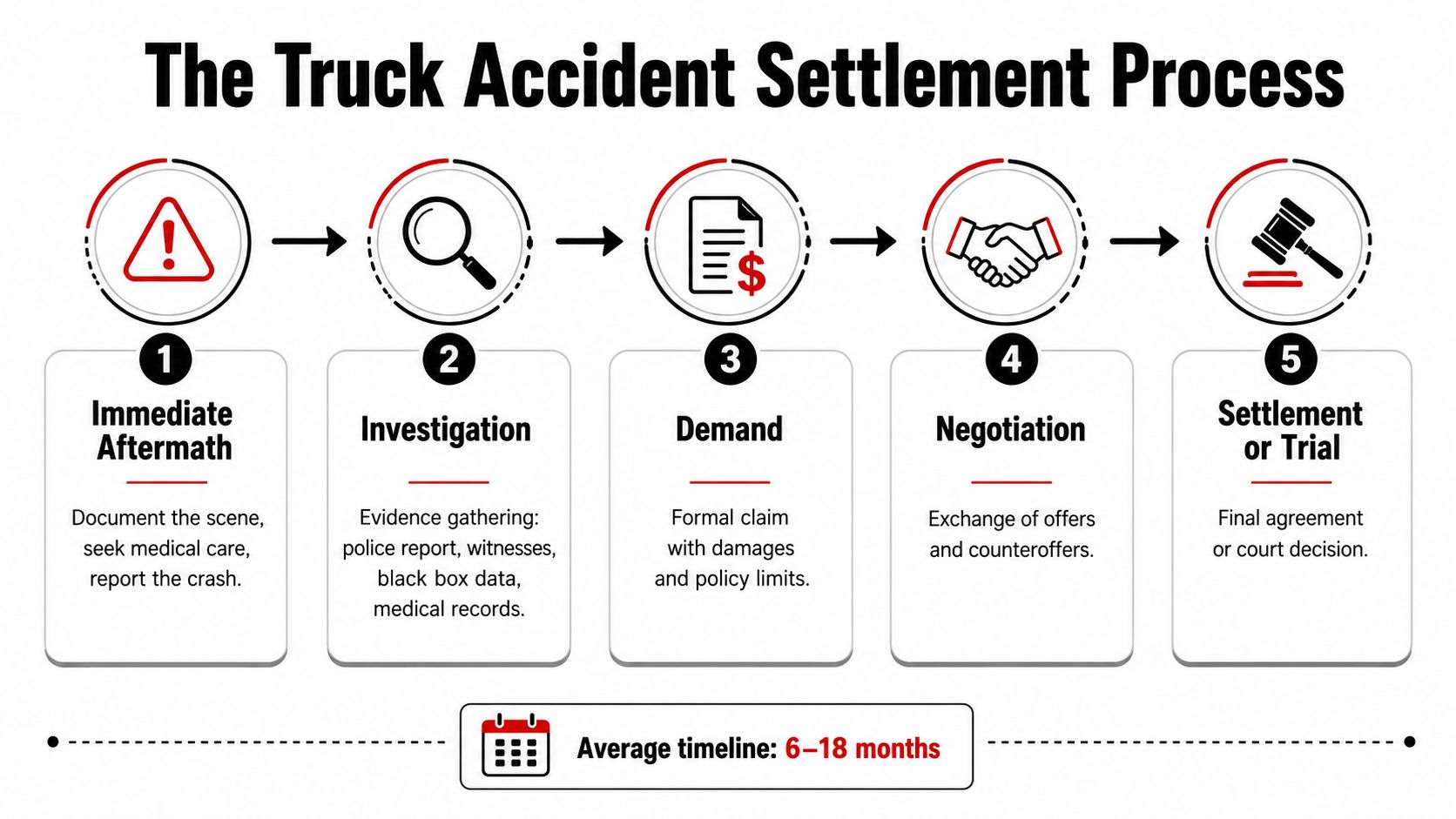
Here's the point. The settlement process is not one event. It is a sequence of moves, and each one affects the next.
- Immediate aftermath. Document the scene, report the crash, and get medical care.
- Investigation. Pull records, preserve devices, and identify every possible source of proof.
- Demand. Present damages, liability, and policy exposure in writing.
- Negotiation. Trade offers and counteroffers while the defense tests your resolve.
- Resolution. Sign a release or prepare for court if the offer stays low.
A release ends the claim, not just the conversation
When you sign a release, you are usually giving up the right to ask for more later. That matters because truck injuries can change over time, especially when symptoms do not settle quickly. If the insurer is pushing a fast release before your doctors know the full picture, it is doing that for one reason, to close out the claim before the full extent of harm is documented.
Get the file built correctly before you give up your position. Medical proof, liability proof, and preserved truck data are what force the defense to pay attention. If earnings are part of the loss, documentation matters there too, and a useful overview appears in navigating a loss of earnings claim.
The Key Factors That Determine Your Settlement Value
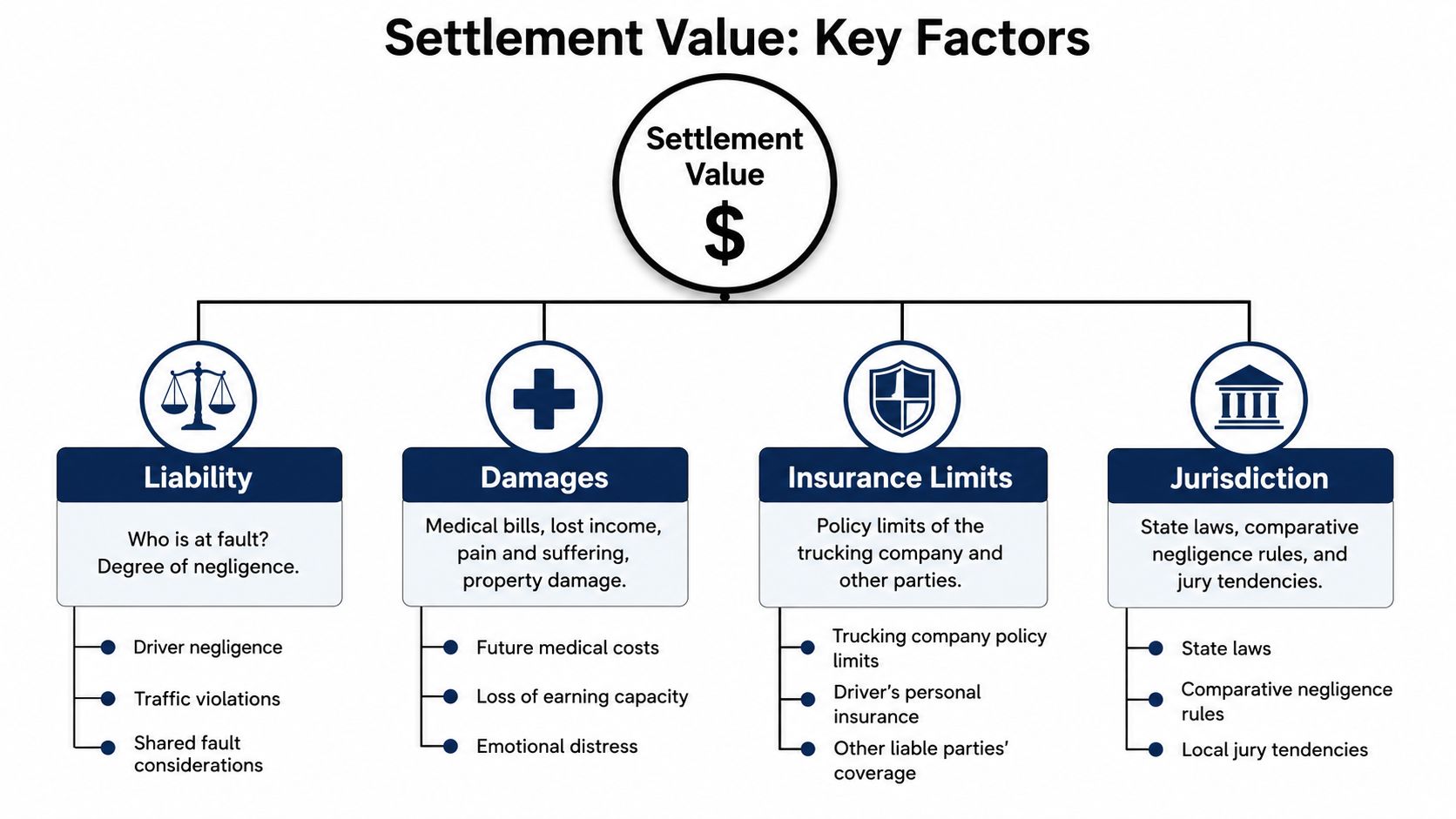
Settlement value in a truck case comes down to four things, liability, damages, insurance limits, and jurisdiction. Timing sits underneath all four. Miss the window to preserve proof, and the value drops fast. Get the evidence locked down early, and the defense has far less room to minimize the claim.
Liability is the first lever
If the truck driver clearly caused the crash, settlement pressure rises. If the carrier trained the driver poorly, skipped maintenance, or pushed unsafe schedules, the pressure rises more. Strong liability proof leaves less room for the insurer to argue about blame, which usually improves your negotiating position.
Documents beat speeches every time. ELD records, maintenance entries, black-box downloads, and witness accounts tell the story. If those records disappear, get altered, or are requested too late, the defense gains breathing room it should never have had. For practical guidance on wage proof, see understanding a loss of earnings claim, because income loss has to be documented, not guessed at.
Damages drive the ceiling
The injury itself sets the tone. A short recovery gets treated very differently from permanent impairment, future surgery, or life-care needs. Medical imaging, specialist opinions, and future-care projections matter because they move the case from a temporary pain argument into a long-term loss argument.
Economic damages need the same discipline. Wage loss, reduced earning capacity, and ongoing treatment costs belong in the file, not in casual conversation. A clean record gives the demand credibility. A sloppy one lets the insurer shave value off the claim. If you want a quick reality check on how those inputs interact, a truck accident settlement calculator can help you frame the numbers before the defense starts setting the terms.
Bottom line: a truck settlement grows when your lawyer can prove the injury changed your life, not just your week.
Insurance and jurisdiction can cap the result
Commercial policies often give you more room than ordinary auto claims, but they still set a ceiling. If the policy stack is shallow, a large claim can still get squeezed. Jurisdiction matters too, because state fault rules and jury tendencies shape how the defense evaluates risk.
The question is not the average result. It is what proof, what defendants, and what coverage can support the number you need. If the carrier sees missing records, delayed treatment, or gaps in the wage file, it will use those holes to cut the settlement.
Realistic Settlement Ranges by Injury Severity
People want a number, and I get why. A truck accident settlement is shaped by the injury, the proof, and the commercial coverage in play. The smart way to frame it is by severity band, because that is how insurers size up risk.
Moderate-injury claims are often discussed in the $100,000 to $500,000 range, while severe injuries or wrongful death can reach $1 million to several million dollars (Brown & Crouppen). Published settlement summaries also show why averages can mislead. One dataset of more than 400 truck cases settled between 2021 and 2024 reported an average settlement of about $103,654 and a median of $30,000, which tells you that a few large recoveries can pull the average upward. That same summary said plaintiffs prevailed in 71% of truck verdict cases, with average jury awards of $532,034, disc-injury cases averaging $122,532, and fatal truck cases averaging just over $1 million (Wexford Insurance).
| Injury Category | Typical Settlement Range | Key Value Drivers |
|---|---|---|
| Soft tissue and minor injury claims | Qualitatively lower than serious-injury claims | Short treatment, modest wage loss, limited permanency |
| Fractures and disc injuries | Often in the moderate-injury range | Imaging, surgery, therapy, missed work, lingering symptoms |
| TBI, spinal injury, amputation | Often in the severe-injury to catastrophic range | Permanent impairment, future care, lifetime wage loss |
| Wrongful death | Often reaches the highest range | Financial support loss, companionship loss, commercial coverage |
Why the table is only a starting point
The table gives you a framework, not a promise. A disc case with clean liability and strong imaging can outrun a messier claim with more pain but weaker proof. A catastrophic injury case can still produce a disappointing result if coverage is thin.
Timing and recordkeeping also decide a lot of cases before anyone gets to the numbers. Gaps in treatment, missing imaging, lost wage records, or a delay in locking down medical opinions give the carrier room to argue the claim is worth less than it is. If you want a practical read on how your facts fit together, use this truck accident settlement calculator to organize the evidence before the defense starts shaping the story.
Why a Large Settlement Number Does Not Always Mean Full Recovery
A big demand number can make people relax too early. Don't. A claim can look strong on paper and still pay poorly if the wrong defendants were left out or the wrong policy layers were ignored.
Multiple defendants change the math
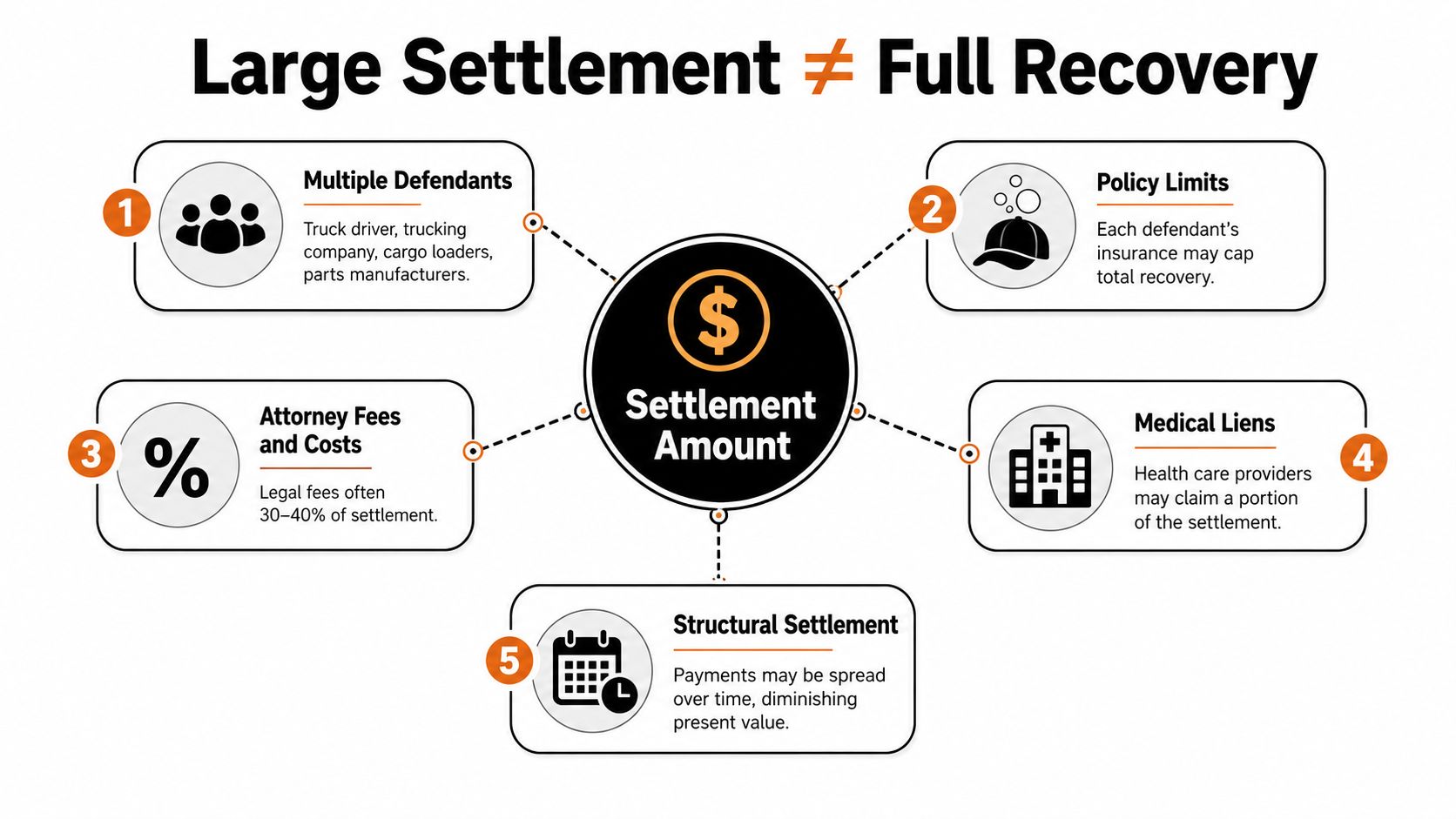
Commercial truck crashes can involve the driver, the carrier, the maintenance provider, the freight broker, the cargo loader, or the manufacturer. If your legal team stops at the obvious defendant, money can stay off the table. That is why an early investigation has to chase logs, maintenance records, and ELD data before the record goes stale (FindLaw).
Coverage layers matter just as much. A primary policy may not be enough if the injury is severe, and excess or umbrella coverage may exist only if somebody finds it. A headline settlement number means little if the recovery cannot be collected.
The deduction problem is real
Even when the gross number looks good, the net number can shrink fast. Medical liens can claim part of the settlement, and fee structures reduce the amount that reaches the client. Structural payouts can also spread money over time, which changes present value and planning. If a lien is sitting on the claim, use a medical lien on settlement review early so the final number is measured against what you will keep.
That is why the question is not “How large is the number?” It is “How much of that number gets into your pocket, and when?”
Practical rule: ask your lawyer which defendants were investigated, which policies were identified, and which recovery layers were verified.
If those questions do not get clean answers, you do not have a valuation problem. You have a collectability problem.
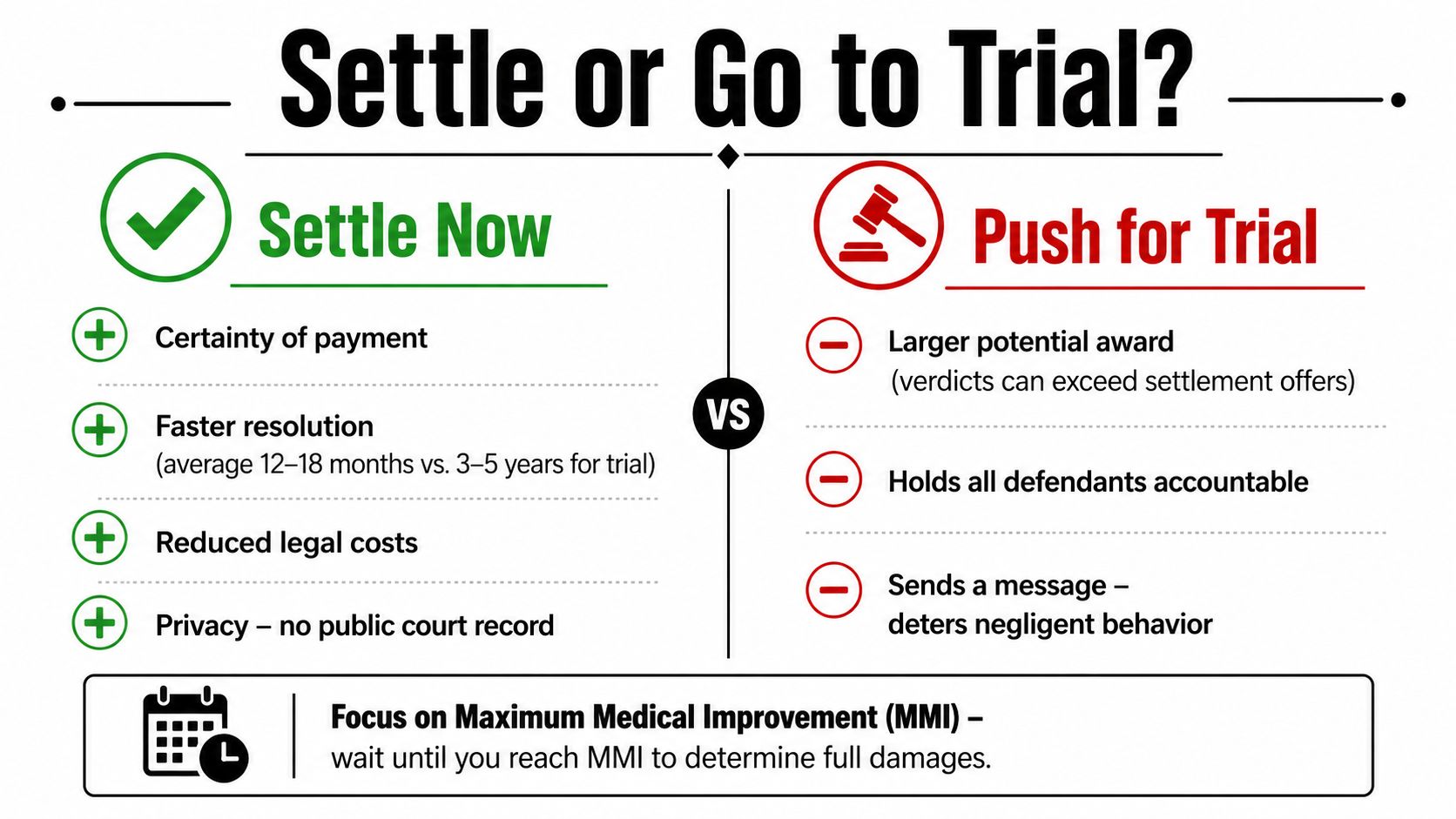
When to Accept a Settlement and When to Push for Trial
Settling too early is one of the easiest ways to lose real money. If your injuries are still evolving, the defense is betting you'll undervalue future care, future pain, and future wage loss. That bet works for insurers more often than it should.
Wait for medical clarity
Maximum medical improvement matters because it tells you whether the injury has plateaued. If you settle before that point, you risk pricing the case as if recovery is finished when it isn't. That problem gets worse with traumatic brain injury, spinal injuries, and conditions with delayed or progressive symptoms, where the early picture can be misleading.
Nolo's guidance on truck cases notes that insurers may push early offers before the full injury picture is known, and that documented medical costs, lost wages, and pain and suffering drive value (Nolo). That's the trap. They want certainty at a discount while you still don't know what the next scan or specialist visit will show.
Trial is a tool, not a religion
There are times to take the money. A fair offer with solid coverage, solid liability, and a realistic medical picture can be the smart move. Trial adds time, cost, and stress, and it carries risk. A defense verdict is always on the table.
But trial also forces accountability when the defense won't pay fairly. It can expose unsafe company practices, hold every responsible party in the case, and create pressure that never appears in a polite negotiation. A disciplined lawyer knows when to press and when to close.
The decision should be blunt. If the injuries are still unfolding, wait. If the offer fully accounts for the loss and the risk of trial outweighs the upside, take it. Anything in between is where insurers try to drag you into a cheap resolution.
Practical Steps to Protect Your Claim From Day One
The first days after a truck crash are not the time to be passive. Take control of what you can control, because the defense will absolutely control what you ignore. Your job is to preserve facts, not guess at value.
Do these things immediately
- Get medical care right away. Even small symptoms matter, because serious injuries can show up late.
- Photograph everything. Vehicles, lane positions, debris, injuries, skid marks, and traffic control devices all belong in the file.
- Save your own records. Keep phone logs, texts, dashcam footage, and work records that show what changed after the crash.
- Do not give a recorded statement. The trucking company's insurer is looking for admissions, gaps, and uncertainty.
- Tell your doctors the full story. If pain moves, worsens, or limits sleep and work, say so early and in detail.
Watch the clock on deadlines
State deadlines matter, and missing them can kill a claim. In Colorado, most personal injury claims use a two-year limitations period. In Texas, many use two years as well. In New York, many personal injury claims also use three years. Those deadlines can vary by claim type, so don't assume you have time just because the bruises are still visible.
If you hire counsel, ask about the fee structure in plain English. Most personal injury firms work on contingency, which means no upfront fee, but the costs of obtaining records, experts, and litigation support still matter. You should know that before anyone pushes you to sign.
Direct advice: if a lawyer can't explain deadlines, evidence preservation, and likely recovery layers in plain language, keep looking.
One more practical point. I mention Nares Law Group LLC here because the firm handles truck wreck litigation, including case investigation and co-counsel support in trucking matters. That's the kind of representation that should be on the table when your claim is complex, not an afterthought.
Your Next Steps Toward Fair Compensation
A truck case is won or lost early. Preserve the electronic evidence, build the medical record carefully, identify every responsible party, and don't let an insurer rush you into a release before the injury picture is real. If you remember only one thing, remember this, timing is part of value.
The people who get hurt worst are usually the ones who settle on the insurer's schedule. Don't let that be your story. Hold the line until the claim is documented, the coverage is understood, and the medical future is clear enough to price fairly.
Nares Law Group LLC handles serious crash and trucking cases with the kind of case development these claims demand, including evidence preservation, negotiation, and trial preparation. If you're dealing with a truck accident settlement issue and want straight advice on your options, visit Nares Law Group LLC and ask for a consultation before you sign anything.