The crash is over, but the disruption is just getting started.
Your car is in the body shop, or the adjuster has already called it a total loss. You still have to get to work. Your kids still need rides. Medical appointments don't move just because another driver hit you. If you drive for work, carry tools, or need a larger vehicle for family or mobility reasons, losing your car can turn an already stressful week into a logistical mess.
Auto insurance loss of use serves a vital purpose here. This component of a claim covers the financial value of losing access to your vehicle during a period you normally would have driven it. Drivers frequently encounter rental vehicle options and assume they understand the entire coverage, but that rarely represents the complete picture.
Sometimes you're using a limited benefit under your own policy. Other times you're making a legal claim against the at-fault driver for the reasonable value of your vehicle's downtime. Those are different paths, with different rules, different proof, and very different outcomes.
If the insurer has already told you, “We'll pay for a small rental for a few days,” don't assume that ends the discussion. In many cases, the core issue is whether that offer matches your loss, your needs, and the time your vehicle is reasonably unavailable.
Your Life on Hold After a Car Accident
A lot of people first learn the phrase loss of use when they're already exhausted.
They've spent days dealing with police reports, tow yards, repair estimates, and adjusters. Then the practical problem hits. They don't have a vehicle, but life still runs on a schedule. School drop-offs, groceries, physical therapy, work commutes, and care for relatives all continue whether the insurer moves quickly or not.
What loss of use really means
Loss of use is the legal and insurance concept that addresses that disruption. It recognizes something simple. A vehicle isn't just a piece of property sitting in a driveway. It's a tool people rely on every day.
If another driver caused the crash, your damages may include more than the cost to repair or replace the car. You may also have a claim for the value of being deprived of its use during the reasonable downtime.
That point matters because many adjusters talk as if the only available help is a basic rental benefit. Sometimes that's true under your own policy. But when another driver is at fault, the analysis often goes beyond the narrow terms of your rental coverage.
Losing access to your car can create real economic harm even when you haven't missed a paycheck. Colorado drivers feel that harm in transportation costs, missed flexibility, and the pressure to accept whatever the insurer offers just to get moving again.
The problem clients run into
The insurer may focus on one question only. “Did you rent a car?”
That's too narrow. The key questions are whether your vehicle was unavailable, how long that unavailability reasonably lasted, and what comparable transportation would have cost in your market. A person can suffer a loss of use even when they borrow a car, juggle rides, or temporarily go without.
What works is treating this as a proof problem, not just a frustration problem. The stronger your paperwork, timeline, and explanation of vehicle needs, the harder it is for the carrier to minimize the claim.
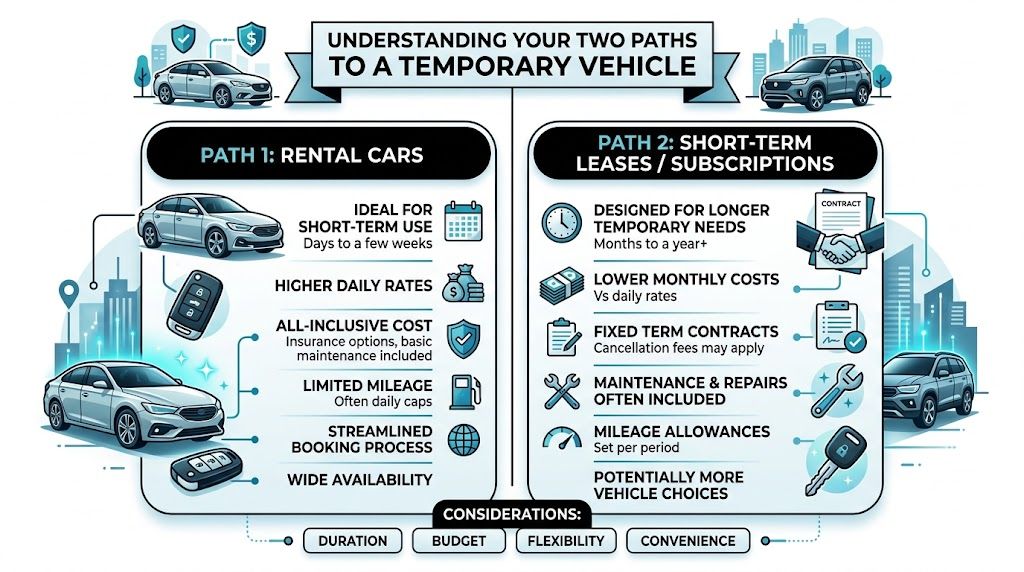
Understanding Your Two Paths to a Temporary Vehicle
Most confusion about auto insurance loss of use comes from mixing up two separate things.
The first is rental reimbursement coverage under your own policy. The second is a loss of use damages claim against the at-fault driver or that driver's insurer. One is a contract benefit you already bought. The other is a damages claim you have to support with evidence.
Your own policy benefit
Rental reimbursement is usually tied to a covered physical damage claim. Industry guidance notes that auto insurance loss of use is commonly handled as rental reimbursement linked to collision or other physical damage coverage, and common caps are about 30 days, with no separate deductible for the rental benefit itself, although the underlying physical-damage claim and policy limits still control recovery, as explained in The Zebra's guide to loss of use coverage.
That means your own carrier may pay quickly, but only within the boundaries of your policy. If your coverage is modest and you need a more expensive vehicle class, you may still have out-of-pocket exposure.
If you're sorting out whether your claim belongs under property damage liability or your own collision coverage, this overview of property damage versus collision coverage helps frame the difference.
The liability claim against the other driver
A third-party loss of use claim is different. You're not asking for a prepaid benefit. You're asserting that the at-fault driver caused a compensable loss and that the reasonable value of substitute transportation, or the value of the lost use itself, should be paid as part of the property-damage claim.
That claim can be broader than your own rental reimbursement coverage. It can also be slower and more contested, because the other insurer isn't bound by your policy terms. It will look for weak spots in your documentation, your timeline, and the type of rental you chose.
Side-by-side comparison
| Attribute | Rental Reimbursement Coverage | Loss of Use Damages |
|---|---|---|
| Source of right | Your own insurance policy | Claim against the at-fault driver |
| Trigger | Covered collision or comprehensive claim | Another party's fault caused your vehicle downtime |
| Main limit | Policy daily limit and total cap | What you can prove was reasonable and necessary |
| Speed | Often faster if coverage applies | Often slower because liability and value may be disputed |
| Vehicle type issue | Controlled by policy limits | Controlled by reasonableness and comparability |
| Best use | Immediate transportation help | Full recovery when your actual loss exceeds your policy benefit |
Practical rule: Use your own coverage when you need transportation now and liability is still being sorted out. Preserve your third-party claim anyway if the other driver caused the crash and your actual loss is higher than your policy benefit.
Proving the Real Value of Your Car's Downtime
Insurers often act as if loss of use is a courtesy payment. It isn't. It's a valuation exercise.
The usual benchmark is straightforward. Loss-of-use damages are commonly measured by the cost to rent a similar vehicle for the period of downtime, and the claim value rises or falls based on how many days were reasonably necessary and whether the rate reflects a comparable vehicle, as summarized in SelectQuote's explanation of loss of use valuation.
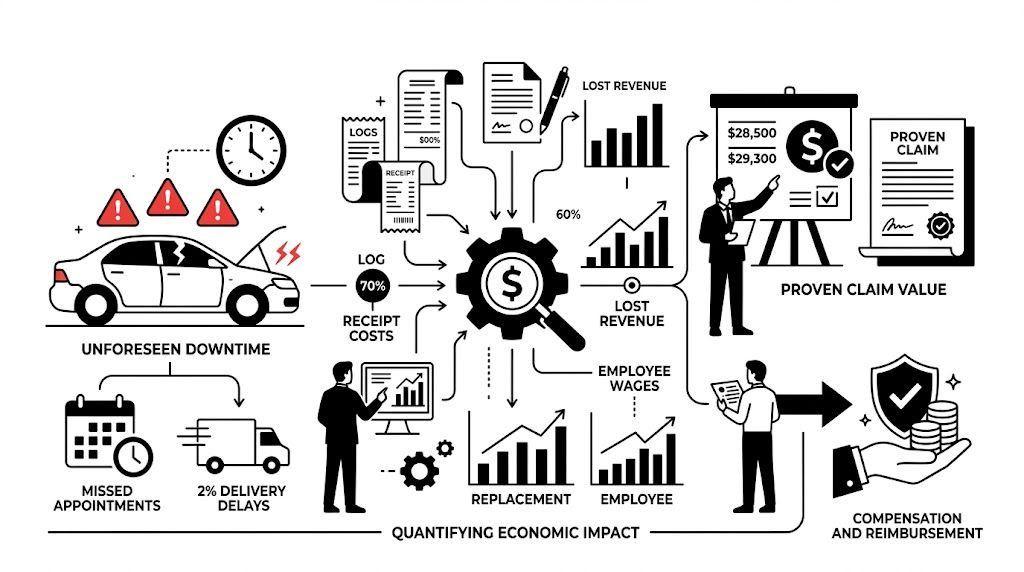
The first variable is time
Downtime isn't limited to the hands-on repair days.
It can include the period reasonably spent waiting for inspection, estimate approval, supplemental approvals, and documented parts delays. If the body shop is waiting on an insurer decision, that delay may still belong in the timeline if you can show it was real and unavoidable.
What doesn't work is guessing. What works is a dated record.
- Repair start and finish dates from the shop
- Supplement approval dates when extra damage was found
- Parts delay notices in writing
- Total loss decision date if the vehicle was not repairable
- Communication logs showing when the insurer caused or extended delay
The second variable is comparability
A comparable vehicle doesn't mean “whatever was cheapest on the screen.” It also doesn't mean “whatever I wanted to drive.”
The replacement should match the damaged vehicle in a practical way. A sedan usually supports a sedan claim. A work truck may justify a truck. A family hauling children in car seats may need an SUV or minivan rather than a compact car.
“I needed a replacement vehicle comparable to my damaged vehicle in passenger capacity and ordinary use. A smaller vehicle would not have reasonably met my family and transportation needs.”
That kind of statement is stronger when it's supported by facts. Mention the number of child seats, wheelchair access issues, job equipment, or regular travel demands. The more concrete your explanation, the less room the adjuster has to frame your request as an upgrade.
Build the rate from local market proof
Don't rely on the insurer's number if it doesn't reflect the market.
Save screenshots from major rental providers in your area for the relevant vehicle class and the relevant dates. If availability was limited, preserve that too. A “comparable” daily rate should come from your local rental market, not a generic adjuster assumption.
Navigating At-Fault vs Your Own Insurance
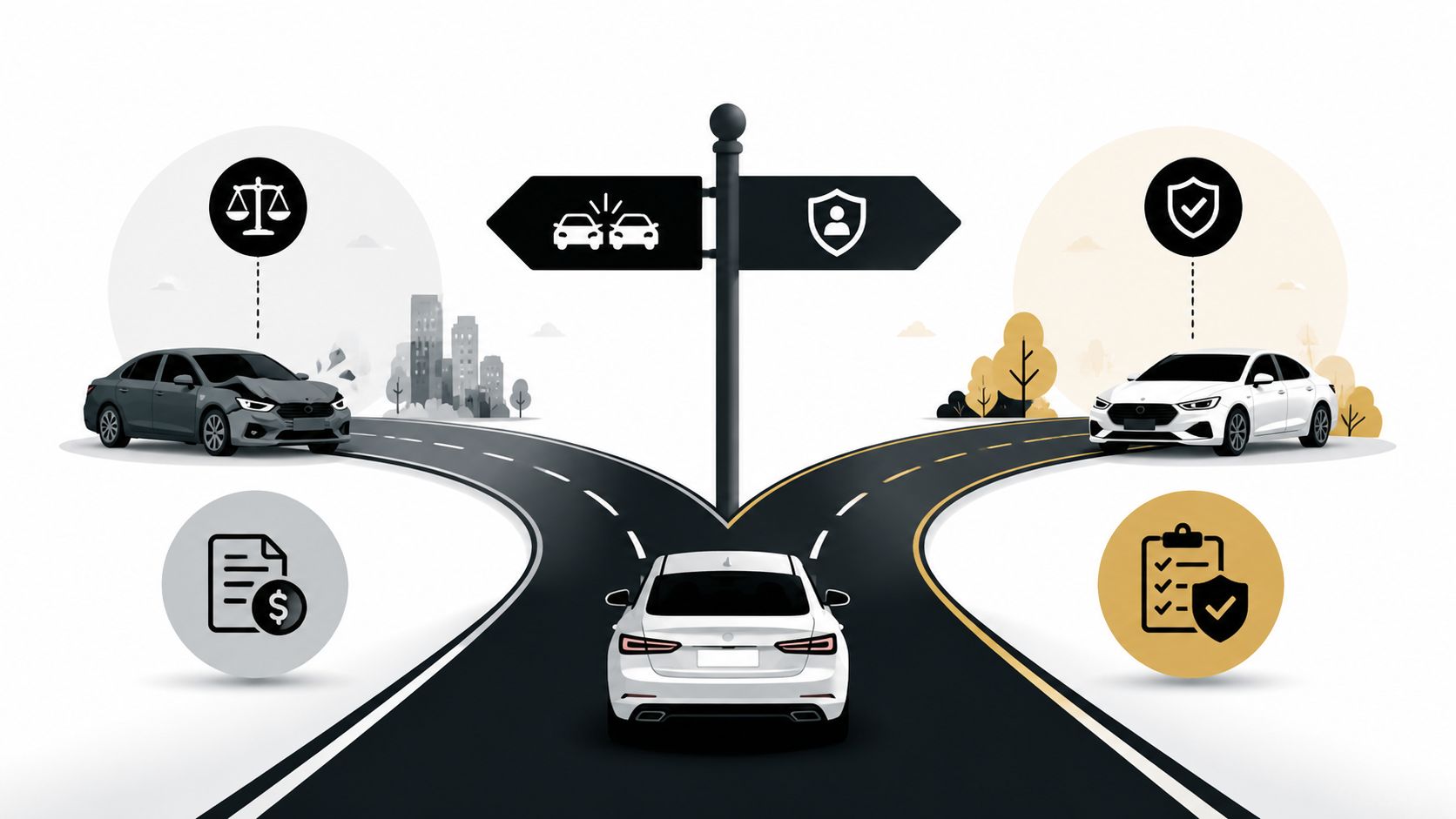
The first place to look is usually the at-fault driver's property damage liability coverage.
If that driver clearly caused the crash, their insurer should evaluate your property damage, including a proper loss of use component. In a clean liability case, that's often the most complete path because you're not boxed in by the rental limits on your own policy.
Still, many people can't wait for the liability carrier to finish its investigation. They need transportation right away. That's where your own collision coverage and rental reimbursement may become the practical first move.
Why carriers push back
Insurers aren't handling these claims in a cheap environment. The U.S. Treasury reported that between 2015 and 2022, premiums for minimum required auto liability coverage increased while loss severity also increased, and in 2022 the average auto expenditure per vehicle was $1,127, up 6.1% from 2021, as stated in the Treasury Department's Auto Insurance Affordability update.
That broader cost pressure shows up in everyday claims handling. Adjusters scrutinize rental class, repair duration, total-loss timing, and whether a delay was really necessary. You should expect questions. You should also be ready with documents.
Using your own policy without giving up your rights
Many Colorado drivers hesitate to use their own coverage because they think it helps the wrongdoer. Usually, that's not how it works.
If your policy applies, your insurer may pay for covered damage or rental reimbursement first and then seek recovery from the at-fault side. That process is often called subrogation. The practical point is simple. Getting help under your own policy doesn't automatically erase your right to pursue the responsible driver for uncompensated loss.
A realistic order of operations
- Open the liability claim with the at-fault insurer immediately.
- Open your own physical-damage claim if transportation can't wait.
- Ask about rental reimbursement right away so there's no gap.
- Track what your insurer paid versus what your total loss of use was.
- Preserve proof of any shortfall if the liability carrier later tries to cap the claim.
What fails is passivity. If you assume the two insurers will coordinate perfectly, you'll often end up with a paper trail full of gaps and a claim that looks smaller than it really was.
Colorado Law and Total Loss Vehicle Claims
One of the most common mistakes in these cases is the assumption that loss of use ends the moment the insurer declares your vehicle a total loss.
That's too simplistic. A totaled car can still leave you without transportation for a reasonable period while value is being resolved and a replacement vehicle is being secured. From a legal standpoint, the loss is not just physical damage to metal. It's also the deprivation of your ability to use your vehicle.
Why total loss should not automatically end the claim
Courts in different states approach this issue differently, but the trend has moved toward recognizing loss of use even when the vehicle will never be repaired. A prominent example is that the Texas Supreme Court held in 2016 that owners of totaled vehicles could recover loss-of-use damages, reflecting the principle that loss of use is a tort damage, not merely an insurance add-on, as discussed in CLM Magazine's article on overlooked loss-of-use claims.
Colorado practitioners should pay attention to that reasoning even though every state has its own case law and claims practices. The core logic is persuasive. If someone wrongfully deprives you of your vehicle, the fact that the vehicle is later declared a total loss doesn't magically erase the downtime you reasonably experienced before replacement.
How this plays out in Colorado claims
In Colorado, the practical fight is usually over reasonableness.
The carrier may agree that some period is compensable but argue it ended earlier than you claim. For example, it may say you should have accepted a valuation sooner, found a replacement faster, or made do with less. That is why documentation matters so much in total-loss cases.
You need records showing when the total-loss decision was made, when the valuation was communicated, whether there was a legitimate dispute over value, and what steps you took to obtain a replacement vehicle.
For a broader look at the legal framework surrounding vehicle crash claims, this summary of Colorado car accident laws is a useful starting point.
The strongest total-loss loss-of-use claims don't rely on outrage. They rely on dates, written communications, and proof that the replacement timeline was reasonable under the circumstances.
Documenting and Submitting a Bulletproof Claim
A good loss of use claim reads like a timeline, not a complaint.
The adjuster should be able to see what happened, when it happened, why the delay was reasonable, what vehicle class you needed, and how you calculated the amount claimed. If your file is organized, you hold a stronger position. If it's vague, the insurer will fill the gaps in its own favor.
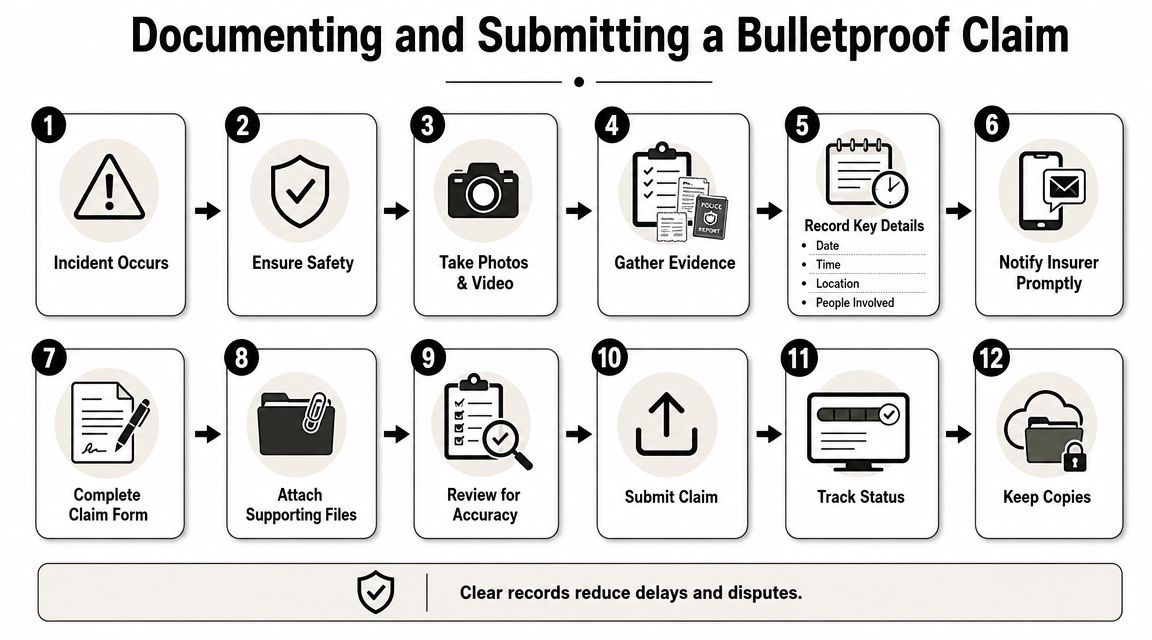
What to gather first
Start with the basics, but don't stop there.
- Transportation need summary. Write down how you normally use the vehicle. Work commute, child transport, medical care, jobsite travel, equipment hauling, or mobility-related needs.
- Repair or total-loss timeline. Ask the shop for written status updates and dates. If the vehicle is totaled, keep every valuation letter and communication about settlement timing.
- Comparable rental proof. Save screenshots showing available rental options for the relevant class of vehicle in your area.
- Vehicle necessity proof. If you needed a minivan, SUV, or truck, preserve the facts that explain why.
A common dispute involves what counts as “comparable.” Insurers may argue that a family who needs a minivan can use a compact sedan instead, so it's critical to document family size, work requirements, or mobility needs and show that you mitigated by choosing a similar, not luxurious, replacement, as described in Wagner Reese's discussion of comparable rentals and denial issues.
The written demand matters
Send a formal written demand once you have the timeline and supporting records. Keep it short, factual, and attached to documents.
I am seeking payment for loss of use damages for the period my vehicle was reasonably unavailable due to this collision. The enclosed records show the dates of unavailability, the reason for each delay, and the market cost of a comparable replacement vehicle. Please evaluate this claim based on the documented downtime and comparable local rental rates.
If your body shop's paperwork is unclear or thin, it helps to understand what detailed repair documentation should look like. Even a consumer can benefit from reviewing an invoicing guide for auto repair shops because it shows the kind of line-item detail that strengthens a property-damage claim.
Common mistakes that weaken a claim
Some problems are avoidable.
- Renting far above your vehicle class without a clear necessity explanation.
- Failing to save screenshots of local rates when the vehicle was unavailable.
- Relying on phone calls only instead of confirming dates and delays by email.
- Submitting receipts without context so the insurer can argue the rental period was excessive.
- Waiting too long to challenge a low offer and letting the carrier treat silence as acceptance.
If you're dealing with repeated adjuster delays or mixed messages, this guide on how to deal with insurance after a car accident can help you tighten up the communication record.
Frequently Asked Questions About Loss of Use
Loss of use questions usually come up after the insurer has already made a narrow offer. Here are the issues I see most often.
Can I claim loss of use if I borrowed a car instead of renting one
Often, yes. The claim is about the value of losing use of your own vehicle, not only whether you paid a rental company. But you still need proof that your vehicle was unavailable and that substitute transportation was reasonably necessary.
What if the insurer offers a daily rate that seems too low
Counter it with market evidence.
Send screenshots for comparable vehicles in your area, on the relevant dates, and in the relevant class. If your damaged vehicle was a truck, SUV, or minivan, make that point directly and support it with practical need, not preference.
Can I claim the whole repair period if parts were backordered
Potentially, if the delay was reasonable and documented. The key is proof from the body shop or supplier showing the parts issue was real and that the vehicle could not be returned to service sooner.
What if my car was totaled
Don't assume the claim ends on the total-loss date. In many cases, the actual question is the reasonable period needed to resolve valuation and obtain a replacement vehicle. Total-loss loss of use is a frequent point of underpayment.
Why are these claims getting harder to resolve
Because they're showing up more often and in more serious property-damage situations. LexisNexis reported that total loss frequency rose to 29% of all collision claims, and property damage severity also increased, making fair loss-of-use compensation more important as drivers spend longer without their vehicles, according to the LexisNexis auto insurance trends report.
When should I talk to a lawyer
Talk to a lawyer when the insurer is cutting off rental time early, undervaluing a comparable vehicle class, using a total-loss designation to shut down your downtime claim, or ignoring written proof of delay. Those are not minor paperwork issues. They directly affect what you recover.
If an insurer is minimizing your vehicle downtime, cutting off payment too early, or treating your total-loss claim like loss of use doesn't apply, Nares Law Group LLC can help you assess your rights under Colorado law. The firm represents crash victims in Denver and across Colorado, and offers free consultations for people dealing with unreasonable insurance tactics after a serious accident.