When a loved one is suddenly taken because of someone else’s carelessness, the world stops. If you’re here, searching for a wrongful death attorney in Colorado, it means your family is facing an unimaginable loss. It also means you’re up against a legal system that feels confusing and overwhelming.
A wrongful death claim is a civil action—completely separate from any criminal case. Its purpose is to provide a path to financial stability for surviving family members and, just as importantly, to hold the responsible party accountable for their actions.
Navigating the Aftermath of a Wrongful Death in Colorado

Losing a family member this way is a devastating experience. The legal complexities that follow can feel crushing when you’re already carrying so much weight. A wrongful death claim isn’t about assigning blame in a criminal courtroom; it’s a vital legal tool that allows families to seek justice and secure financial support after a preventable tragedy.
This legal action acknowledges that the loss created profound emotional and economic voids. It serves as a bridge, helping your family move from a place of deep instability to one of greater security. The goal is to ensure your family doesn’t have to bear the financial burden of someone else's negligence alone.
To help you get a clear, high-level view of what this process involves, we've created a simple summary.
Colorado Wrongful Death Claims at a Glance
| Key Element | What It Means for Your Family |
|---|---|
| Who Can File | In the first year, only a surviving spouse can file. In the second year, children or a designated beneficiary may also file. |
| Statute of Limitations | You generally have two years from the date of death to file a claim. This deadline is strict. |
| Basis of the Claim | The death must have been caused by the wrongful act, neglect, or default of another person or entity. |
| Recoverable Damages | Compensation can cover funeral costs, lost income, loss of companionship, grief, and other emotional and financial losses. |
| Legal Burden | You must prove that the other party’s negligence was the direct cause of your loved one's death. |
This table is just a starting point, but it helps frame the key components you'll encounter. Each case is unique, and the details truly matter.
Why You Need a Compassionate Advocate
The main purpose of hiring a wrongful death attorney in Colorado is to have a dedicated advocate who shields you from the legal burdens. This gives your family the space you need to grieve and begin to heal.
An experienced attorney manages every single aspect of the case. They handle the investigation, the calculations, the communications, and the negotiations with powerful insurance companies.
Your legal team’s role extends far beyond just filing paperwork. They are there to:
- Conduct a thorough investigation to gather evidence and prove negligence.
- Calculate the full, long-term extent of your family’s financial and emotional losses.
- Handle all communication with insurance adjusters and opposing counsel so you don’t have to.
- Fight to secure the compensation your family needs to face the future.
A wrongful death claim is not just a legal battle; it is a crucial step toward rebuilding your family’s foundation. It provides a path to accountability, ensuring the person or entity responsible is held liable for the immense harm they caused.
Common Causes of Wrongful Death in Colorado
These tragic events can arise from many different forms of negligence. Here in Colorado, a significant number of claims stem from incidents on our state's busy roads, highways, and even in places we are supposed to feel safe.
Fatalities often occur due to:
- Catastrophic Car Accidents: High-speed collisions on I-25, head-on crashes on I-70, or wrecks caused by distracted drivers.
- Commercial Truck Wrecks: Negligence from trucking companies cutting corners on safety, or drivers who are overworked and exhausted.
- Medical Malpractice: Fatal errors made by doctors, surgeons, or hospitals that should have been preventable.
- Defective Products: Flaws in a product’s design or manufacturing that lead to a fatal injury.
No matter the cause, the path forward starts with understanding your rights. This guide is designed to provide clarity and support, helping you find a sense of stability during an impossibly difficult time.
When a loved one is taken from you by someone else's negligence, the question of "what now?" is overwhelming. Colorado law provides a path for seeking justice, but it’s a path with very specific rules about who can walk it and when.
Not just anyone can file a wrongful death claim. The law sets out a strict, time-sensitive order of eligibility. Understanding where you and your family fit into that timeline is the first, most critical step.
For the first year after a person’s death, the law gives the surviving spouse the exclusive right to file a lawsuit. This isn’t an arbitrary rule. It’s designed to give the spouse a protected window to make decisions without the pressure of competing claims from other family members during an already unbearable time.
During this one-year period, the surviving spouse holds the sole authority. Children and other relatives cannot file their own claim unless the spouse gives them explicit permission to join in the legal action.
The Filing Window Opens in Year Two
Once the one-year anniversary of the death has passed, the dynamic changes. The exclusive right held by the spouse expires, and the door opens for other close family members to seek justice on their own.
In the second year, the right to file a wrongful death lawsuit expands. The following people can now bring a claim:
- The surviving spouse can still file.
- The deceased person's children can now file a claim, either together as a group or individually.
- A designated beneficiary, if one was legally named by the deceased before their death, can also file.
This two-year structure creates a delicate timeline that grieving families must manage with care. While it rightfully protects a spouse’s initial authority, it also forces children to wait an entire year before they can take independent legal action. This is one of the main reasons it's so important to speak with a Colorado wrongful death attorney early—to make sure every eligible person’s rights are understood and protected from day one.
What Happens if There Is No Surviving Spouse
If the person who passed away was unmarried, widowed, or divorced, the line of succession for filing a claim shifts directly to other family members.
The law provides a clear order:
- Children of the Deceased: The surviving children have the first and primary right to file the lawsuit.
- Parents of the Deceased: If the person had no living children, their parents may then file the claim.
This structure ensures that there is always a way to hold a negligent party accountable, even when there is no spouse to lead the claim.
The most urgent factor in all of this is Colorado’s unforgiving statute of limitations. Under C.R.S. 13-21-204, you have a strict two-year deadline from the date of death to file a lawsuit. If you miss that window, the right to seek compensation is lost forever. This deadline doesn't pause for grief or confusion.
The interplay between the one-year spousal exclusivity period and the overall two-year deadline can be a minefield. An experienced attorney can clarify exactly who is eligible to file and when, preventing devastating mistakes that could jeopardize your family’s only chance for justice.
Critical Timelines You Cannot Afford to Miss
In a wrongful death claim, time is not on your side. Think of Colorado’s legal deadlines as a window of opportunity that begins to close the moment a tragedy occurs. If that window shuts before you take action, the chance to hold the negligent party accountable and secure your family's future is lost forever.
The most important deadline is Colorado’s general statute of limitations. It gives families just two years from the date of death to file a lawsuit. This isn't a suggestion; it's a hard stop. Waiting too long makes it impossible to get justice, no matter how clear the fault was.
Shorter Deadlines That Demand Urgent Action
While the two-year mark is the final cutoff for most cases, some situations require you to act much, much faster. If the wrongful death was caused by a government entity—like a city, county, or state agency—the rules are even stricter.
Imagine a fatal crash caused by a poorly maintained public road or a malfunctioning city-controlled traffic signal. In these cases, you must provide a formal notice of your claim to that government body within just 182 days of the incident. Missing this six-month notice period will almost certainly prevent you from ever filing a lawsuit.
These unforgiving timelines show why contacting a wrongful death attorney in Colorado immediately is so critical. An experienced lawyer can instantly identify which deadlines apply to your specific situation and make sure every requirement is met on time.
This graphic shows the key deadlines your family must navigate in a Colorado wrongful death claim.
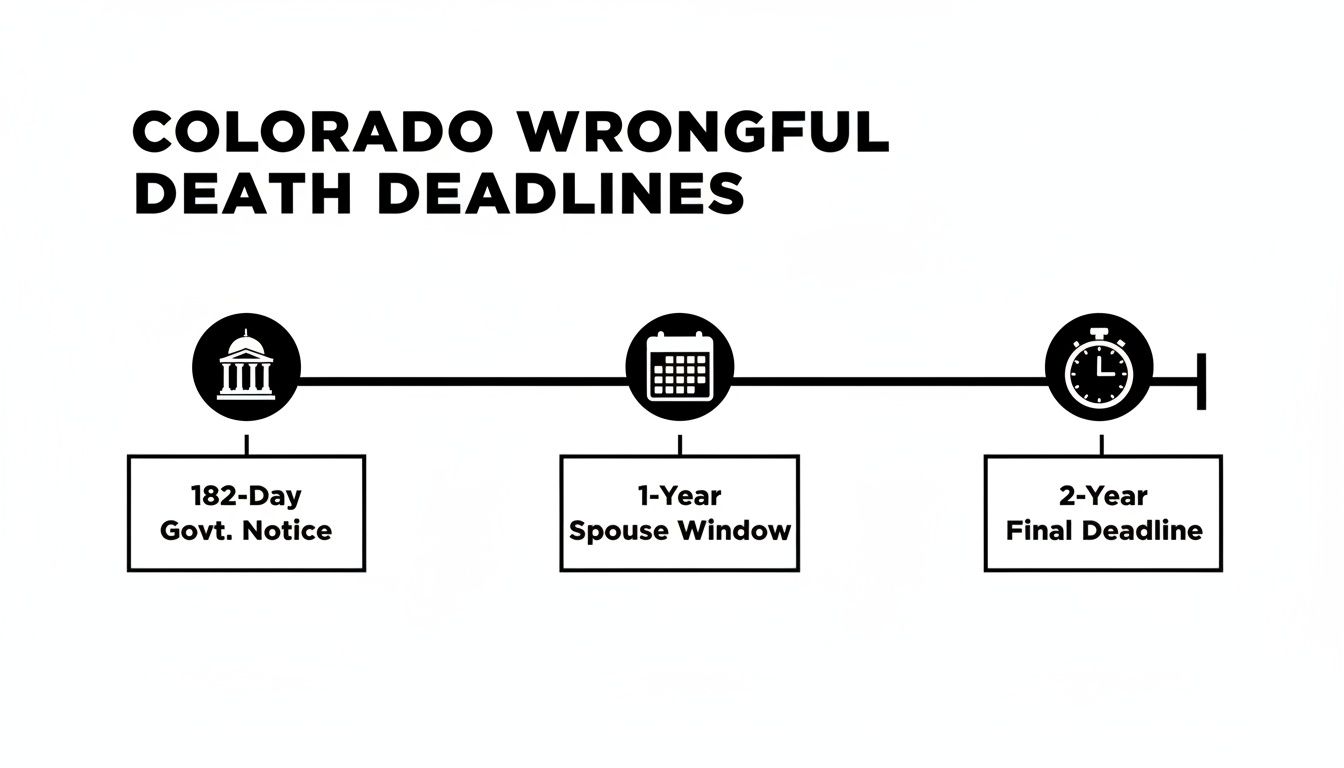
As you can see, the government notice deadline is the most immediate risk. It’s followed by the spouse's exclusive filing window and, finally, the two-year statute of limitations.
How Timelines and Filing Rights Intersect
These deadlines also interact with the rules about who can file the claim. As we’ve discussed, a surviving spouse has the exclusive right to file during the first year. That one-year period exists within the broader two-year statute of limitations.
This creates a layered and sometimes confusing timeline:
- Days 1-182: The clock is ticking on the potential government notice deadline.
- First Year: Only the surviving spouse has the right to file the claim.
- Second Year: If the spouse hasn't acted, the children or a designated beneficiary can now file—but that two-year clock is still running out.
Don’t let these complex rules intimidate you or cause you to hesitate. The most important takeaway is the need for immediate, informed action. An experienced attorney can manage these deadlines, protect your family’s rights, and build the strongest possible case from the very beginning.
If you are trying to make sense of these strict time limits, you can learn more about the statute of limitations for wrongful death in our detailed article. Understanding these dates is the first step toward securing justice.
Understanding the Compensation Your Family Is Owed

When a sudden, senseless loss shatters a family, the first thing everyone knows is that no amount of money can ever fill the void. Nothing can bring them back.
But the law provides a path to hold the responsible party accountable and, just as importantly, to secure your family’s financial future. This financial recovery is known as “damages,” and it’s helpful to think about it in two parts: the tangible, calculable losses and the profound human cost.
Rebuilding Your Financial Foundation with Economic Damages
The first part of a claim focuses on economic damages. Think of these as the concrete, provable financial losses your family is now facing. It’s about rebuilding the financial bedrock that was ripped away without warning.
An experienced wrongful death attorney will work to identify and document every single one of these costs to ensure your family's stability isn't a casualty of someone else's negligence.
These are not vague estimates. They are real numbers backed by bills, pay stubs, and expert financial analysis. A thorough claim for economic damages will almost always include:
- Final Medical Expenses: The cost of any emergency treatment or medical care your loved one received for their final injury.
- Funeral and Burial Costs: The full expense of a respectful memorial, burial, or cremation service.
- Lost Future Income: This is a critical calculation of the wages, salary, and raises your loved one would have earned over their expected career.
- Loss of Future Benefits: This covers the value of lost health insurance, retirement contributions (like a 401k match), and pensions.
Calculating lost future earnings is a complex process. It takes a skilled wrongful death attorney in Colorado working alongside financial experts to project a lifetime of contributions. They build a clear, undeniable picture of the financial support your family has lost.
Acknowledging the Human Cost with Non-Economic Damages
The second part of a claim addresses non-economic damages. These are the immense, intangible losses that will never show up on a spreadsheet. They represent the deep, human toll of the tragedy—the grief, the sorrow, and the permanent hole left in your lives.
In a wrongful death claim, non-economic damages acknowledge the immense emotional suffering of the surviving family members. They represent the loss of companionship, guidance, comfort, and the unique relationship you shared with the person who was taken from you.
Proving these damages means telling the story of your loss. It involves testimony from family and friends that shows the true depth of your relationships and the devastating impact of their absence. This is where a compassionate legal team is vital—to help you share that story with the dignity and strength it deserves. You can learn more about the different types of wrongful death damages in our detailed guide.
A Landmark Change in Colorado Law
For a long time, Colorado law placed a cap on non-economic damages that felt painfully low, a limit that seemed to undervalue the lifelong impact of losing a family member. But a monumental shift in the law now gives families a far greater chance at a just outcome.
A game-changing law that took effect on January 1, 2025, dramatically raised Colorado's cap on non-economic damages in wrongful death cases to $2,125,000. This increase more than triples the potential recovery available for a family’s unimaginable grief, better recognizing the true emotional cost of a preventable death. As you can discover more insights about this law change on coloradoinjurylaw.com, this update provides a more realistic path toward security for families facing a lifetime of loss.
The new law also expands who can file a claim, allowing siblings to seek justice under certain conditions. This is a significant update that ensures the law better reflects the devastating ripple effects of a wrongful death. An experienced attorney can explain exactly how this powerful change could impact your family's case.
The Reality of Wrongful Death Claims in Colorado
It's easy to think of a wrongful death claim as an abstract legal concept, something that happens to other people. But in Colorado, the need for this legal action is a harsh reality, driven by a frightening trend on the roads we all share every day.
The numbers don't lie. Car accidents have become a leading cause of preventable death in our state. In 2022 alone, 754 lives were lost in crashes here—a massive 57% jump from the 480 deaths recorded just a decade before in 2012. As you can see in the data from trialproven.com, this surge includes a record number of pedestrians and motorcyclists.
This isn't a distant problem. It’s happening on the streets and highways we use to get to work, school, and home.
High-Risk Roads and Real Consequences
For those of us who live here, these statistics have a familiar, unsettling ring to them. We see the dangerous driving, and we know the roads where it happens most often. The rise in fatal accidents is heavily concentrated on high-traffic corridors where speed, congestion, and outright negligence create a recipe for tragedy.
Some of the most dangerous routes in Colorado include:
- Interstate 25 (I-25): As the state's main north-south artery, I-25 is a constant site of high-speed collisions, chain-reaction pileups, and devastating wrecks involving commercial trucks.
- Interstate 70 (I-70): The mountain corridor is notorious. Treacherous weather, steep grades, and driver error combine to cause a high rate of deadly accidents year-round.
- Urban Streets like Colfax Avenue: In cities like Denver, dense traffic, constant pedestrian crossings, and the prevalence of impaired or distracted drivers make these roads especially hazardous.
Behind every number is a family whose world has been shattered. A statistic on a report is a parent, a spouse, or a child who will never come home again. When someone's negligence on these roads causes a death, a wrongful death claim is often the only way to hold them accountable.
These cases are about far more than statistics. They are about finding justice for real people.
A landmark case result isn't just about the money. It shows what a determined wrongful death attorney in Colorado can achieve. It proves that even against the biggest insurance companies, it is possible to secure a future for a grieving family and find a profound sense of justice.
Think about a recent case that changed the landscape in Colorado. In 2021, a Denver jury delivered a record-setting $33 million wrongful death verdict. The case involved a 30-year-old engineer who was killed by a driver recklessly speeding at over 100 mph in a 35 mph zone.
This historic verdict, the largest of its kind in Colorado's history, wasn't just a number. It was a powerful message that extreme negligence has severe consequences. It gave the victim’s family the resources to face a future without their loved one, and it sent a clear warning about the importance of accountability on our roads.
While not every case will end in a headline-making verdict, this result illustrates a crucial truth: the right legal strategy can achieve an outcome that truly honors the life that was lost. It shows that with tenacious, skilled advocacy, families can get the justice they deserve.
Choosing the Right Advocate for Your Family
After losing a family member, the thought of hiring an attorney can feel overwhelming. But this isn't just about hiring a lawyer. It's about finding an advocate—someone who will step in and shield your family from the legal complexities so you have the space to grieve.
The right firm brings two things to the table: genuine, compassionate support and a reputation for trial-ready advocacy that insurance companies take seriously. One without the other is not enough.
What to Look for in a Wrongful Death Attorney
Your attorney should be ready to take on every single part of the case. This isn't about delegating tasks; it's about lifting the entire legal burden off your shoulders so you can focus on what matters.
A true advocate handles all communication with insurance adjusters, corporate lawyers, and anyone else involved. This is critical. It stops them from contacting you directly, pressuring you when you are at your most vulnerable, and trying to get you to accept a quick, lowball offer.
Look for a firm that works on a contingency fee basis. This is non-negotiable. It means you pay no upfront costs or hourly fees. The firm only earns a fee if they win your case and recover compensation for your family. This structure ensures their only goal is getting you the best possible outcome.
Finally, you need a team with specific, deep experience in catastrophic injury and wrongful death cases. The knowledge needed to investigate a fatal commercial trucking crash or a complex medical error is worlds apart from a standard car accident claim. That specialized skill set is what builds a powerful case from day one.
The Importance of Trial-Tested Advocacy
It’s true that most wrongful death claims settle before a trial. But the best settlements don't happen by accident. They are secured because the other side knows your lawyer is fully prepared to go to court and win.
An attorney's reputation for being ready and willing to take a case to a jury is their most powerful negotiating tool. It forces insurance companies to make fair offers because the risk of losing a much larger amount in court is too great.
Insurance companies are meticulous record-keepers. They know which law firms have a history of fighting in the courtroom and which ones will fold for an easy settlement. Hiring a firm with a proven trial record sends an immediate message: your family will not be undervalued.
A Partnership Built on Trust and Strength
Ultimately, you are not just hiring a service. You are entering a partnership that must be built on trust, clarity, and an unwavering commitment to your family's well-being.
You should feel comfortable asking questions and confident that your family’s best interests are the only priority. This relationship will guide you through one of life's most difficult chapters.
A dedicated wrongful death attorney in Colorado will:
- Conduct an immediate, in-depth investigation to lock down critical evidence before it can be lost or destroyed.
- Work with leading experts—like accident reconstructionists and economists—to build an undeniable case for both fault and the full extent of your family’s losses.
- Tell your loved one’s story with the dignity and respect it deserves, making it clear that this case is about a human life, not just numbers on a page.
Finding this partner gives you the power to demand justice and the support to navigate the path forward. The right legal team can make all the difference in honoring your loved one and securing your family's future. For more information on how a dedicated team can support you, explore how an experienced Denver personal injury attorney can help.
Frequently Asked Questions About Wrongful Death Claims
When you’re grappling with the sudden loss of a family member, the legal world can feel overwhelming and confusing. You likely have urgent questions running through your mind. Getting clear, straightforward answers is the first step toward finding your footing.
Here, we’ll address the questions we hear most often from families trying to understand their options during an impossibly difficult time.
How Much Does It Cost to Hire a Wrongful Death Attorney?
This is often the first and biggest worry families have, and the answer should provide some relief. In Colorado, you pay no upfront fees to hire a leading wrongful death attorney. We, like other reputable personal injury firms, work on a contingency fee basis.
What does that actually mean for you?
- You pay absolutely nothing to get your case started.
- The law firm advances all the costs required to investigate and pursue the claim.
- You only pay a fee if we win and recover financial compensation for your family.
This arrangement ensures our goals are perfectly aligned with yours. Our payment is a percentage of the compensation we secure for you, so our focus is always on achieving the best possible outcome for your family.
How Long Will My Wrongful Death Case Take?
Every case is different, so there’s no single, simple answer. The timeline really depends on the complexity of the facts and whether the at-fault party’s insurance company is willing to be reasonable. Some claims resolve in a matter of months, while more complicated cases can take a year or longer.
Most wrongful death claims—well over 90%—end in a settlement without ever going to trial. Negotiations can happen at any point, but they often gain momentum once your attorney has gathered enough evidence to clearly prove the other party’s liability. If the insurance company refuses to make a fair offer, your lawyer must be ready and willing to take them to court.
The single best way to secure a fair and timely settlement is to have an attorney on your side who is known for being a serious trial threat. When the other side knows you’re prepared to fight it out in court, their motivation to negotiate in good faith increases dramatically.
What if My Loved One Was Partially at Fault?
It’s a common and valid concern. Colorado law directly addresses this situation through a rule called modified comparative negligence. This means your family may still be able to recover damages even if your loved one shared some responsibility for the incident.
Here’s how it works: As long as your loved one is found to be 49% or less at fault, you can still pursue a claim. The total compensation your family receives will simply be reduced by their percentage of fault. For instance, if a jury awarded $1 million but found your loved one was 10% at fault, your final recovery would be reduced by that 10% to $900,000. However, if your loved one is found 50% or more responsible, Colorado law bars any recovery.
Will I Have to Go to Court?
The thought of testifying in a courtroom is stressful, but it’s highly unlikely you will ever have to. Because the vast majority of cases settle, most families never set foot in court. Your attorney handles all the complex legal work behind the scenes.
Their job is to build such a powerful and compelling case that the insurance company has little choice but to offer a fair settlement. This strategy is designed to get you justice while shielding you and your family from the emotional strain of a public trial.
Navigating a wrongful death claim is a heavy burden, but you do not have to carry it alone. The team at Nares Law Group LLC is here to lift that weight by handling every legal detail, allowing your family to focus on healing. If you are ready to find a path toward accountability and a more secure future, we invite you to start a free, confidential conversation with us today.