A week after a crash, many people expect bruises to fade and soreness to ease. Instead, they stand up from bed and the room tilts. They turn their head in the grocery store and feel as if the floor moved. They try to explain it to family, employers, or an insurance adjuster, but nothing looks broken from the outside.
That kind of vertigo is frightening because it feels invisible. You know something is wrong, yet it can be hard to point to a cast, a scan, or a wound and say, “There. That's the problem.” When dizziness follows an accident, people often start doubting themselves. They wonder if they're overreacting, if the symptoms will pass, or if anyone will believe them.
A VNG test, short for videonystagmography, can help turn that uncertainty into something much clearer. It records your eye movements while a clinician checks how your inner ear balance system and your brain are working together. Since balance and eye movement are closely linked, the test can reveal patterns that symptoms alone can't sort out.
For someone dealing with post-accident vertigo, that matters in two ways. First, it helps your medical team decide what may be causing the spinning, imbalance, or nausea. Second, it creates objective documentation of a problem that insurance companies often treat as “just a complaint.”
Good communication also matters while you're going through this process. If you're trying to keep up with appointments, results, and follow-up questions, these digital patient engagement strategies can help you think about how better education and communication tools support patients who are already overwhelmed.
Introduction
Vertigo after an accident often starts with ordinary moments. You lean down to tie your shoe, then feel a sudden wave of motion. You roll over in bed, and the ceiling seems to swing. You ride in a car and feel disoriented long after the trip ends.
That experience can be isolating. Friends may hear “dizzy” and think of something minor. But vertigo isn't ordinary lightheadedness. It can affect walking, reading, driving, working, and even simple tasks like showering or going down stairs.
Why this test often becomes a turning point
A VNG test gives doctors a way to look at a balance problem instead of relying only on how the symptoms sound. The test uses video or infrared goggles to record involuntary eye movements called nystagmus. Those movements can provide clues about whether the problem is coming from the inner ear balance system, the pathways connecting that system, or the brain's processing of balance signals.
Practical rule: If your symptoms are real but hard to describe, objective testing can help bridge the gap between what you feel and what your records show.
For many injured people, that shift matters emotionally. The test doesn't just ask you to repeat, “I feel off balance.” It looks for measurable signs of dysfunction. That can be very reassuring when you've been trying to explain a hidden injury to doctors, family members, or insurance representatives.
What clarity can change
Once there's a clearer picture, treatment becomes more focused. Some people need vestibular rehabilitation. Some need a neurologic workup. Some need both. The important point is that dizziness after a crash shouldn't be brushed aside as vague or unprovable just because it doesn't show up like a broken bone.
When people search for VNG testing vertigo, what they usually want isn't technical jargon. They want to know what's happening in their body, whether the test will help, and whether it can support both healing and documentation. That's exactly where this test can make a difference.
Why Doctors Recommend VNG Testing for Vertigo
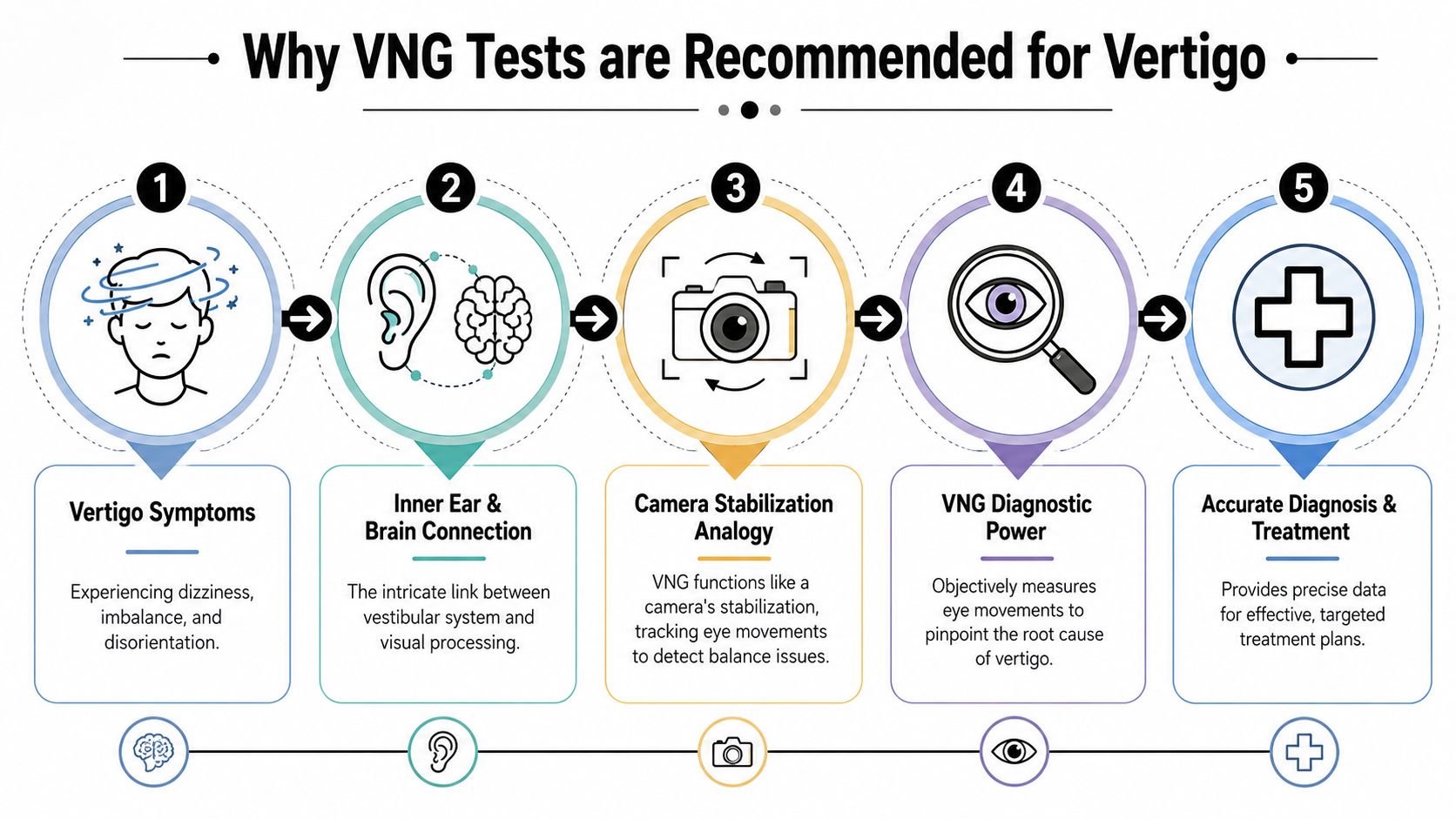
Your balance system works a lot like a camera's stabilization feature. When the camera moves, the stabilizer helps keep the image steady. Your body has a similar system. Your inner ears, eyes, and brain constantly coordinate so that when your head moves, your eyes adjust smoothly and your visual world stays stable.
When that system is disrupted after a crash, the result can be spinning, blurring, nausea, or the feeling that your eyes can't keep up with your body.
The eye and ear connection doctors are checking
Doctors recommend VNG because the balance system leaves traces in eye movement. If one side of the inner ear isn't sending the right signal, or if the brain isn't processing that signal correctly, the eyes may drift and correct in a telltale pattern. VNG captures that pattern.
StatPearls notes that dizziness and vertigo affect 15% to 35% of individuals, and it describes VNG and ENG as tools that provide objective eye-movement data to help localize vestibular pathology rather than relying only on symptoms. In the same reference, a cross-sectional study of 67 patients found that VNG aided in 75% of diagnoses and was especially useful in a vertigo clinic setting (StatPearls on videonystagmography).
Why symptoms alone usually aren't enough
Two people can both say, “I feel dizzy,” and mean very different things. One may have brief spinning when rolling in bed. Another may feel unsteady all day with trouble focusing and walking. Those symptom descriptions are important, but they don't always tell a doctor where the problem is.
VNG is useful because it's a structured battery of tests. It checks different parts of the balance system instead of assuming all dizziness comes from the same cause.
Here's what doctors are usually trying to sort out:
- Inner ear problem: A vestibular organ or nerve may be sending faulty signals.
- Brain-related problem: The central vestibular system may not be processing balance information normally.
- Position-triggered problem: Specific head or body movements may provoke a distinct pattern.
- Mixed picture: Some patients show findings that don't fit neatly into one simple category.
A VNG test doesn't diagnose “dizziness” in the abstract. It helps identify where the balance system is breaking down.
Why this matters after an accident
After a motor vehicle collision, symptoms can overlap. Whiplash, concussion, migraine, anxiety, visual strain, and vestibular injury can all create similar complaints. That's one reason doctors often don't want to guess.
A patient with an inner ear issue may benefit from targeted vestibular therapy. A patient with signs pointing toward central involvement may need neurologic evaluation and a broader brain injury workup. The test helps separate those paths.
That's why the recommendation isn't random. It's based on the need for objective information in a symptom area that can feel chaotic and hard to prove.
How to Prepare for Your VNG Appointment
The best preparation is simple. Follow the clinic's instructions exactly, and if anything is unclear, call ahead and ask. VNG works best when the test captures your natural eye and balance responses, not the effects of substances or products that can interfere with recording.
What to check with your doctor before the visit
Some medications can affect dizziness, alertness, or eye movements. Don't stop anything on your own. Instead, ask the ordering doctor or testing clinic whether they want you to pause specific medicines before the appointment.
A good question is: “Are there any prescription or over-the-counter medications that could affect my VNG results?”
Common do's and don'ts
- Ask about medications first: Sedating drugs, motion-sickness medicines, sleep aids, and other symptom-relief medications may affect testing. Get individualized instructions from the clinician who ordered the exam.
- Avoid alcohol if your clinic tells you to: Alcohol can change balance responses and make the results harder to interpret.
- Limit caffeine if instructed: Caffeine can affect how you feel during the exam and may interfere with clean baseline responses in some clinics.
- Skip eye makeup: Mascara, eyeliner, false lashes, and similar products can interfere with the goggles or camera tracking.
- Wear glasses instead of contacts if advised: Some clinics prefer that patients avoid contact lenses so recording is easier and more comfortable.
- Bring a driver if you're worried about symptoms: Some people feel fine after testing. Others feel stirred up for a while, especially if positional or caloric testing provokes dizziness.
What to wear and what to expect emotionally
Choose comfortable clothes that won't make it hard to lie back or move on the exam table. Avoid anything tight around the neck if turning your head already makes you uncomfortable.
If you're anxious, tell the staff before the test begins. They do this regularly, and a short explanation of each step often makes the appointment much easier.
It also helps to plan a lighter day afterward. You may not need to rest, but many patients feel better if they don't schedule demanding errands or work immediately after the appointment. The more prepared you feel going in, the less intimidating the testing usually feels.
What Happens During a VNG Test
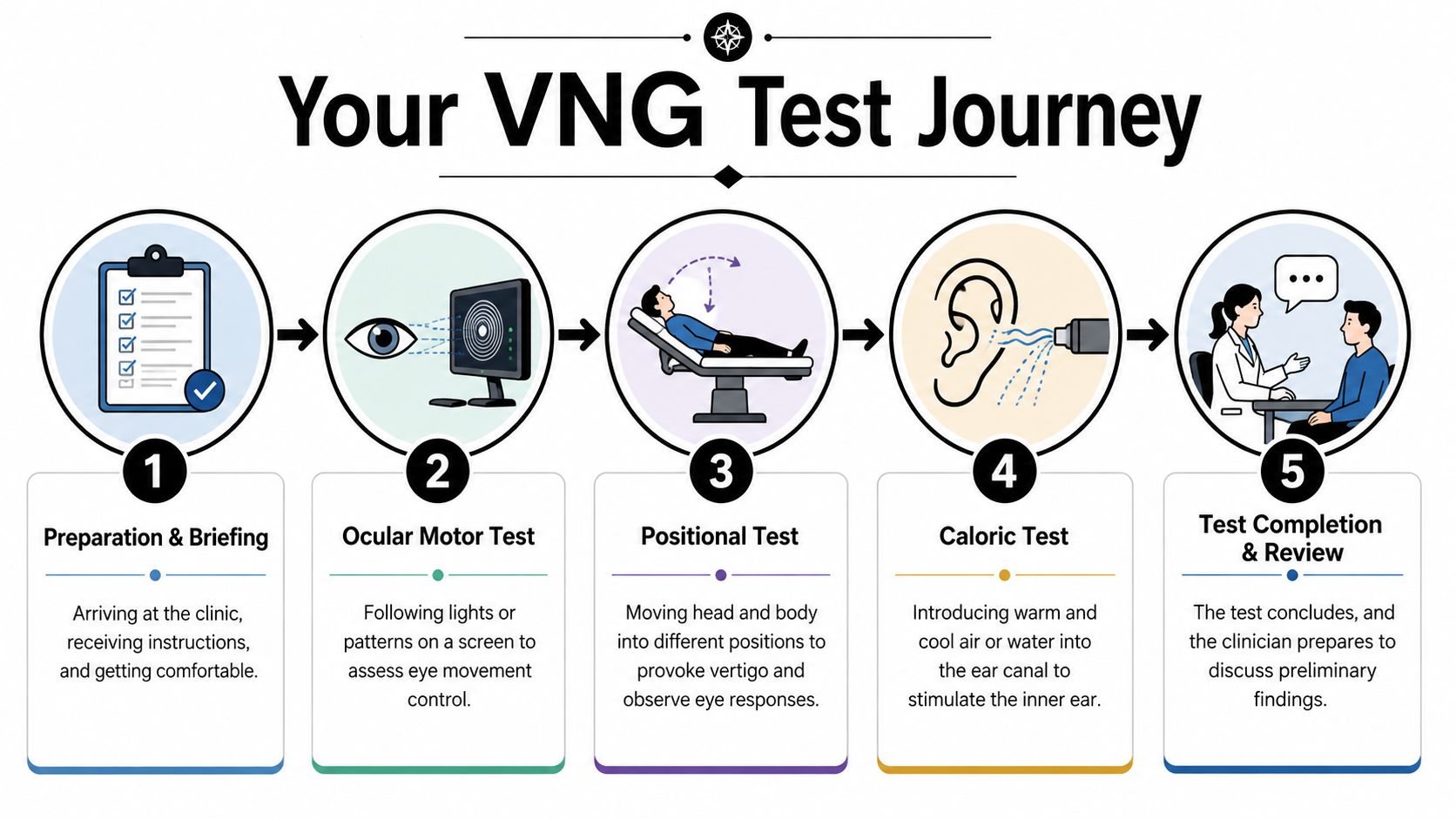
When you arrive, the first thing you'll likely notice is that the room feels more like a testing space than a dramatic procedure room. A clinician explains the steps, places recording goggles over your eyes, and makes sure the equipment is tracking correctly. You're not being “put through” something painful. You're helping the clinician observe how your system responds.
A visual overview can make that easier to picture.
The ocular motor portion
This part often feels the least intimidating. You may be asked to look at dots, lights, or targets on a screen and follow them with your eyes. Sometimes the target moves slowly. Sometimes it jumps.
Think of it as a precise eye-tracking exercise. The clinician isn't judging how “well” you perform. They're looking at whether your eyes move smoothly, accurately, and in ways that match normal control patterns.
If your accident involved concussion symptoms, visual strain, or suspected neurologic involvement, this portion can be especially informative.
The positional portion
Next, the clinician may move your head or body into different positions. You might lie back, turn to one side, or have your head repositioned in a controlled way. This is the part that often reproduces symptoms in people with position-triggered vertigo.
Some patients say this feels unsettling because it can briefly bring on the spinning they've been trying to avoid. But that reaction is often exactly what helps identify the source of the problem. If a certain position causes a consistent eye-movement response, that gives the clinician useful evidence.
Here's where people often get confused. Feeling dizzy during the test doesn't mean something has gone wrong. It often means the test is capturing the response it was designed to observe.
The caloric portion
This is the step many patients worry about most. Warm and cool stimulation, often air and sometimes water depending on the clinic, is introduced into each ear canal one at a time. That stimulation activates the balance organs in a controlled way so each ear can be assessed separately.
VNG records eye movements with video or infrared goggles during these tasks, and caloric irrigation is used to help identify a site of lesion in either the vestibular end organ or the central vestibular system. The Weill Cornell explanation also notes that clinicians often describe abnormal nystagmus in terms of slow-phase velocity, with horizontal nystagmus greater than 6°/s often considered abnormal during positional testing, and some software flagging values greater than 4°/s (Weill Cornell VNG testing overview).
That sounds technical, but the practical meaning is simple. The test can detect low-level abnormal eye movement that a person in the room might miss without objective video recording.
What it feels like in real life
During caloric testing, you may feel brief vertigo, nausea, or a sense of motion. Many people find it unpleasant, but it's usually temporary. The staff knows this step can be uncomfortable and will guide you through it.
For readers comparing vestibular and neurologic testing more broadly, this overview of evoked potential tests may also help place VNG in the larger picture of objective diagnostic tools used after injury.
Some people also prefer seeing the process before their appointment. This short walkthrough can help reduce the fear of the unknown:
By the end of the appointment, most patients feel one main thing: relief that the mystery is becoming more concrete.
Understanding Peripheral vs Central Vertigo Results
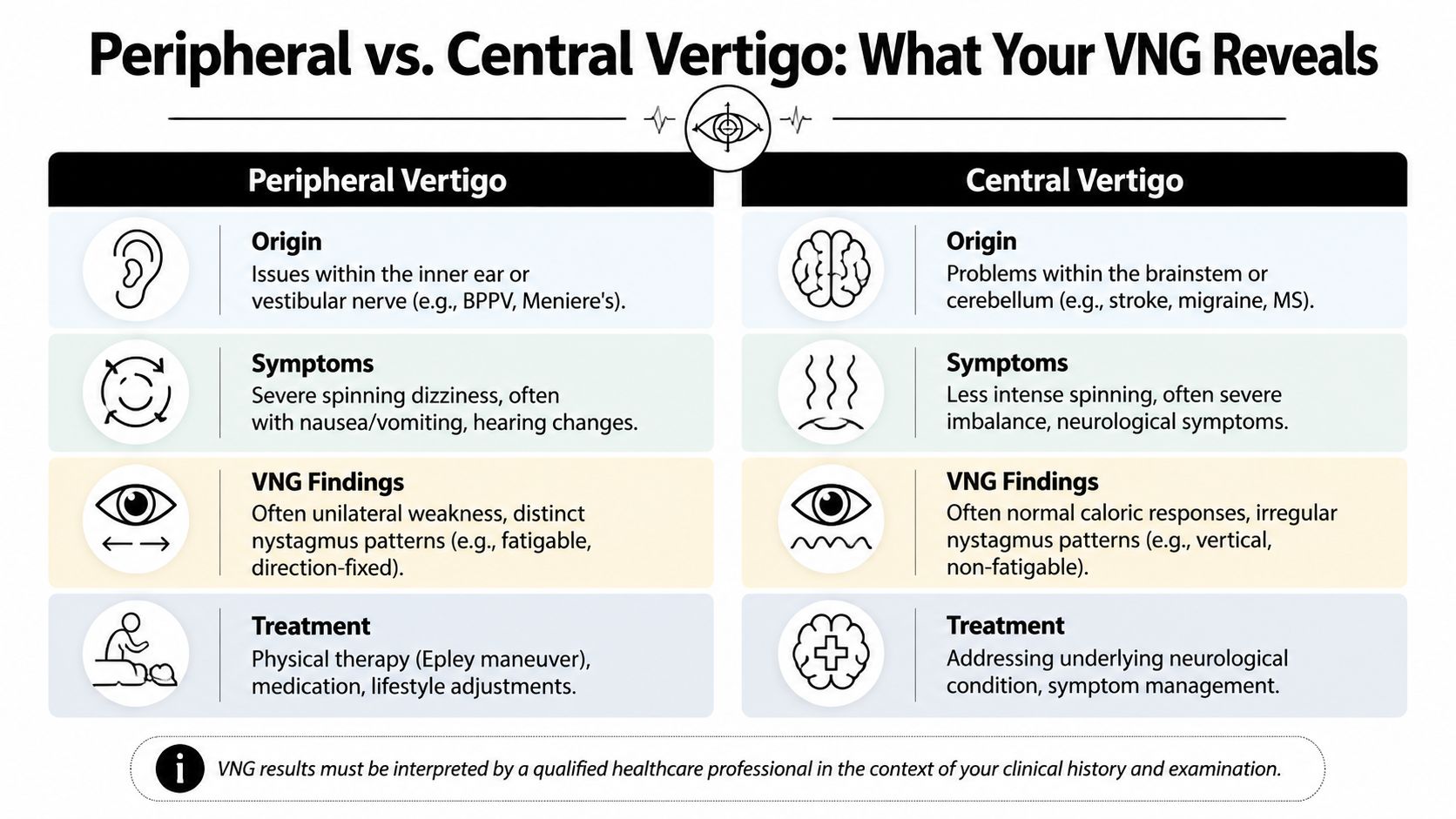
When patients get VNG results back, the biggest question is usually not about the graph itself. It's about meaning. They want to know whether the findings point to a peripheral problem or a central one.
That distinction shapes both treatment and legal documentation.
What peripheral vertigo means
Peripheral vertigo usually refers to a problem in the inner ear balance organs or the vestibular nerve. In plain language, the machinery that detects motion and head position isn't signaling normally.
This category often includes position-related or ear-based disorders. In post-accident settings, a person may have symptoms that fit a vestibular injury pattern even though there's no obvious external sign of damage.
Typical clues may include:
- Motion-triggered spinning: Rolling in bed, looking up, bending over, or turning quickly may provoke symptoms.
- Nausea with movement: The mismatch between what the eyes see and what the inner ear signals can make people feel sick.
- Patterned positional findings: Certain head positions may trigger repeatable nystagmus on testing.
Peripheral findings often lead toward vestibular rehabilitation, repositioning maneuvers, symptom management, or ENT follow-up.
What central vertigo means
Central vertigo points toward the brain or central nervous system pathways that process balance information. In an injury case, this matters because central findings can overlap with concussion or traumatic brain injury concerns.
A central pattern doesn't automatically tell you the full diagnosis by itself. It tells the medical team that the problem may not be limited to the inner ear. That often changes what comes next, including referrals, imaging decisions, and the overall seriousness of the workup.
Central findings can matter far beyond dizziness. They may become part of the larger story of how an accident affected the brain's processing systems.
How VNG gives objective clues
VNG doesn't rely only on whether you say the room spun. It measures eye movement. Clinicians evaluate nystagmus by looking at the slow-phase velocity of the eye movement. As noted earlier, software may flag responses above 4°/s, and horizontal nystagmus greater than 6°/s during positional testing is often treated as abnormal.
That matters because numbers and recorded eye patterns help translate symptoms into documented findings. A report may show that the response fits better with a peripheral lesion, suggests central involvement, or contains mixed findings that need broader interpretation by the treating doctor.
A plain-language comparison
| Category | Peripheral | Central |
|---|---|---|
| Main location | Inner ear or vestibular nerve | Brain or central vestibular pathways |
| Common patient experience | Spinning with movement or position changes | Imbalance, disorientation, or complex neurologic symptoms |
| Why it matters medically | Often points toward vestibular-focused treatment | Often triggers broader neurologic evaluation |
| Why it matters legally | Supports a documented vestibular injury | Can support documentation of brain-related injury concerns |
If your report mentions abnormal saccades, positional nystagmus, unilateral weakness, or central signs, don't panic and don't guess. Ask your doctor to explain what each finding means in everyday language and how it fits your accident history.
Using VNG Results to Document Your Injury Claim
Insurance companies often push back on symptoms they can't see. Dizziness, brain fog, imbalance, and motion sensitivity are easy for an adjuster to minimize on paper. A person may look fine during a short meeting and still be unable to drive safely, work a full day, or walk through a crowded store without symptoms.
That's where a VNG report can carry real weight.

Why objective testing changes the conversation
When your records only say “patient reports dizziness,” an insurer may frame the issue as subjective. When the chart includes recorded eye-movement abnormalities and a clinician's interpretation, the discussion changes. The complaint is no longer just self-reported. It's tied to objective vestibular findings.
That doesn't guarantee a fair outcome. But it gives your lawyer, your doctors, and your claim file something much stronger than a description of symptoms alone.
A VNG report can help show:
- The injury is real: There is measurable dysfunction, not just a vague complaint.
- The problem has a likely source: The findings may support either peripheral vestibular injury or central dysfunction.
- Treatment is medically necessary: Therapy, follow-up care, specialist referrals, and work restrictions become easier to justify when tied to documented findings.
- The effects are functional: The report can support why reading, driving, working, or navigating daily life has become difficult.
How this fits a personal injury case
In a whiplash case, vestibular findings may support the argument that the crash caused more than neck pain. In a concussion or brain injury case, central-type findings may help explain why the person has persistent dizziness, disorientation, and visual-motion symptoms.
This is one reason lawyers handling complex injury matters often gather vestibular and neurologic evidence together. If you're trying to understand how these issues fit into a broader brain injury workup, this guide to neurological tests for brain damage can help.
A strong injury claim often depends on connecting symptoms, diagnostic findings, treatment records, and daily limitations into one consistent story.
For legal purposes, timing also matters. Report symptoms early. Keep follow-up appointments. Tell each provider exactly what triggers your vertigo, how often it happens, and what activities it disrupts. A test result is powerful, but it works best when it matches a clear medical timeline and detailed records.
Your Recovery Pathway After VNG Testing
Once the test is done, patients often want the same thing. They want to know what happens next and whether life can start feeling normal again.
The answer depends on what the findings suggest. A peripheral pattern may lead to vestibular rehabilitation therapy, home exercises, or specific repositioning maneuvers. A central pattern may lead to neurology follow-up, more imaging, or concussion-focused care. Some people need a combination because post-accident dizziness can be layered.
What to do after you get results
- Review the report with the ordering doctor: Ask what the findings mean in plain language, what diagnosis is most likely, and what treatment path they recommend.
- Follow through with therapy: Vestibular rehab can feel repetitive, but consistency matters when retraining the balance system.
- Track your daily limits: Note what triggers symptoms, whether you're improving, and what tasks remain difficult.
- Watch for urgent red flags: Seek prompt medical attention if you develop new severe neurologic symptoms, worsening confusion, sudden weakness, chest pain, or other alarming changes.
When symptoms overlap with brain fog
Many people with vestibular problems also describe mental fuzziness, trouble concentrating, or sensory overload. Those symptoms deserve discussion with your doctor because they can relate to fatigue, concussion, medication effects, vestibular dysfunction, or all of the above. Some patients also like reading practical wellness perspectives while they wait for formal follow-up, and Tecton Ketones' brain fog advice is one example of consumer-oriented guidance to review critically alongside medical care.
If your accident involved head trauma, recovery may not be linear. This overview of TBI recovery time can help you understand why symptoms sometimes improve in stages rather than all at once.
The most important step is not to minimize what you're feeling. A VNG test can give shape to a hidden injury. Your job after that is to keep building the record, follow the treatment plan, and protect your health while the evidence catches up to what your body has been telling you.
If an accident left you dealing with vertigo, dizziness, or possible brain injury symptoms, Nares Law Group LLC provides information and legal guidance for people navigating personal injury claims tied to complex medical issues. A consultation can help you understand how medical records, vestibular testing, and ongoing treatment may affect your rights and your case.