The call comes in when the family is already exhausted. One doctor's office has a portal download. Another hands over a paper packet with lab pages, visit notes, and a billing sheet. The insurance adjuster wants everything fast, and nobody in the house is sure which records matter, which ones are private, or which release just handed away too much information.
That chaos is exactly why medical record organization matters in an injury claim. It isn't clerical busywork. It's how you protect the story of the injury, the treatment, and the timeline from being blurred by missing pages, bad labels, and sloppy releases.
The Moment an Insurance Company Asks for Your Records
The first request usually sounds simple. “Send all your medical records.” In practice, that phrase is a trap for families who don't have a system yet. If you dump unorganized records on an adjuster, you give them room to misunderstand treatment gaps, miss the injury timeline, or pick apart the file for anything that looks unrelated.
The history of recordkeeping shows why this matters. Health records have long been tied to documentation, education, and legal use, with primitive records going back to around 2500 BC and the earliest known medical text on a Sumerian clay tablet from around 2400 BCE. In the United States, patient case records were already being kept in the late eighteenth century, and a separate system from Europe was established in 1793 (historical overview). The point is simple, records have always been more than paperwork.
Today, the injury file gets read by people who are not treating your loved one. Adjusters, defense counsel, mediators, and sometimes a jury will look for consistency, not compassion. If the records are scattered, that reader fills in the blanks the wrong way.
Practical rule: if a record set is sloppy, it usually costs you in three places, credibility, clarity, and leverage.
A clean file changes that. It lets you answer the insurer's request with a disciplined set of documents, not a box of guesswork. It also forces the family to separate active treatment from old noise, which matters because the other side will absolutely do that for you if you don't.
The modern trend toward structured records only reinforces the point. The HITECH Act of 2009 pushed healthcare toward electronic systems, and by 2019 nearly 90% of U.S. physicians were using electronic systems, with hospital clinics reaching 92% by 2015 (electronic health record history). The claims side expects records to be searchable now. If yours aren't, you're already behind.
Requesting Records the Right Way and Getting Them on Time
The right move is to request records provider by provider, not as one giant vague demand. Hospitals, imaging centers, pharmacies, therapists, and primary care offices each hold different pieces of the picture. That's why a release should name the provider, the date range, and the categories you want, not just say “all records.”
A practical release layout is plain and narrow:
- Patient identification: full legal name, date of birth, and contact details.
- Provider target: the exact hospital, clinic, imaging center, pharmacy, or specialist.
- Date range: from the first visit related to the injury through the most recent treatment date.
- Record categories: progress notes, imaging, radiology reports, operative reports, discharge summaries, itemized billing, and medication history.
- Delivery method: PDF through portal, secure email, or mailed paper copy.
- Signature and authorization date: so nobody can claim the request was incomplete.
HIPAA gives patients a route to their own information, but the provider's release form still matters because offices process requests through their own system. Some requests go faster with a patient authorization, some with attorney authorization, and some with both. The legal rhythm of record gathering is part of discovery, which is why litigation teams treat the request as a tracking exercise, not a one-off task, as explained in this discovery overview for litigation.
| Provider Type | Average Response Window | Common Delays | Best Practice |
|---|---|---|---|
| Hospital | Often around 30 days under HIPAA procedures | Archiving delays, missing departments, billing split from chart | Request records, imaging, discharge papers, and itemized bills separately |
| Primary care office | Often faster than hospitals, but still variable | Old paper charts, portal confusion | Ask for the full chart and medication history |
| Imaging center | Usually faster when the exam date is precise | Wrong exam date, missing disc, missing radiology report | Request both the report and the images |
| Pharmacy | Often quick if the patient is correctly identified | Limited date range, closed chain locations | Ask for a medication fill history, not just a current list |
When a provider stalls, don't argue by instinct. Send a follow-up that repeats the exact request, the date, and the delivery method. If the office sends an incomplete chart, treat it as a records problem, not a mystery. If a fee looks wrong or the release was ignored, escalate immediately and keep a log of every contact. That log becomes useful fast when the other side starts asking why a chart has gaps.
Building Your Folder and Index System From Scratch
A strong file system doesn't need to be fancy. It needs to be boring, predictable, and easy for someone else to follow under pressure. The best setup uses one source of truth, meaning every document lives in one master system, not three different versions scattered across email, phone photos, and desktop folders.
Start with a simple top-level structure built around the injury episode, not around random document types. For a case involving ongoing treatment after a crash, the master folder can be split into Active Treatment and Archive & Reference. Under Active Treatment, create only the folders you need, such as intake, diagnostics, correspondence, and billing. That keeps the file usable when it grows.
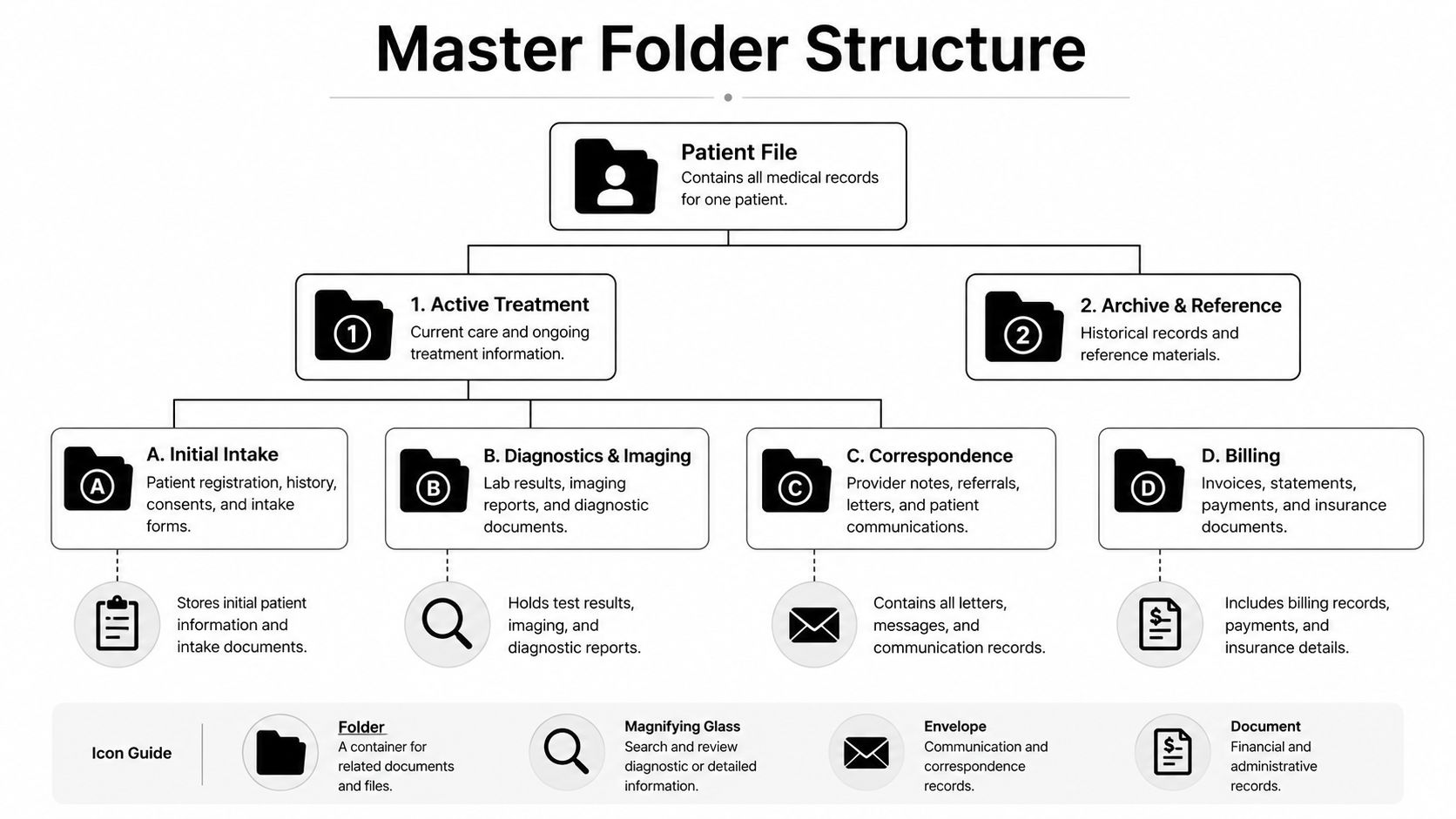
The naming convention matters more than you might think. Use a single format for every file, starting with an ISO date, then the document type, then the provider or facility. A file name like 2026-02-14_MRI-LumbarSpine_RadiologyCenter.pdf sorts cleanly in any system and tells a reader what it is before they open it. That is better than “scan1” or “newfilefinal.”
The workflow is simple:
- Capture the document as soon as it arrives.
- Validate the patient name, date, and legibility.
- Classify it by category and episode.
- File it in the right place using the same naming rule every time.
Keep the system shallow. Deep folder nests slow people down, and slow people misfile things.
The index should sit at the front of the file like a roadmap. List each document by date, provider, document type, and a short note on why it matters. If the file set is large, dual index it by date and provider so a reviewer can find the same event either way. Newest-first ordering works well for active treatment, but consistency matters more than the direction you pick.
The reason this works is practical. Clinicians and reviewers reconstruct care as a timeline, not as a pile of paper. The organization should match that logic.
Digitizing Paper Records Without Losing Evidence Value
Paper still shows up in injury files all the time. Portal downloads mix with discharge summaries, imaging printouts, and stapled billing packets. If you digitize badly, you don't preserve the evidence, you just create a prettier mess.
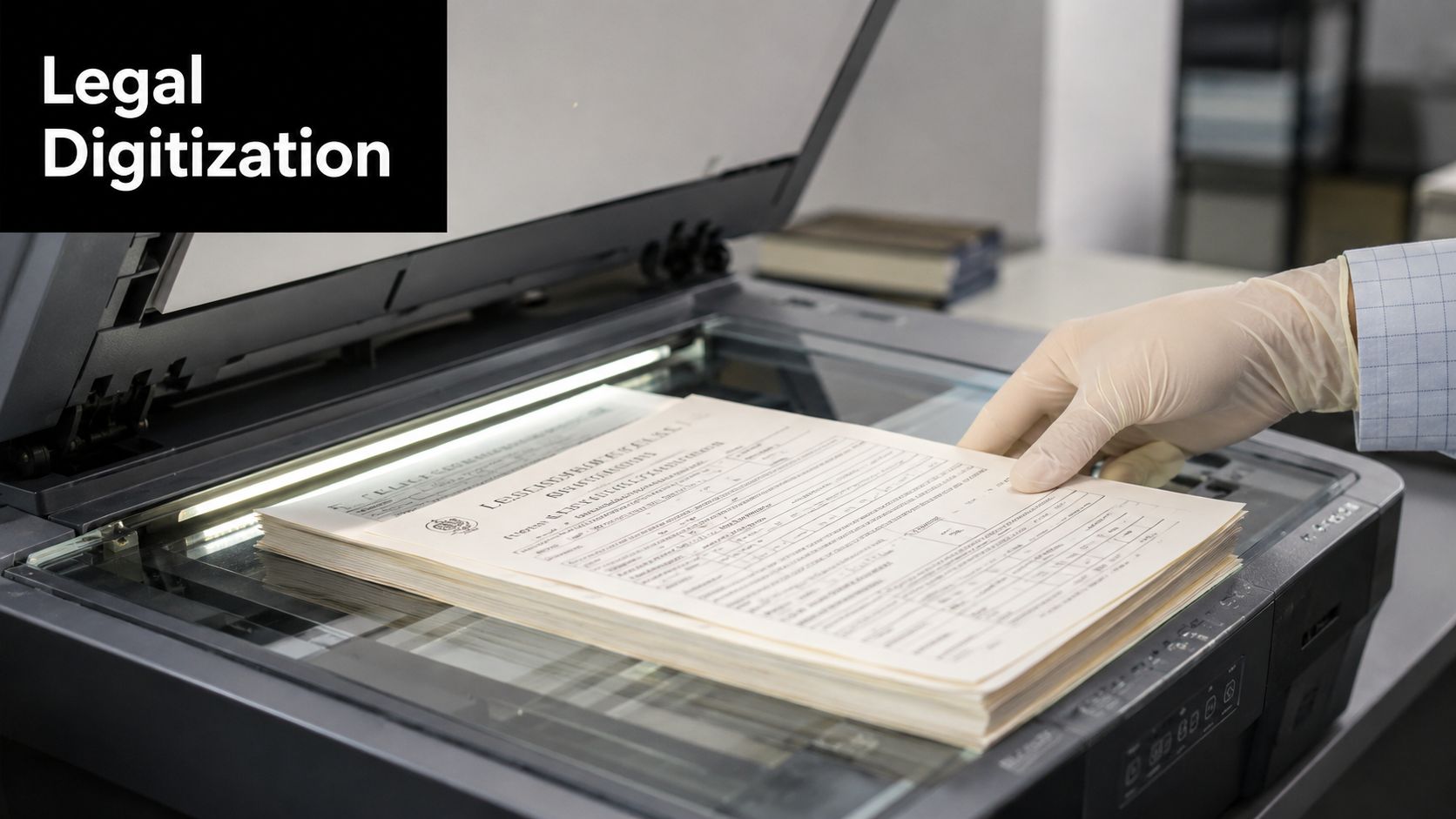
The technical floor in the available guidance is clear, 300 dpi or higher for medical scans, with multi-page capture into a single PDF, followed by verification against the original for completeness and legibility (digitization playbook). That level of detail matters because blurred notes, missing pages, and broken page order create opening after opening for a defense argument that the file can't be trusted.
Use a dark surface under the scanner when possible, remove staples and paper clips, and review every file right after scanning. Those steps are basic, but they catch the problems people usually discover too late. Don't batch too many documents into one digitization session either. Long sessions lead to skipped pages and tired eyes.
For storage, use redundancy. Keep an encrypted cloud copy and a second external copy so one device failure doesn't wipe out the archive. The point isn't paranoia, it's preservation.
A good outside reference for the retrieval side is this guide on records retrieval for finance teams. The process is different in finance, but the lesson is the same, records only help if they can be found fast and verified cleanly.
Here's the hard truth. If you're scanning on a phone at midnight and naming files by memory, you're building avoidable risk into the file. Use a scanner when you can, especially for thick packets. A scan that is readable, complete, and labeled correctly is evidence. A fuzzy photo in a random album is not.
The One-Summary-Document Strategy That Wins Negotiations
Raw records are for storage. A single up-to-date care summary is for persuasion. That is the document a mediator, adjuster, or defense reviewer can read in one pass without digging through hundreds of pages for the point.
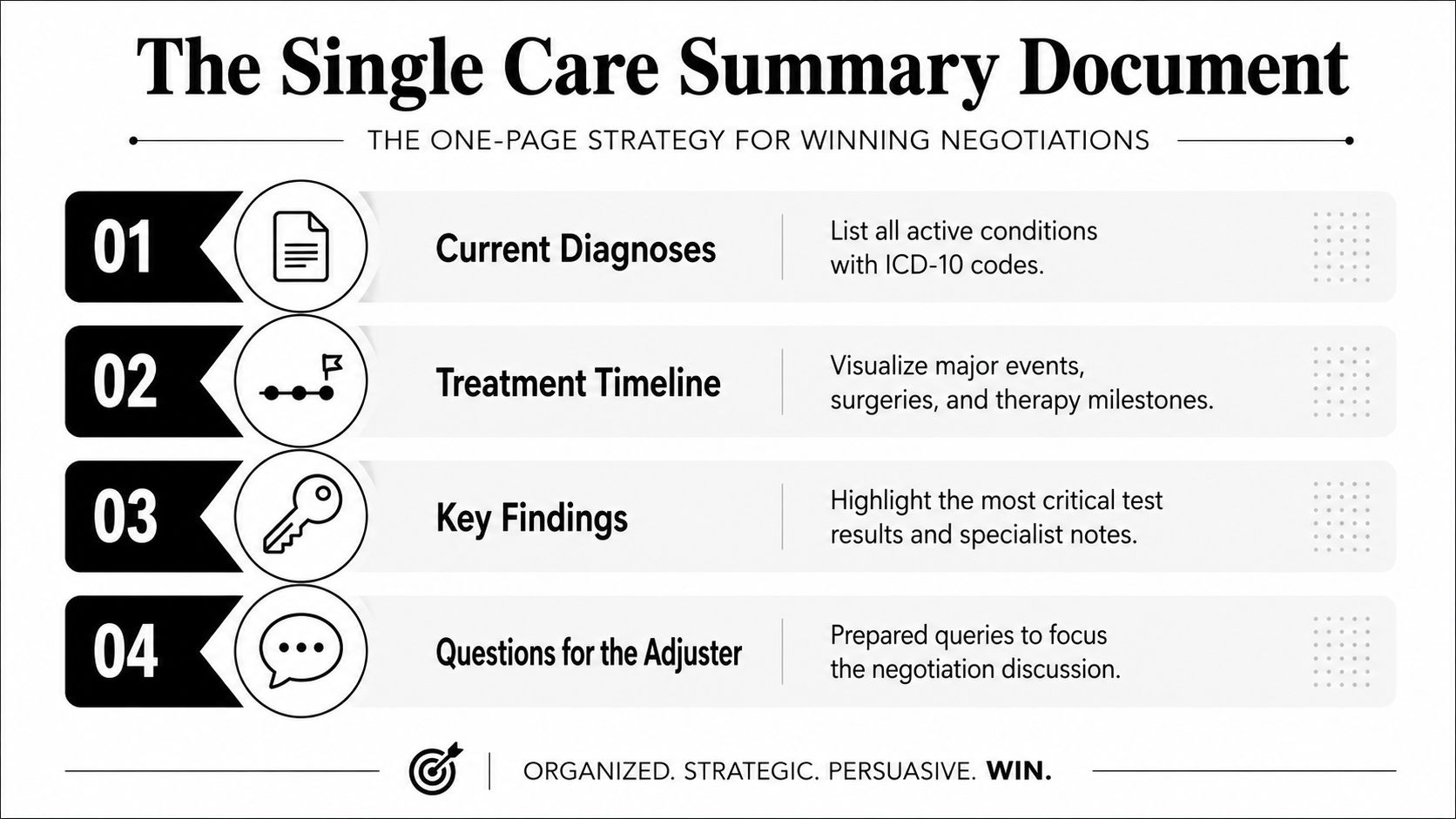
Build it with four headings only. Current Diagnoses, Treatment Timeline, Key Findings, and Questions for the Adjuster. Keep the wording plain. This document should read like a clean case roadmap, not a medical school outline. A file that is easy to skim gets read. A file that looks crowded gets pushed aside.
The summary should include current diagnoses, active medications, allergies, major test trends, treatment milestones, and the main care contacts. That structure fits the way record-management sources keep pointing toward portable, current summaries and hybrid digital-paper workflows (community practice summary research). It also matches what happens in a real injury claim, where the raw chart is too bulky for quick review and too scattered for a fast negotiation.
For injury negotiations, the value is obvious. A concise summary makes the injuries readable. It shows what changed, what stayed the same, and what still needs care. A thick chart buries all of that in administrative clutter.
Keep the summary disciplined. Do not stuff it with every minor complaint or side issue. Sensitive items need review before anyone shares the file. If a detail does not help explain the injury, the treatment course, or the current functional picture, it does not belong in the summary that leaves the house.
A useful way to keep this sharp is to pair the summary with a settlement narrative. If you need a model for how that narrative is used in practice, this settlement demand letter resource shows why the summary has to be tight, readable, and ready to move.
This structure also lines up with EHR optimization for small practices, because the same habits help lawyers and families. Keep the active picture current, separate the old noise, and make the file easy to verify without opening every page. That is the whole point for an adjuster, and it is the whole point for a family that needs to keep a clean backup and protect privacy at the same time.
A summary keeps the file honest. If the raw records are massive but the summary still fits on a few pages, the negotiator sees control. That matters more than volume.
A good summary does one job, it helps the other side understand the claim without making them work for it.
The firms that do this well do not win because they have more paper. They win because they translate the paper into a story that cannot be missed.
Pitfalls That Quietly Sabotage Injury Claims
Most bad record files are not ruined by one giant mistake. They fall apart through small habits that seem harmless at the time. The worst one is the blanket release, because it hands over a person's entire history when only a narrow injury-related slice was needed.
Another common problem is organizing by accident date instead of by treatment episode. That sounds neat until the reviewer opens the file and sees unrelated visits jammed together with no clear line between the injury, the follow-up care, and the older conditions. The better habit is to keep the injury episode clean and move unrelated material into Archive & Reference.
There's also the gap-record problem. A pause in treatment without explanation looks like the injury improved or the family stopped caring. Sometimes that isn't true at all, it's just poor documentation. If the gap has a reason, document the reason in the summary and keep the records that support it.
Social media can undercut the file faster than people expect, especially when a post contradicts the treatment timeline or the claimed limitations. That's not a records problem in the narrow sense, but it affects how the records are read. The better habit is to treat every public post like it might be compared against the chart.
For a deeper legal frame on preservation problems, see this spoliation of evidence overview. The issue isn't just losing files. It's creating the appearance that the file was altered, trimmed, or managed carelessly.
A few other errors come up constantly:
- Over-nesting folders: Too many layers slow retrieval and create misfiles.
- Premature release to insurers: Sending incomplete records before you've reviewed them gives the other side a head start.
- Missing authorizations: One missing signature can stall the whole request cycle.
- Unredacted sensitive pages: Private history that doesn't matter to the claim can distract from the injury.
The fix is discipline, not heroics. Use the narrow release. File by episode. Keep the active file lean. And never send a record set you haven't reviewed yourself or through counsel.
The family in crisis wants certainty, but certainty comes from habits, not panic. A controlled file is a stronger file.
Maintaining the System and Answering the Questions Families Actually Ask
A medical file only works if somebody keeps touching it. The maintenance routine should be short enough to survive real life, not ideal life. I like a weekly 15-minute review for new papers and portal downloads, plus a quarterly archive pass to move closed material out of the active file.
The weekly check is simple. Scan loose papers, verify digital files landed in the right folder, and update the care summary if anything changed. The quarterly pass is for cleanup, backup, and removing dead weight from the active file. That keeps the system from turning into a junk drawer.
If the client switches counsel, transfer the master summary first, then the indexed record set, then the archive. Don't dump an unorganized folder tree on the next team and hope they sort it out. They won't have the time, and the claim will pay for that delay.
Families also ask the same questions over and over, and they deserve direct answers.
How long should records be kept after settlement? Keep the core file, especially the summary, discharge papers, imaging reports, surgical records, and major diagnostic reports. Those documents are part of the medical history, not just the claim.
What if a provider refuses to release records? Escalate with a second written request, keep the log, and make sure the exact provider and date range are stated. Incomplete responses are common, but they should not be ignored.
Can a spouse access records? Sometimes, but not automatically. Access depends on authorization, privacy rules, and the provider's process.
What if the injured family member has a brain injury and can't manage the file? Assign one trusted person to be the records steward and keep a single secure folder for the whole household. That person should maintain the summary, the portal downloads, and the contact list for every provider.
Good medical record organization gives a family control over one thing during a hard case. The records may be complicated, but the system doesn't have to be.
Take one hour this week, gather every portal download and paper packet, name the files correctly, and build the one-page summary first. Then keep it alive with the weekly review. If you do that, the next request for records won't feel like a crisis, it'll feel like a task you already know how to handle.
If you're staring at a stack of records and don't know where to start, get help now, not after the adjuster has already used the confusion against you. A careful review of the file, the releases, and the summary can save a claim from avoidable damage. A CTA for Nares Law Group LLC can help your family organize the record set, protect the claim, and move forward with a clearer case strategy.