You may be staring at an injury that makes no sense.
A hotel sign crashed onto your parked car. A stack of merchandise toppled in a store aisle when no customer touched it. A loved one went into a routine procedure and woke up with an injury to a body part no one was even treating. You know something went wrong. What you don't know is exactly who made the mistake, what they did, or how to prove it.
That gap is where many injured people feel stuck. The defendant controls the scene, the records, the equipment, or the explanation. You have the harm, but not the inside view.
In some cases, the law has a tool for that. It's called Res Ipsa Loquitur. If that phrase sounds intimidating, don't worry. The idea behind it is much simpler than the Latin makes it seem.
When an Accident Happens Without a Clear Cause
A lot of injury cases start with a straightforward story. A driver runs a red light. A property owner ignores a spill. A company skips a safety step. In those cases, the careless act is visible.
But some accidents don't look like that.
You may know what happened, but not why it happened. A heavy object falls from above. A ceiling panel drops in a restaurant dining area. A truck component comes loose on the road and causes a crash. The event itself feels wrong, yet the exact act of carelessness happened out of sight.
That's frustrating for injured Coloradans because the normal instinct is, "How can I prove negligence if I didn't see it happen?" In a car wreck, you might start with records, photos, and the officer's summary. If you're sorting through that first layer of information, this guide on how to read a police accident report can help you understand what the paperwork does and doesn't tell you.
When the evidence lives with the other side
In many of these cases, the defendant holds the best evidence.
A trucking company has the maintenance records. A store has the incident reports and surveillance footage. A hospital has the charting, staffing information, and equipment logs. The injured person often has the least access to the very facts that would explain the accident.
Some cases aren't hard because the injury is doubtful. They're hard because the proof sits in someone else's hands.
That's why this doctrine matters. It gives courts a way to recognize that some events are so unusual, and so tied to another party's control, that negligence may be inferred from the occurrence itself.
Common examples people understand right away
These examples make the idea less abstract:
- Falling object cases: A sign, shelf item, or overhead fixture falls where it shouldn't.
- Vehicle equipment failures: A truck part detaches in ordinary travel.
- Post-procedure injuries: A patient suffers harm unrelated to the treatment area while unconscious.
- Building condition failures: Part of a ceiling, railing, or structure gives way under normal use.
None of those examples automatically proves a claim. But they raise the right question. Should this have happened at all if reasonable care was being used?
The Meaning of Res Ipsa Loquitur
A serious accident can leave you with a clear injury and no clear explanation. In that situation, res ipsa loquitur gives a name to a common-sense idea. Sometimes the event itself strongly suggests negligence.
Res Ipsa Loquitur means "the thing speaks for itself." In plain English, the circumstances of the accident may allow a judge or jury to infer that someone was careless, even if the injured person cannot identify the exact act that went wrong.
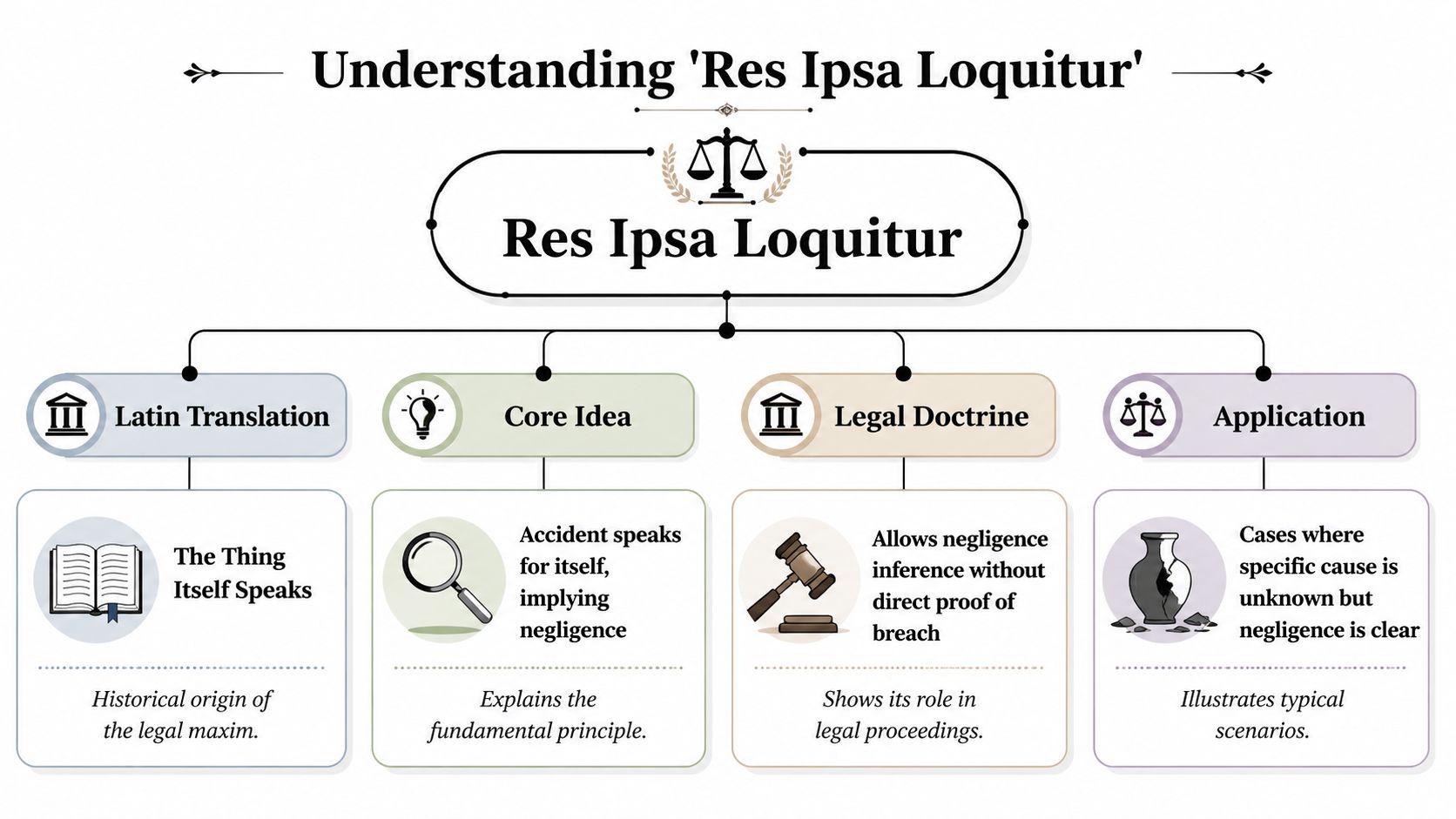
Lawyers describe this as a circumstantial-evidence doctrine. That phrase sounds technical, but the idea is familiar. You do not need to see every second of an event to draw a reasonable conclusion about what probably happened. If a store customer is struck by a heavy ceiling panel that falls during normal business hours, people do not usually assume that is just bad luck. They ask what failed, who was responsible for inspection or maintenance, and why the hazard existed in the first place.
That is the role of this doctrine in an injury case. It can help an injured Colorado plaintiff get past the unfair problem of having no direct window into the defendant's conduct.
A simple analogy
An old warehouse example shows the point well. A pedestrian is walking below a warehouse window when a barrel falls and causes serious injury. The injured person cannot say which employee mishandled it or what precise mistake occurred inside the building.
Still, common sense tells us something important. Barrels do not usually drop from upper windows when a property is being run with reasonable care.
That is the basic logic of res ipsa loquitur. The accident does not prove every detail of negligence. It supports an inference that negligence likely occurred.
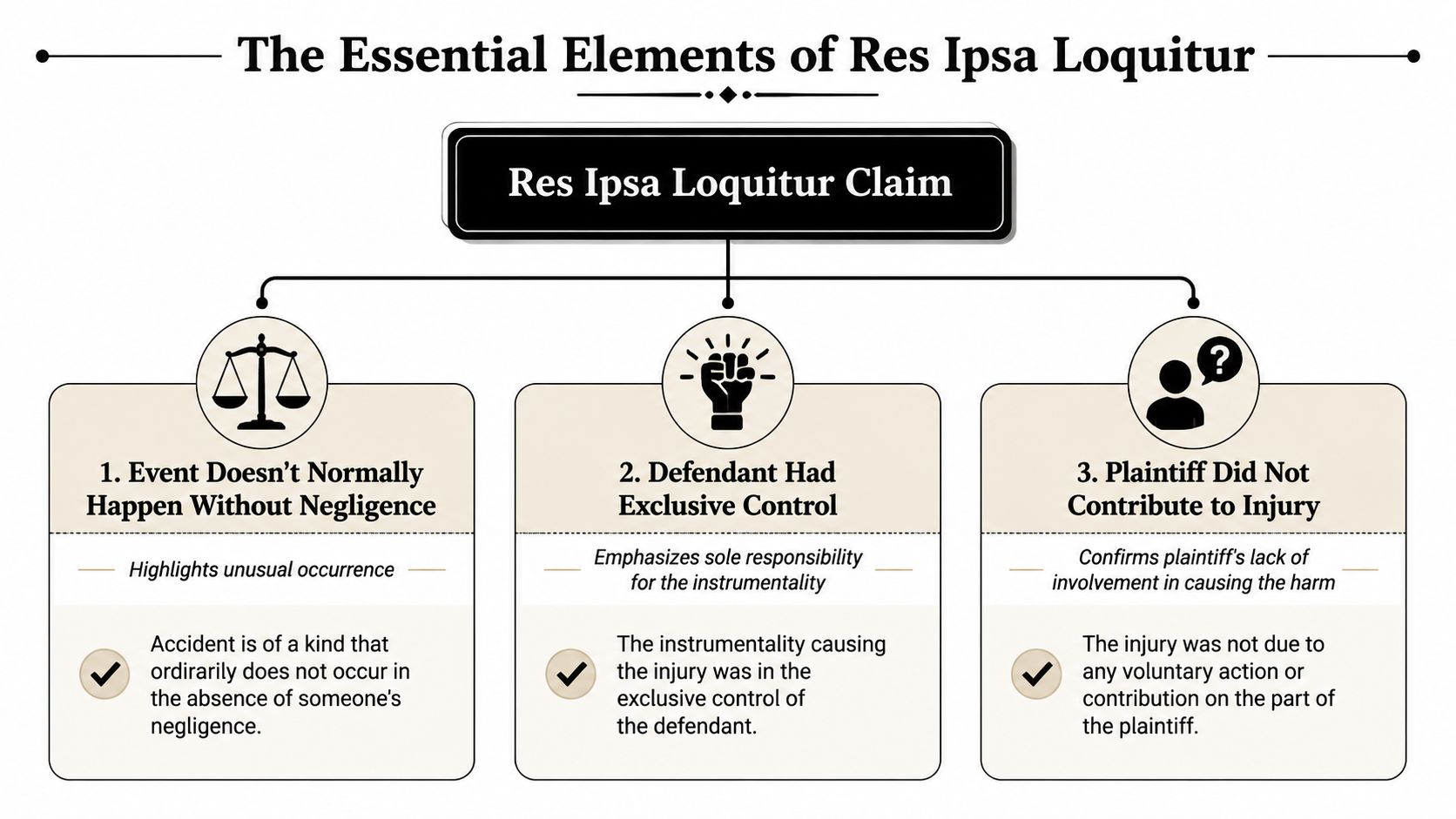
Cornell Law School's Wex entry on Res Ipsa Loquitur explains the doctrine in those terms. It applies when the type of event ordinarily does not happen without negligence, the cause was under the defendant's control, and the injured person did not cause the harm.
The three questions behind the doctrine
In practice, this doctrine asks jurors to work through three grounded, practical questions:
- Is this the kind of event that usually does not happen unless someone was careless?
- Was the thing that caused the injury under the defendant's control?
- Did the injured person do anything that significantly caused the event?
Those questions matter because real cases are messy. In a truck accident, for example, a detached wheel, a failed brake component, or shifting cargo may point toward poor maintenance or loading even when the injured driver never saw what happened inside the trucking company's operation. In a premises liability case, a collapsing fixture or broken railing may speak volumes before anyone finds the maintenance log.
Res ipsa loquitur does not hand you an automatic win. It gives the court a fair way to treat accidents that should not happen if reasonable care was used, especially when the best explanation is in the hands of the other side.
The Three Elements You Must Prove
A good way to understand this part of the doctrine is to picture a three-leg stool. If one leg is missing, the argument wobbles. To use res ipsa loquitur, you usually need facts that support all three points: the accident is the kind that usually does not happen without negligence, the defendant controlled what caused it, and you did not materially cause it yourself.
The event usually doesn't happen without negligence
This is the common-sense question.
Some accidents happen even when everyone acts carefully. A grocery cart rolling into your ankle could be careless, or it could be a minor everyday mishap. A ceiling panel falling onto customers during normal business hours is different. Ceilings, railings, store fixtures, and major vehicle components are supposed to stay in place if they are inspected, maintained, and used with reasonable care.
That is the heart of this first element. Does the event itself suggest that something probably went wrong behind the scenes?
Colorado injury cases often make this easier to see with concrete examples:
- A surgical tool or sponge left inside a patient
- A wrong-site or wrong-limb surgery
- A heavy display or fixture collapsing in a store without customer interference
- A wheel or major truck part separating during ordinary travel
You do not need to prove every hidden detail at this stage. You need enough facts to show the incident is abnormal in a way that points toward negligence.
The defendant had control over what caused the harm
This part often causes confusion because "exclusive control" does not mean the defendant had physical possession every second of the day.
It usually means the defendant had the right, responsibility, or practical ability to manage the thing that caused the injury during the relevant time period. In plain English, who was in charge of keeping this from happening? A restaurant customer does not inspect ceiling hardware. A driver next to a semi-truck does not maintain its brakes, wheels, or axles. A patient under anesthesia does not control the surgical team or the operating room.
Here is how that often looks:
| Situation | Who likely controls the instrumentality |
|---|---|
| Store shelving collapses | Store owner or operator |
| Truck part fails on the road | Trucking company or maintenance provider |
| Surgical error during anesthesia | Medical providers handling the procedure |
Control can get messy in real cases. A property owner may blame a contractor. A trucking company may point to a repair shop or parts manufacturer. Sorting that out early matters because res ipsa works best when the source of the danger was within the defendant's area of responsibility.
After this first explanation, a short video can help reinforce the concept in a different format.
You didn't contribute to the injury
This element does not require you to have behaved perfectly. The question is whether your own conduct was a meaningful cause of what happened.
For example, if someone climbs into an area clearly closed to customers and a shelf collapses, the defense will argue the person's actions helped cause the event. If a driver personally altered a vehicle part that later failed, that fact may weaken the argument. But many injured people in Colorado res ipsa cases were going about normal life. They were driving in their lane, shopping in a store, walking through a parking lot, or lying unconscious during medical treatment.
That is why this doctrine can be so useful. It addresses situations where the injured person did not create the danger and could not possibly know exactly what failed.
Why these elements matter together
Courts do not apply this rule just because an injury is serious or the result feels suspicious. They apply it when the surrounding facts make negligence a reasonable inference.
A lawyer's job is to line up those facts carefully. In a truck wreck, that may mean maintenance records, inspection gaps, and photographs of the failed part. In a premises liability case, it may mean incident reports, repair history, and testimony showing no customer interfered with the fixture before it fell.
When those pieces fit together, res ipsa loquitur gives injured Coloradans a fair way to move a case forward even when the defendant knows far more about what went wrong than they do.
Res Ipsa Loquitur in Colorado Injury Cases
In Colorado injury cases, the doctrine becomes practical when the event itself points toward carelessness but the plaintiff can't identify the exact internal failure.
Car wreck example
Start with a highway crash where one vehicle suddenly crosses the median for no clear external reason and collides with oncoming traffic. The injured driver in the other lane may not know whether the cause was a mechanical failure, a cargo issue, a maintenance lapse, or careless operation.
That doesn't automatically make it a res ipsa case. But if the surrounding facts show the event was unusual and tied to conditions managed by the defendant, the doctrine may become part of the legal strategy.
In ordinary two-car collisions, lawyers often prove negligence through direct evidence such as speeding, texting, lane violations, or witness testimony. Res ipsa is more useful when the direct proof is thin and the event itself is abnormal.
Truck wreck example
Truck cases often make the idea easier to see.
A commercial truck travels down the road. Then a wheel detaches, debris flies, and nearby drivers crash while trying to avoid it. The injured motorists don't know which mechanic performed the last service, whether the carrier skipped inspections, or whether a maintenance procedure was done improperly. What they do know is that heavy truck parts aren't supposed to separate during normal travel if the vehicle is being properly maintained and operated.
That kind of scenario is why circumstantial-evidence doctrines matter. The key records are usually with the trucking company, its maintenance vendors, or its insurers.
When the defendant controls the truck, the maintenance history, and the explanation, res ipsa can help level the field.
Premises liability example
Premises cases are another natural fit.
A restaurant customer sits down for lunch and a ceiling section collapses. A shopper walks past a display and a large shelf fixture tips over. A hotel guest enters a common area and a mounted object drops from above. In each of those situations, the injured person usually had no role in maintenance, inspection, or repair.
That doesn't mean every property incident qualifies. A slip on tracked-in snow may involve different proof. But a structural failure during ordinary use often raises the kind of question res ipsa is built to address.
Medical setting example
Though this article focuses on everyday injury claims Coloradans may recognize, the doctrine is also well known in medical cases. Historical examples often include a foreign object left in the body or a wrong-limb amputation, where the occurrence itself seems sharply inconsistent with proper care.
The takeaway is simple. In Colorado cases involving unexplained but highly unusual harm, lawyers look closely at whether the event itself can carry part of the proof.
How It Shifts the Burden of Proof
Most negligence cases start with the plaintiff carrying the load. The injured person has to present evidence showing the defendant likely acted negligently.
Res ipsa loquitur changes that dynamic in an important way. It doesn't hand the plaintiff an automatic win. It does move the case away from "You can't prove the exact mistake" and toward "Defendant, explain how this happened without negligence."
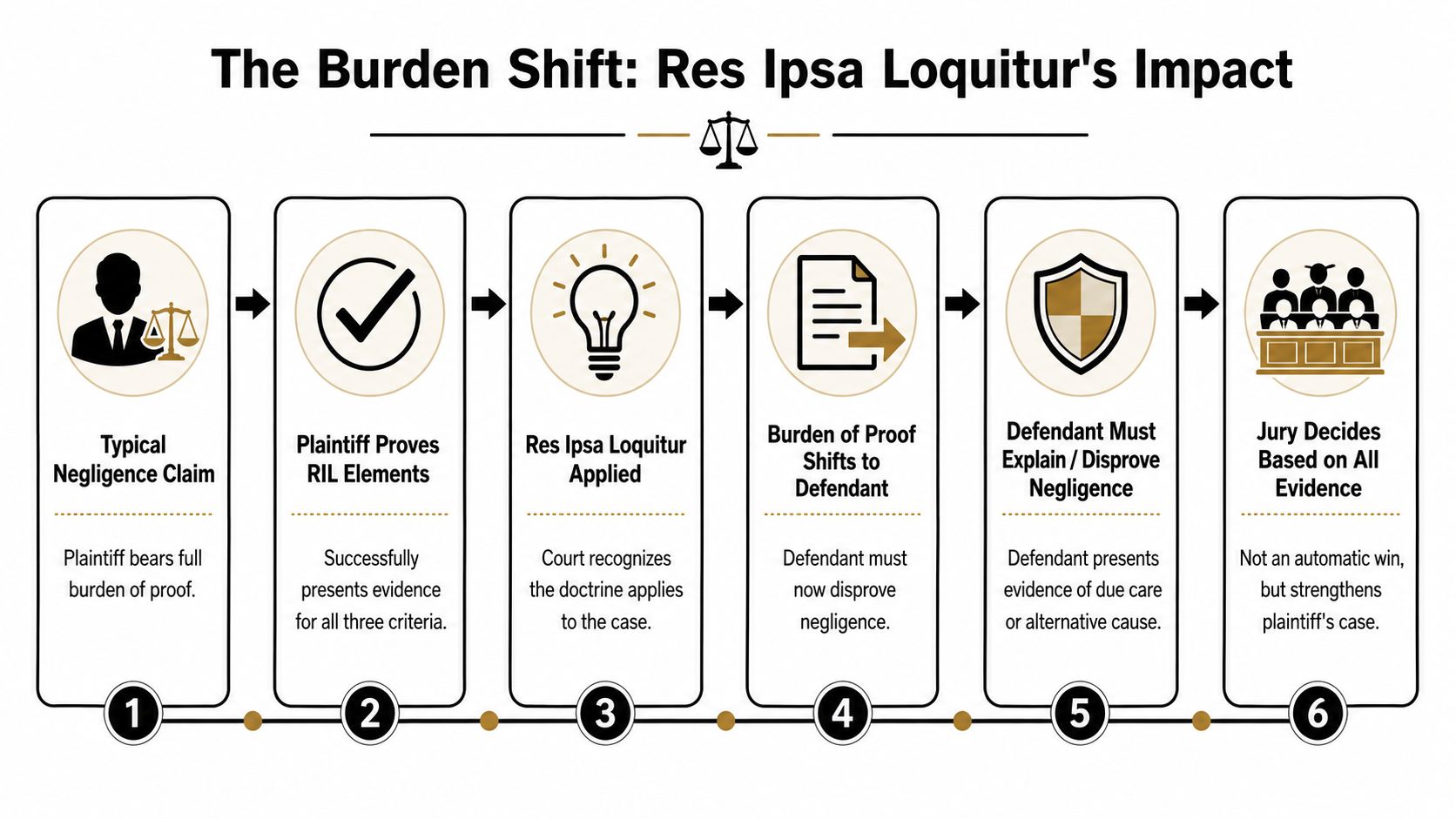
The doctrine traces its modern origin to Byrne v. Boadle in 1863, the famous barrel-of-flour case, and a major U.S. milestone is Ybarra v. Spangard (1944). The doctrine is described as a burden-shifting device: once the plaintiff shows the accident implies negligence and the defendant had control, the defendant must come forward with evidence to explain or rebut the inference, according to this historical overview of res ipsa loquitur.
Think of it like a spotlight
At first, the spotlight is on the injured person. Prove what happened. Prove who was careless. Prove the connection.
If res ipsa applies, the spotlight swings toward the defendant. The defendant now needs to offer a credible alternative explanation, challenge control, or show the event could happen without negligence. If you're unfamiliar with burden concepts generally, this plain-language guide to the burden of proof in injury cases can help.
What this means in practice
The practical impact is often procedural as much as persuasive.
- It helps a case survive early attack: A defendant can't say, "You don't know the exact mistake, so your case fails."
- It forces an explanation: The defense has to engage the facts instead of hiding behind the plaintiff's lack of inside knowledge.
- It gives the jury a path: Jurors may infer negligence from the circumstances rather than requiring an eyewitness to the precise act.
The doctrine doesn't eliminate the fight. It changes where the fight happens.
What it doesn't do
Res ipsa loquitur doesn't guarantee liability. A jury can still reject the inference. A defendant can still present evidence showing reasonable care, an alternative cause, or plaintiff contribution.
That's why good lawyering still matters. The doctrine opens a door. Evidence still has to walk through it.
Common Defenses and Exceptions to the Rule
Defense lawyers rarely concede a res ipsa argument without pushing back. That's normal. It doesn't mean your case is weak. It means the doctrine has real force when it fits.
A key limitation is that res ipsa loquitur is narrowly applied. Courts may require that the injury be one laypeople would recognize as not ordinarily happening absent negligence, and the doctrine can be defeated by alternative explanations or proof that the plaintiff contributed to the event because it creates a permissible inference for the jury, not automatic liability, as explained in this discussion of the doctrine's limits.
The defense says the event can happen without negligence
This is one of the most common responses.
The defendant argues that the incident, while unfortunate, can occur even when reasonable care is used. In a building case, they may claim a hidden defect. In a vehicle case, they may point to an unforeseeable failure. In a medical setting, they may argue the outcome was a known complication rather than proof of carelessness.
Your legal team answers this by testing whether that explanation fits the facts, the records, and ordinary experience.
The defense says someone else controlled the instrumentality
This is the "wrong defendant" strategy.
A trucking company may blame a maintenance vendor. A property owner may point at a contractor. A store may suggest another customer caused the condition. Sometimes that argument is valid. Sometimes it's a smoke screen.
The essential question is who had meaningful control over the thing that caused the injury during the relevant time.
The defense says you contributed to the event
If the defendant can show the injured person played a real role in causing the harm, the doctrine becomes harder to use.
That argument may focus on conduct, warnings, misuse, or interference with the object or area involved. The response usually turns on detail. What were you doing? What access did you have? What evidence supports the claim that you caused or worsened the event?
The defense says the cause is too technical for common knowledge
Some cases require more than common sense.
If the issue involves specialized equipment, engineering, or medical causation, the defense may argue that a lay jury can't infer negligence without expert help. That doesn't always defeat the case. It may mean the case needs stronger expert analysis.
A predictable defense isn't a dead end. It's a sign that the facts need to be pinned down carefully and early.
Practical Evidence Checklist for Your Case
If you think your accident may involve res ipsa loquitur, evidence disappears fast. Cleanup crews move in. Vehicles get repaired. Businesses overwrite video. Memories fade.
Start preserving what you can.
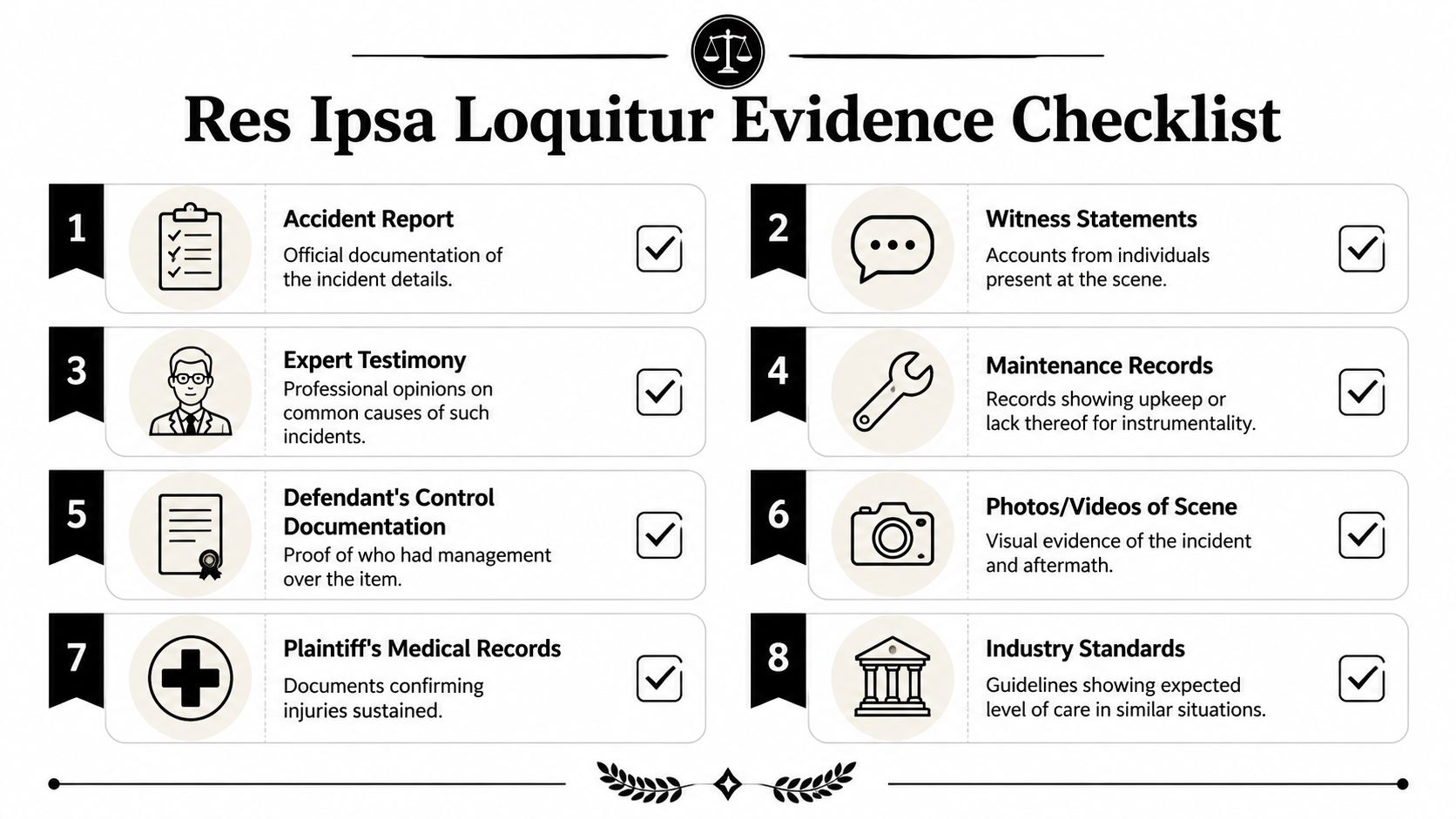
What to gather right away
- Photos from multiple angles: Capture the object, vehicle, roadway, store aisle, ceiling area, debris field, warning signs, and your visible injuries.
- Video if it's safe: A slow phone walkthrough often preserves context that still photos miss.
- Witness names and contact information: Even if they didn't see the exact moment, they may have seen conditions right before or right after.
- Your own timeline: Write down what you were doing, where you were standing, what you heard, and what happened next.
- Damaged property: Don't throw away a broken helmet, torn clothing, child car seat, or vehicle component if it's still available.
- Medical records and discharge papers: These help tie the event to the injury.
- Incident or crash reports: Ask for store reports, employer reports, and police documentation where applicable.
- Evidence of control: Save receipts, booking confirmations, truck company names, photos of logos, or anything showing who managed the object involved.
When expert help may matter
Some cases need a specialist to explain why the event points to negligence. In crash cases, an accident reconstruction specialist may help evaluate vehicle movement, impact patterns, and mechanical issues.
If you're trying to organize facts, documents, and open questions in a methodical way, SparkPod's research guide offers a useful framework for gathering information without losing the thread.
What not to do
- Don't repair or discard key items too quickly
- Don't post detailed theories online
- Don't assume the business or insurer will preserve evidence for you
The strongest res ipsa cases often depend on ordinary evidence gathered early and kept intact.
Frequently Asked Questions
Is res ipsa loquitur the same as strict liability
No. These rules solve different problems.
Res ipsa loquitur helps in a negligence case when the accident itself strongly suggests someone was careless, even if you cannot point to the exact mistake yet. Strict liability is different. In those cases, the law can hold a person or company responsible because of the activity, product, or legal duty involved, even if they claim they acted carefully.
A simple way to separate them is this. Res ipsa asks, "Did this event probably happen because someone failed to use reasonable care?" Strict liability asks, "Does the law impose responsibility here even without proving carelessness?"
Can this doctrine be used in medical malpractice cases
Sometimes, yes. Medical cases are often harder because hospitals, doctors, nurses, and contractors may all be involved, and the patient is usually in no position to see what happened.
A classic example is a patient who goes into a procedure for one problem and wakes up with an injury to a completely different body part. In a narrow set of cases like that, res ipsa may help because the injury can point to negligence even when the patient cannot identify the exact person who caused it. Courts still examine these claims carefully, and medical expert testimony is often needed.
For Colorado injury claims, this matters beyond hospitals. The same practical problem comes up in truck crashes, serious car wrecks, and property injury cases. You know something went badly wrong, but the proof of exactly how it happened may be in the hands of the other side.
Does res ipsa loquitur mean I don't need evidence
You still need evidence. You just may not need direct proof of the precise careless act.
That distinction confuses many injured people. Res ipsa does not replace records, photos, witness statements, inspection reports, or expert opinions. It lets you build your case with circumstantial evidence when the event itself is the strongest clue. A store shelf does not usually collapse onto a customer without some failure in inspection, loading, maintenance, or setup. A commercial truck wheel does not usually detach in traffic if proper maintenance and inspection happened.
So the doctrine helps fill an evidentiary gap. It does not erase the need to prove your case.
What happens if the defendant rebuts the inference
The case continues, and the court looks at the full record.
The defense may argue that the incident happened for a reason unrelated to negligence, such as a hidden defect, third-party interference, or unexpected misuse. Sometimes that explanation is credible. Sometimes it falls apart once maintenance logs, photographs, scene evidence, or testimony come into view.
Res ipsa gives you a fair starting point. It does not guarantee that the judge or jury will accept your side.
Can it apply in a Colorado truck or premises case
Yes, if the facts support it.
In a truck case, the question might be whether a failure such as detached equipment, shifting cargo, or a mechanical breakdown is the kind of event that usually does not happen without poor inspection, maintenance, or loading. In a premises case, the issue may be whether a falling ceiling tile, collapsing display, or malfunctioning automatic door points to negligent upkeep by the party in control.
Colorado courts do not apply labels mechanically. They look closely at control, the nature of the event, and whether ordinary care usually prevents this kind of harm. That is why these cases are so fact-specific.
If you were hurt in Colorado and the accident still does not make sense, Nares Law Group LLC can evaluate whether circumstantial proof, maintenance failures, scene evidence, or control issues may support your claim. The firm helps injured people and families after serious crashes, truck wrecks, and premises liability incidents, especially when the facts feel murky at first but the injury is very real.