You may be reading this while your arm is still in a sling, your phone won’t stop buzzing, and another medical bill just landed in your inbox. You want help. But you also don’t want to sign something you don’t understand.
That concern is reasonable.
When people ask what percentage do personal injury lawyers take, they usually mean something deeper. They want to know what they’ll owe, what they’ll receive, and whether hiring a lawyer will leave them with less than they expect. The answer starts with the fee percentage, but it doesn’t end there.
The hardest part for many injured people is this: the number in a settlement headline is not always the number that goes into your bank account. The difference between gross and net matters. So do case costs. So do medical liens. And if your case is in Colorado, Texas, or New York, the local rules and norms matter too.
The 'No Fee Unless We Win' Promise Explained
A lot of clients come in with the same fear. They’ve missed work. Their car may be totaled. They’re trying to get treatment. Then they hear the words “hire a lawyer” and assume that means a retainer, hourly bills, and another financial problem.
In most personal injury cases, that’s not how it works.

A personal injury lawyer usually works on a contingency fee. That means the lawyer’s fee is contingent on a successful outcome. If there’s no recovery, there’s no attorney fee.
Why this model exists
This arrangement became common because injured people often can’t afford to pay a lawyer up front. A contingency fee opens the door to representation even when money is tight.
It also changes the relationship. Instead of billing you by the hour no matter what happens, the lawyer shares the risk with you. In many cases, the law firm also advances the costs needed to build the claim.
Practical rule: A contingency fee means your lawyer gets paid from the recovery, not from your pocket at the start of the case.
What clients often misunderstand
“No fee unless we win” does not always mean “you keep the whole settlement minus one simple percentage.” That promise usually refers to the attorney fee itself.
Other deductions may still matter, including:
- Case expenses such as records, filing fees, and experts
- Medical liens from providers or insurers seeking repayment
- Outstanding bills tied to your treatment
That’s why clear paperwork matters. A good fee agreement should tell you what happens if the case resolves early, what happens if a lawsuit is filed, and how costs are handled.
Consider it similar to hiring a builder after a storm damaged your home. The builder may agree to get paid only if the insurance company pays the claim. But materials, permits, and subcontractor charges still have to be accounted for. A personal injury case works in a similar way.
The Standard Contingency Fee and What to Expect
If you want the short answer to what percentage do personal injury lawyers take, the usual range in the United States is 33% to 40% of the final settlement or award, and 33.3% is the most common rate for cases that settle before a lawsuit is filed, often rising to 40% if litigation is required, according to this explanation of standard personal injury contingency fees.
That’s the baseline many people see in fee agreements.
A simple way to think about the fee
The cleanest analogy is a business partnership for one case.
You bring the legal claim.
Your lawyer brings time, strategy, negotiation, and the willingness to take the financial risk of pursuing the case.
If the case succeeds, the lawyer takes an agreed share.
That’s why contingency fees feel different from hourly billing. You’re not paying for every email, phone call, or court appearance as the case unfolds. The lawyer is betting their work will produce a result.
What the range usually means
The percentage often tracks the stage of the case.
| Case stage | Typical fee structure |
|---|---|
| Early resolution before a lawsuit | 33% to 33.3% is common |
| Litigation after filing suit | Often 40% |
| Trial in some matters | May be higher depending on the agreement |
The reason is practical. A case that settles early usually takes less labor and less financial risk than one that moves into formal litigation.
A straightforward example
The same source explains that on a $100,000 settlement with a 35% fee, the lawyer would receive $35,000 and the client would have $65,000 left before expenses. It also gives a smaller example. On a $30,000 settlement with a fee in the 33% to 40% range, the lawyer’s share would be $9,900 to $12,000, with the client receiving the balance before liens and other deductions are addressed.
The fee percentage answers only one part of the money question. The rest of the answer lives in the deductions that come after the gross settlement is set.
That’s where many people get surprised. They hear “one-third” and assume they know their take-home amount. Often, they don’t.
Gross Versus Net How Your Settlement Is Calculated
This is the part people rarely get in plain English.
Your gross settlement is the total amount paid to resolve the case. Your net settlement is what you take home after deductions. Those two numbers can be very different.

Start with the gross number
The insurance company may agree to pay one total figure. That figure is the top-line number.
But that top-line number doesn’t automatically become your check.
The money usually passes through several deductions first.
Then account for case costs
Many firms advance the out-of-pocket expenses needed to move the case forward. According to this Colorado discussion of personal injury case costs, attorneys often front costs that can range from $5,000 to over $50,000 in complex trucking or traumatic brain injury claims, and those costs are reimbursed from the recovery.
Those costs can include things like:
- Medical records and billing requests
- Court filing fees
- Expert witness retainers
- Investigation expenses
- Depositions and transcripts
In a serious injury case, these aren’t optional luxuries. They may be what allows the lawyer to prove how the crash happened and how badly you were hurt.
Then address liens and reimbursement claims
A medical lien is a claim against the settlement by someone who paid for, or provided, your care.
That could include:
- A provider who agreed to wait for payment
- A health plan seeking reimbursement
- Another party with a lawful right to be repaid from the settlement
Clients often feel blindsided at this stage. They hear that the case settled for a strong amount, but a chunk of that money is already spoken for.
Why gross and net both matter
Two settlements with the same gross amount can produce very different net results.
One case may involve modest expenses and limited treatment balances. Another may involve extensive records, experts, and significant lien claims. The gross numbers look identical. The take-home numbers do not.
Before you focus on the settlement amount, ask for a written breakdown of the expected deductions.
A plain-language formula
Here’s a simple breakdown:
- Start with the gross settlement
- Subtract the attorney fee under the contract
- Subtract case costs
- Subtract medical liens or reimbursement claims
- The remainder is your net recovery
Some fee agreements calculate the fee in one order, others in another. That’s why the contract language matters so much. Don’t assume every firm handles the math the same way.
Where confusion usually starts
Clients often ask, “Does the lawyer take the percentage from the full settlement or after costs?” That’s a smart question.
It matters because even a fair percentage can feel very different depending on how the deductions are applied. If you don’t ask early, you may not understand your numbers until the case is over. By then, the surprise feels much worse.
How Case Stage and Location Change the Percentage
The percentage isn’t always static. It can change based on how far the case goes and where the case is handled.
Why the fee often increases after a lawsuit is filed
In Colorado, the standard contingency fee is typically 33% for cases resolved without a lawsuit and usually increases to 40% if litigation begins, according to this Colorado fee overview. That same source explains the increase by pointing to the added work and expense of litigation, including expert witness fees that can cost $5,000 to $20,000.
That jump makes sense when you look at what changes after filing suit.
A pre-lawsuit claim may involve investigation, records, demand preparation, and negotiation. A litigated case may require written discovery, depositions, motions, expert work, and trial preparation. The lawyer’s time commitment expands. The financial risk does too.
If you want a plain-English overview of how a case moves through those phases, this guide to the stages of a personal injury case is a useful reference.
A side-by-side look at Colorado, Texas, and New York
State rules don’t all look the same.
| State | General pattern |
|---|---|
| Colorado | No statutory cap for ordinary personal injury contingency fees was identified in the verified material. Fees must still be reasonable under ethical rules. Standard practice commonly falls in the one-third to forty percent range. |
| Texas | Ordinary personal injury cases such as car wrecks generally follow standard contingency tiers, but certain medical malpractice matters have a separate capped structure. |
| New York | Fees may vary by case type and court oversight can matter in specific situations, including matters involving infants. Typical personal injury practice still often falls within the same broad range people see nationally. |
The most important takeaway is simple. Location can affect the rules, even when the headline percentage sounds familiar.
What changes besides the percentage
Case stage can change more than the fee itself.
A lawsuit may also bring:
- More documentation demands
- More pressure to hire experts
- More waiting
- In some cases, it creates an advantage because the other side now faces formal discovery and trial exposure
That doesn’t mean litigation is always better. It means litigation is more intensive. If your agreement uses a tiered fee, ask exactly what event triggers the increase. Is it filing the complaint? Reaching a certain stage? Going to trial? The contract should answer that in direct language.
The right question isn’t only “What percentage do you charge?” It’s “When does that percentage change, and why?”
Putting It All Together With Sample Calculations
Abstract rules become clearer when you see the money move line by line.
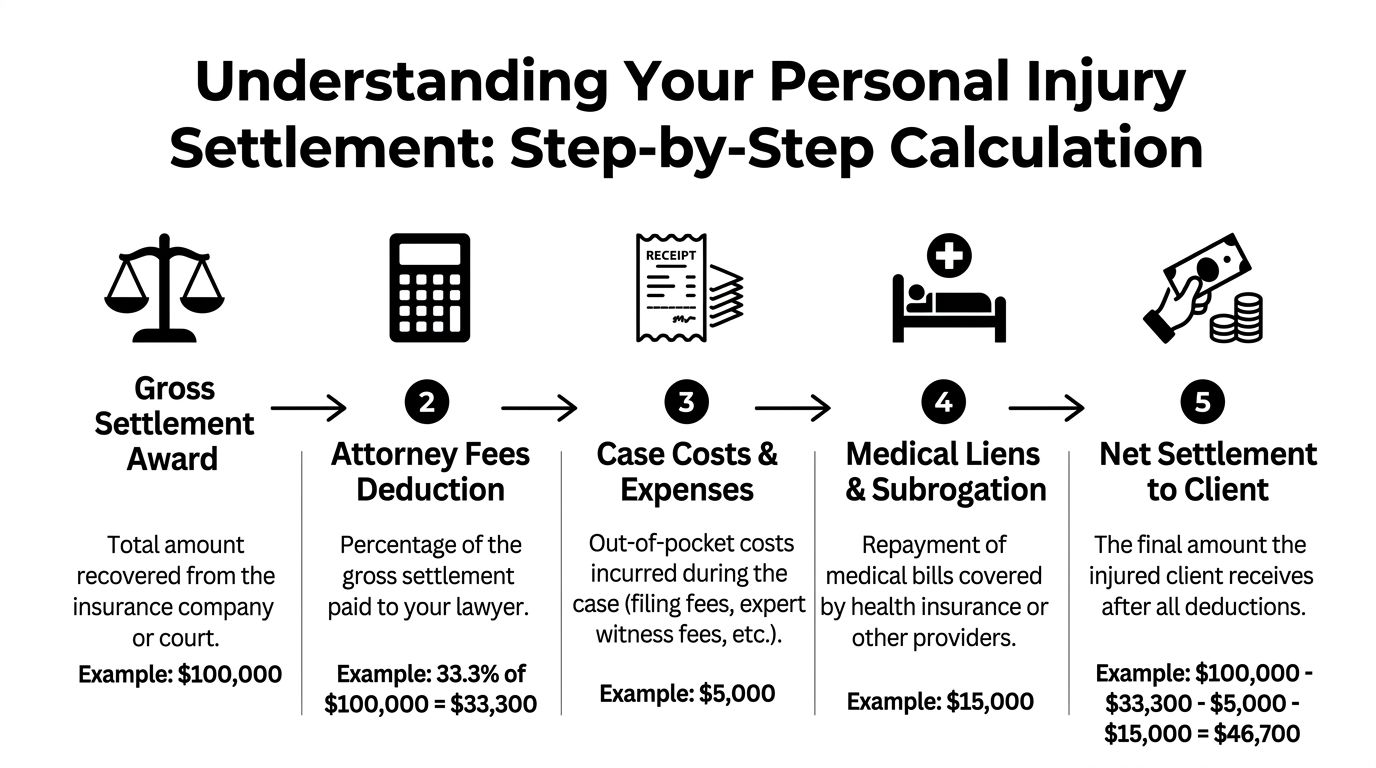
If you want to test different scenarios on your own, a free settlement calculator can help you visualize how deductions affect the final number.
Example one with an early settlement
Use the simple example already grounded in the standard fee discussion.
- Gross settlement: $100,000
- Attorney fee: 35%, which equals $35,000
- Amount remaining before other deductions: $65,000
That example comes from the verified fee discussion cited earlier. But your check still may not be $65,000.
If the case also has advanced costs and medical liens, those amounts come out too. So the net recovery will be lower than the “after fee” number.
Example two with a smaller settlement range
The verified material also gives a compact example with a lower settlement amount.
| Item | Low end | High end |
|---|---|---|
| Gross settlement | $30,000 | $30,000 |
| Attorney fee percentage | 33% | 40% |
| Attorney fee amount | $9,900 | $12,000 |
| Balance before liens | $20,100 | $18,000 |
This illustrates a point many people miss. Even before anyone calculates liens, the fee tier changes the balance noticeably.
How to use examples the right way
Sample math is useful, but only if you ask the right follow-up questions.
Ask for a settlement sheet that shows:
- Gross recovery
- Fee percentage
- Case costs
- Medical liens or reimbursements
- Final net amount
If a lawyer can’t explain the calculation on one page, that’s a warning sign. The math doesn’t need to be mysterious.
The question that protects you
When clients feel disappointed at the end of a case, it’s often because they focused on one number too early.
The better question is this: “What will my likely net recovery look like under a few different scenarios?”
That shifts the conversation from marketing language to actual dollars.
Can You Negotiate Your Lawyer's Fee?
Yes, sometimes you can.
Many people assume contingency fees are fixed and not open to negotiation. They often aren’t. The room for discussion depends on the case, the risk, the likely workload, and the firm.
A verified source states that a 2025 Colorado Bar Association survey found 28% of clients successfully negotiated their contingency fee down, typically by 5% to 10%, especially in high-value truck wreck cases with clear evidence, as discussed in this article addressing common personal injury fee percentages.
When negotiation is more realistic
Fee negotiation is more likely when:
- Liability is clear and the defense issues are limited
- Damages are substantial so the case may justify a lower percentage
- The matter may resolve quickly without heavy litigation
- You’re comparing firms carefully and asking informed questions
A lawyer may have less flexibility in a difficult case with contested fault, uncertain medical proof, or major upfront cost exposure. In those matters, the risk to the firm is higher.
How to ask without making the conversation awkward
You don’t need a confrontational approach.
Try questions like:
- “Is your standard fee flexible in a case like this?”
- “If the case resolves before suit, do you offer a lower percentage?”
- “Can we discuss how costs and fees would work in a best-case early settlement?”
That approach signals that you’re thoughtful, not difficult.
A transparent lawyer won’t be offended by respectful questions about money. You’re hiring help during one of the most expensive periods of your life.
What matters more than a lower number
A lower fee is attractive. But it isn’t the only factor.
You should also weigh:
- Experience with your injury type
- Trial readiness
- Communication style
- Clarity on costs and liens
- Whether the agreement is easy to understand
A smaller percentage on paper can still lead to a frustrating outcome if the lawyer doesn’t explain deductions or prepare the case well.
The Nares Law Group Commitment to Transparency
After reading all of this, one point should stand out. Fee percentages matter, but clarity matters just as much.
People dealing with crashes, brain injuries, or the death of a loved one don’t need vague answers about money. They need a written agreement they can understand, a lawyer who explains the gross-to-net process plainly, and a team that answers hard questions before signatures happen.
That’s the standard injured people should expect.
Transparency means more than stating a percentage. It means explaining when the percentage changes. It means identifying whether costs are advanced. It means discussing liens before the case ends, not after. It means telling a client that a strong gross result may still produce a smaller net check because medical claims must be resolved.
That approach reduces stress. It also builds trust.
A firm that values transparency should be willing to walk through sample calculations, discuss likely expense categories, and explain what can affect take-home recovery in Colorado, Texas, or New York. Clients shouldn’t have to decode legal billing language while they’re recovering from a serious injury.
If a consultation leaves you more confused than before, keep looking. Good legal guidance should make the financial side of a case easier to understand, not harder.
Key Questions to Ask About Fees Before You Sign
Bring these questions to every consultation. Write down the answers. If the lawyer seems irritated, that tells you something too.

If you’re comparing attorneys in Colorado, reviewing options from a Denver personal injury attorney can help you frame the conversation.
Your fee checklist
- What percentage do you charge at each stage of the case? Ask whether the rate changes before suit, after filing, or at trial.
- Is the fee calculated from the gross settlement or after certain deductions? This is one of the biggest sources of confusion.
- What case costs do you advance? Ask for examples in plain language.
- How are medical liens handled? You want to know who negotiates them and when.
- If the case is lost, do I owe any costs? Don’t assume the answer.
- Will I receive a written settlement breakdown before I sign the final release? You should.
- Are there situations where the fee is negotiable? It’s worth asking respectfully.
- Who can explain the numbers to me if I have questions later? You want a point person, not a vague promise.
What a good answer sounds like
A good answer is direct. It uses real examples. It doesn’t hide behind jargon.
A weak answer sounds slippery. It relies on “standard practice” without defining the standard. It treats your money questions like a nuisance.
You’re not being difficult by asking these questions. You’re protecting yourself.
If you want clear answers about contingency fees, case costs, and what your recovery may look like, Nares Law Group LLC offers a client-focused approach built around transparency. The firm helps injured people and families understand the financial side of a case in plain English, so they can make informed decisions without added stress.