The first days after a work injury are usually a blur. You're trying to get treatment, figure out whether you can work, answer messages from your employer, and keep the bills from piling up. Somewhere in that mess, a legal question starts nagging at you: How long after a work injury can I sue?
For Colorado workers, that question often sounds simpler than it is.
The problem is that a job-related injury can trigger more than one legal deadline at the same time. One deadline may affect your right to workers' compensation benefits. Another may affect your right to bring a separate lawsuit against someone other than your employer. If you treat those as the same thing, you can lose rights you didn't even realize you had.
That's why the timing issue matters so much. A work injury case isn't one clock on one wall. It's two clocks ticking in different rooms, and each one controls something different.
Your Guide to Work Injury Lawsuit Timelines
A warehouse worker hurts his back lifting inventory. A delivery driver gets hit by another vehicle while making a route. A construction laborer falls because another company left the site unsafe. All three people might ask the same question, but the answer won't be identical.
That's where many injured workers get blindsided.
One person hears “workers' comp” and assumes that's the only option. Another person hears “lawsuit” and waits too long to report the injury to the employer. Both mistakes are costly. In real practice, the first issue usually isn't whether someone was badly hurt. It's whether the right claim was started on the right timeline.
Why the answer depends on who caused the harm
If the claim is against your employer's workers' compensation system, you're dealing with administrative deadlines. Those often move fast.
If the claim is against a third party, such as a negligent driver, subcontractor, property owner, or product manufacturer, you may be dealing with a separate civil lawsuit timeline. That clock can be longer, but it doesn't replace the workers' comp clock.
A serious injury doesn't automatically preserve your claim. Deadlines apply even when liability seems obvious.
That's the hard truth people usually discover too late.
The question you should ask first
Instead of asking only, “How long after a work injury can I sue,” ask this first:
- Was this injury caused only by workplace conditions
- Was another company or outside person involved
- Have I already reported the injury properly
- Am I pursuing benefits, a lawsuit, or both
Those answers control which clock is running.
A useful way to think about this is simple. A work injury is the starting gun, not the whole race. From that moment forward, different legal tracks may open. If you choose the wrong one, or ignore one while focusing on the other, you can end up preserving less than you should.
The Two Clocks Ticking After a Work Injury
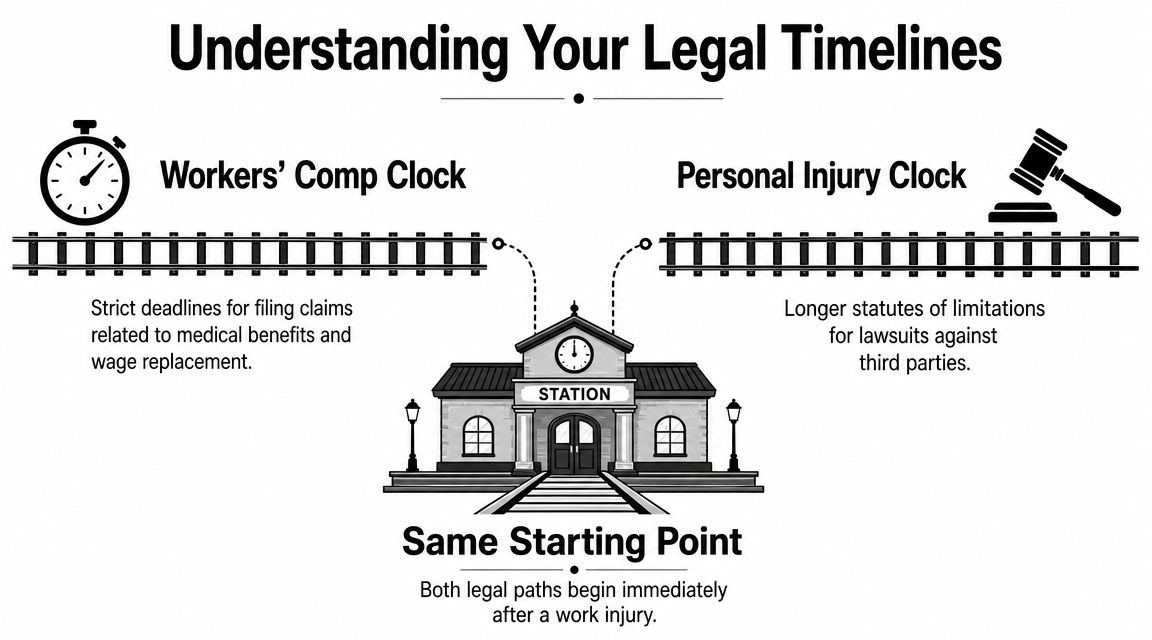
A work injury often sends a case onto two separate train tracks leaving the same station. The injury happens once. The legal consequences split immediately.
One track is the workers' compensation clock. That usually applies to benefits through the employer's insurance system, including medical care and wage-related benefits allowed by law.
The other track is the personal injury clock. That applies only if someone other than the employer may be legally responsible.
Why there are two tracks
Workers' compensation exists because, in many states, it often replaces the right to sue the employer directly. That exclusive remedy structure appears in states discussed in the verified materials, including Georgia and Florida, where injured workers generally pursue workers' comp rather than suing the employer, while separate claims may still exist against third parties such as negligent drivers or manufacturers, as discussed in this workplace injury overview.
That history matters because it explains why people get confused. They assume one injury means one deadline. It usually doesn't.
Practical rule: Workers' comp and a third-party lawsuit are not interchangeable paths. You can preserve one and lose the other.
Workers' comp claims vs third-party lawsuits at a glance
| Aspect | Workers' Compensation Claim | Third-Party Lawsuit |
|---|---|---|
| Who you claim against | Employer's workers' compensation insurer or system | Someone other than the employer who may have caused the injury |
| Why it exists | Provides a no-fault benefits system for job-related injuries | Holds an outside negligent party legally accountable |
| Typical examples | Slip at work, lifting injury, repetitive stress, on-the-job accident | Work vehicle crash caused by another driver, faulty machine, unsafe property owned by another entity |
| Core trade-off | Usually available without proving fault, but more limited in scope | May allow broader damages, but fault must typically be proven |
| Deadline pattern | Notice and claim-filing deadlines can arrive quickly | Civil lawsuit deadlines are often longer |
| Main risk | Late reporting can cut off benefits early | Waiting too long can bar the lawsuit entirely |
What the two-clock problem looks like in real life
The verified materials show how this layered framework works across states. For example, South Carolina requires workers to report an injury within 90 days and file a formal claim within two years, while New York commonly uses 30 days for notice, up to two years for a workers' compensation claim, and three years for a separate third-party personal injury lawsuit, according to the South Carolina injured worker FAQs.
That illustrates the central danger. A person may still think they have time to sue, while their workers' comp rights have already been damaged by late notice.
For Colorado workers, the lesson is straightforward. Don't ask only whether you can sue. Ask which clock is ticking for your specific situation.
Colorado Workers Compensation Deadlines You Cannot Miss
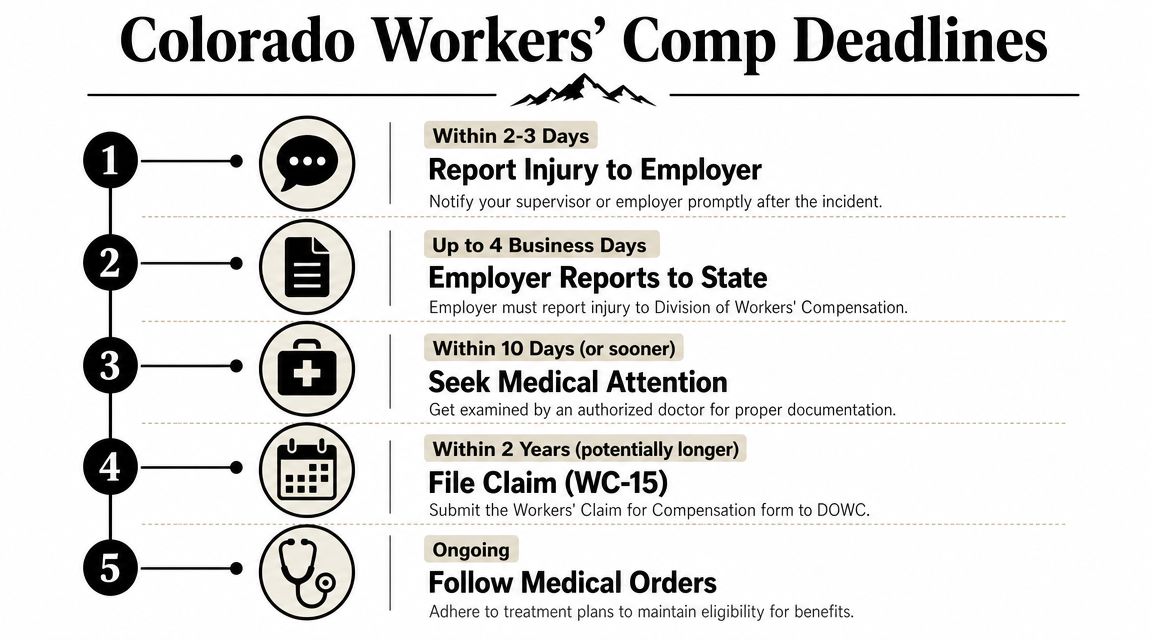
Colorado workers' compensation claims have their own timing rules, and those deadlines matter even if you're also thinking about a separate lawsuit. This is the first clock many injured workers accidentally ignore because they assume they can “deal with the paperwork later.”
That approach often goes badly.
What to do right away
Start with written notice to your employer. Even when the injury seems minor, delay creates problems. Symptoms often worsen, memories fade, and insurers begin arguing that the injury didn't happen the way you say it did.
Your notice should be clear and simple. Include:
- What happened. State the accident or work activity that caused the injury.
- When it happened. Use the date and, if possible, the approximate time.
- Where it happened. Identify the site, vehicle, area, or piece of equipment involved.
- What body parts were hurt. Be specific, even if you're still awaiting a full diagnosis.
If you're trying to understand how Colorado injury deadlines can affect related claims, this overview of the Colorado personal injury statute of limitations is a useful companion resource.
Why delay is so dangerous
In many work-injury systems, the first operational step is identifying the immediate deadline. The verified materials show the pattern clearly. South Carolina requires reporting within 90 days and filing within two years, while New York uses a 30-day notice period and a two-year claim-filing period. Missing the first notice requirement can destroy benefits long before any lawsuit deadline arrives.
That same principle applies in Colorado even though the precise state rules should always be checked against the facts of your case.
The earliest deadline usually matters most, not because it ends the whole case, but because it can shut off the benefits people need first.
What works and what doesn't
What works
- Reporting in writing so there's a record
- Getting prompt medical care that documents the injury
- Keeping copies of every form, email, and work restriction
- Following authorized treatment instructions so the insurer has less room to challenge the claim
What doesn't
- Telling only a coworker
- Waiting to see if it gets better
- Assuming HR “already knows”
- Giving a vague report that leaves out how the injury happened
Workers' comp deadlines aren't technicalities. They're gatekeepers. If you miss them, the argument often stops being about your injury and starts being about whether you waited too long.
Suing a Third Party After a Work Injury in Colorado
Some work injuries involve more than your employer and its insurance carrier. That's when the second clock matters.
A third party is someone other than your employer who may have caused or contributed to the injury. In practice, that can include a driver who hits you while you're working, a contractor from another company on a job site, a property owner who failed to fix a dangerous condition, or a manufacturer whose equipment malfunctioned.
Common third-party examples
A few situations come up often:
- Vehicle collisions during work duties. A delivery driver, home health worker, or traveling employee may have a claim against the at-fault driver.
- Construction site injuries involving multiple companies. One subcontractor's carelessness may injure another company's worker.
- Defective tools or machinery. A product claim may exist if equipment failed because of a design or manufacturing problem.
- Unsafe premises. If you were working on property controlled by someone else, premises liability may become part of the case.
The key distinction is legal responsibility. The same accident can support a workers' comp claim and a separate negligence case, depending on who caused it.
Why this path is different
The verified materials explain the rule well. The lawsuit window is usually longer only for claims against non-employer third parties, because many jurisdictions treat workers' compensation as the exclusive remedy against the employer. That means the same incident can trigger a short administrative deadline for workers' comp and a longer tort deadline for a negligent driver, contractor, or manufacturer, as summarized in this discussion of work injury lawsuit timing.
That longer lawsuit window matters because a third-party claim may seek damages that workers' comp does not fully address.
If you're dealing with both claims at once, it also helps to understand how repayment issues can arise between them. This explanation of a workers' compensation lien on a personal injury settlement addresses one of the most overlooked trade-offs.
The practical trade-off
Workers' comp helps people move quickly into a benefit system. A third-party case can address the broader losses caused by negligence. But the civil claim usually demands more investigation, more evidence, and tighter proof on fault.
That's why waiting can be expensive in a different way here. Even if the filing deadline seems farther away, skid marks disappear, surveillance footage gets erased, vehicles get repaired, and witnesses move on. Legally, you may still have time. Factually, your best evidence may already be gone.
When the Legal Clock Can Be Paused or Extended
Deadlines matter, but they aren't always as simple as circling one date on a calendar and calling it done. Some cases involve injuries that don't fully reveal themselves right away. Others involve minors or a death that changes who brings the claim and when.
That's where people hear phrases like “discovery rule” or “tolling” and feel like the law has become abstract. It hasn't. The easier way to think about it is this: sometimes the clock starts later, and sometimes it pauses, but only under specific rules.

Injuries that aren't obvious on day one
Some workplace harm is immediate. A fall, a crush injury, a collision. Other harm surfaces later.
Occupational exposure cases and certain internal or repetitive-use injuries can develop gradually. In those situations, the legal fight may turn on when the worker knew, or reasonably should have known, that the condition was connected to the job or to another party's conduct.
That issue is rarely self-proving. Medical records, job history, and early reporting all matter. If a worker waits because the symptoms seemed minor, the defense may argue the delay was unreasonable. If the condition wasn't discoverable earlier, the timeline may look different.
A delayed diagnosis doesn't automatically save a late claim, but it can change when the legal analysis begins.
Claims involving minors
When an injured person is a minor, the law may treat time differently. The basic idea is fairness. A child shouldn't lose a legal right before they're old enough to act on it.
That doesn't mean families should wait. Evidence still gets weaker over time, and related claims can involve adults, insurers, employers, or third parties whose own timelines don't pause in the same way. In practice, early action is still the safer move.
Wrongful death changes the timeline and the claimant
A fatal work-related incident creates another layer of timing. The claim may no longer belong to the injured worker alone. Surviving family members or the estate may have rights, and those claims usually operate under their own legal rules.
That's one reason families shouldn't rely on general internet advice after a workplace death. Wrongful death timing, workers' comp death benefits, and any third-party liability analysis have to be evaluated together. A family may be grieving and still be on the clock.
Why exceptions don't remove urgency
Exceptions exist, but they shouldn't be treated like safety nets. They're more like narrow side doors. If the facts fit, they may matter a great deal. If they don't, relying on them can cost the claim.
The safest assumption is still the simplest one. Act as though the earliest plausible deadline controls until a lawyer confirms otherwise.
Steps to Protect Your Right to Compensation
A deadline problem usually starts with something small. A worker doesn't report the injury in writing. A family assumes an insurance adjuster will explain the options fairly. A person signs a form without understanding what claim it affects.
Good cases are often protected by boring habits done early.
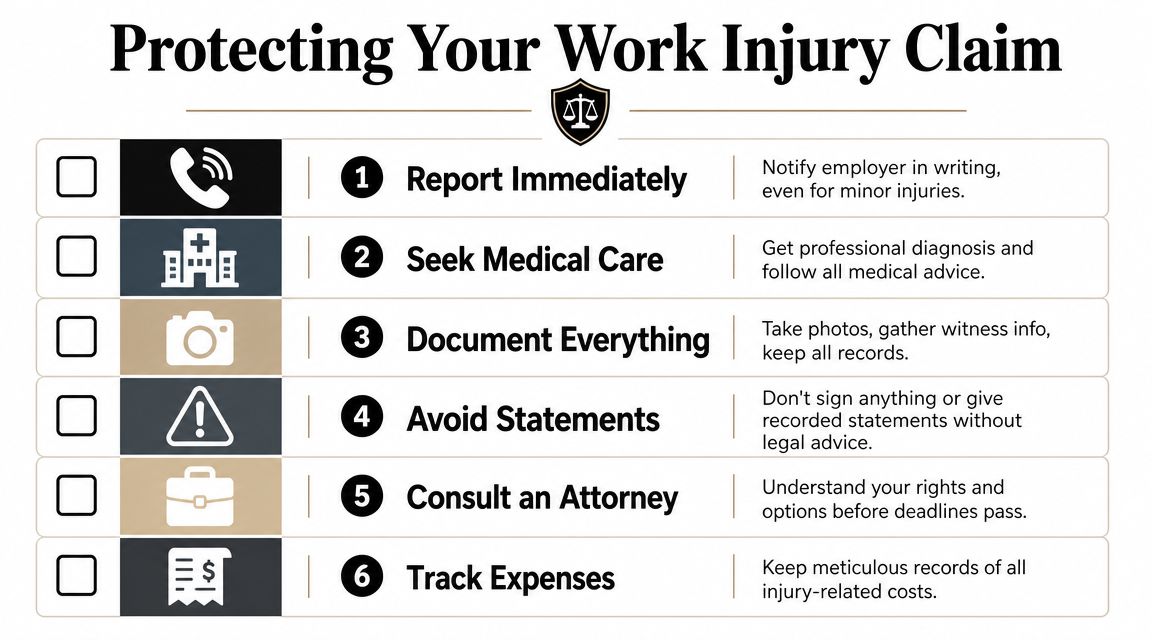
Use this checklist immediately
Get medical care first
Your health comes first, but treatment also creates the first clean record of what hurt, when symptoms started, and what doctors observed.Report the injury in writing
Don't rely on a hallway conversation. Written notice reduces later arguments about whether the employer knew and when they knew it.Document the scene and your symptoms
Take photos. Save texts. Write down witness names. Keep a timeline. Small details that seem forgettable today can become central months later.
A short video can help reinforce the basics after a work injury:
Avoid the common mistakes
The verified materials show why speed matters. Deadlines vary sharply by state. New York generally allows 3 years for a civil lawsuit but requires a workers' comp claim within 2 years, while Florida generally uses a 2-year limit for lawsuits, according to this overview of New York work injury timing rules. The broad lesson is that missing any applicable deadline can permanently block recovery.
Here are the mistakes that create trouble fastest:
- Giving a recorded statement too soon. Early statements are often incomplete because you don't yet know the full scope of your injuries.
- Signing documents without review. Forms can affect medical treatment, work status, or claim positions in ways people don't realize.
- Ignoring language barriers. If a worker's first language isn't English, misunderstandings in handbooks and reporting policies can become case issues. Employers that use accurate employee handbook translation reduce confusion, but workers should still confirm they understand every instruction and deadline.
- Waiting for the insurer to “figure it out”. Insurance companies evaluate claims. They don't manage your rights for you.
When to get legal help
Early legal advice is useful when fault is disputed, multiple companies were involved, a claim has been denied, or the injury may involve both workers' comp and a third-party case. This guide on when to hire a personal injury attorney is a good starting point for thinking through that decision.
The best time to sort out deadlines is before anyone argues you missed one.
Keep receipts, mileage records, prescriptions, work restrictions, and out-of-pocket costs in one place. The goal isn't paperwork for paperwork's sake. The goal is control.
Frequently Asked Questions About Colorado Work Injury Claims
Colorado workers usually have the same set of follow-up questions once they realize a work injury can involve more than one legal path. These are the issues that tend to matter most.
Can I be fired for filing a workers' comp claim
An employer shouldn't treat a lawful claim as a reason for retaliation. But workers often worry less about formal firing than about reduced hours, changed duties, or a colder workplace after reporting an injury.
That's one reason documentation matters. Keep copies of your report, restrictions, schedule changes, and written communications. If the employment relationship changes right after a claim, the timeline of events becomes important.
What if my workers' comp claim is denied
A denial doesn't automatically mean the injury isn't compensable. It may mean the insurer disputes how the injury happened, whether it was work-related, which treatment is necessary, or whether deadlines were met.
The practical response is to act quickly, gather the records, and determine whether the case also involves a third party. A denied workers' comp claim and a valid negligence case can exist side by side.
Can I receive workers' comp and still sue a third party
Often, yes, if the third party is someone other than the employer. That's the core two-clock issue. The workers' comp claim addresses one legal relationship. The third-party case addresses another.
The catch is coordination. Settlement money from the third-party claim may interact with workers' comp benefits or reimbursement rights. Those issues need to be handled carefully rather than at the end as an afterthought.
What if I'm not sure whether I'm an employee or an independent contractor
Classification can affect what benefits and rights may apply. Some workers are told they are contractors when the working relationship is more complicated than that. If you're unclear on the distinction, this plain-English breakdown of employee vs contractor differences is a helpful starting point.
Classification questions often matter most in construction, delivery work, and gig-adjacent job arrangements.
Do I have a case if the injury seemed minor at first
Possibly. Many people try to push through pain because they need the paycheck or assume soreness will fade. Later, they learn the injury was more serious than it looked.
That doesn't eliminate the timing issue. In fact, it makes prompt reporting and medical documentation even more important. If symptoms evolve, the medical chart should show that progression rather than leaving a gap the insurer can attack.
What's the safest next move if I'm unsure which clock applies
Assume both clocks matter until proven otherwise. Report the injury, get treated, preserve evidence, and get advice before the facts become harder to prove.
That approach doesn't overreact. It protects options.
If you were hurt on the job in Colorado and you're trying to figure out which deadline controls your case, Nares Law Group LLC can help you sort through the workers' comp issues, third-party liability questions, and evidence problems that often overlap after a serious injury. Getting clear answers early can make the difference between preserving your rights and learning too late that one of the clocks already ran out.