Your phone keeps buzzing. The other driver's insurance company wants a statement. The repair shop needs an answer. A doctor tells you to follow up, but you're not even sure which symptoms matter yet. Bills start arriving before you've had time to catch your breath.
That's where many people first ask, what does a car accident lawyer do, exactly? Many imagine courtrooms, arguments, and stacks of legal papers. In real life, a car accident lawyer often serves a much more immediate role. They step into a disorganized, stressful situation and start putting it in order.
A good lawyer doesn't just file a claim. They help protect your time, your words, your medical records, and your right to make decisions based on the full picture instead of panic. If you're hurt, overwhelmed, and trying to keep your life from slipping further off track, that kind of help matters.
The Chaos After the Crash
The crash itself may have lasted seconds. The disruption that follows can take over your days.
One client experience looks a lot like another in the first week. Your neck hurts more on day two than it did at the scene. The insurance adjuster sounds friendly, but keeps asking the same questions in slightly different ways. The body shop talks about estimates. Your doctor says to monitor symptoms. Your employer wants to know when you'll be back. You're trying to answer everyone while your body and mind are still catching up.

Some people also find themselves dealing with side issues they never expected. A damaged windshield, for example, can become its own insurance problem. If that's part of what you're facing, this resource on filing for auto glass coverage can help you understand that piece of the puzzle while the larger claim is still unfolding.
Why the first days feel so disorienting
After a wreck, you're often making decisions before you have complete information. That's what makes the process feel so unfair. You may not know yet:
- How serious your injuries are
- Whether fault will be disputed
- Which insurer should pay what
- How long treatment will last
- What deadlines apply to your claim
Colorado accident law adds another layer. Rules about fault, insurance, and deadlines can affect what happens next, which is why many people benefit from a plain-English overview of Colorado car accident laws.
Practical rule: If you feel overwhelmed after a crash, that doesn't mean you're handling it poorly. It means the process is larger than most people expect.
A car accident lawyer enters at this exact point. Not to add more complexity, but to reduce it. Their first job is often simple and powerful. They take the noise coming at you from all directions and turn it into a manageable plan.
Your Lawyer as a Shield and Project Manager
In the days after a crash, your phone may keep buzzing while your body is still catching up to what happened. An adjuster wants a statement. A repair shop needs approval. Medical bills start arriving before you even know how long treatment will last. A car accident lawyer brings order to that confusion and gives you one clear priority: heal while someone else manages the claim.

The shield part of the job
A lawyer stands between you and the pressure that often builds early in a case. Insurance adjusters are trained to gather facts quickly, test for weaknesses, and limit what the company pays. Even a simple answer from you can be misunderstood if you are medicated, exhausted, or still missing pieces of the story.
That is why one of the first practical steps is taking over communication. Your lawyer handles calls, letters, document requests, and settlement discussions so the claim is not shaped by rushed conversations during a stressful week.
If insurer calls have already started, this guide on how to deal with insurance after a car accident can help you understand what to expect.
Protection also includes knowing when a case may involve formal questioning later. If you have never heard terms like "deposition transcript" before, this guide on deposition transcripts for journalists gives helpful background on how sworn testimony is recorded and used.
The project manager part of the job
Protection is only half the role. A lawyer also keeps the case organized, on schedule, and moving in the right order. That matters because a car accident claim is really a series of connected jobs. If one piece is missing, the whole file becomes harder to prove.
A good lawyer tracks the details the way a careful project manager would track a complicated rebuild after a house fire. Who still owes records? Which bill belongs to which provider? Has key evidence been requested before it disappears? Has anyone answered the insurer in writing? Are there deadlines coming up?
That often includes:
- Evidence collection: crash reports, photos, video, witness information, repair records
- Medical documentation: records, bills, provider notes, treatment timelines
- Liability analysis: identifying how the collision happened and what proof supports fault
- Insurance coordination: sorting through claims with the at-fault driver's insurer and sometimes your own
- Deadline control: making sure required filings and responses happen on time
Here's a short explainer that shows that role in action:
What this looks like in real life
Say you are trying to recover from a back injury. While you are going to appointments and figuring out what daily life looks like now, someone still has to gather records, confirm insurance coverage, organize bills, preserve evidence, and keep the other side from steering the claim off course. Your lawyer handles that work so your case does not become another burden on top of the injury itself.
That is why strong legal help often feels quiet rather than dramatic. The benefit usually shows up as fewer surprise calls, cleaner paperwork, better timing, and a file that makes sense when it is time to negotiate or, if necessary, go to court.
Firms such as Nares Law Group LLC handle investigation, treatment coordination, insurance negotiation, and trial preparation for motor vehicle injury cases. For many injured people, that steady case management is what restores a sense of control.
The Anatomy of a Car Accident Case Step by Step
Most claims follow a sequence. The details vary, but the structure is usually more predictable than people think. Once you can see the roadmap, the process feels less mysterious.
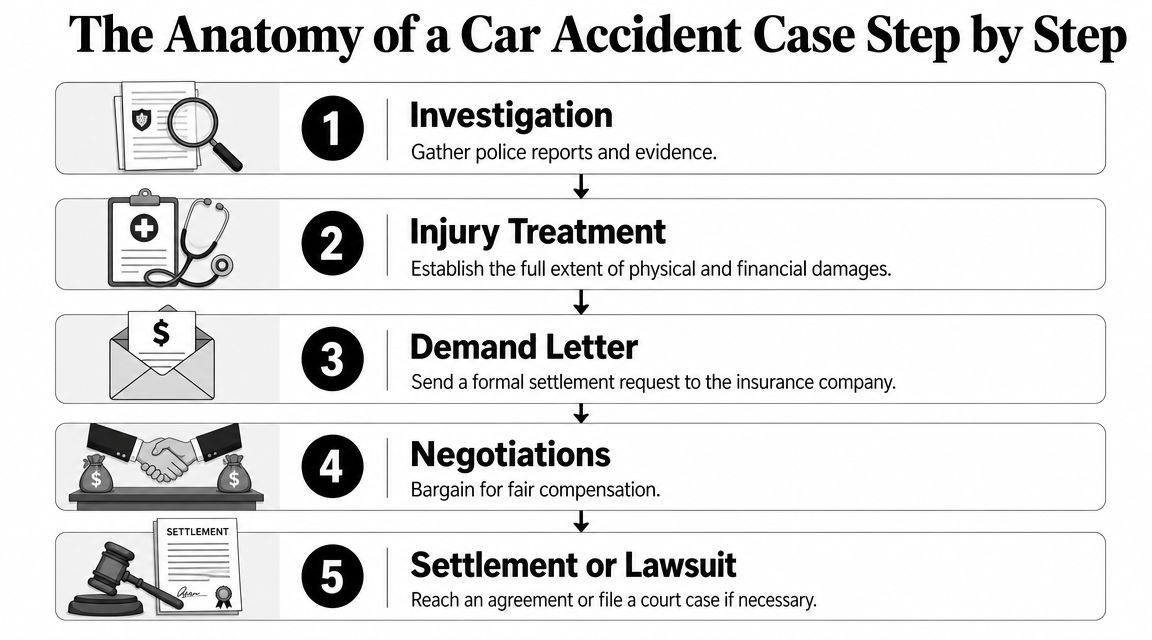
Step one is investigation
The lawyer starts by building the factual foundation of the case. That means gathering the documents and materials that show what happened.
This often includes the police report, scene photographs, vehicle damage photos, witness names, insurance information, and any available video. In some cases, your lawyer may also request records from businesses or agencies that might have relevant footage before it disappears.
The purpose here is simple. Memories fade. Evidence doesn't help unless someone preserves it.
Step two is documenting the injury story
Your claim isn't just about the crash. It's about what the crash did to your body, your daily routine, and your finances. That's why lawyers pay close attention to medical records and treatment history.
They want the file to answer basic but critical questions. What injuries were diagnosed? What treatment was recommended? Are you improving, plateauing, or still being evaluated? How has the injury changed your ability to work, sleep, drive, lift, or care for your family?
What your lawyer needs from records: a clean timeline, consistent treatment history, and clear links between the crash and your symptoms.
This is also where people get confused. Many think they should settle once the car is repaired or the first bills arrive. In reality, the injury portion of the case often needs more time because a fair evaluation depends on understanding the full course of treatment.
Step three is proving fault and answering defenses
Colorado follows an at-fault system, so your lawyer has to show why the other party is legally responsible. Sometimes that's straightforward. A rear-end crash at a stoplight may not leave much room for debate. Other times, both drivers tell different stories.
A lawyer studies the available proof and looks for weak spots in the defense. If the insurer argues you changed lanes suddenly, failed to brake, or were partly responsible, your lawyer works to test that claim against the physical evidence and witness accounts.
This part matters because fault arguments can reduce or defeat recovery if they aren't answered carefully.
Step four is preparing the demand package
When the lawyer has enough information about liability and damages, they usually prepare a demand package for the insurance company. Think of this as the case presented in organized form.
A demand package commonly includes:
- A liability summary: why the insured driver was at fault
- Medical records and bills: showing the nature of the injuries and treatment
- Proof of losses: wage information, out-of-pocket expenses, and related documentation
- A narrative of harm: how the injury affected your routine, pain level, and function
The insurer reviews that material and responds. Sometimes it requests more documents. Sometimes it disputes parts of the claim. Often it makes an offer that starts the negotiation process.
If you've ever wondered how lawyers deal with sworn testimony later in a case, this guide on deposition transcripts for journalists gives a useful plain-language look at how deposition records are created and used.
Step five is negotiation
Negotiation is not just haggling over a number. It's the process of using evidence to push back when the insurer minimizes injury, disputes treatment, or undervalues the impact on your life.
A strong negotiator doesn't rely on outrage. They rely on preparation. They know which records support the claim, which arguments are weak, and when the insurer is testing whether you understand the value of your case.
Here's a simple comparison:
| Stage | What the insurer may do | What the lawyer does |
|---|---|---|
| Early review | Ask for statements and records quickly | Controls communication and organizes the response |
| Demand review | Downplay injury or treatment | Ties records and facts into a coherent claim |
| Offer stage | Start low or stay vague | Counters with reasons, not guesses |
Step six, if needed, is filing a lawsuit
Not every case settles through informal negotiation. If the insurer won't make a reasonable offer, a lawyer may recommend filing suit.
That starts a more formal phase involving pleadings, written discovery, depositions, motion practice, and trial preparation. Filing suit doesn't always mean a trial will happen. It does mean the case moves into a system with stricter procedures and court oversight.
Some clients worry that a lawsuit means their life will become consumed by litigation. Usually, your lawyer is still the person carrying the procedural weight. You'll be involved, but you won't be expected to master civil procedure while recovering from an injury.
How Do Car Accident Lawyers Get Paid
For many injured people, this is the first practical question. They assume hiring a lawyer means large hourly bills arriving while they're already struggling with medical expenses and missed work. That's usually not how car accident representation works.
Most work on a contingency fee
A contingency fee means the lawyer's fee comes from the recovery in the case, not from hourly invoices sent to you as the case moves forward. If there's no recovery, there is typically no attorney fee.
That model matters because it makes legal help more accessible to people who couldn't afford to fund a case out of pocket. It also means the lawyer has a direct stake in the outcome.
If you want a fuller explanation of percentages and fee structures, this page on what percentage personal injury lawyers take breaks that down in more detail.
Fees and costs are not the same thing
People often use these words as if they mean the same thing. They don't.
- Attorney fee: the lawyer's payment for legal work
- Case costs: expenses tied to building and pursuing the case, such as records, filing fees, or expert-related costs when needed
The important question to ask at a consultation is not just, “What is your fee?” Ask, “How are case costs handled, and when are they paid?” A clear answer helps you understand the financial arrangement before anything begins.
Ask for the fee agreement in writing and read it slowly. A good lawyer expects that and should welcome your questions.
Why people still hire lawyers even when fees apply
Some people hesitate because they think handling the claim alone will let them keep more of the money. That sounds logical on the surface, but it leaves out how difficult valuation and negotiation can be. A 2021 Insurance Research Council study found that, on average, personal injury claimants who hired a lawyer received settlements 3.5 times larger than those who handled their own claims (Insurance Research Council).
That doesn't mean every case follows the same path. It does show why many injured people decide that experienced representation can materially change the outcome.
When You Should Hire a Car Accident Lawyer
Not every crash requires a lawyer. A minor property-damage-only collision may not justify full legal representation. But some situations should prompt you to speak with counsel quickly, because the risk of mishandling the claim is much higher.

Strong signs you shouldn't handle it alone
If any of the following are true, it's smart to at least get a legal opinion:
- You have more than minor injuries: broken bones, head trauma, serious back pain, surgery, or ongoing treatment all raise the stakes.
- Fault is disputed: if the other driver blames you, the case can turn on details you may not know how to preserve or present.
- An insurer denied the claim: once the company takes that position, casual back-and-forth usually won't fix it.
- A commercial vehicle was involved: truck and business-use cases often involve additional records, policies, and parties.
- You're being pressured for a recorded statement: quick statements can lock you into facts before you know the full medical picture.
- A fast settlement offer arrives: early money can be tempting, especially when bills are stacking up, but it may come before the full scope of injury is known.
The subtle situations people underestimate
Some cases don't look complicated at first. Then the symptoms linger. The diagnosis changes. Time off work expands. The insurer starts asking why you waited to get imaging or why one provider wrote something differently than another.
That's when people realize the claim wasn't simple. It was only early.
If your injuries are still developing, your case is still developing too.
Waiting can create its own problem
Even strong claims can weaken when people wait too long to get legal advice. Evidence becomes harder to find. Witnesses become harder to reach. Records may still exist, but the story connecting them becomes less clear.
Colorado also has filing deadlines for auto accident cases, and missing a legal deadline can destroy a valid claim entirely. If there's any real injury, disputed fault, or insurer resistance, the safer move is to talk with a lawyer early enough to preserve your options.
Hiring a lawyer doesn't force you into a lawsuit. It gives you information before the clock and the insurance process start making decisions for you.
Your Role as the Client in the Partnership
Once you hire a lawyer, you're not expected to become your own case manager. But you do play an important role. The strongest claims usually come from strong partnerships between client and counsel.
What your lawyer needs from you
The first requirement is honesty. Tell your lawyer the good facts, the bad facts, and the awkward facts. If you had a prior injury, say so. If you posted something online you're worried about, bring it up. Surprises are much harder to fix when they show up late.
Your lawyer also needs you to stay engaged with medical care. Missing appointments, stopping treatment without explanation, or ignoring provider advice can create gaps that the insurer may try to use against you.
A good client usually does these things well:
- Share complete information: accident details, prior injuries, insurance information, and all treating providers
- Keep appointments: follow through with recommended care unless a doctor changes course
- Give updates: tell your lawyer about new symptoms, new providers, missed work, or changes in diagnosis
- Stay quiet outside the legal team: don't discuss the case casually with adjusters, coworkers, or online audiences
Why this partnership matters
A lawyer can organize records, negotiate with insurers, and prepare a lawsuit. They can't feel your pain for you or guess what changed in your daily life if you never tell them.
That's why the best attorney-client relationships are built on prompt communication and candor. Your lawyer provides structure and protection. You provide the lived facts that make the file accurate and persuasive.
The legal claim is built from documents, but the human story still matters. Your lawyer needs both.
Three Common Mistakes That Can Weaken Your Claim
Generally, people do not damage their case on purpose. They do it while trying to be cooperative, quick, or optimistic. Those instincts are understandable. They can also be costly.
Giving the other insurer a recorded statement
You may think, “I'm just telling the truth.” The problem is timing. Right after a crash, you often don't know the full extent of your injuries, and the adjuster controls the questions.
If your answers are incomplete, inconsistent, or casually phrased, the insurer may later use them to challenge your claim. You're rarely helping yourself by giving the other side recorded material before getting advice.
Posting about the accident or recovery on social media
A photo, caption, or comment can be misunderstood quickly. Even a harmless post can be framed as proof that you weren't hurt, weren't limited, or weren't taking recovery seriously.
Set your accounts to private if you wish, but don't assume privacy settings solve the problem. The safer move is simple. Don't post about the crash, your injuries, your activities, or your claim.
Taking the first settlement offer
Early offers often arrive before your medical picture is complete. That's the trap. The amount may feel like relief, but once you accept and sign a release, you usually don't get to come back later and ask for more because treatment lasted longer than expected.
Before accepting any offer, make sure someone has evaluated the claim with the full timeline in mind, not just the immediate pressure you're under today.
If you're injured and trying to understand your next step, Nares Law Group LLC offers guidance for Colorado crash victims dealing with insurance pressure, medical treatment, and uncertainty about their rights. Sometimes the most important first step is talking to someone who can bring order to the process so you can focus on healing.