A crash can turn an ordinary Colorado day into a blur of sirens, phone calls, and hard questions. One minute you’re driving to work, heading home, or taking your child to school. The next, your neck is stiff, your hands are shaking, and an insurance adjuster is already asking for a statement.
That confusion is normal. So is the fear that you’ll say the wrong thing, miss something important, or end up paying for someone else’s mistake.
People usually start looking for auto accident lawyers colorado when life feels unstable in very practical ways. The car may be in the shop. Work may not wait. Medical symptoms may get worse after the adrenaline wears off. You may also be wondering whether you even “have a case,” especially if the other driver is denying fault or your injuries seem hard to explain.
This guide is for that moment. It walks through what to do, how Colorado law works, what a lawyer does behind the scenes, and why early expert involvement can matter so much in serious injury cases, especially when a traumatic brain injury changes daily life in ways that aren’t obvious on day one.
The Moments After a Crash Your First Steps
You’re standing on the shoulder after a collision on a busy Denver street. One car door won’t open right. Traffic keeps moving. The other driver says they’re “fine,” but your head hurts and your thoughts feel slow. Your phone is full of missed calls. You’re trying to answer basic questions while your body is still catching up to what happened.
That’s often how this starts. Not with legal strategy, but with overload.

Colorado roads see a high volume of crashes. A Colorado crash statistics report notes that the state saw over 115,000 crashes in 2025, and Denver reported 22,000 crashes. For injured people, that means one thing: you are not overreacting by taking a crash seriously.
What to do before you worry about the legal claim
Start with health and safety.
- Get medical help first. Some injuries, including concussions, whiplash, and internal injuries, can hide behind adrenaline.
- Call law enforcement if you can. A report helps create a neutral record of what happened.
- Take photos if it’s safe. Vehicle positions, damage, debris, road conditions, and visible injuries all matter.
- Avoid debating fault at the scene. Stress makes people say things they don’t mean, and insurers may later use those comments against them.
If your neck pain starts later, that doesn’t mean it isn’t real. This practical guide for whiplash recovery can help you understand why symptoms often show up after the crash, not just at the scene.
First priority: get evaluated, even if you hope it’s “just soreness.”
The first insurance call is not a small thing
Many people think the first call with insurance is routine. It isn’t. It can shape how the claim develops from the start.
If you’re already getting calls and don’t know what to say, this guide on dealing with insurance after a car accident helps explain the common pressure points. The goal isn’t to be difficult. It’s to avoid guessing about injuries, timelines, or fault before the facts are clear.
A good next step is simple: write down what you remember while it’s fresh, keep every medical record and receipt, and don’t assume the situation will sort itself out. Early decisions often affect both your recovery and your finances.
Understanding Colorado's Unique Accident Laws
Colorado law matters because it decides whether you can recover money, how fault gets assigned, and how long you have to act. Most injured people don’t need a law lecture. They need the rules translated into plain English.
Colorado is not a no fault state
Colorado follows a fault-based system for car accidents. That means the person who caused the crash, and usually that person’s insurer, is the starting point for a claim. If you want a simple overview, Colorado’s fault system explained is a useful place to start.
The practical takeaway is this: proving fault matters. A lot.
Think of fault like a blame pie
Colorado uses modified comparative negligence. The easiest way to understand it is to picture a pie divided into slices of blame.
If another driver gets most of the pie, your claim may still succeed even if you made a mistake too. But if your slice gets too large, you may lose the right to recover.
Here’s the basic rule from the verified data: plaintiffs recover if less than 51% at fault.
That rule changes how insurance companies handle claims. They often don’t need to prove you caused everything. They only need to push enough blame onto you to reduce what they pay, or try to block recovery altogether if they can.
Why this rule creates anxiety after a crash
People often call a lawyer because they’re worried about details that seem small:
- “I might have been going a little fast.”
- “I didn’t see the other car until late.”
- “I changed lanes before impact.”
- “There were no witnesses.”
Those details matter because insurers use them to argue percentages of fault. That’s where evidence becomes more important than memory alone.
When fault is shared, the case often turns on who can explain the crash most clearly, not who speaks first.
Evidence is how lawyers answer blame shifting
In disputed cases, lawyers often build the case from physical proof rather than opinion. That can include photographs, vehicle damage, roadway marks, electronic data, and medical records.
The verified data allows one especially important point here. In Colorado, lawyers use accident reconstruction experts under Colorado Rule of Evidence 702 and the People v. Shreck framework when liability is disputed. These experts analyze things like skid marks, crush patterns, and event data recorder information. The same verified data notes that EDRs can capture pre-crash speed, braking, and stability control activation up to 5 seconds before impact.
That matters because comparative negligence is really a story about mechanics. Who was where. How fast. What happened first. Whether someone braked. Whether a distraction changed the outcome.
One example from the verified data makes this concrete: a 1.5-second distraction at 60 mph results in 132 feet of travel. That’s the kind of detail that can turn a vague argument into a persuasive explanation of negligence.
Timing matters, even before a lawsuit starts
Colorado motor vehicle cases also come with deadlines. The verified data states a 3-year statute of limitations for these claims, and it also notes a 2-year wrongful death deadline. You should never treat those dates as something to think about later.
Deadlines matter for another reason too. Evidence fades long before the filing deadline arrives. Tire marks disappear. Vehicles get repaired or totaled. Digital data can be lost. Witness memories soften.
That’s why people often benefit from speaking with counsel early, even if they’re unsure whether they want to file a claim. The early phase isn’t just about suing. It’s about preserving the pieces you may need if fault becomes a fight.
A simple way to think about Colorado law
If you’re overwhelmed, reduce it to two questions:
| Legal issue | What it means for you |
|---|---|
| Who gets the blame pie | Your compensation can depend on how fault is divided |
| How long do you have | Waiting can damage the case before the legal deadline even arrives |
Colorado law isn’t designed to comfort injured people. It’s designed to sort out responsibility. A lawyer’s job is to make sure your side of the story is supported by facts strong enough to survive that process.
The Legal Journey After a Colorado Car Accident
Many individuals hear “legal claim” and picture one dramatic courtroom moment. Real cases rarely work that way. They move through stages, and each stage has a purpose.
Near the start of the process, it helps to see the roadmap.
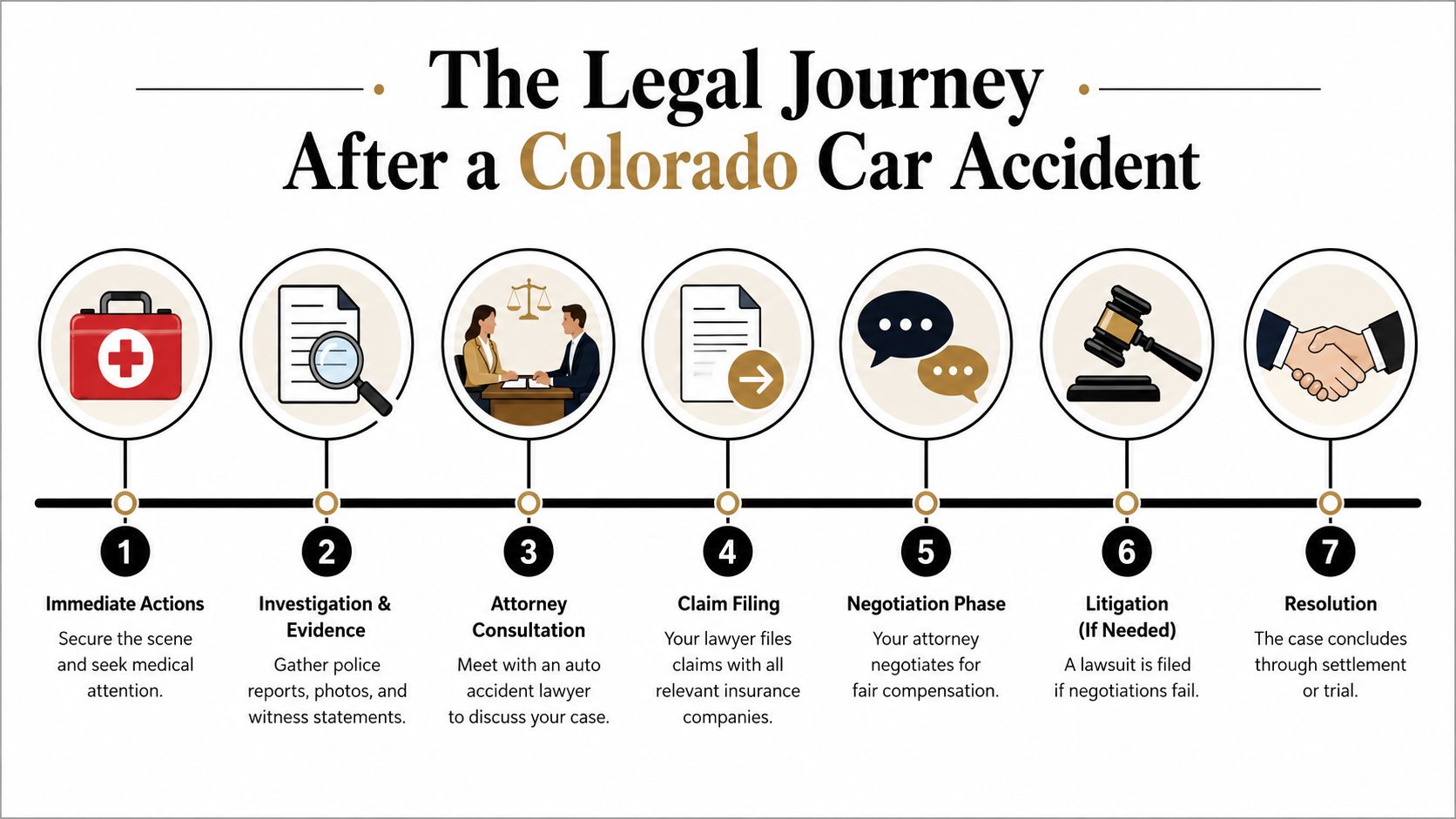
Stage one starts before the paperwork
The first stage is often about stabilizing your situation, not arguing with the insurer. That means medical evaluation, symptom tracking, getting the report, protecting the damaged vehicle if possible, and identifying available evidence.
This is also where many mistakes happen. People downplay symptoms. They skip follow-up care because life is busy. They assume the police report tells the whole story. Or they give a recorded statement before they know what their injuries really are.
Investigation is where strong cases are built
In the investigation phase, Colorado auto accident lawyers often use accident reconstruction experts and event data recorder evidence. A Colorado accident reconstruction overview explains that EDRs can capture pre-crash speed and braking up to 5 seconds before impact, which can provide objective fault evidence under Colorado’s comparative negligence rule.
That’s especially important in crashes with few witnesses, conflicting accounts, intersection impacts, or severe injuries. Lawyers may also gather:
- Police materials such as the crash report and officer observations
- Vehicle evidence including crush patterns and black box data
- Scene evidence like debris fields, gouge marks, and roadway layout
- Medical records that connect the crash forces to the injuries reported
- Third-party footage from businesses, traffic cameras, or private systems if available
One reason early action matters is that some evidence is temporary. A vehicle may be repaired. A business may overwrite footage. Tire marks may fade quickly.
Practical rule: the sooner the evidence is gathered, the less room the defense has to rewrite what happened.
The consultation phase is more strategic than people expect
A first meeting with a lawyer isn’t just about “Do I have a case?” It’s often about triage.
The lawyer is usually asking questions like these:
- What injuries are already documented?
- Is fault clear, or likely to be disputed?
- Are there signs of a brain injury, spinal injury, or another condition that needs early expert review?
- Which insurance policies may apply?
- What evidence is in danger of disappearing?
For people managing pain, therapy, and missed work, this phase can also provide structure. If you’re trying to understand the physical recovery side, this resource on recovering from auto accident injuries can help explain why healing often takes longer than expected, especially when soft tissue injuries and concussion symptoms overlap.
Negotiation is not just exchanging numbers
Once enough evidence is gathered, the claim usually moves into negotiation. That doesn’t mean the insurer suddenly becomes neutral. It means both sides are using documents, opinions, and timelines to argue value and fault.
A lawyer may present:
- a clear liability theory
- organized medical records
- opinions from treating providers
- future care projections in more serious cases
- proof of lost income and daily life disruption
The insurer may respond by questioning causation, claiming treatment was excessive, or arguing that some symptoms were pre-existing. In these situations, complex injuries can become especially vulnerable.
A traumatic brain injury is a good example. Some people look “fine” to others while struggling with headaches, memory problems, sensory overload, fatigue, or personality changes. Without prompt medical and legal attention, these injuries can be misunderstood.
Later in the process, a video explanation can help make the road ahead feel more concrete.
Litigation is the pressure point, not the failure point
If negotiations stall, the next step may be filing a lawsuit. Many clients worry this means everything has gone wrong. Often, it means the case needs formal tools.
Litigation can allow a lawyer to:
- require sworn testimony
- demand documents through discovery
- question defense experts
- preserve witness testimony
- present the dispute to a jury if needed
That doesn’t mean every filed case goes to trial. But the ability to litigate changes the bargaining power of the claim. Some insurers evaluate cases differently when they know the lawyer is prepared to prove the case in court.
Resolution should match the real impact of the crash
Cases usually end in settlement or trial. Either way, the goal is not just “some compensation.” It’s a result grounded in the actual harm done.
For a minor collision, that may be relatively straightforward. For a serious injury, the claim may need to account for long-term treatment, future limitations, work disruption, and the human cost of living differently after the crash.
That’s why the legal journey can feel slow from the outside. Much of the work happens in records requests, expert review, witness development, and negotiation strategy. A good lawyer isn’t adding drama. They’re building proof so you don’t have to carry the argument alone.
How Lawyers Calculate and Fight for Your Compensation
Many people make the same first assumption. They think a claim is just a stack of medical bills plus car repairs. That’s only part of the picture.
A serious accident affects finances in layers. Some losses are easy to count because they show up on invoices, pay records, or receipts. Others are harder because they measure what the injury changed in your body, your routine, and your future.
Economic damages are the visible losses
These are the losses with paper trails. They usually include medical expenses, lost wages, and other direct financial costs tied to the crash.
A lawyer may gather and organize:
- Treatment bills from emergency care, imaging, specialists, therapy, medication, and follow-up visits
- Income records showing missed work, reduced hours, or interrupted self-employment
- Out-of-pocket costs such as transportation to appointments or help needed at home
- Future care projections when the injury won’t resolve quickly
For a person with a concussion, for example, the bill from the first urgent care visit may be the smallest part of the loss. The larger issue may be months of follow-up treatment, reduced concentration at work, or the need for cognitive rehabilitation.
Non economic damages describe the human loss
This category is harder to explain, which is one reason insurers often try to minimize it. Non-economic damages usually address pain, suffering, inconvenience, emotional distress, and changes in quality of life.
That can mean very different things for different people:
| Type of harm | Real-life example |
|---|---|
| Pain | Ongoing headaches, neck pain, back pain, or sleep disruption |
| Loss of normal life | You can’t pick up your child, exercise, drive comfortably, or enjoy hobbies the same way |
| Emotional impact | Anxiety in traffic, irritability, fear, concentration problems, or mood changes |
| Relationship strain | The injury changes family roles, intimacy, or household responsibilities |
The law uses formal categories, but the lived experience is simpler. If the crash changed how you function, that change has value.
Experts often decide whether future losses are taken seriously
In serious injury cases, especially brain injuries, the fight is often about the future. Will symptoms resolve? Will treatment continue? Will work capacity change? Will the person need rehabilitation, support, or accommodations later?
A Colorado auto accident damages overview notes that attorneys use medical expert testimony to project lifetime costs, including over $500,000 for TBI rehabilitation. The same verified data states that expert involvement can increase verdict values by 2 to 3 times because it helps prove causation and future need.
That matters because insurers often attack serious claims at the causation level. They may argue that symptoms came from stress, age, prior injuries, or unrelated conditions. A well-supported expert opinion can answer that.
The verified data also allows another important point: Colorado’s 2025 non-economic damages cap in severe injury cases is $1,500,000. That doesn’t mean every case reaches that level. It means the law recognizes that severe injuries can have enormous non-financial consequences.
The larger the future impact, the more dangerous it is to value the claim too early.
Why traumatic brain injury cases need special care
TBI cases are often misunderstood because the injury may not be obvious to other people. The person may walk, speak, and look normal while struggling in ways that affect every part of life.
Medical experts can help connect crash mechanics and symptoms. The verified data notes that lawyers may use biomechanical analysis and standards such as the Abbreviated Injury Scale. It also gives an example that a 25 mph rear-end collision can generate 15 to 20g forces, enough for serious soft tissue injury or concussion-related harm in the right circumstances.
That kind of analysis helps answer a common defense argument: “The crash wasn’t bad enough to cause this.”
Lawyers don’t just total losses. They build a proof model
When people search for auto accident lawyers colorado, they’re often trying to find out what a lawyer does to increase case value. The answer is not magic language. It’s disciplined documentation.
That usually includes matching every claimed loss to supporting evidence, then organizing the claim in a way an insurer, judge, or jury can follow. If you want a deeper look at one part of that process, this resource on how pain and suffering damages are calculated explains why non-economic harm needs concrete support too.
Strong compensation claims are built, not guessed. The more the injury affects the future, the more important that becomes.
Choosing the Right Legal Team for Your Case
Choosing a lawyer after a crash can feel like making a financial decision while your life is still shaking. You may be in pain, missing work, fielding calls from insurance, and trying to guess which choice protects your recovery instead of creating another problem.
Start with the question nearly every injured person asks first. How do I afford legal help?
Contingency fees reduce upfront pressure
Most car accident lawyers use a contingency fee. That usually means the lawyer is paid from a settlement or verdict, not through hourly bills while your case is still active.
For many families, that fee structure works like hiring help on the same timeline as the injury itself. You get legal support now, while the financial pressure is highest, and the fee is tied to the outcome later. You should still ask direct questions about the percentage, case costs, and what happens if there is no recovery. Clear answers early can prevent stress later.
The right legal team depends on the kind of case you actually have
A simple rear-end claim with short-term injuries calls for one level of attention. A case involving a truck, disputed fault, or symptoms that may point to a brain injury calls for another.
The difference is not just experience in a general sense. It is whether the firm knows how to spot trouble early, before the insurance company turns uncertainty into a discount. From the client’s perspective, that can affect medical access, income stability, and the amount of pressure your household carries in the months ahead.
Some useful signs include:
- Case focus. Does the attorney regularly handle injury cases, or is personal injury only one small part of the practice?
- Trial readiness. Can the firm file suit and present the case in court if negotiations stall?
- Expert coordination. Do they know when to bring in accident reconstruction, medical specialists, or financial experts?
- Communication habits. Will they explain what is happening in plain language and tell you who is handling your file?
- Experience with evolving injuries. Have they handled claims where symptoms worsened over time or were not obvious right away?
One factual example that may matter here: Nares Law Group LLC handles investigation, medical treatment coordination, negotiation, trial, and settlement for people harmed in motor vehicle crashes, truck wrecks, traumatic brain injuries, and wrongful death cases in Colorado.
A consultation is a two-way evaluation
You are not showing up to prove you deserve representation. You are deciding whether this team can protect both the legal side of the case and the personal side of it, your treatment, your income, your deadlines, and your peace of mind.
Bring your paperwork, but bring questions too.
| Question Category | Specific Question to Ask |
|---|---|
| Fees | How does your contingency fee work, and what case expenses might be separate? |
| Communication | Who will update me on my case, and how often should I expect to hear from your office? |
| Case strategy | What do you see as the strongest and weakest parts of my claim right now? |
| Injuries | If my symptoms get worse later, how would that change the way you handle the case? |
| Experts | Do you bring in accident reconstruction or medical experts when fault or injury is disputed? |
| Litigation | If the insurer won’t make a fair offer, are you prepared to file suit and try the case? |
| Medical proof | How do you document injuries that are hard to see, like concussions or chronic pain? |
| Timing | What should I do in the next few weeks to help, rather than hurt, my claim? |
| Insurance issues | Will you handle the adjusters directly, or should I still expect contact from them? |
| Client fit | Have you handled cases like mine involving similar injuries or disputed facts? |
Red flags are usually ordinary
A poor fit does not always announce itself with a dramatic mistake. Sometimes it shows up as a vague answer, a rushed call, or pressure to settle before your doctors understand where your recovery is headed.
Pay attention if you notice:
- Rushed answers that gloss over your medical condition
- Pressure to settle early before treatment and prognosis are clear
- No discussion of experts in a case with complicated fault or injury issues
- Confusing explanations about fees or who is responsible for the file
- A focus on vehicle damage first when your health and future limitations are the larger problem
A strong consultation should leave you with more clarity, more calm, and a better sense of what happens next.
Choose carefully, and choose in time
You do not have to hire the first lawyer you speak with. You do need to make the decision before records go missing, witnesses get harder to reach, or the insurer gets too much room to define the story.
A good legal team should make the process easier to understand. They should also recognize the moment a case stops being routine. This distinction is most critical in claims involving concussion symptoms, delayed neurological complaints, truck wrecks, and disputed fault. In those cases, early decisions often shape the medical proof, the bargaining position, and the financial stability of the person trying to heal.
When to Call Nares Law Group
Some crashes are straightforward. Others only look straightforward for the first few days.
If your injuries are serious, the other driver is denying fault, or the insurance company is already minimizing what happened, that’s usually the point where legal help stops being optional and starts being protective. The same is true when symptoms suggest a traumatic brain injury. Confusion, headaches, fatigue, memory trouble, dizziness, and personality changes can reshape daily life long before outsiders understand the severity.
Situations where a call makes sense
You should strongly consider reaching out when the case involves:
- A possible TBI or other injury with long-term effects that aren’t easy to “see”
- A truck or commercial vehicle, where the evidence may include company records and multiple insurance layers
- Disputed fault, especially in a comparative negligence state like Colorado
- An insurer pushing a fast statement or fast settlement
- Medical bills and missed income that are already affecting stability at home
For families, one of the hardest parts of a serious crash is not knowing whether things will return to normal. A lawyer can’t remove the injury, but the right team can help create order. That includes preserving evidence, coordinating with medical proof, handling insurer communication, and building a claim around the full future impact rather than the easiest short-term number.
Why this matters in complex injury cases
Brain injury and truck crash cases often require earlier, deeper work than people expect. The legal value of the case may depend on whether someone recognized the complexity soon enough to gather the right proof.
Nares Law Group’s published background states that the firm focuses on motor vehicle crashes, truck wrecks, traumatic brain injuries, and wrongful death, while handling investigation, medical treatment coordination, negotiation, trial, and settlement. For injured people who need both clarity and structure, that kind of full-case approach can be especially important when recovery is uncertain.
If you’re at the stage where you’re trying to decide whether your situation is “serious enough” to call, that hesitation is common. A consultation is often less about committing to a lawsuit and more about finding out what needs protection right now.
Frequently Asked Questions About Colorado Auto Accidents
What if there were no witnesses to the crash
A lack of witnesses does not mean your claim fails. It means the case may rely more heavily on physical and digital evidence.
Lawyers can look at vehicle damage, road markings, photos, police observations, and event data recorder information. The verified data also notes that modern vehicles often contain black box data, and it discusses other sources such as dashcam footage from nearby businesses or telematics in some situations. In no-witness cases, the goal is to replace missing human observation with objective reconstruction.
What if the other driver is uninsured or doesn’t have enough insurance
That’s where uninsured or underinsured motorist coverage may become important. The verified data describes a growing focus on UM and UIM claims in Colorado and notes that many drivers misunderstand how this coverage works.
In practical terms, your own policy may become a key source of recovery if the at-fault driver can’t fully cover the harm. These claims still require proof. Your insurer may not automatically agree with your valuation just because it’s your own policy.
Should I talk to the insurance adjuster if I’m still being treated
Be careful. If treatment is ongoing, you may not yet know the full extent of your injuries. That is especially true with concussions, soft tissue injuries, and cases where symptoms evolve over time.
A premature statement can lock you into descriptions that don’t match what doctors later find. Many people benefit from speaking with counsel before giving detailed recorded statements in a serious injury case.
How soon should a lawyer get involved if the crash caused a brain injury
Early. The verified data specifically emphasizes the importance of early expert involvement in serious injury cases. Delays can create “gap” arguments, where insurers claim symptoms came from something other than the crash or argue that the condition wasn’t serious at the start.
That’s one reason TBI cases often need more careful handling than they appear to at first glance. The injury may be complex long before it is fully documented.
If you were injured in a Colorado crash and need clear guidance on what to do next, Nares Law Group LLC offers free consultations for people dealing with car accidents, truck wrecks, brain injuries, and wrongful death claims. A conversation can help you understand what evidence should be protected, how Colorado law applies to your case, and what steps may support both your recovery and your financial stability.