A crash in Arlington rarely feels orderly. One second you're driving through a normal day, thinking about work, school pickup, or the next exit. The next, you're gripping the steering wheel, hearing the after-noise of impact, and trying to figure out whether you're hurt, whether your car can move, and what you're supposed to do now.
That confusion is normal. So is the temptation to minimize what happened. Many people tell themselves they'll deal with it later, especially if they can still stand, talk, and exchange insurance information. But the hours right after a collision often shape the strength of your injury claim just as much as the crash itself.
For a car accident lawyer Arlington TX drivers can trust, you probably don't need slogans. You need practical guidance. You need to know what helps, what hurts, and how to protect yourself if the wreck looked minor at first, or if the other vehicle belonged to a delivery company, rideshare driver, or commercial operator.
The Moment After an Arlington Car Accident
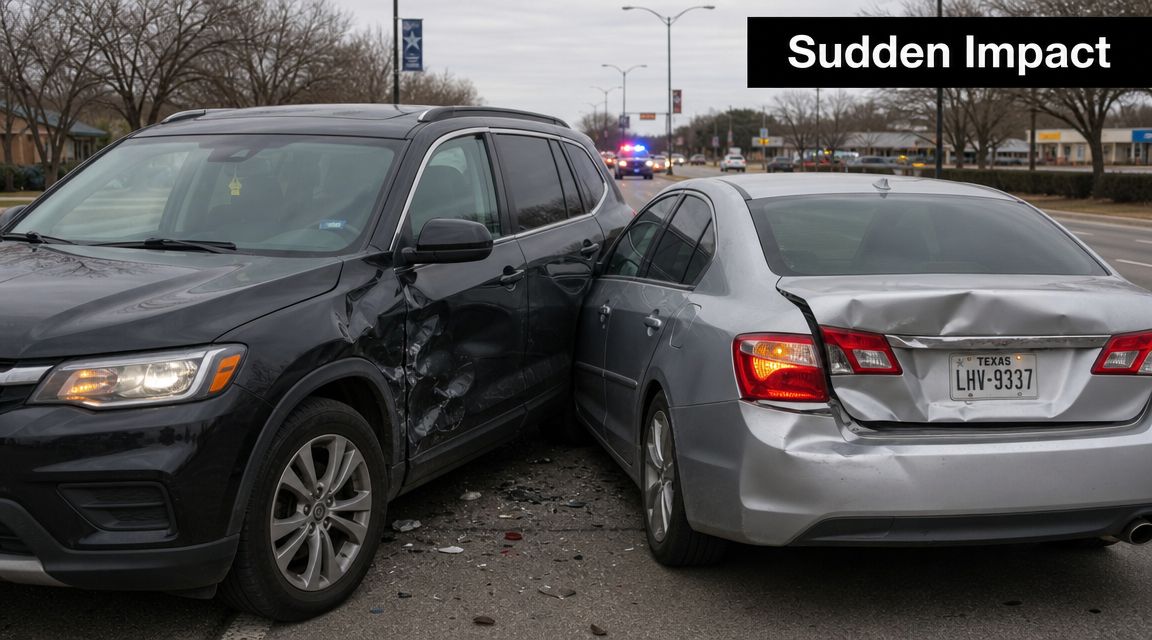
The scene is usually messy in ways people don't expect. Traffic keeps moving. Someone insists they're "fine." A witness starts to leave. Your phone battery is lower than you thought. You may feel embarrassed, angry, shaky, or oddly calm.
That matters because Arlington sees crashes often enough that this isn't some rare event. One Arlington-focused report says the city averaged about 19 accidents per day, with a crash rate of 1,796 per 100,000 residents and roughly a 4.6% chance of being involved in an accident in an average year in Arlington, according to Queenan Law's Arlington crash overview. In a city with that kind of traffic pressure, legal readiness isn't paranoia. It's basic self-protection.
What people usually get wrong
A lot of injured drivers make the same early mistake. They treat the crash like a short inconvenience instead of the beginning of an evidence problem.
Insurance companies don't evaluate your claim based on how stressful the wreck felt. They look for records, timing, consistency, and gaps. If your statement, your photos, your treatment history, and the crash report don't line up, the insurer will use that. If you want a better sense of what officers record and why it matters, this guide on how to read a police accident report is worth reviewing.
Practical rule: The first story told about a crash often becomes the version everyone fights over later.
Regaining control quickly
You don't need to become a lawyer at the roadside. You do need to slow down and make a few smart choices.
Focus on three things first:
- Safety first: Move out of traffic if you can do it safely and check on injuries.
- Report the crash: If police respond, get the report number or enough information to obtain it later.
- Preserve the basics: Names, insurance details, photos, witness contacts, and visible conditions at the scene.
A strong case rarely starts with a dramatic courtroom moment. It starts with ordinary details captured before they disappear.
Your First 24 Hours What to Do Immediately
The first day after a wreck is where good claims often separate from weak ones. Not because the law changes overnight, but because evidence does. Bruising develops. memories shift. Vehicles get repaired or moved. Camera footage gets overwritten. People who promised to help stop answering.
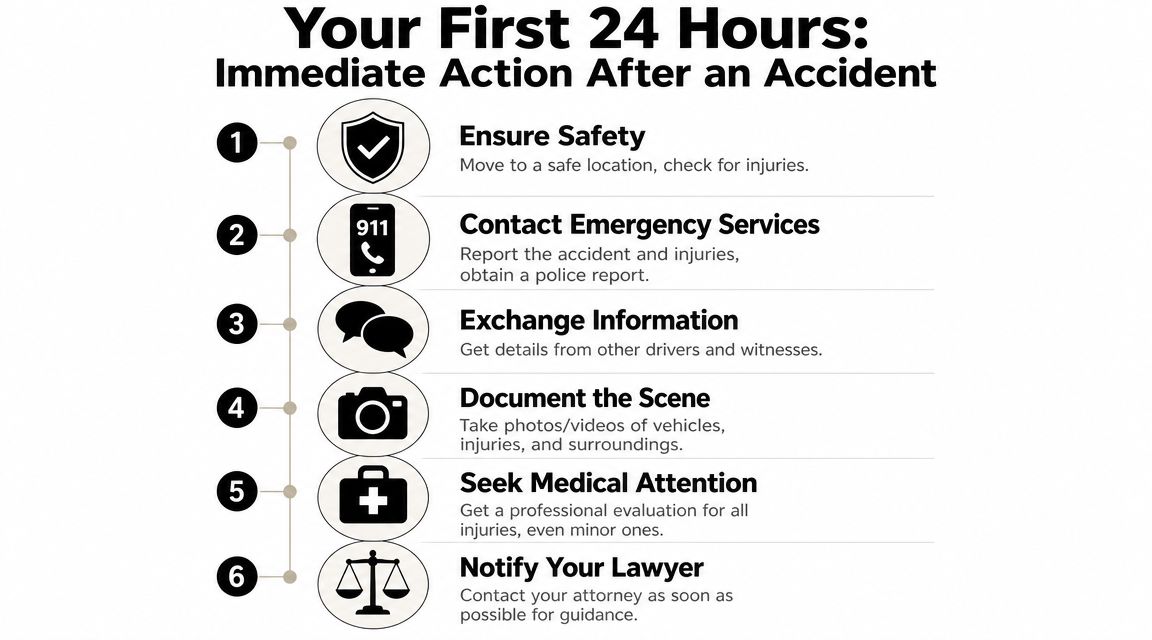
Use this checklist as your working plan.
At the scene and right after
- Get to a safe location if possible. If the vehicles can move and staying put is dangerous, relocate carefully.
- Call for help. If anyone may be hurt, ask for emergency response and law enforcement.
- Exchange information, but don't argue liability. You can be polite without agreeing to fault.
- Photograph more than the damage. Get wide shots, close-ups, skid marks, traffic lights, lane positions, broken glass, debris, weather conditions, and anything that explains how the impact happened.
- Identify witnesses. A neutral witness can matter more than either driver's opinion.
One sentence can save you trouble later: "I'm shaken up and I need to get checked out, so I don't want to guess about what happened."
What not to say
People often hurt their own claims while trying to be decent. Don't speculate. Don't apologize in a way that sounds like an admission. Don't say you're uninjured if you haven't been evaluated.
A common problem in "minor" crashes is delayed symptoms. One Arlington firm notes that soft-tissue, neck, and brain injury symptoms can be delayed, that quick payouts can be risky, and that early legal advice helps preserve evidence and prevents insurers from using an early "I feel fine" statement against you later, as explained by Cooper Law Firm's Arlington accident guidance.
If your body says "maybe" after a crash, treat it like "not yet clear," not "fine."
A lot of people don't feel pain immediately because adrenaline is doing its job. That doesn't make the injury unreal. It just means your body hasn't settled enough to show you the full picture.
Here's a useful companion resource on how to deal with insurance after a car accident, especially if the adjuster calls before you've even seen a doctor.
Get medical care before the insurer shapes the narrative
Clients undermine their own case. They wait. They go to urgent care days later. They tell the doctor only about the worst pain and forget the headache, dizziness, or numbness. Then the insurer says the treatment gap proves the injury wasn't serious or wasn't caused by the crash.
Be thorough. Tell the provider everything that feels different, even if it seems minor. If your back is tight, your jaw hurts, your vision feels off, or you feel mentally foggy, say it.
Later in the day, after you've handled the immediate basics, watch this short video for a practical overview of post-crash next steps:
Before the day ends
Take these final steps before you go to sleep:
- Create a simple file: Put photos, report details, claim numbers, tow information, and medical paperwork in one place.
- Write down what you remember: Include where you were going, traffic flow, what you saw before impact, and what the other driver said.
- Pause social posting: Even harmless-looking photos or jokes can be twisted later.
- Talk to a lawyer before giving a recorded statement if injuries may be involved: That conversation can prevent avoidable mistakes.
Building Your Case The Evidence That Matters Most
Winning a car wreck claim isn't about sounding believable. It's about proving four things cleanly: who caused the crash, how the crash caused your injuries, what those injuries cost, and whether your proof would hold up if challenged.
The core file every strong case needs
Start building evidence like you're assembling a toolbox. Each item does a different job.
- Liability proof: Police report, scene photos, video, witness names, and vehicle damage images.
- Causation proof: Prompt medical records that connect your symptoms to the collision.
- Damages proof: Bills, prescription receipts, wage-loss documents, repair estimates, and notes showing how daily life changed.
- Comparison proof: Prior medical history only when needed, so false "pre-existing injury" arguments can be answered directly.
A simple pain journal helps more than people think. Don't make it dramatic. Make it accurate. Note missed work, sleep disruption, mobility problems, headaches, school pickup struggles, and activities you stopped doing because of pain.
What works better than general complaints
"Everything hurts" is understandable, but it doesn't help much. Specific details do.
Try entries like these:
| Type of record | Useful example |
|---|---|
| Symptom note | Neck pain worsened when turning left to back out of driveway |
| Daily impact | Couldn't lift laundry basket without sharp shoulder pain |
| Work effect | Left early because sitting at desk increased lower back pain |
| Family impact | Missed child's event due to headache and light sensitivity |
That kind of record gives shape to a claim. It also helps your doctor document your limitations accurately.
Good evidence is boring on purpose. It is organized, dated, and hard to argue with.
Complex crashes need faster action
If the other vehicle was a box truck, company van, delivery vehicle, rideshare car, or any commercial unit, the case changes quickly. Liability may involve the driver, the employer, a contractor relationship, or a company insurer with its own investigation team.
For Arlington crashes involving commercial, rideshare, or delivery drivers, the evidence often extends beyond the scene itself. It's important to investigate possible employer liability and preserve digital evidence such as telematics or app logs, because that proof can drive recovery value in Tarrant County cases, as noted by Chandler Ross on Arlington car accident cases.
A preservation letter is often critical in those cases. Think of it as a written demand telling the company not to destroy relevant evidence. That can include:
- Driver activity records: App status, dispatch records, route data
- Vehicle-generated data: Telematics, onboard systems, dashcam files
- Business records: Employment status, maintenance logs, internal incident reports
If you wait too long, that material may be deleted in the ordinary course of business. Once it's gone, you may never know what it showed.
How to Find and Evaluate the Right Arlington Lawyer
Not every injury lawyer handles cases the same way. Some firms move files in bulk and push for quick resolution. Others build cases as if the insurer might force a fight. You want to know which kind you're talking to before you sign anything.
One benchmark from the personal injury market is hard to ignore. Plaintiffs who hire a lawyer receive over 4.4 times more compensation on average than people who handle claims alone, according to Cain Firm's discussion of what it takes to win a Texas car accident lawsuit. That doesn't mean every lawyer is the right lawyer. It means choosing carefully matters.
What to listen for in the consultation
A good consultation shouldn't feel like a sales script. It should feel like a case assessment.
Pay attention to whether the lawyer asks detailed questions about treatment timing, witness contact, vehicle ownership, insurance coverage, road conditions, and any statements already given. Those questions show the lawyer is testing the case, not just signing it up.
This overview of what a car accident lawyer does can help you judge whether the attorney's role is being explained clearly or glossed over.
Essential Questions for Your Lawyer Consultation
| Question Category | Specific Question to Ask |
|---|---|
| Case handling | Will you personally handle my case, or will most communication go through staff? |
| Investigation | What evidence would you try to secure first in my case? |
| Insurance strategy | Do you recommend giving a recorded statement now, later, or not without counsel? |
| Medical proof | How do you help clients document delayed symptoms or treatment gaps? |
| Complex liability | If a company vehicle or rideshare driver was involved, how would you investigate employer liability? |
| Communication | How often should I expect updates, and who gives them? |
| Negotiation approach | What would make you push a case harder instead of settling early? |
| Trial readiness | If the insurer undervalues the claim, are you prepared to file suit and build the case for trial? |
| Fees and costs | How are expenses handled, and what happens if there is no recovery? |
| Client fit | What concerns do you see in my case right now? |
Fee transparency matters more than promises
Most car wreck lawyers work on a contingency fee. That means the attorney gets paid from the recovery rather than charging upfront by the hour. The basic structure is simple. The details matter.
Ask two money questions directly:
- How are case expenses handled? Filing fees, records, experts, and depositions can add up.
- What happens if the case doesn't recover money? You should know the answer before signing.
If the lawyer gets evasive when money comes up, that's a warning sign. Clear firms explain the agreement in plain English and invite questions.
Red flags that should slow you down
Some warning signs are easy to spot. Others are subtler.
- Guaranteed outcomes: No honest lawyer can promise a result.
- Pressure to sign immediately: You need advice, not a rushed commitment.
- Very little discussion of evidence: Strong firms talk about proof early.
- No real explanation of fault issues: In Texas, blame allocation can make or break value.
- Slow or confusing communication from the start: It usually doesn't improve later.
The right lawyer won't just tell you that you have a case. They'll tell you where the case is strong, where it's vulnerable, and what needs to happen next.
What the best answers usually sound like
Strong lawyers tend to sound measured, not flashy. They talk about records, timing, advantage, and risk. They explain what can be done now, what has to wait, and what may complicate the claim.
If you're looking for a car accident lawyer Arlington TX residents can rely on, look for someone who treats your case like a file that needs to be built, not just settled.
Understanding Your Claim Under Texas Law
Texas law shapes your case long before anyone talks about a courtroom. The rules on timing, fault, and damages all affect strategy.
The rule that changes everything in disputed crashes
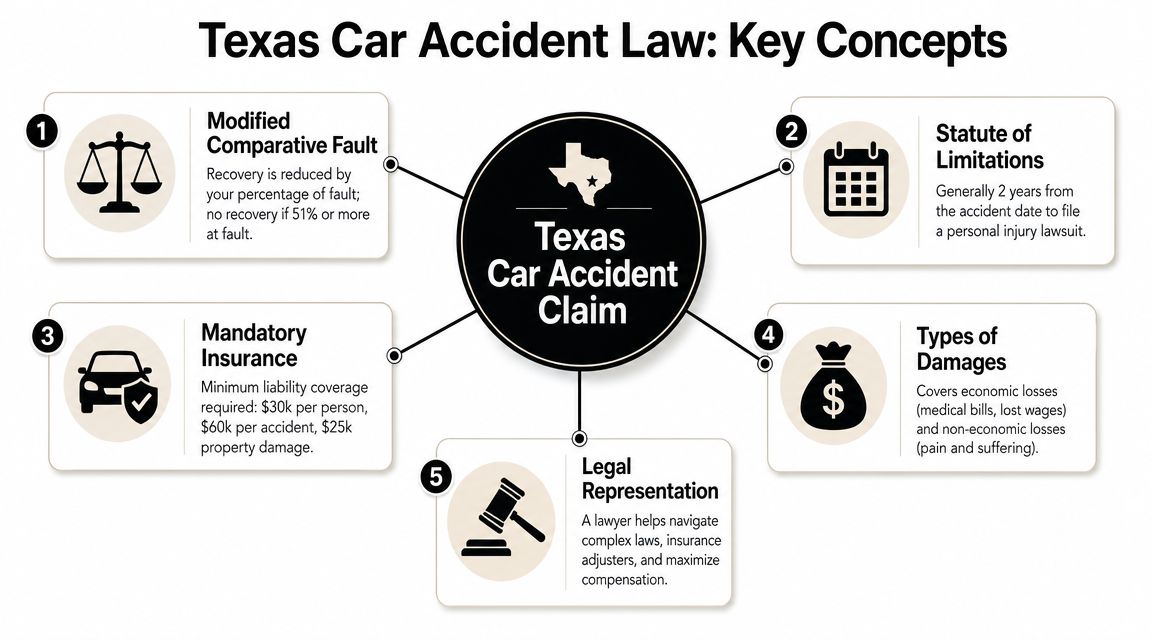
Texas uses a 51% Bar system for fault. If you're found 51% or more responsible, you recover nothing. If you're less responsible than that, your recovery is reduced by your share of fault. The same source also notes that about 95% to 97% of personal injury claims resolve before trial, which is why pre-trial evidence carries so much weight, according to Devoted Injury Lawyers on trial percentages and Texas fault rules.
Consider a real-life scenario: Suppose the insurer agrees you're injured but claims you were mostly at fault because you changed lanes, followed too closely, or could have avoided the crash. That blame argument isn't just rhetoric. It's a direct attack on whether you recover at all.
Why fault proof often matters more than forceful argument
Think of Texas fault law like a gate. You don't get through by insisting you're right. You get through by bringing enough evidence to keep the insurer from pinning the majority of blame on you.
That is why lawyers focus so heavily on:
- Crash reconstruction details
- Witness consistency
- Medical timing
- Vehicle position and scene evidence
- Any digital or video record that confirms what happened
If a defense adjuster can create doubt on liability, they can cut value fast.
In Texas wreck cases, fault isn't a side issue. It's the lever that moves the entire claim.
Timing and damages
Texas law generally gives injured people two years from the accident date to file a personal injury lawsuit. That doesn't mean you should wait. Waiting makes evidence harder to find and treatment history harder to explain.
The main categories of damages are usually straightforward:
| Damage type | What it usually includes |
|---|---|
| Economic losses | Medical bills, lost wages, future care needs, property-related financial loss |
| Non-economic losses | Pain, suffering, physical limitations, disruption to daily life |
| Case-specific additional damages | In some matters, other remedies may be considered depending on the facts |
The infographic above also reflects Texas minimum liability insurance requirements. Those policy limits can matter a lot in settlement strategy, especially in serious injury cases where available coverage may be contested or insufficient.
The legal rule is simple. The practical effect is not. A lawyer's job is to keep a disputed case from being reduced to an insurer's blame formula.
Why Arlington Families Trust Nares Law Group
Arlington families dealing with a crash don't need a law firm that treats them like a claim number. They need lawyers who understand what serious injury cases require: early investigation, disciplined medical proof, pressure-tested negotiation, and readiness to litigate when the insurer refuses to be reasonable.
Nares Law Group LLC brings that kind of approach. The firm represents people harmed in motor vehicle crashes, truck wrecks, traumatic brain injuries, and wrongful death cases. Those practice areas matter in Arlington, where some of the hardest cases involve delayed symptoms, complicated fault disputes, and commercial vehicles with layers of insurance and company responsibility.
Kaitlin Nares is licensed in Texas, which means Arlington clients can work with counsel who understands the legal rules governing Texas crash claims. The firm is known for pairing compassionate client care with trial-tested advocacy, which is exactly what injured families need when they're juggling treatment, missed work, vehicle damage, and an insurance company already looking for ways to narrow the claim.
Just as important, the firm handles the full life of a case. Investigation. Medical treatment coordination. Negotiation. Trial preparation. That matters because strong outcomes usually come from consistent pressure and organized proof, not from one aggressive letter sent at the beginning.
If your crash involved a truck, possible brain injury, a disputed liability story, or an insurer pushing a fast settlement before your condition is clear, experienced legal help can change the direction of the case.
If you need clear guidance after a wreck, Nares Law Group LLC offers free, no-obligation consultations. The firm helps injured people and families understand their rights, protect evidence, and move forward with a smart plan built for the problems that follow a serious car accident.