Riding through the Rockies is a feeling you can't get anywhere else. That sense of freedom is why people ride. But we also know the truth: motorcycle accidents in Colorado are a serious and growing risk. The danger for a rider is just fundamentally different than for someone in a passenger car, a fact we see reflected in the state's crash numbers every year.
The Sobering Statistics Behind Colorado's Rider Risks
You see it in the news or on the side of the road. It’s clear that riders face dangers others don’t. While motorcycles are only a small percentage of the vehicles on our roads, they are involved in a tragically high number of serious and fatal crashes.
Think of it like this. Every time a rider gets on their bike, they are stepping into a world with far less protection than the driver in the enclosed car right next to them. This isn't just a feeling; the statistics prove it. The numbers show just how vulnerable riders are, with distracted drivers, road hazards, and inconsistent helmet use all playing a part. Understanding these realities is the first step to protecting yourself.
A Record Year for Fatalities
The trend in Colorado is alarming. In 2024, the state saw a heartbreaking 165 motorcyclist deaths—the highest number ever recorded. That figure represents a staggering 57% increase since 2015 and a 60% jump from just 2018.
What’s even more concerning is that this happened while the number of registered motorcycles in the state actually fell by 9%. These aren't just numbers on a page; they represent a severe and escalating problem. You can explore the full data on rising Colorado motorcycle fatalities to see the scope of this issue for yourself.
The gap between riders and other drivers becomes even clearer when you look closer:
- A Small Footprint: Motorcycles make up just 3% of all registered vehicles in Colorado.
- A Massive Impact: Despite that, riders accounted for a shocking 24% of all traffic deaths in 2024. That’s up from 16% in 2018.
- The Opposite Trend: During that same time, fatalities for people in passenger vehicles actually dropped by 7%. The crisis is hitting riders the hardest.
The Preventable Factor
When you dig into these tragedies, one detail stands out. Of the 165 riders who lost their lives, an unbelievable 73 of them—or 44%—were not wearing a helmet when they crashed.
That single fact highlights a difficult truth. While a helmet can't stop a crash from happening, it is undeniably tied to whether a rider survives one. Choosing to ride without a helmet dramatically increases the odds that a survivable crash will become a fatal one.
This isn't meant to scare you away from riding. It's about arming you with knowledge. In the sections that follow, we’ll get into the specific laws, common crash scenarios, and the legal steps you can take to protect yourself and your rights after a motorcycle accident in Colorado.
Where and When Crashes Happen in Colorado
The freedom of the open road is what riding is all about. But the reality is that danger often follows predictable patterns. By looking at Colorado’s crash data, we can see exactly where and when the risks are highest for motorcyclists.
Understanding these patterns isn’t about fear. It's about awareness.
This is what that risk looks like. The numbers paint a stark picture of just how vulnerable riders are compared to drivers in enclosed vehicles.
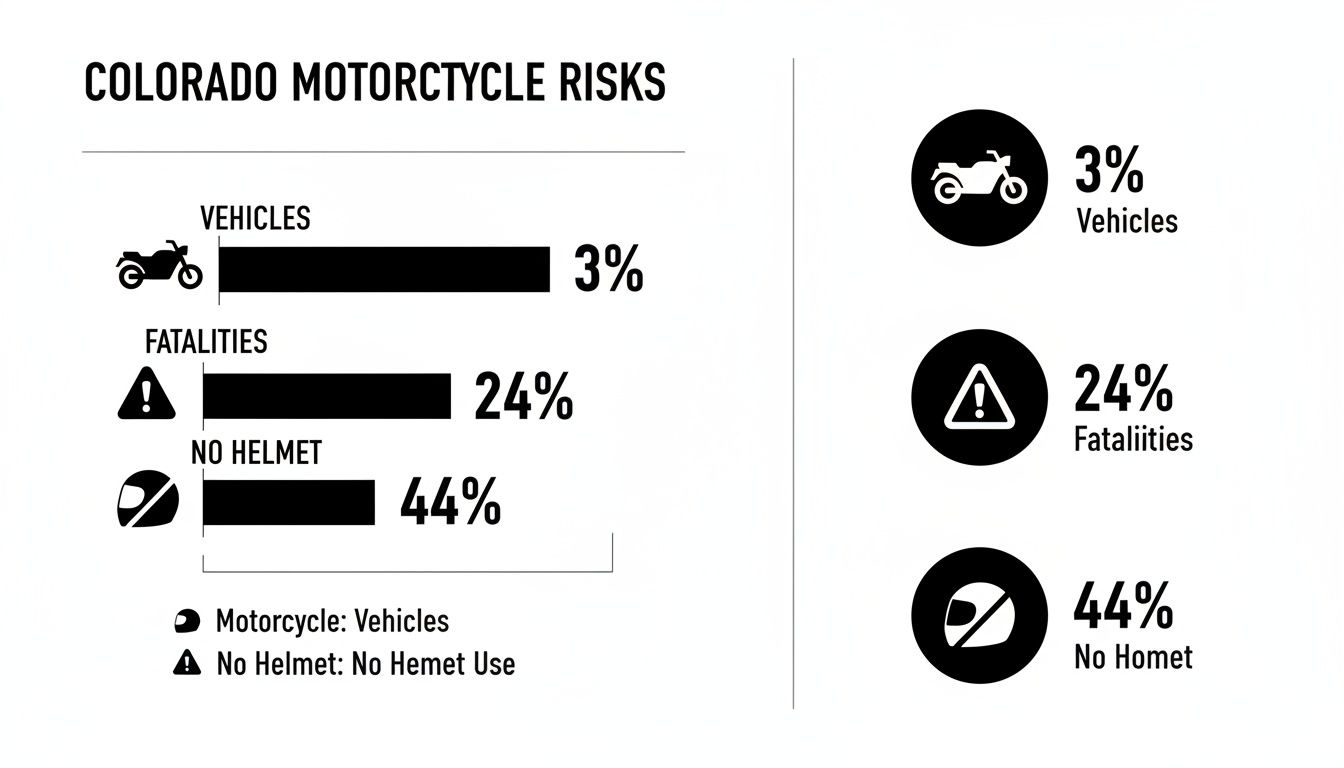
The math is simple but brutal. Motorcycles make up only 3% of the vehicles on our roads, yet they account for a staggering 24% of all traffic fatalities. Nearly half of those riders weren't wearing a helmet.
Urban Centers and Rural Roads
You might assume the most congested cities have the most crashes, and you'd be partly right. The sheer volume of traffic in major urban centers makes them definite hotspots.
The data below from 2017 to 2021 confirms that Colorado’s most populated counties see the highest number of total motorcycle accidents.
Colorado Motorcycle Crash Hotspots (2017-2021)
| County | Total Motorcycle Crashes (2017-2021) |
|---|---|
| Denver | 1,420 |
| El Paso | 1,391 |
| Jefferson | 1,219 |
These numbers highlight the constant danger of navigating dense city and suburban traffic. You can explore more details about these crash statistics to see the trends in your own area.
But the total number of crashes doesn’t tell the whole story.
A surprising truth emerges when you look at crash rates relative to population. Smaller, scenic counties like Park and Teller actually have some of the highest rates. This points to a hidden danger on the very roads that draw us to ride—the beautiful, winding mountain passes, often filled with tourists unfamiliar with the terrain.
So, while city riders face a constant barrage of threats, those enjoying a scenic mountain ride face different, but equally serious, dangers.
The Most Dangerous Time to Ride
The "when" is just as critical as the "where." In Colorado, the risk of a motorcycle accident spikes dramatically with the warm weather.
It’s no coincidence that the best riding weather is also the most dangerous time of year. A massive two-thirds of all motorcycle collisions happen between May and September. This is our prime riding season, but it demands our highest level of vigilance.
Several things are happening at once during these months:
- More Riders: Good weather simply means more bikes are on the road, which statistically increases the odds of a crash.
- Tourist Traffic: Colorado is a destination. Tourists flock here in the summer, and many are not used to sharing winding roads with motorcycles.
- Driver Blindness: After a long winter with few bikes out, other drivers aren't conditioned to look for a motorcycle's smaller profile. This "forgotten search image" is a huge factor in dangerous left-turn and lane-change accidents.
Knowing that the most popular time to ride is also the most hazardous is a powerful piece of information. It reminds you to stay extra sharp, whether you're navigating a packed city street in July or a beautiful mountain highway in August.
Navigating Colorado Motorcycle Laws
Knowing the rules of the road isn’t just about avoiding a ticket. It’s about protecting yourself—both on the pavement and in a potential legal claim after a motorcycle accident in Colorado.
Think of these laws as the official rulebook for every ride. Understanding them helps you ride defensively, but it also creates a strong foundation if you ever have to prove another driver was at fault.
Core Motorcycle Rules in Colorado
While you have to follow the same traffic laws as any car, a few regulations apply specifically to motorcycles. An insurance company can use a violation of these rules to argue you were partially to blame for a crash, even if you weren't.
It’s crucial to know the basics:
- Lane Splitting Is Illegal: Colorado law is clear on this. You cannot ride a motorcycle between lanes of traffic or on the shoulder. You must occupy a full lane.
- Eye Protection Is Mandatory: Every rider and passenger, no matter their age, must wear some form of eye protection. This can be glasses, goggles, or a helmet visor.
- Handlebar Height: Your handlebars can’t be higher than your shoulders when you are seated on the bike.
- Passenger Rules: If you’re carrying a passenger, your motorcycle must have a dedicated passenger seat and footrests.
Following these simple rules makes your actions predictable and legal. That matters when it comes time to establish who was responsible for a collision.
The Helmet Law Explained
There’s a lot of confusion around Colorado’s helmet law because it’s a "partial" law—it doesn’t apply to everyone.
Under state law, helmets are only mandatory for riders and passengers under the age of 18. Adults aged 18 and over can legally choose whether or not to wear one.
But that legal choice has serious real-world consequences. Even if it's legal for an adult to ride without a helmet, an insurance company will almost always argue that not wearing one made your injuries worse, especially with head trauma. They use this argument to reduce what they have to pay, even if their driver was 100% at fault for causing the crash. You can learn more about how this impacts your rights in our guide to Colorado helmet laws.
How Colorado's Fault System Works
This brings us to a critical legal concept in any motorcycle accident case: Modified Comparative Negligence.
Imagine a set of scales. In Colorado, you can recover financial compensation for your injuries as long as your share of the fault is less than 50%. If those scales tip and you are found 50% or more responsible for the crash, you are legally barred from recovering anything.
If you’re found partially at fault—say, 10% responsible—your final compensation is simply reduced by that amount. A $100,000 award would become $90,000. Insurance adjusters are experts at finding ways to shift even a small amount of blame onto riders to exploit this rule and pay out less.
This is a dangerous reality for riders, and it’s amplified by a deeply concerning trend. Nationally, motorcyclists make up just 3% of registered vehicles but account for 15% of all traffic fatalities. In Colorado, that vulnerability has been compounded by a 54% drop in traffic enforcement penalties from 2018-2024, a period that saw a 60% spike in rider deaths. The data suggests that when enforcement goes down, the risks for everyone on the road go up.
What to Do Right After a Motorcycle Crash: Your First Steps
The moments after a motorcycle hits the pavement are a complete blur. There’s a rush of adrenaline, a wave of confusion, and the sharp reality of pain. What you do in that chaotic window matters more than you can imagine—not just for your health, but for your ability to get fair compensation down the road.
Think of the next few minutes and hours as your post-crash playbook. The actions you take, or fail to take, can profoundly shape your physical and financial recovery.
Priorities at the Scene
Your first instinct might be to check on your bike. Don't. Your only priority is your safety. If you can move, get yourself out of the flow of traffic to avoid getting hit again. Everything else can wait.
Once you’re in a safer spot, your job is to get official help on the way and start documenting what happened.
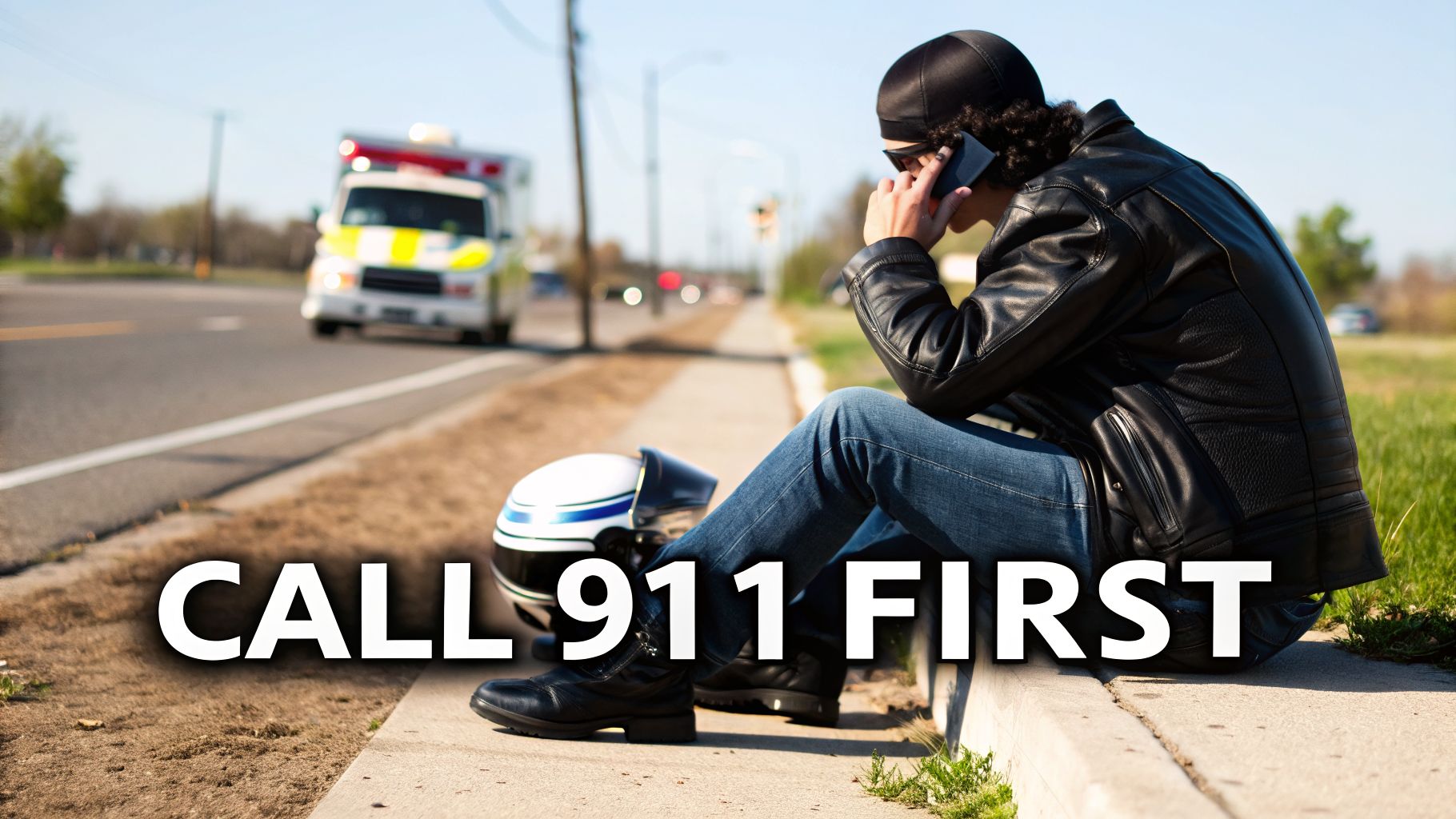
- Call 911 Immediately: This is not optional. A 911 call brings police and paramedics to you. The police report they create is the first official, unbiased record of the crash, and it’s a document that insurance claims are built on.
- Gather Evidence (If You’re Able): Pull out your phone and start taking pictures and videos of everything. Capture the final positions of all vehicles, skid marks on the road, traffic signs, and any damage to property. Take photos of your injuries and the damage to your gear and bike from every angle.
- Collect Witness Information: Did anyone see it happen? If so, get their name and phone number. An independent witness can provide a neutral account that cuts through the other driver’s story.
- Do Not Admit Fault: With adrenaline pumping, it's easy to say something like, "I'm so sorry," or "I didn't even see you." Don't. Never apologize or admit fault to anyone—not the other driver, not the police. Just stick to the facts.
In the Hours and Days That Follow
What you do after leaving the scene is just as critical. Your focus now shifts to your medical needs and protecting yourself from the insurance company’s tactics.
The single most important thing you can do is get a medical evaluation right away.
Even if you think you feel fine, adrenaline is a powerful painkiller. It can easily hide serious issues like internal bleeding, organ damage, or a concussion. Going to an ER or urgent care creates an official medical record that connects your injuries directly to the crash—a link the insurance company will absolutely try to deny.
If you wait days or weeks to see a doctor, the insurer will argue your injuries happened somewhere else or that they aren't as bad as you claim. Don't give them that opening.
Notifying Your Insurance Company
You do have to report the crash to your own insurance provider, but you need to be smart about it. Give them only the basic facts: who was involved, and the date, time, and location of the accident.
Politely but firmly decline to give a recorded statement until you've spoken with a lawyer. Insurance adjusters are trained to ask leading questions designed to trip you up, get you to downplay your injuries, or make you accidentally accept some of the blame. That recording can—and will—be used to reduce or deny your claim.
Things get even more complicated in a hit-and-run. If the driver who hit you takes off, your own Uninsured/Underinsured Motorist (UIM) coverage is often the only way to get compensation. You can learn more by reading our guide on what to do after a hit and run in Colorado.
Following these steps builds a solid foundation for your recovery. You’re protecting your health by getting immediate care and protecting your legal rights by documenting everything. In the chaos after a Colorado motorcycle accident, these actions are your best defense.
Why You Need an Attorney After a Motorcycle Crash

Trying to handle an insurance claim after a motorcycle accident in Colorado often feels like a rigged game. The insurance company has a team of adjusters and lawyers whose entire job is to minimize what they pay you. They know the rules inside and out because they helped write them.
Hiring an experienced motorcycle accident attorney doesn't just level the playing field; it puts a pro in your corner. They act as your shield, protecting you from aggressive tactics and lowball offers, and as your advocate, fighting for the full compensation you need to truly recover.
Building Your Case from the Ground Up
The official police report is just the first draft of the story, not the final word. Police officers do their best to secure the scene and note any obvious traffic violations, but their investigation isn't designed to build a civil claim for your injuries.
A dedicated attorney starts from scratch, launching a private investigation focused on one thing: proving the other driver was at fault.
This means getting to work immediately to:
- Reconstruct the Crash: We bring in accident reconstruction experts who can analyze everything from skid marks to vehicle damage, creating a scientific model of what really happened. This often uncovers critical proof of the other driver's negligence.
- Preserve Key Evidence: We send legal notices to make sure crucial evidence, like a truck driver’s logbooks or surveillance video from a nearby business, isn't lost or erased.
- Find and Interview Witnesses: A skilled investigator knows how to locate witnesses and ask the right questions to get clear, detailed statements that strengthen your case.
Calculating the Real Cost of Your Injuries
The true impact of a serious crash goes far beyond a stack of medical bills. It affects your ability to work, your family life, and your daily comfort. Insurance adjusters will try to focus only on the numbers they can see on a receipt, completely ignoring the human cost.
The full value of your claim isn't just about past expenses. It's a complete picture of your life before the crash compared to your life now—the career you can no longer pursue, the hobbies you had to abandon, and the daily pain you're forced to endure.
An experienced lawyer makes sure your claim accounts for everything, including:
- Future Medical Care: This covers not just the bills you already have, but the estimated cost of future surgeries, physical therapy, medication, or lifelong pain management.
- Lost Earning Capacity: If your injuries mean you can't return to your job or have to take a lower-paying one, you deserve compensation for the income you will lose over the rest of your career.
- Pain and Suffering: This is the legal term for the physical pain, emotional trauma, and loss of enjoyment of life you’ve experienced. It’s a real, significant loss that deserves to be recognized.
Shielding You While We Fight for You
The moment you hire an attorney, the harassing phone calls from the insurance company stop. All communication goes through us. You are finally free from the pressure to give a recorded statement or accept a quick, unfair offer. Your only job is to focus on getting better.
Knowing when to hire a personal injury attorney is often the first step toward taking back control.
We handle the entire process, starting with a comprehensive demand package that lays out the full extent of your damages. Insurance companies take these demands far more seriously when they come from a law firm known for its willingness to go to court. They know we won't back down.
If they refuse to offer a fair settlement, we are fully prepared to take your case to a jury and fight for the justice you deserve.
Frequently Asked Questions About Motorcycle Accidents
After a crash, your mind is racing with urgent questions. The shock, the stress, the uncertainty—it's overwhelming. Here are some clear, straightforward answers to the questions we hear most often from riders in Colorado, designed to give you a starting point for what comes next.
How Much Does It Cost to Hire a Motorcycle Accident Lawyer?
Most experienced motorcycle accident attorneys, including our firm, work on a contingency fee basis.
Think of it as a partnership built on trust. You pay absolutely nothing out of your own pocket to get us started. Our fee is simply a pre-agreed percentage of the settlement or verdict we win for you.
This levels the playing field, ensuring you can afford top-tier legal help regardless of your financial situation after an accident. The most important part? If you don’t get paid, we don’t get paid. It's that simple.
Can I Still Get Compensation if I Was Partially at Fault?
Yes, in many cases, you can. Colorado operates under a rule called “modified comparative negligence.”
This legal principle allows you to recover damages as long as you are found to be less than 50% at fault for the crash. If your share of the blame is determined to be 50% or more, you are unfortunately barred from recovering anything.
Let’s say a jury awards you $100,000 but finds you were 10% responsible—maybe you were going just a hair over the speed limit. Your final award would be reduced by your 10% of fault, meaning you’d receive $90,000. Insurance adjusters love this rule and will use any excuse to shift blame onto a rider to slash their payout. This is a key reason having an attorney to fight back against an unfair fault percentage is so critical.
How Long Do I Have to File a Motorcycle Accident Claim?
In Colorado, the clock starts ticking the moment the accident happens. The legal deadline to file a lawsuit is called the statute of limitations.
For most motor vehicle accidents, you generally have three years from the date of the crash to file your personal injury claim.
But be careful—there are major exceptions. If your claim involves a government employee or entity, like a city bus or a state-owned vehicle, the deadline can shrink dramatically, sometimes to just a few months. If you miss that deadline, your right to seek compensation is almost always lost forever. Acting quickly is the only way to make sure evidence is preserved and your legal options are protected.
What Is My Motorcycle Accident Case Really Worth?
There's no online calculator or simple formula that can tell you the value of your case. Every crash is different, and the true worth is a measure of every single loss you've endured.
An experienced lawyer determines a full and fair value by meticulously calculating all the factors involved, which fall into a few key categories:
- Economic Damages: These are the tangible financial losses you can add up with receipts and pay stubs. It includes all past and future medical bills, lost income from being unable to work, and any impact on your ability to earn a living down the road.
- Non-Economic Damages: This is about the human cost. It’s compensation for the physical pain, the emotional trauma, the mental anguish, permanent scarring or disfigurement, and the loss of your ability to enjoy your life and hobbies.
- Property Damage: This part is straightforward—it’s the cost to repair or replace your bike, your helmet, your leathers, and any other gear destroyed in the crash.
Piecing this all together requires a deep dive into medical records, financial documents, and an understanding of how the accident has truly impacted your life. It’s not about just covering the bills you see today; it's about securing a future that accounts for the total cost of the crash.
If you or someone you care about has been hurt in a motorcycle accident, you don’t have to take on the insurance companies by yourself. The team at Nares Law Group is here to bring clarity and aggressive advocacy to your corner. Contact us for a free, no-obligation consultation to discuss your rights and see how we can help. Visit https://www.nareslawgroup.com to get started.