Let's clear up the confusion around Colorado’s helmet laws. When it comes to motorcycles, the rule is surprisingly simple: if you’re under 18, you must wear a helmet. If you’re an adult, the choice is yours.
This single distinction between minors and adults is the foundation of Colorado's entire approach to helmet use, balancing personal freedom with protecting younger, more vulnerable riders.
Your Guide to Colorado's Helmet Rules
Figuring out who needs a helmet and when can feel like untangling a mess of different rules for different vehicles. Colorado's laws are unique. They give adults a lot of leeway while putting strict protections in place for anyone under 18. This directly affects everything from road safety to how an insurance company has to handle your claim after an accident.
And it’s not just about motorcycles. The rules also cover mopeds, scooters, e-bikes, and even off-road vehicles. Each one has its own guideline, usually tied to the rider's age. We'll break it down so you know exactly what’s required.
It All Comes Down to Age
The easiest way to understand the law is to think in two simple categories: minors and adults. This one visual makes that split crystal clear.
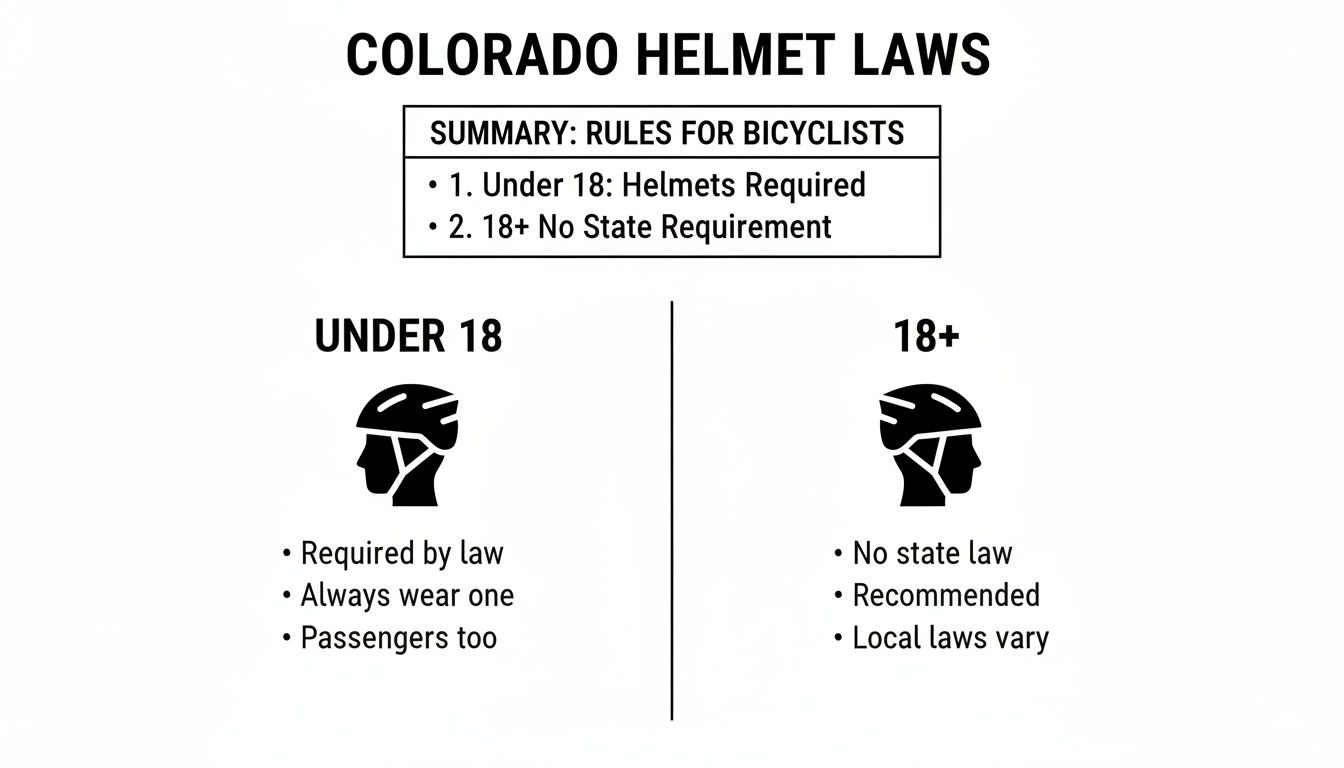
As you can see, the legal duty to wear a helmet falls almost entirely on riders under the age of 18. For adults, the law steps back, trusting you to make your own decision about safety.
Because Colorado does not have a universal helmet law for adults, an insurance company cannot punish you for choosing not to wear one. They can't use it as an excuse to deny your claim or slash your settlement offer.
This is a critical point to remember if you're ever dealing with an adjuster after a crash. Knowing your rights is the first step toward getting fair compensation. Since the person who caused the accident is held responsible under our state's laws, evidence like helmet use can become a point of contention. You can get a better handle on this by reading our guide explaining if Colorado is a no-fault state.
To give you an at-a-glance reference, we put together a simple table that lays out the rules for the most common vehicles you'll see on and off the road.
Colorado Helmet Requirements by Vehicle and Age for 2026
This table summarizes the legal helmet requirements for various types of vehicles in Colorado, clearly distinguishing between rules for minors and adults.
| Vehicle Type | Riders Under 18 | Riders 18 and Over |
|---|---|---|
| Motorcycles | Helmet Required | Helmet Optional |
| Mopeds & Motor Scooters | Helmet Required | Helmet Optional |
| Class 3 E-Bikes | Helmet Required | Helmet Required |
| Bicycles | No Statewide Law | No Statewide Law |
| ATVs & UTVs | Helmet Required | Helmet Optional |
With this breakdown, you can ride with confidence, knowing exactly where you stand with the law.
The Story Behind Colorado's Motorcycle Helmet Law
Colorado's current helmet rules didn't just appear out of nowhere. To really grasp them, you have to look back at the tug-of-war that created them—a battle between federal mandates and Colorado's deep-rooted belief in personal freedom. This history isn't just trivia; it’s the legal foundation that protects injured riders today.
The story really kicks off in the 1960s, when a national push for highway safety swept the country. The federal government had its sights set on making roads safer, and it decided universal helmet laws were a non-negotiable part of the plan.
Federal Pressure Meets State Independence
In 1966, Congress passed the Federal Highway Safety Act. This gave the government a powerful lever. The deal was simple: states that enacted universal helmet laws for motorcyclists would get their full share of federal highway funding. States that refused would lose a chunk of that money.
It was a classic carrot-and-stick approach, and for a while, it worked. Colorado, like many other states, fell in line. In 1973, a new law went into effect requiring every single motorcycle operator and passenger to wear a helmet.
But that period of mandatory helmet use didn't last long. The federal pressure cooker sparked a fierce debate across the country about government overreach.
The question was straightforward: should the government have the power to protect people from their own choices, or does that right belong to the individual? Colorado's lawmakers ultimately came down on the side of personal choice.
When the federal government finally backed off and removed the financial penalties in the mid-70s, it gave states the green light to go their own way. Colorado didn’t hesitate.
The Repeal and Its Lasting Legacy
In 1977, the Colorado General Assembly officially repealed the universal helmet law. Just like that, helmets became optional again for adult riders. The effect was immediate. One study from the time found that in 1978, only 48.5% of motorcyclists chose to wear a helmet—a massive drop that proved how quickly behavior changes when a mandate is removed. You can explore the details behind this historical shift and its immediate effects on rider behavior.
That 1977 repeal is the single most important event shaping modern helmet laws in Colorado. It's not a historical footnote. For an injured rider, it’s a legal shield.
Because the legislature made such a clear and deliberate choice to get rid of the mandate for adults, our courts have consistently ruled that an adult's decision not to wear a helmet cannot be used against them as evidence of negligence. This is a game-changer in personal injury cases. It stops an insurance company from claiming you were to blame for your own head injury just because you were exercising your legal right.
We frequently use the history of this repeal in court to shut down those unfair arguments and protect our clients' right to full compensation. A decision made over 40 years ago is still one of the most powerful tools we have to protect riders today.
How Helmet Use Impacts Your Personal Injury Claim

After a crash, the other driver's insurance company starts searching for one thing: a reason to pay you less. If you’re a motorcyclist, one of the first questions they’ll ask is whether you were wearing a helmet. This is a tactic designed to shift blame, but Colorado law gives you a powerful defense.
The state legislature made a very deliberate choice back in 1977 when it repealed the universal helmet law for adults. That decision is not just a piece of history; it’s a legal shield for riders today. Your choice to ride without a helmet as an adult cannot be used against you.
The Failed "Helmet Defense" in Colorado
Insurance adjusters love to pull out a tired argument they call the “helmet defense.” The logic goes like this: by not wearing a helmet, you contributed to your own injuries, so they shouldn’t have to cover the full cost.
In Colorado, that argument is a dead end for any rider over 18.
Our courts have shut this down time and time again. Since you weren't breaking the law, your personal choice about protective gear is legally irrelevant to who caused the crash. The focus stays exactly where it belongs—on the negligent driver who hit you.
An experienced personal injury attorney knows how to stop this argument in its tracks. We point directly to the 1977 repeal and make it clear that the legislature intentionally protected your freedom of choice. This precedent is a critical tool we use to hold insurance companies accountable.
An adjuster might tell you, “Your head injury would’ve been minor if you’d worn a helmet, so we’re cutting your settlement.” Our response is simple: “Colorado law doesn’t let you punish our client for making a legal choice. The only issue here is your driver’s negligence.”
This firm legal boundary is what prevents insurers from unfairly blaming you. It ensures your compensation for medical bills, lost income, and a life-altering Traumatic Brain Injury (TBI) is based on the harm the other party caused, not your gear.
Comparative Negligence and Helmet Use
The “helmet defense” is really just a backdoor attempt to use the concept of comparative negligence. This legal rule is used to assign a percentage of fault to everyone involved in an accident. For example, if you were found to be 20% at fault, your final compensation would be reduced by that amount.
You can get a deeper understanding by reading our explanation of comparative fault in Colorado.
But here’s the key: because riding without a helmet isn’t illegal for adults, it cannot be considered negligent. It doesn’t count toward your percentage of fault. Period.
Let’s look at how this plays out for an adult rider in a real-world case:
- The Crash: A car blows through a red light and T-bones you. The driver is clearly at fault for causing the collision.
- The Injury: You suffer a serious head injury. You were not wearing a helmet.
- The Insurance Argument: The adjuster claims you’re partially responsible for how severe your injury is.
- The Legal Reality: Your attorney shuts it down, citing Colorado law. Helmet use is inadmissible for proving fault, so the conversation returns to the driver’s dangerous actions.
This protection is absolutely vital. It allows you to fight for the full compensation needed to cover the staggering costs of a TBI or other catastrophic injuries without being unfairly penalized for a choice the law explicitly gives you.
Understanding the Rules for Bikes and Scooters
Motorcycle laws often get the most attention, but Colorado’s roads are full of other two-wheeled vehicles. From traditional bikes and e-scooters to mopeds, the helmet laws in Colorado for these rides are surprisingly specific. It’s not a one-size-fits-all rule; the law changes based on the vehicle’s speed and the rider’s age.
Think of it less like a single rule and more like a sliding scale. The more power and speed a vehicle has, the stricter the safety requirements become. Knowing where you land on that scale is the key to riding legally and protecting yourself.
Traditional Bicycles
Let's start with the simplest case: a standard, human-powered bicycle. This one surprises a lot of people. In Colorado, there is no statewide helmet mandate for bicyclists of any age.
While cities and local towns can pass their own ordinances, the state itself doesn’t require you to wear one. Of course, just because it’s not legally required doesn’t mean it’s not a good idea. If you've been in a crash, you can learn more about how to protect your rights in our guide to handling a Colorado bicycle accident.
Mopeds and Motorized Scooters
This is where the rules start to mirror motorcycle laws. Mopeds and most electric scooters are grouped into a category called "low-power scooters." For these vehicles, the law is split by age.
- Riders Under 18: A helmet is mandatory.
- Riders 18 and Over: A helmet is optional.
It’s crucial to know that for minors, the law specifies a DOT-approved helmet. This means the helmet has been certified to meet federal safety standards for motorized vehicles. A simple bike helmet won’t cut it and won't satisfy the legal requirement.
Electric Bikes or E-Bikes
E-bikes are everywhere, and Colorado law is very clear about them. The state sorts them into three classes based on their speed and power, and the helmet rules are tied directly to these classes.
The real game-changer is the Class 3 e-bike. Because these models can hit higher speeds—up to 28 mph with pedal assistance—the law treats them with extra caution to protect riders from that increased risk.
Here’s a simple breakdown of the e-bike helmet laws:
- Class 1 and Class 2 E-Bikes: These bikes provide motor assistance up to 20 mph. Like traditional bicycles, there are no statewide helmet rules for any age group.
- Class 3 E-Bikes: These faster models assist up to 28 mph. For a Class 3 e-bike, a helmet is required for all riders, regardless of age.
This is the big exception to Colorado’s usual pattern of only requiring helmets for minors. If you ride a Class 3 e-bike, you must wear a helmet, whether you're 16 or 60. The law rightly recognizes that the speeds these vehicles can reach create dangers closer to a moped than a regular bicycle, and it demands universal protection to match.
What the Science Says About Helmet Safety
While Colorado law gives adult riders the freedom to choose, the science of safety tells a much different story. This isn't about judging your decision to ride with or without a helmet. It's about giving you the full picture of what happens in a crash and why this one piece of gear matters so much.
Think of an accident as a sudden, violent burst of energy. When a rider gets thrown from their bike, all that energy has to go somewhere. A helmet acts like a crucial shock absorber, spreading the force of an impact across a wider surface. This buys your brain precious time to slow down, dramatically lowering the risk of a severe traumatic brain injury (TBI).
The numbers from national safety experts don’t just suggest this works; they prove it.
The Hard Data on Helmet Effectiveness
When you dig into the research, the benefits of wearing a helmet are impossible to ignore. Organizations like the Centers for Disease Control and Prevention (CDC) and the National Highway Traffic Safety Administration (NHTSA) have been studying this for decades. Their findings are both consistent and powerful.
According to the CDC, helmets are incredibly effective. Their data makes a clear case:
- Helmets reduce the risk of death in a motorcycle crash by 37%.
- They cut the risk of a head injury by an astounding 69%.
These aren't small percentages. They represent a massive shift in a rider’s odds of surviving a crash or walking away without a life-altering injury. It’s often the difference between a close call and a catastrophe.
The most compelling proof often comes from comparing states. States with universal helmet laws consistently see far lower fatality rates for motorcyclists than states like Colorado, which only require them for younger riders.
This comparison shows a direct line between more helmets and fewer deaths. While the helmet laws in Colorado protect personal freedom, the scientific consensus is clear: universal helmet use is the single best way to prevent needless tragedy on the road.
The Financial and Human Cost of Not Wearing a Helmet
The aftermath of riding without a helmet goes far beyond the immediate physical pain. For those who suffer a serious head injury, the financial fallout can be just as devastating for them and their families.
The NHTSA estimates that in a single recent year, helmets saved the lives of 1,872 motorcyclists. Even more sobering, they calculated that if every rider had worn a helmet, another 749 people could have been saved.
Beyond the tragic loss of life, the economic costs are staggering. Think about it:
- A single non-fatal head injury can lead to a lifetime of medical bills for surgeries, rehabilitation, and round-the-clock care.
- The loss of income from being unable to work can financially ruin a family.
- The CDC found that helmets saved the country over $21 billion in economic costs in just one year. Had everyone worn one, another $8 billion could have been saved.
These numbers give context to the severe TBI cases we see. When we fight for maximum compensation for an injured rider, we are fighting to cover these immense, often lifelong costs. The science is a constant reminder that so many of these devastating injuries are preventable, which only strengthens our resolve to hold negligent drivers fully accountable for the harm they cause.
How Public Opinion Shapes the Helmet Debate
Colorado law gives adult motorcyclists the freedom to choose whether or not to wear a helmet. But that legal freedom exists in a world where most people believe helmets should be mandatory. This is a crucial, often overlooked, part of the conversation.
This gap between the law and what the public thinks is a big deal, especially when a crash case goes to a jury. Jurors don’t leave their personal beliefs at the courtroom door. If a rider suffers a serious head injury without a helmet, a jury’s gut reaction might be to blame them for it—even though the law was on their side.
The Courtroom vs. The Court of Public Opinion
It’s not just a hunch that most Coloradans support helmet laws. It’s a fact backed by years of data. Survey after survey shows a strong majority of residents think helmets should be required for all riders, not just those under 18. The community’s consensus leans toward safety, even if the law prioritizes personal choice.
What’s even more surprising is that this feeling exists within the riding community itself. A landmark 1997 Colorado motorcycle safety survey found that 65% of all adults thought every rider should have to wear a helmet. Digging deeper, 47% of motorcyclists agreed, showing that nearly half of the people directly affected by the law actually disagreed with the state’s hands-off approach for adults. You can explore the full results and what they mean for policy in the original survey.
This widespread support for helmets creates a unique challenge—and a strategic opening—in a personal injury case.
A jury’s bias is a real threat. But we can reframe the conversation. Instead of just talking about what the law allows, we can focus on what a reasonable, safety-conscious community expects.
This shifts a jury's focus back where it belongs: on the driver who caused the crash.
By showing that the community as a whole values safety, we can argue that every driver should expect motorcyclists to be taking steps to protect themselves. This helps neutralize the automatic bias a jury might have against a rider who was simply exercising a legal right.
We argue that while our client was following the law, they were injured because the other driver was not. It steers the jury away from judging our client’s choice and toward evaluating the defendant’s negligence. The case becomes about who is at fault for the crash, not about a helmet.
Frequently Asked Questions About Helmet Laws
When it comes to helmet laws in Colorado, there's a lot of confusion out there. Let's cut through the noise and answer some of the most common questions we hear from riders and their families every day.
We've put together these straightforward answers to give you the clarity you need.
Can I Still Get Compensation if I Was Not Wearing a Helmet?
Yes, you can. If you are an adult rider (18 or older) on a motorcycle or moped, your choice not to wear a helmet cannot be used against you to reduce your compensation in a personal injury claim.
The law is very clear on this. Because the Colorado legislature made a deliberate choice to repeal the universal helmet mandate for adults, the at-fault driver's insurance company is legally blocked from punishing you for it. A skilled personal injury attorney will shut down any attempt to use this unfair tactic to deny what you are owed.
Do I Need a DOT-Approved Helmet in Colorado?
It depends on who you are and what you're riding. If the law requires you to wear a helmet—specifically for motorcycle or moped riders and passengers under 18—then it must be DOT-approved. A standard bicycle helmet simply doesn't offer the protection required for motorized vehicles.
For adults who choose to wear a helmet or for bicyclists, a DOT-certified helmet isn't legally mandatory. That said, it is always the best choice for protecting yourself against a serious head injury.
Will My Health Insurance Cover My Injuries?
Yes, your health insurance should cover your medical treatment based on the terms of your policy. It doesn't matter who was at fault for the crash.
However, that's only one piece of the puzzle. Filing a personal injury claim against the driver who hit you is the only way to recover all the other costs your health insurance won't touch, including:
- Deductibles and co-pays you paid out of pocket
- Lost income from being unable to work
- Pain and suffering
- Future medical care that isn't covered by your policy
What Are the Most Important Steps After a Head Injury Accident?
What you do in the moments and days after a crash can make a huge difference for both your health and your legal rights. Here are the four steps you need to take.
- Seek Immediate Medical Care: The symptoms of a traumatic brain injury (TBI) can show up hours or even days later. Get a full medical evaluation, even if you think you feel fine.
- Report the Accident to the Police: An official police report is a critical piece of evidence. It creates an objective record of what happened, which is essential for your insurance claim.
- Avoid Speaking to Insurance Adjusters: Never give a recorded statement to the other party's insurance company. Their only job is to find reasons to pay you as little as possible.
- Contact a Personal Injury Firm: Talk to an attorney who focuses on motor vehicle accidents and TBI cases. Getting expert advice from the start is the best way to protect your rights.
If you or someone you love has been hurt in an accident, you don’t have to deal with the insurance companies on your own. At Nares Law Group LLC, we guide injured families toward a hopeful future by protecting their rights and securing the outcomes they deserve. For a free, no-obligation consultation to discuss your case, please visit us at https://www.nareslawgroup.com.