The tow truck has left. The adrenaline is fading. Your phone is full of photos you barely remember taking, and the quiet after a crash on I-25 can feel stranger than the impact itself. Individuals in that moment are not thinking about electronic logging devices, corporate insurance teams, or preservation letters. They are thinking about pain, work, family, and whether life is about to get much harder.
That reaction is normal. A collision with a commercial truck is not just a larger car crash. It is often the start of a layered recovery process involving medical care, evidence that can disappear quickly, and legal questions that do not show up in ordinary wrecks. People searching for truck accident attorneys colorado springs are usually not shopping casually. They are trying to regain control.
The Unseen Aftermath of a Colorado Springs Truck Accident
A truck crash often leaves two scenes. The first is the highway scene, with shattered glass, cargo debris, skid marks, and emergency lights reflecting off wet pavement. The second begins later, at home or in the hospital, when you try to explain to your employer why you cannot return yet, or to your child why you are forgetting things, or to yourself why you still hear the impact when the room is quiet.

That private aftermath is more common than many people realize. Colorado records show a substantial number of accidents involving medium and heavy trucks annually, often resulting in numerous fatalities and injuries. The weight difference explains why these cases are so severe. A fully loaded commercial truck can weigh significantly more than a typical passenger car. In truck versus car crashes, occupants of the smaller vehicle suffer most of the serious harm, as noted by Anderson Hemmat’s discussion of Colorado truck crash data.
What families often face first
Some problems appear immediately. Others show up days later.
- Medical uncertainty. You may know you are hurt, but not yet know how hurt.
- Insurance pressure. Calls start before you have a complete picture.
- Work disruption. Paychecks stop faster than bills do.
- Emotional whiplash. Serious crashes create fear, frustration, sleep issues, and confusion even when injuries are not visible.
A truck accident claim is not only about proving a collision happened. It is about protecting your ability to recover physically, financially, and emotionally before key evidence and key choices are lost.
People often feel they should be able to handle things one step at a time. In ordinary fender-benders, that can work. In a trucking case, delay creates risk. The company may control critical records. The insurer may already be shaping the narrative. Your medical record may still be incomplete.
The good news is that there is a path through it. It starts with the first few days.
Your First 72 Hours What to Do After a Truck Wreck
The first three days matter because they shape both your treatment and your claim. Think of this window like securing a storm-damaged house. You are not rebuilding everything at once. You are preventing more loss while creating a record of what happened.
Put your health first, even if you think you are okay
Get evaluated promptly. Truck crashes often produce injuries that do not announce themselves immediately, especially head injuries, neck injuries, back trauma, and internal issues.
A same-day or next-day medical evaluation does two jobs. It gets you treatment, and it creates a clean medical timeline. When people wait, insurers often argue that the injury came from something else or was not serious.
Control the information you give out
If the trucking company’s insurer calls, be polite and brief. Do not agree to a recorded statement before speaking with counsel.
Recorded statements sound routine, but they are often used to lock you into incomplete descriptions before the full medical picture develops. “I’m okay” said in pain and shock can become a defense theme later.
If you need a simple script, use this. “I am getting medical care and I am not prepared to discuss the facts yet.”
Preserve the evidence you personally control
A trucking company may have the truck, the internal logs, and the maintenance file. You still control important pieces.
Take steps quickly:
- Photograph your vehicle thoroughly. Get all angles, interior shots, deployed airbags, and close-ups of impact points.
- Photograph your body. Bruising changes fast. Casts, stitches, and abrasions tell a timeline.
- Save your clothing and shoes. Do not wash or discard them if they show blood, tearing, or debris.
- Keep every discharge paper and prescription sheet. Start one folder, physical or digital.
- Write down what you remember. Road position, weather, lane changes, what the truck did, what was said after impact.
Be careful with repairs and disposal
Do not rush to dispose of the vehicle or authorize invasive repairs before speaking with an attorney. Damage patterns can become evidence. Crush depth, underride marks, transfer patterns, and event timing can matter later.
If the vehicle must be moved, ask where it will be stored and keep that information.
Protect the practical side of your case
Truck cases become expensive for injured families before they become legally clear. Start documenting the practical fallout.
A simple list helps:
- Missed work. Dates, hours, and job duties you cannot perform
- Out-of-pocket costs. Medications, travel to appointments, medical devices
- Symptoms diary. Pain, headaches, dizziness, sleep problems, anxiety, memory issues
- Help from others. Childcare, rides, household tasks you now need assistance with
Avoid common mistakes
Some mistakes do real damage early.
| Mistake | Why it hurts |
|---|---|
| Posting details on social media | Opposing insurers look for photos or comments they can reinterpret |
| Missing follow-up appointments | Gaps in care create arguments about whether you sustained injuries |
| Signing broad medical releases | Insurers may seek records beyond what is fairly related to the crash |
| Settling early | Early offers often arrive before future treatment needs are clear |
If you are overwhelmed, that does not mean you are behind. It means the case needs structure. A trucking claim improves when someone starts organizing evidence before the other side defines the story for you.
How a Specialized Attorney Investigates a Trucking Case
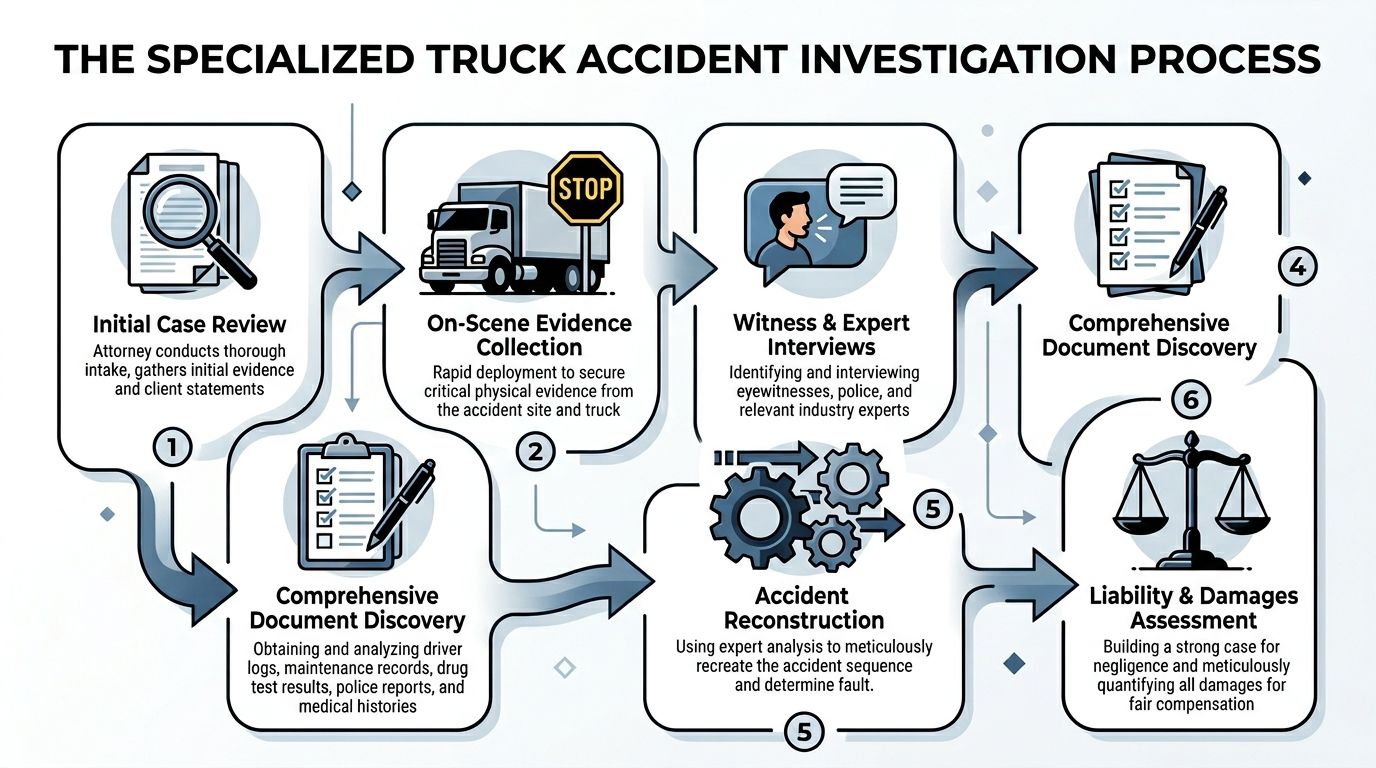
A serious trucking case is built more like an engineering file than a routine insurance claim. General personal injury work often focuses on police reports, photos, and medical bills. A specialized trucking investigation goes deeper because the key evidence usually sits inside a company system, not in plain view.
The first move is preservation
The defense often controls the most valuable material. That is why experienced lawyers move fast to send preservation demands, sometimes called spoliation letters. These tell the carrier and related parties to preserve the truck, onboard data, electronic logs, inspection materials, driver records, and communications.
Without that early step, evidence can be overwritten, lost in routine retention cycles, or reframed later as unavailable.
Black box data changes the conversation
One reason truck accident attorneys colorado springs cases differ from passenger car claims is the amount of machine-generated evidence available. According to Genco Injury Attorneys’ explanation of black box and FMCSA evidence, expert attorneys prioritize securing a truck’s black box data because it can show objective records of speed, braking, and throttle position. They also analyze Federal Motor Carrier Safety Administration compliance records, which can directly challenge an insurer’s version of events and connect driver behavior to the collision.
That matters because memory is imperfect, and post-crash narratives are often self-serving. Machine data does not solve every question, but it can narrow the argument. If a carrier says the driver reacted appropriately, braking and speed data may confirm or contradict that claim. If the defense says a lane change was unavoidable, time-stamped inputs may reveal whether the truck driver had enough time to respond.
The file matters as much as the scene
A truck wreck rarely turns on one bad moment alone. Many cases involve a chain of decisions made long before impact.
A focused investigation may look at:
- Driver qualification records. Hiring, training, certifications, prior issues, and fitness to operate
- Hours and log compliance. Whether the driver was following service rules
- Maintenance records. Brake work, tire condition, inspection history, repair delays
- Cargo and dispatch records. Loading practices, schedules, route pressure, delivery demands
- Post-crash testing and reporting. What the company documented after the collision
For a practical example of one critical category, a truck driver qualification file can reveal whether the company put the right person behind the wheel and whether warning signs were ignored.
Reconstruction is where isolated facts become a case theory
Evidence alone is not enough. It must be interpreted correctly. That is where accident reconstruction professionals become useful.
They study impact angles, vehicle damage, roadway markings, sight lines, timing, and downloaded data to rebuild the collision sequence. Think of reconstruction as assembling a sequence from fragments. One photo shows resting position. Another shows crush damage. The electronic data shows pre-impact inputs. Witnesses fill in movement. The reconstruction specialist connects the pieces into a scientifically grounded timeline.
Good truck litigation does not rely on outrage. It relies on proof that can survive cross-examination.
Medical and economic experts do different jobs
Injury cases fail when lawyers treat damages as a stack of bills. Truck cases often involve injuries with future consequences, and those consequences need support from the right professionals.
A specialized team may use experts to answer very different questions:
| Expert type | What they help prove |
|---|---|
| Accident reconstruction specialist | How the collision happened and who had the last clear chance to avoid it |
| Treating physician or medical specialist | What injuries were caused by the crash and what treatment is reasonable |
| Economist | How lost earnings and future financial losses should be measured |
| Occupational therapist or life care planner | What long-term support, equipment, or daily assistance may be needed |
What does not work in trucking cases
Several shortcuts routinely weaken claims.
First, relying only on the police report. It is important, but it is not the whole case.
Second, assuming the truck driver is the only defendant. In some cases, the carrier, maintenance contractor, cargo company, or another entity may share responsibility.
Third, waiting for the insurer to “investigate fairly.” Trucking defendants often begin protecting themselves immediately. Your side should too.
Some law firms build this infrastructure in-house. Others work with co-counsel and outside specialists. Firms handling these cases throughout Colorado, including Nares Law Group LLC, often structure the matter around rapid evidence preservation, medical coordination, and expert development rather than treating it like an ordinary auto claim.
Understanding the Full Value of Your Truck Accident Claim
Many injured people undervalue their claim because they look only at current bills. That is understandable. Bills are visible. Future limitations are harder to price.
A stronger way to think about damages is this. Economic damages are the receipts. Non-economic damages are the human consequences. In rare cases, punitive damages focus on punishment for especially wrongful conduct rather than compensation.

Economic damages are the measurable losses
These are the items people expect.
They can include past medical bills, future treatment, rehabilitation, lost income, reduced earning ability, and property damage. In a truck case, future losses often become the primary issue. A person may return to work in some form, but not in the same role, with the same stamina, or at the same wage trajectory.
According to Frank Azar’s discussion of damages proof in truck cases, top firms use multidisciplinary experts, including economists to calculate present-value losses for reduced earning capacity and occupational therapists to explain the cost of diminished quality of life. That same source ties this thorough approach to track records that include over $100 million collected in verdicts and settlements.
If you want a starting point for thinking through categories, a truck accident settlement estimator can help organize issues, but tools do not replace a case-specific legal and medical review.
Non-economic damages reflect what the bills miss
Pain is real even when it is not itemized on a statement. So is fear of driving, loss of sleep, headaches that make parenting harder, and the inability to do activities that once felt ordinary.
Common examples include:
- Physical pain
- Emotional distress
- Loss of enjoyment of life
- Scarring or disfigurement
- Loss of normal daily function
- Relationship strain and reduced independence
These categories are often the hardest for clients to discuss because they sound less concrete. They are not less important. They are often the part of the case that explains how much life changed.
A short video can help frame how lawyers and insurers often approach value in injury claims:
Future care changes everything
Truck crashes can create needs that last far beyond the settlement conversation. Physical therapy, follow-up imaging, counseling, home modifications, and cognitive care may continue long after the wreck is out of the news and off the police blotter.
The right valuation question is not “What has this crash cost so far?” It is “What will this crash require over the course of your recovery?”
That is why a rushed settlement is dangerous. Once a claim resolves, you usually do not get to reopen it because treatment took longer than expected or symptoms became more serious.
Colorado's Critical Deadlines and Legal Hurdles
A strong case can still fail if it is filed late. Deadlines matter in trucking claims because investigation takes time, and some deadlines arrive before people expect them.
The statute of limitations is the legal stopwatch
In Colorado, a truck accident claim generally does not stay open indefinitely. There is a deadline for filing suit, and missing it can end the case regardless of how serious the injuries are.
Many people make the mistake of treating the deadline like a target date for starting the process. It is not. It is the outer edge. By the time a lawsuit is filed, records should already be collected, witnesses identified, and damages understood well enough to plead the claim correctly.
Delay creates practical problems before legal ones
Even before a filing deadline becomes the issue, delay causes evidence problems.
Witnesses forget details. Vehicles get repaired or destroyed. Electronic records may not be preserved. Medical treatment gaps create unnecessary arguments. The longer the pause, the more room the defense has to say the case is uncertain.
Government involvement can change the timeline
If a government-owned vehicle or agency is involved, notice rules can be much tighter than in an ordinary private-party case. Those claims can involve special procedures and shorter notice requirements.
That is why waiting to “see how you feel in a few months” can be costly. In trucking litigation, the calendar is not just a scheduling issue. It is part of the defense strategy.
Comparative negligence is another hurdle
Colorado follows a comparative negligence framework. That means fault can be divided, and your recovery may be reduced if you are assigned part of the blame. In trucking cases, the defense may try to shift focus onto your lane position, speed, following distance, or reaction time.
This is one reason early technical investigation matters. If fault is going to be debated, it is better to have logs, scene evidence, and expert analysis in place before those arguments harden.
Time does not just pass in a truck accident case. It changes the evidence.
If you are unsure which deadline applies to your situation, especially if there is a commercial fleet, public entity, or out-of-state company involved, get legal guidance early. Waiting for certainty usually creates less of it.
How to Choose the Right Truck Accident Attorney For You
Choosing counsel after a truck wreck is not about finding the loudest advertisement. It is about finding the lawyer whose process matches the complexity of the case. Trucking defendants do not defend these claims casually. Your lawyer should not handle them casually either.

Ask questions that reveal process, not slogans
A consultation should tell you how the attorney thinks, not just how they market.
Useful questions include:
- How much of your practice involves commercial trucking cases
- What evidence do you try to preserve immediately
- Who do you typically work with on reconstruction, medical issues, and damages
- Have you handled cases involving multiple liable parties
- Who will manage my file day to day
- What would concern you most about my case right now
Answers matter less for polish than for substance. You want specifics. If the lawyer speaks only in generalities, that is a warning sign.
Track record matters, but context matters too
Past results do not guarantee future outcomes. They do, however, tell you whether a lawyer or firm has experience carrying serious cases.
According to Super Lawyers’ Colorado Springs trucking attorney listings, The Gold Law Firm reports over $100 million collected for clients, Anderson Hemmat is credited with achieving the largest wrongful death verdict in state history, and 24 top trucking accident attorneys in Colorado Springs are recognized in that market. Those benchmarks help show what dedicated trucking experience can look like.
Ask about experts before you need them
A trucking case often rises or falls on expert support. The right lawyer should be able to explain, in plain language, when they use reconstructionists, medical specialists, economists, and other professionals. If you want a sense of how these roles work in litigation, this overview of expert witnesses in trucking accident trials is a useful reference.
Understand the fee model
Most truck accident cases are handled on a contingency fee basis. That generally means the client does not pay attorney’s fees up front, and the fee is tied to recovery.
That model matters because injured families are usually dealing with lost income and medical costs already. It also aligns incentives in a practical way. The lawyer gets paid when the case produces a result.
Still, ask clear questions:
| Question | Why ask it |
|---|---|
| How are case expenses handled | Expert work and records can become significant |
| What happens if the case does not recover money | You should understand your financial exposure |
| Does the fee change if suit is filed or trial becomes necessary | Some agreements have stage-based changes |
A good consultation should leave you less confused than when you started. If it leaves you more pressured, keep looking.
The right fit is not only about credentials. It is about whether the attorney sees the whole problem, including evidence, medicine, timing, and the practical strain on your household.
Why Nares Law Group Is a Partner in Your Recovery
Many truck accident guides stop at liability and settlement. That leaves out one of the hardest parts of these cases. Recovery does not end when a check arrives. For some families, especially those dealing with head trauma, the significant challenge begins with long-term treatment, rehabilitation planning, and learning how daily life has changed.
That gap matters. According to Ben Crump’s Colorado Springs truck accident page discussing long-term TBI needs, a critical weakness in much truck accident guidance is the lack of attention to traumatic brain injury care coordination. The same source notes that Nares Law Group’s expertise in TBI care coordination, including work with neurorehabilitation specialists and economists to quantify future care costs, directly addresses the needs of families facing lifelong impacts.
Why that approach is different
A brain injury case is not just a liability file with larger medical bills. It can involve memory deficits, mood changes, attention problems, fatigue, sensory overload, and reduced independence. Some clients look outwardly normal while struggling profoundly at home or at work.
That changes what a lawyer must do.
A recovery-focused approach may involve:
- Coordinating with treating providers so the medical record accurately reflects cognitive and functional changes
- Planning future care rather than valuing the case only around immediate treatment
- Managing liens and financial pressure so a client can continue treatment without avoidable disruption
- Preparing for trial if needed when the defense minimizes “invisible” injury
Why this matters in trucking litigation
Truck cases are already document-heavy and defense-driven. When the injury includes TBI, the challenge multiplies because the harm may not fit neatly into an X-ray or a short office note. The law firm handling the claim needs to understand both proof and practical care.
For families who feel like they are juggling medicine, insurance, work loss, and fear all at once, that kind of representation is not a luxury. It is part of stabilizing life after the wreck.
A consultation should give you a clearer plan, not just a rough estimate. If you need guidance after a Colorado truck wreck, speaking with counsel who can address both the case and the recovery process is often the first step toward relief.
Frequently Asked Questions About Truck Accident Claims
What if more than one party caused the crash
That is common in trucking cases. The driver may be one piece of the case, but the carrier, maintenance provider, cargo company, or a manufacturer may also matter depending on the facts.
According to Trial Proven’s discussion of comparative negligence and multiple liable parties in Colorado truck cases, a frequent issue is how fault gets divided when several parties contributed. The same source explains that victims can still recover damages even if they were partially at fault, but the award is reduced, and experienced attorneys use FMCSA logs and reconstruction experts to apportion fault properly.
Can I still recover if the insurer says I was partly to blame
Possibly, yes. Comparative negligence does not automatically bar recovery. But it makes evidence more important.
In practice, this means your lawyer needs more than a general argument that the truck was large or dangerous. The case may require a specific explanation of timing, visibility, braking, lane position, and compliance issues so fault is assigned fairly.
How long does a truck accident case take
There is no honest one-size-fits-all timeline. A straightforward case with clear liability and completed treatment can move very differently from a case involving severe injury, disputed fault, multiple defendants, or future care issues.
Truck claims often take longer than ordinary car wreck cases because more evidence must be collected and more parties may be involved. Faster is not always better. If treatment is still evolving, a rushed resolution can leave major losses unpaid.
What if the trucking company is based outside Colorado
That does not necessarily prevent a Colorado claim. Interstate trucking is common, and commercial carriers often operate across multiple jurisdictions. An attorney handling trucking litigation should be comfortable addressing venue, service, insurance structure, and coordination with out-of-state parties when needed.
Do I need a lawyer if the crash seems clearly the truck driver’s fault
Clear fault helps, but it does not solve valuation, future care, comparative negligence arguments, document preservation, or insurer tactics. In trucking cases, the fight is often not only over who caused the wreck. It is over how much harm the wreck caused and what evidence will be allowed to prove it.
What if I suspect a brain injury but scans were normal
That concern deserves attention. Some brain injuries are diagnosed through symptoms, neuropsychological issues, functional decline, and specialist evaluation rather than a dramatic imaging finding. If your memory, concentration, mood, sleep, or sensory tolerance changed after the crash, raise that issue with your doctors and your attorney promptly.
If you were injured in a commercial truck collision and need practical guidance, Nares Law Group LLC offers free consultations for Colorado injury cases. The firm handles truck wreck litigation, traumatic brain injury matters, and wrongful death claims, with attention to both legal recovery and the treatment planning families often need after a serious crash.