The seconds after a car wreck are a blur of twisted metal and shattered glass. If you're on a busy Fort Collins road like College Avenue or Harmony Road, the chaos can feel overwhelming. Your mind is racing, but what you do in these first few minutes is absolutely critical.
Stay calm. Prioritize safety. Call 911 to get Fort Collins Police on their way, and then carefully exchange the right information with the other driver.
Your First Moves After a Crash in Fort Collins
No one ever plans for a car accident. The screech of tires, the jolt of impact—it’s a disorienting and stressful experience. Your first instincts are what matter most, and they can set the stage for your physical and financial recovery down the road.
Think of it less like a checklist and more like a simple, powerful strategy to regain control when you feel like you have none.
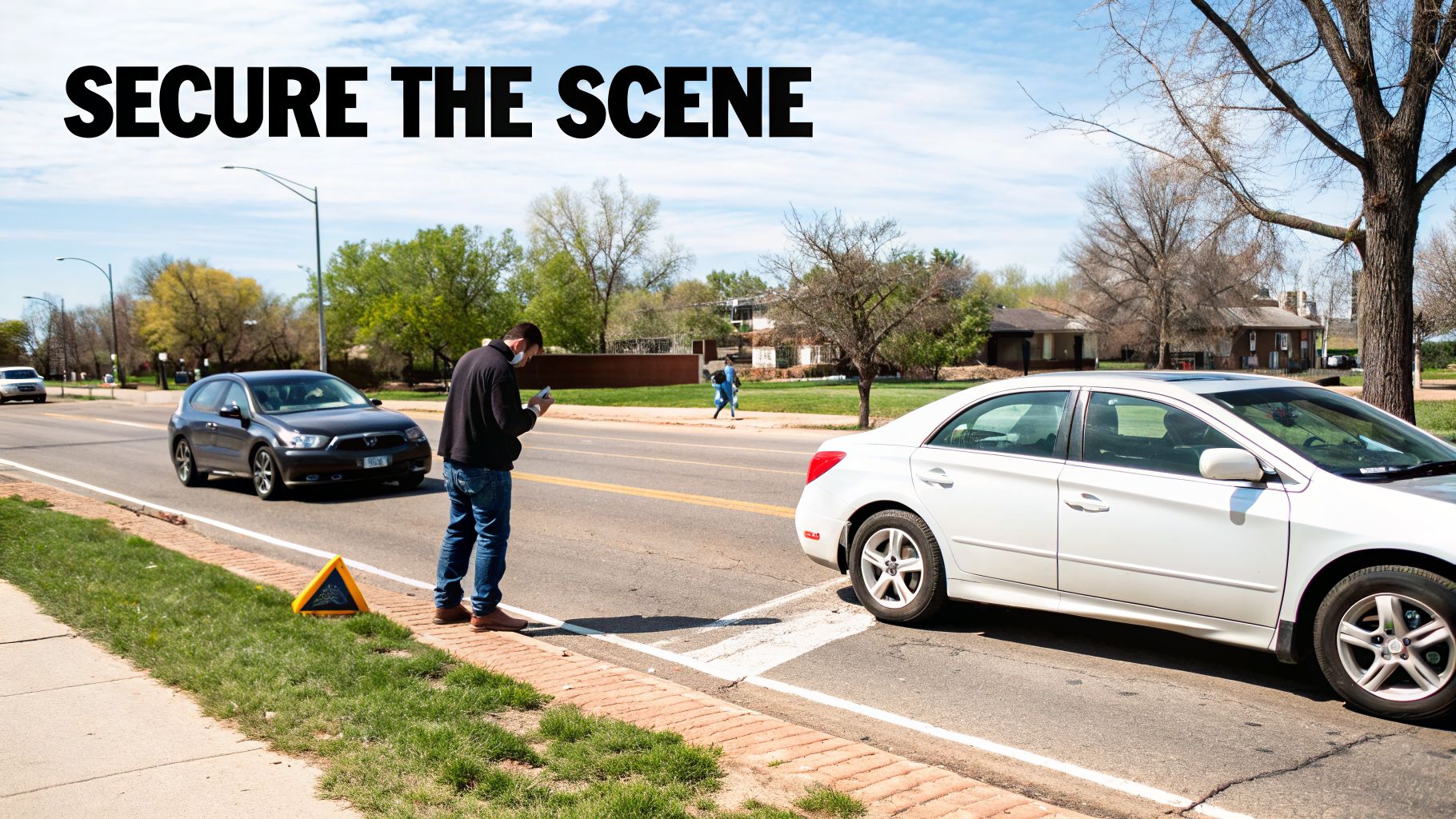
The number one priority is preventing anyone else from getting hurt. If your car is still drivable and you're on a high-traffic road like I-25 or Mulberry Street, try to move to the shoulder or a nearby lot. Flip on your hazard lights immediately. This simple act can prevent a second, more serious collision.
Get to Safety and Call for Help
Once you’re out of the flow of traffic, take a deep breath and call 911.
Reporting the accident isn't just a good idea; it’s a legal requirement in Colorado if there are injuries or what looks like significant property damage. Asking for both police and medical services ensures anyone who is hurt gets immediate help and, just as importantly, creates an official record of the event.
An officer from the Fort Collins Police Department will arrive and create an official accident report. This document is a neutral, third-party account of the crash scene, and it will become a vital piece of evidence for your insurance claim.
Crucial Takeaway: Never let another driver convince you not to call the police. That official report is your best defense against the other driver changing their story later. It’s an invaluable, unbiased record of what happened.
The most important first steps are straightforward. You need to secure your safety, get help on the way, and gather the facts.
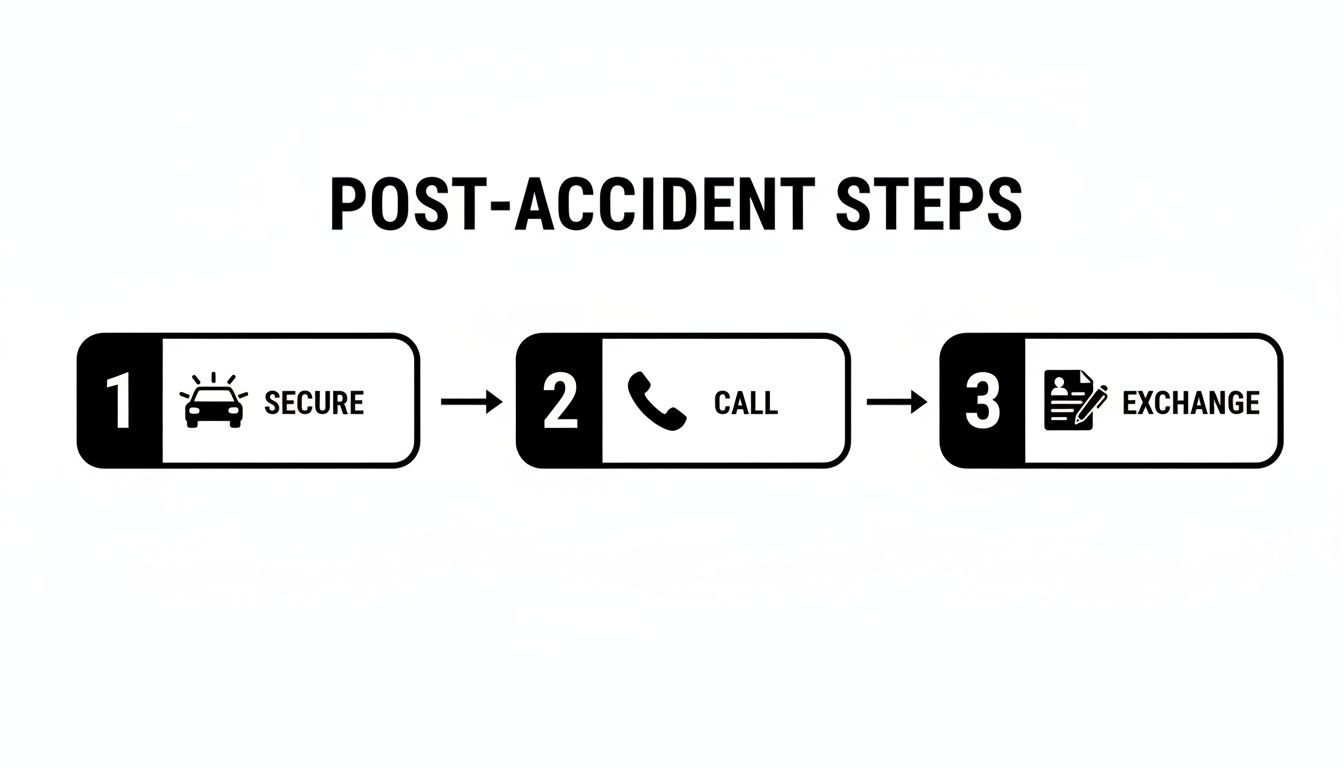
These three actions are the foundation for everything that comes next.
Talking With the Other Driver
While you wait for the police, you’ll need to exchange key information with the other driver. Try to keep the conversation polite, brief, and focused only on the necessary details.
Get the following from the other driver:
- Full name and phone number
- Insurance company and policy number
- Driver's license number
- License plate number
- Make, model, and color of their vehicle
What you don't say is just as important as what you do say.
Don't discuss fault. Don't apologize. Even a simple "I'm so sorry" can be twisted into an admission of guilt by an insurance company. Similarly, avoid saying "I'm fine," as the adrenaline of the moment can easily mask serious injuries. Stick to the facts. For more on this, check out our guide on what to say to police after a car accident.
To make things easier during a stressful moment, here's a quick-reference checklist you can save to your phone.
Fort Collins Post-Accident Checklist
This table breaks down the most important steps to take right after a crash in Fort Collins.
| Action | Why It's Critical | Pro Tip |
|---|---|---|
| Move to Safety | Prevents a secondary accident and protects you from oncoming traffic. | If your car is disabled, stay inside with your seatbelt on until police arrive. |
| Call 911 | Creates an official record and ensures anyone injured gets prompt medical attention. | Tell the dispatcher your exact location, if there are injuries, and if traffic is blocked. |
| Document the Scene | Photos and videos capture evidence that can fade or be moved. | Take wide shots of the scene and close-ups of all vehicle damage, skid marks, and road signs. |
| Exchange Information | You need this to file an insurance claim. | Use your phone's camera to take a picture of the other driver's license and insurance card. |
| Do NOT Admit Fault | Apologies can be used against you by insurance companies. | Stick to factual statements. Avoid emotional comments or speculating on what happened. |
| Seek Medical Attention | Some serious injuries (like whiplash or concussions) don't have immediate symptoms. | Even if you feel fine, get checked out by a doctor or at an urgent care clinic. |
Having this list handy can help you stay focused and ensure you don't miss a critical step that could affect your health and your case.
After a crash, your mind is racing, and adrenaline is pumping. It’s hard to think straight. But the actions you take in these first few minutes and hours are critical. You have two jobs now: gather proof and protect your health. Get these right, and you build the foundation for your recovery and your claim.
Think of yourself as the first investigator on the scene. Before a single piece of glass is swept away, pull out your phone.
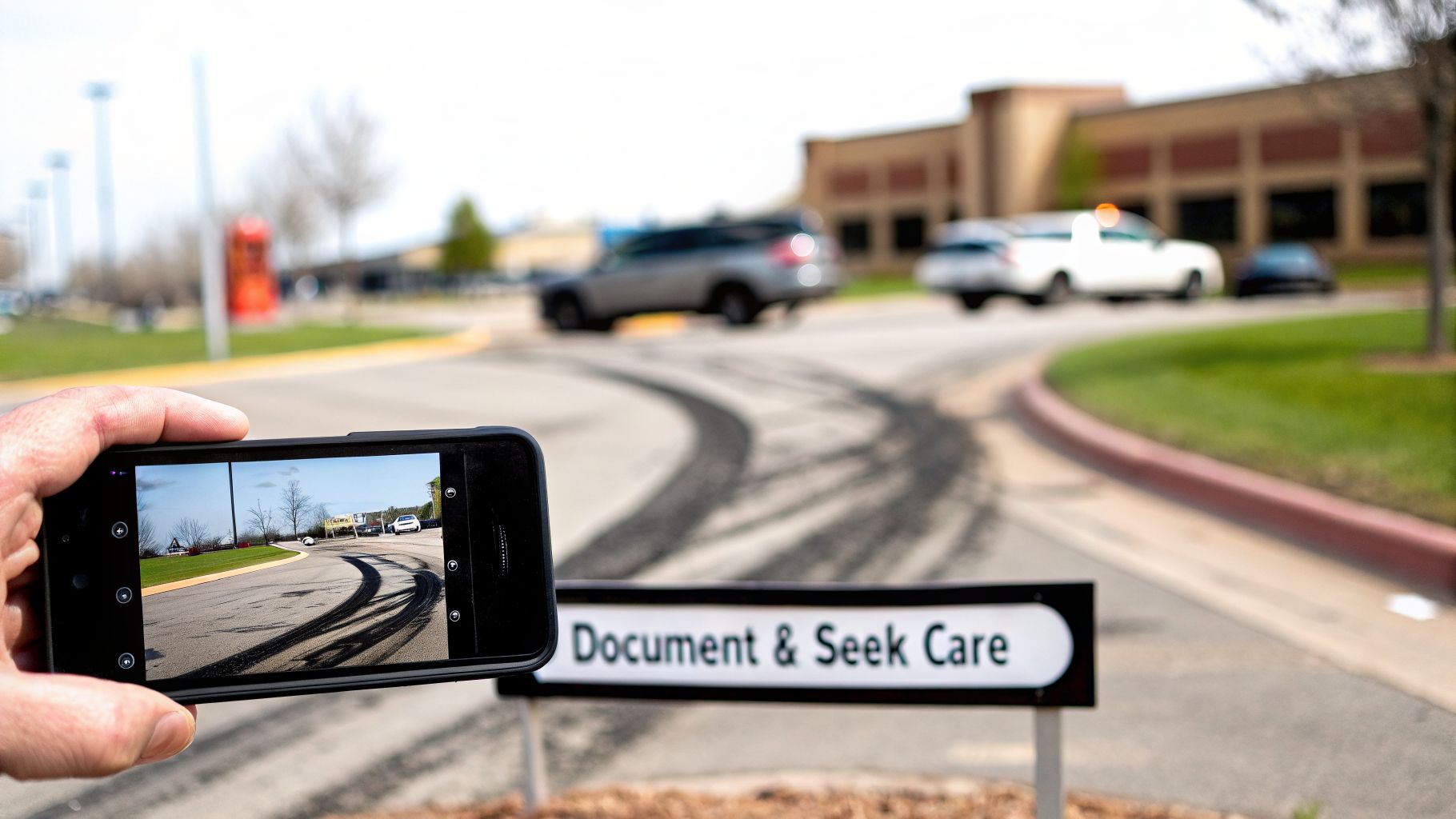
Take more photos than you think you need. Start wide, capturing the whole scene—where the cars ended up, the flow of traffic, the street signs. Then, get closer.
What to Capture: Building Your Case Photo by Photo
Your photos need to tell the story to someone who wasn't there. This evidence can disappear in a matter of minutes.
Your camera roll should have pictures of:
- Damage to all vehicles. Get up close on the dents, scrapes, and shattered parts of your car and theirs.
- Skid marks and debris on the road. These little details help experts reconstruct what happened, showing speed and the point of impact.
- The surrounding area. Snap photos of traffic lights, stop signs, and speed limit postings. Note the weather and road conditions. Was the sun in your eyes? Was the asphalt wet?
- Any visible injuries. If you have cuts or bruises, photograph them.
As you’re taking pictures, look around. Did someone walking their dog see the crash? Was there a delivery driver in a van behind you? Politely ask for their name and number. An independent witness can be incredibly powerful down the road.
A Quick Word of Advice: Don't move anything. Leave the debris, the broken car parts, everything right where it landed unless it's an immediate danger. You want the scene documented exactly as it was at the moment of impact.
Your Health Comes First. Always.
Documenting the scene is important, but nothing is more important than your health. Right after a car wreck, adrenaline floods your system. It’s nature’s way of coping, but it’s also a powerful painkiller that can hide serious injuries.
It’s the reason people say, “I feel fine,” only to wake up the next day in agony.
Delayed-onset injuries are real and they are common. Whiplash symptoms, like neck pain and headaches, might not show up for 24 to 48 hours. A concussion might not be obvious at first, but confusion, memory problems, or dizziness can creep in later.
That is why getting checked by a doctor is not optional. It’s essential.
Even if you think you’re okay, go to an urgent care or the emergency room at a local hospital like UCHealth Poudre Valley Hospital. This does two things.
First, it protects your health. A doctor can spot injuries you don’t feel yet, preventing them from getting worse.
Second, it creates a medical record. This record is your proof. It draws a direct, time-stamped line from the car accident to your injuries. If you wait, the insurance company will argue your injuries happened somewhere else or weren't that serious. A delay of even a day gives them an opening to deny your claim.
Think of that first doctor's visit as the cornerstone of your recovery. It’s the undeniable evidence that links your pain and suffering directly to the crash. It might be the single most important step you take.
Once the shock of a car accident starts to fade, a different kind of challenge begins. The chaos of the scene is replaced by the quiet, often confusing world of paperwork and phone calls. You'll quickly be dealing with two powerful forces: the official police report and the insurance companies. How you handle this part is just as critical as what you did in the first few minutes after the crash.
Let’s start with the police report. The officer who responded to your crash in Fort Collins files a traffic accident report, and this document carries a lot of weight. It’s the first official story of what happened, containing the officer’s notes, statements from drivers and witnesses, and often their initial opinion on who was at fault. This report becomes a cornerstone of your insurance claim.
Getting and Checking Your Accident Report
A few days after the crash, you can usually request your Fort Collins accident report online through the city's portal. When it arrives, don't just file it away. Read every single word.
Make sure the basic facts are right—names, dates, license plates, and locations. But look closer at the officer’s diagram of the collision and their written narrative. If you spot a factual mistake, you can contact the police department to ask for an addendum or a correction. You can’t change the officer’s opinion, but you can and should make sure the facts they based it on are accurate. Insurance adjusters will pick this report apart, so every detail matters.
These crashes are far from rare here. In a single recent year, Fort Collins recorded 3,803 traffic accidents. The financial toll is staggering, with collisions along hotspots like College Avenue and Horsetooth Road causing over $1 million in damages alone. Your accident is one of thousands, and how it's documented will shape everything that comes next.
Handling the First Call with the Insurance Adjuster
It won’t be long before your phone rings. It will be an insurance adjuster. It could be from your own company, but you can bet you’ll hear from the other driver’s insurer. This first conversation is a pivotal moment.
Never forget who you’re talking to. The adjuster is a trained professional whose job is to protect their company’s bottom line by paying out as little as possible. They do this all day, every day.
Here’s how to handle that first call:
- Be courteous but brief. You don’t need to be confrontational, but don’t feel obligated to chat. Just provide your name, contact info, and the date and location of the crash.
- Stick to the facts. Only state what you know for sure. If you’re asked about speed or distance and aren’t certain, don't guess. It is perfectly fine to say, “I’m not sure about that right now.”
- Politely refuse to give a recorded statement. You are under no obligation to be recorded by the other driver's insurance company. These recordings are a tool they use to lock you into a story and find inconsistencies later. Just say, "I'm not comfortable giving a recorded statement at this time."
- Don't talk about your injuries in detail. Simply say you were injured and are getting medical treatment. Avoid phrases like "I'm just a little sore" or "I think I'll be fine." Downplaying your injuries now can seriously hurt your claim later.
Crucial Insight: The adjuster might sound friendly and may even offer you a quick settlement on that first call. This is a red flag. It’s a common tactic designed to get you to accept a lowball offer before you know the true extent of your injuries or the total cost of your damages. Once you accept, your claim is closed forever.
The best response is to say you are focusing on your medical care and are not ready to discuss a settlement. This protects your rights while you get a complete picture of your recovery and financial needs. Understanding how to manage these conversations is a skill, and you can learn more about the specific strategies for dealing with auto insurance adjusters in our guide.
Having an experienced attorney step in to handle these communications for you creates a shield. We take over all calls and negotiations, ensuring you never say something that could be twisted and used against you. It frees you up to focus on the only thing that really matters: getting better.
Understanding Colorado Accident Law and Local Risks
After a crash in Fort Collins, you're not just dealing with dented metal and insurance adjusters. You're suddenly navigating a web of Colorado state laws and the specific dangers of our local roads. The rules that determine your rights are written in Denver, but they play out right here on streets like College and Harmony.
One of the first things you need to wrap your head around is how Colorado assigns blame. It’s not as simple as one person being 100% at fault. Instead, we use a system called modified comparative fault.
This is one of the most critical factors affecting your ability to get compensation. To understand it fully, you can read our guide on Colorado's fault laws. In short, the law says you can still recover money even if you were partially responsible for the crash, but there's a major catch.
The 50 Percent Bar and Your Claim
Under Colorado law, if you are found to be 50% or more at fault for the collision, you get nothing. You are completely barred from recovering compensation from the other driver.
If you’re found to be 49% or less at fault, you can still make a claim. However, your final award gets reduced by your percentage of fault. For instance, if you have $100,000 in damages but are found to be 20% at fault for the accident, your award is cut by $20,000, leaving you with $80,000. This is exactly why an insurance adjuster will work so hard to pin even a tiny bit of blame on you—every percentage point saves them money.
Then there's the deadline. Colorado law gives you a three-year window from the date of the accident to file a personal injury lawsuit. This is called the statute of limitations. Three years might sound like plenty of time, but it disappears quickly. Evidence gets lost, witnesses move away, and memories fade. Waiting is a risk.
Key Legal Insight: The clock is always ticking. That three-year deadline is absolute. If you miss it, your right to seek compensation in court is gone forever, no matter how badly you were hurt or how clear the other driver's fault was.
Local Risks on Fort Collins Roads
These legal rules don't exist in a vacuum. They're applied to real accidents happening every day on Fort Collins streets, which have their own unique dangers.
Statewide data from 2024 showed a hopeful 5% decrease in traffic fatalities. But here in Fort Collins, we saw an 8% increase, with 14 deaths on our roads. This local trend shows that even when things improve statewide, our community still faces serious risks. You can see how Fort Collins compares to the rest of Colorado on CODOT.gov.
Ask anyone who drives here regularly, and they’ll tell you about the problem spots. These intersections are known hotspots where the risk of a crash is significantly higher:
- Harmony Road and Timberline Road: With its constant high traffic volume, this intersection is a breeding ground for rear-end collisions, often tied to congestion and driver distraction.
- College Avenue and Drake Road: This is one of the most consistently dangerous intersections in the city. The complex turning movements and heavy traffic flow contribute to a high number of serious accidents.
- The CSU Campus Area: You have a constant mix of student drivers, cyclists, and pedestrians all sharing a tight space. It’s a recipe for low-speed crashes that can still cause significant injuries.
Winter weather only makes things worse, turning familiar routes into icy traps and changing how responsibility is assessed. When a collision happens, the specific location, the time of day, and the road conditions all play a huge role in determining fault under Colorado's comparative fault system. You need an attorney who gets both the law and these local realities to protect your rights.
When to Hire a Fort Collins Accident Attorney
The phone won't stop ringing. You’ve got a stack of medical bills growing on the counter, your car is in the shop, and an insurance adjuster is on the other end of the line, asking for a recorded statement. The pressure is immense, and it's easy to start wondering if your situation is "bad enough" to call a lawyer.
Here’s the simple truth: if you were hurt, you should at least have a conversation with one.
The moment the crash happened, the other driver's insurance company started building a case to protect their own bottom line. Their goal is not to help you; it's to pay out as little as humanly possible. Getting an attorney isn't about starting a fight—it’s about making sure you’re not the only one in the ring without gloves.
The Red Flags That Mean You Need a Lawyer Now
Some accidents immediately throw up red flags, signaling that trying to handle things on your own is a huge risk. If any of these sound familiar, it's time to get professional legal help.
- There Was Any Injury: If you or a passenger suffered any harm at all—from what feels like "minor" whiplash to something catastrophic—you need an advocate. The true cost of an injury often doesn't show up for weeks or months. A lawyer makes sure your future medical needs are part of the calculation.
- The Insurer Is Blaming You: This is a classic move. If the other driver’s insurance company suggests you were partially or entirely at fault, they're trying to shut down your claim before it even starts.
- You Got a Quick, Low Settlement Offer: A fast offer is almost always a trap. It's designed to get you to sign away your rights before you understand the real value of your claim. Once you accept, you can never ask for more, even if your injuries turn out to be permanent.
- The Other Driver Was Uninsured or Underinsured: Dealing with your own insurance company for an Uninsured/Underinsured Motorist (UIM) claim can be just as adversarial as fighting the other driver’s.
- Your Injuries Are Serious or Long-Term: When an accident results in significant medical care, disability, or permanent changes to your life, you need an expert to calculate the lifelong financial and personal costs.
An experienced personal injury attorney steps in and takes that burden off your shoulders, giving you the space you need to focus on getting better.
A Word of Experience: We see this happen constantly. A client, trying to be helpful, gives a recorded statement to the adjuster. They say something innocent that gets twisted and used to deny their claim. We act as your shield, handling all communication and protecting you from these tactics.
The Real-World Benefits of Having a Legal Team
Bringing a dedicated law firm into your corner does more than just stop the harassing phone calls. It gives you tangible advantages that can completely change the outcome of your case.
A good attorney doesn't just take the police report at face value. We launch our own independent investigation. We track down witnesses, pull cell phone records, and find traffic camera footage. When needed, we bring in accident reconstruction experts to prove exactly how the crash happened.
Most importantly, we know how to calculate the full value of your damages, which goes far beyond your current medical bills.
This includes:
- Future medical care and ongoing therapies
- Lost wages from the time you couldn't work
- Loss of future earning capacity if you can't go back to your old job
- Compensation for your physical pain and emotional distress
- Damages for the loss of enjoyment of your life
An insurance adjuster will never volunteer to pay for these things. It takes tough, evidence-backed negotiation from a lawyer who isn’t afraid to take your case to court. Insurance companies know which firms will go to trial and which will just take the first offer. That reputation is what forces them to negotiate fairly. Our goal is to secure the resources you need not just to get by, but to heal and build a stable future.
Common Questions After a Fort Collins Car Accident

After the immediate chaos of a car crash fades, a different kind of overwhelm sets in. The adrenaline gives way to a flood of questions and real-world worries. You’re hurt, your car is a mess, and the path forward feels anything but clear.
This uncertainty is completely normal. We’ve seen it countless times with clients after a car accident in Fort Collins, CO. The confusion about money, legal steps, and what your claim is really worth can be just as stressful as the accident itself. Getting clear, honest answers is the first step toward getting back on your feet.
How You Can Afford an Experienced Lawyer
One of the first things people worry about is how they’ll pay for legal help when they're already facing medical bills and lost wages. The truth is, you shouldn’t have to pay a single dollar out of your own pocket.
Most dedicated personal injury attorneys, including our firm, operate on a contingency fee basis. It’s a straightforward and powerful arrangement that levels the playing field.
What this means is simple: we don’t get paid unless you do. There are no upfront retainers or hourly bills. Our fee is a pre-determined percentage of the financial recovery we win for you, whether through a settlement or a court verdict.
If for any reason we don't secure compensation for you, you owe us nothing. This system ensures that your lawyer’s goal is perfectly aligned with yours—to maximize your recovery. It’s a risk-free way for you to get a professional advocate fighting in your corner.
Uncovering the True Value of Your Claim
There's no online calculator or simple formula that can tell you what your case is worth. You should be extremely cautious of any lawyer who throws out a specific dollar figure in your first phone call. A genuine case valuation is a deep, evidence-driven process.
The real value of your claim is woven from many different threads, including:
- The severity and permanence of your injuries
- The full cost of your medical care, both now and what you’ll need in the future
- How much income you’ve lost from being unable to work
- Any impact on your long-term ability to earn a living
- The physical pain and emotional toll the accident has taken on your life
An experienced attorney pieces this all together by meticulously collecting hard evidence like medical records and pay stubs. Just as importantly, we work to quantify the non-economic damages—the pain, suffering, and loss of enjoyment of life. It’s a detailed investigation into how this accident has affected every corner of your world.
Key Insight: A fast settlement offer from an insurance company is rarely a fair one. It's a business move designed to close your file for as little as possible before you understand the full extent of your injuries and losses.
Why Most Cases Settle Without a Trial
The thought of a public courtroom battle is understandably stressful. But the reality is that the vast majority of car accident claims never see the inside of a courtroom. Well over 90% of cases are resolved through a negotiated settlement.
So, why does that happen? Because a skilled attorney prepares every single case as if it’s going to trial. We build an undeniable foundation of evidence, consult with medical and financial experts, and develop a legal strategy designed to win in front of a jury.
It’s this thorough, aggressive preparation that convinces the insurance company to come to the table with a fair offer. They are professional risk assessors. When they see we are fully prepared to go to court and win, settling becomes the smarter business decision for them.
While a settlement is the most likely outcome, having a trial-ready lawyer is your greatest asset. It tells the insurance company you won’t be pushed around. And if they refuse to be reasonable, you have a proven fighter ready to take them on to get the justice you deserve.
If you have more questions or you’re feeling lost after a crash, you don't have to figure it out alone. At Nares Law Group, we provide clarity and compassionate guidance. To understand how we can protect your rights and help you move forward, schedule a free, no-obligation consultation today at https://www.nareslawgroup.com.