The first days after a crash rarely feel orderly. You're trying to get medical care, answer calls from an insurance adjuster, figure out work, and explain to your family why you still can't sleep or drive without panicking.
The bills are easy to spot. The harder part is everything else.
Pain when you get out of bed. Headaches that turn a normal afternoon into a lost day. The strain on your marriage. Missing your kid's game because sitting on bleachers hurts too much. Those losses matter in a Colorado injury claim, even though they don't come with a receipt.
People often search how to calculate pain and suffering damages because they want a number they can trust. That's understandable. But the full picture involves more than just calculations. In Colorado, the value of a pain and suffering claim depends on the method used, the evidence behind it, and the state rules that can change the final result.
Translating Your Harm into a Dollar Value
A client might tell me, "I know what the ambulance cost. I know what the ER charged. I don't know how to explain what this injury has done to my life."
That's the heart of pain and suffering damages. They are part of a personal injury claim meant to account for harms that are real but not neatly itemized. Physical pain is part of it, but so are fear, frustration, loss of normal activity, emotional distress, and the disruption of daily life.
A back injury after a Denver rear-end collision is a good example. The medical records may show imaging, physical therapy, prescriptions, and follow-up visits. Those records matter. But they don't fully show that the injured person now avoids long drives, wakes up stiff every morning, snaps at family from exhaustion, and can't pick up a child without pain.
Those consequences are often what make people feel like their whole life changed after the wreck.
Pain and suffering isn't a bonus category. It's the part of a claim that recognizes the human cost of an injury.
Colorado law doesn't hand you a simple worksheet that spits out the "right" answer. Adjusters, lawyers, and courts usually start with recognized valuation methods, then test those numbers against the facts of the case. Strong cases tie the human story to hard evidence.
That matters because insurance companies don't pay for vague descriptions. They pay attention when pain is documented, treatment is consistent, and the effect on daily life is clear.
If you're trying to understand your case, start with this principle: your suffering has to be translated into evidence, and then into a value that someone else can defend.
The Two Core Methods for Valuing Your Suffering
A client comes in after a Colorado crash with two fair questions. What is my pain worth, and how do they even put a number on it?
The answer usually starts with one of two methods. Lawyers, adjusters, and sometimes juries tend to look at the multiplier method or the per diem method. Neither one controls the outcome by itself. Both are starting frameworks, and in Colorado, the ultimate value still depends on the facts, the available coverage, the fault arguments, and the legal limits that may apply later.
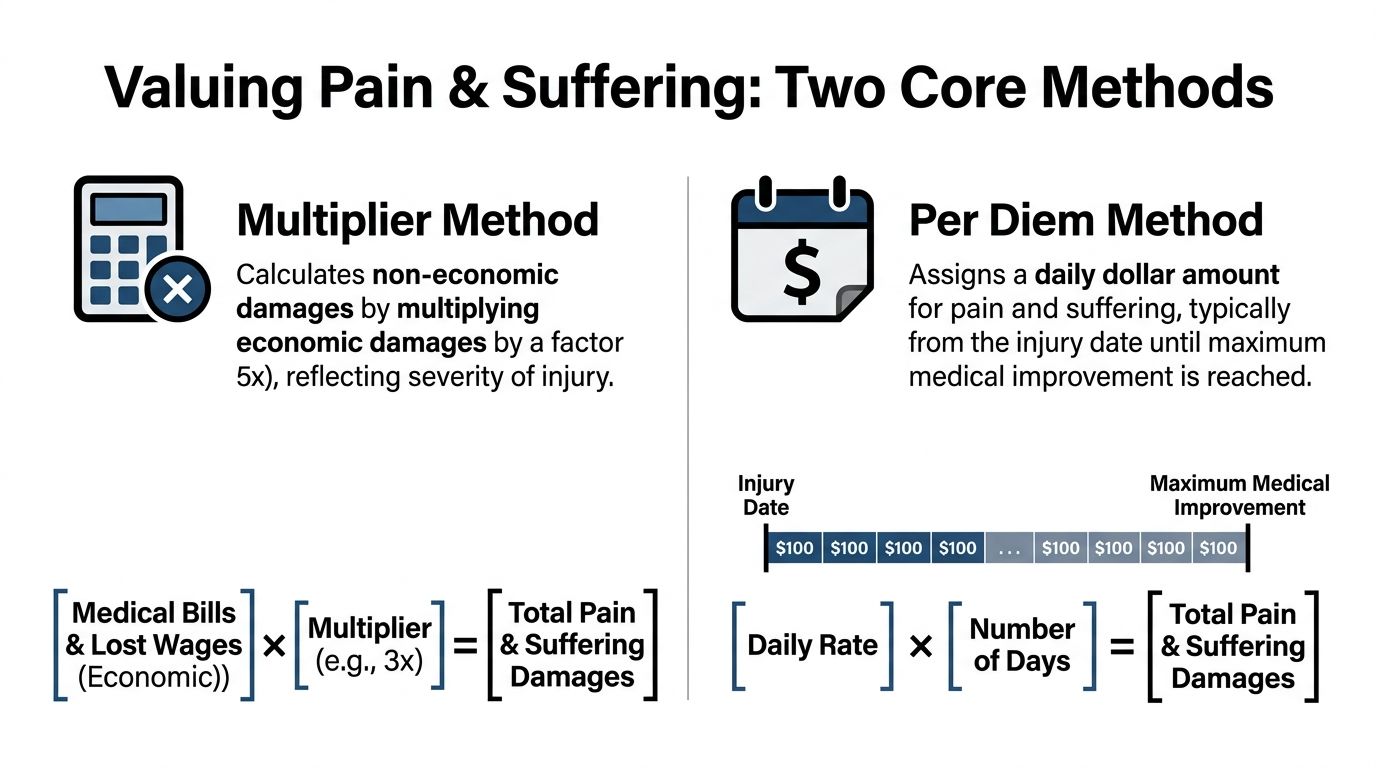
How the multiplier method works
The multiplier method is the approach many insurers use first. According to Hughes & Coleman on how pain and suffering is calculated, multipliers often fall between 1.5 and 5, with higher numbers generally tied to more serious or permanent injuries.
The formula is simple on paper. Add up the injured person's economic damages, then multiply that amount by a number meant to reflect the seriousness of the pain, limitations, and emotional harm.
Economic damages often include:
- Medical bills: ER care, imaging, surgery, therapy, prescriptions, and follow-up treatment
- Lost wages: Pay missed during recovery
- Property damage: In some cases, losses tied directly to the event, such as vehicle damage
Here is a basic example already described in that source. If economic damages are $40,000 and the multiplier is 3, the pain and suffering portion comes to $120,000.
| Item | Amount |
|---|---|
| Economic damages | $40,000 |
| Multiplier | 3 |
| Pain and suffering damages | $120,000 |
That figure is only the non-economic part of the claim. The economic losses are still added separately when valuing the full case.
What changes the multiplier? Usually the same facts that make one injury harder to live with than another.
- Injury severity: A strain that improves in weeks is usually valued differently from a spinal injury, traumatic brain injury, or permanent impairment.
- Length of recovery: Longer treatment often supports a higher number, especially if progress is slow or uneven.
- Effect on daily life: Trouble sleeping, driving, working, parenting, or handling basic chores matters.
- Permanence: Chronic pain, scarring, restrictions, and lasting emotional distress often increase value.
- Credibility of the record: Gaps in treatment, inconsistent complaints, or evidence that conflicts with the claim can pull the number down fast.
In practice, this method favors claims with strong medical documentation. That is one reason Colorado injury victims should understand how non-economic damages in personal injury cases are argued, not just how they are described on a calculator.
The trade-off is obvious. The multiplier method gives structure, but it can undervalue a person whose suffering is serious even though the medical bills are modest. That happens more than people expect. Some injured people delay treatment because they cannot afford it, have no paid time off, or hope the pain will go away. Insurance companies often use that against them.
How the per diem method works
The per diem method assigns a daily dollar amount to the pain and disruption caused by the injury, then multiplies that amount by the number of days the person is expected to suffer. Workman Injury Law's discussion of pain and suffering calculations gives examples of daily rates ranging from $100 to $350.
This approach can work well when the recovery period is reasonably clear. If someone is expected to reach maximum medical improvement after a set period of treatment, a day-by-day calculation can feel concrete and easier to explain.
The examples from that same source show the math clearly:
| Daily rate | Days of suffering | Pain and suffering damages |
|---|---|---|
| $200 | 180 | $36,000 |
| $100 | 365 | $36,500 |
Some lawyers also test a daily rate against the person's earnings. The same source gives an example of dividing a $45,000 annual salary by 250 working days to reach a $180 daily figure. That argument can be useful, but it has limits. Pain is not worth less because someone earns less, and it does not disappear if someone is retired, unemployed, or caring for family at home.
That is why insurers often resist the per diem method. They argue the daily number is arbitrary. They also push back when the end date is unclear.
Which method fits better in a Colorado injury claim
The better method depends on the injury story and the proof available.
The multiplier method usually fits cases with substantial treatment, significant medical expenses, lasting restrictions, or permanent harm. The per diem method often fits injuries with a defined recovery period, where the day-to-day course of pain can be tied to treatment records and a clear timeline.
Some cases benefit from looking at both. One method tests whether the number is proportionate to the hard costs. The other tests whether it reflects what the client lived through.
Colorado adds another layer. A number that looks reasonable under either method may still be reduced later if the insurance company argues you were partly at fault, or if legal limits affect the recoverable non-economic damages. That is why generic formulas often mislead people. They give a rough estimate, but they do not account for how Colorado law and insurer strategy shape the final settlement.
Building Your Case Evidence and Documentation Are Key
Two people can suffer the same injury and receive very different settlement offers. In Colorado claims, the gap often comes down to proof. The person who can show how the injury changed daily life usually has a stronger argument for pain and suffering damages.
That proof needs to do two things at once. It needs to make your experience real, and it needs to hold up when the insurance company starts looking for inconsistencies.

Start with a daily pain journal
As noted earlier, the per diem method depends on a documented day-by-day experience. Even if your case ends up being valued another way, a journal can still make the claim more credible.
Keep it simple. Write like a normal person, not like a lawyer.
Useful entries often include:
- Pain level and location: What hurts, when it flares up, and what movements make it worse
- Sleep disruption: Trouble falling asleep, waking during the night, or needing medication to rest
- Limits on ordinary tasks: Driving, showering, cooking, lifting, working, exercising, or caring for children
- Emotional effects: Anxiety, frustration, embarrassment, fear of driving, or pulling back from social events
- Setbacks and small wins: A bad therapy session, a missed family outing, or the first day you could walk farther without stopping
Short, honest entries carry more weight than dramatic ones. A steady record built over time is hard for an adjuster to dismiss.
Follow treatment and keep the records consistent
Medical records usually form the backbone of a pain and suffering claim. They show what you reported, what providers observed, what treatment was recommended, and whether your condition improved, stalled, or worsened.
Consistency matters in Colorado cases because insurers often argue that pain complaints are exaggerated, unrelated to the crash, or caused by something else. Clean records make those arguments harder to sell.
Here is what different records can help prove:
| Evidence type | Why it matters |
|---|---|
| Treatment notes | They connect your symptoms to the injury and show how often you reported them |
| Imaging and diagnostic testing | They can support the physical source of pain, even if they do not capture every symptom |
| Physical therapy records | They show effort, progress, limitations, and setbacks over time |
| Work restrictions and disability notes | They help show how the injury disrupted your routine and earning ability |
| Mental health records, when appropriate | They can support anxiety, trauma, sleep problems, or depression tied to the event |
Perfect treatment histories are rare. Real life gets in the way. People miss appointments because of cost, transportation problems, work schedules, or childcare. Those issues can often be explained. What hurts a case is leaving the gap unexplained and letting the insurer fill in the story for you.
Use photos, videos, and the evidence of ordinary life
Some of the best evidence does not come from a formal report. It comes from daily life.
Take photos of bruising, swelling, stitches, scarring, casts, and mobility devices. Save videos that show how long it takes to climb stairs, get out of bed, bend, lift, or walk across a parking lot. Keep receipts and records for things like home help, rides to appointments, or equipment you needed after the injury.
Ordinary-life proof can be especially persuasive because Colorado adjusters and defense lawyers often reduce pain and suffering to a formula. A photo of a surgical scar, a video of someone struggling to put on shoes, or messages canceling family plans can show the human side of the claim in a way billing records cannot.
Ask other people to document what changed
Family members, close friends, coworkers, and supervisors often notice changes that an injured person downplays. They see the limp, the fatigue, the short temper, the missed events, and the tasks you no longer handle.
The strongest witness statements are specific. General comments like "she was in a lot of pain" help less than details such as "before the crash he coached his son's team every weekend, and after the crash he could not stand through a full practice."
Useful observations often cover:
- Before-and-after activity levels
- Changes in mood, patience, or memory
- Work limitations or reduced stamina
- Missed family routines, hobbies, and social events
If you want a practical way to organize all of this, this personal injury case checklist for Colorado injury claims can help you gather the right records before they get lost.
What damages credibility
Insurance companies do not need to prove you are lying to reduce the value of pain and suffering. They only need enough inconsistency to argue that your story is uncertain.
Common problems include:
- Treatment gaps with no explanation in the file
- Missed appointments that suggest the symptoms were not severe enough to keep treating
- Social media posts that show activity without context
- Different symptom descriptions from one provider to the next
- Delays in reporting injuries after the accident
I often tell clients that credibility is part of the value of the case. If your records, journal, photos, and witness accounts all point in the same direction, your demand has more force. If they conflict, the insurer will use that conflict to drive the number down.
Good documentation does not guarantee a fair settlement. It does put you in a much stronger position when the insurer starts testing your claim.
How Colorado Law Adjusts Your Final Settlement
A calculation can look fair on paper and still produce a very different result in a Colorado claim. State law and practical limits often reshape the number before the case ever settles.
Many people get blindsided here. They assume the formula controls the outcome. It doesn't.
Comparative fault can reduce or defeat the claim
Colorado follows a modified comparative fault rule. In practical terms, that means the defense will often argue that you caused part of the crash or made your own injuries worse.
If the evidence shows you share fault, your recovery can be reduced. If the defense succeeds in pushing fault far enough, recovery can be barred under Colorado's rule.
That issue shows up constantly in vehicle cases. The insurer may say you were speeding, following too closely, distracted, or failed to react in time. In a truck case, the company may admit some fault but still try to place part of the blame on you to lower the value of the claim.
Why fault matters so much in pain and suffering disputes
Comparative fault doesn't just affect medical bills and wage loss. It affects the entire settlement discussion, including non-economic damages.
That means a strong pain and suffering presentation can still shrink if liability is contested. A person may have compelling proof of pain, emotional distress, and daily disruption, but if the defense convinces the other side that the injured person bears significant responsibility, the settlement value changes.
This is one reason liability evidence needs immediate attention. Vehicle damage photos, black box data, witness statements, roadway evidence, and prompt investigation often matter as much as the medical proof.
A pain and suffering claim is only as secure as the liability case underneath it.
Damage caps can limit non-economic recovery
Colorado also has statutory limits that can affect non-economic damages in many personal injury cases. Those caps are part of the legal framework, and they can matter even when the injury's human impact is substantial.
Because the prompt requires strict factual accuracy and doesn't provide the current Colorado cap figures, I won't invent a number here. The important practical point is that a cap can place a legal ceiling on recoverable non-economic damages in some cases, regardless of what a multiplier or per diem analysis suggests.
That is frustrating for injured people because the formula may point one way while the statute points another.
A lawyer evaluating the claim should always ask two separate questions:
- What is the case worth based on the facts?
- What is legally recoverable under Colorado law?
Those are not always the same answer.
Insurance policy limits can set the ultimate limit
Even when liability is strong and the damages are significant, insurance coverage can set the practical limit on recovery. If the at-fault driver carries a small policy, that can become the first hard boundary in settlement talks.
In Colorado cases, this often raises additional questions:
- Is there underinsured motorist coverage available?
- Is there a commercial policy if a truck or business vehicle was involved?
- Are there multiple liable parties?
- Is there another source of coverage that applies?
These are case-specific questions, and they often determine whether the numbers discussed in early claim evaluations are realistic or purely theoretical.
The insurance company will use every adjustment point
From the defense side, there are predictable pressure points. The insurer may challenge medical necessity, argue pre-existing conditions, question treatment gaps, dispute causation, assign comparative fault, and then remind everyone about policy limits.
That is why a settlement range isn't one number. It is a negotiation zone shaped by liability, damages, legal limits, and collectible coverage.
A Colorado-specific guide to personal injury settlement amounts can help frame that broader picture, especially for injured people who are trying to compare internet estimates with what happens in claims.
Generic calculators miss the Colorado-specific issues
National articles often stop after explaining multipliers and per diem rates. That leaves out the part that changes outcomes in Colorado.
Here is the difference in simple terms:
| Question | Formula answer | Colorado reality |
|—|—|
| How much is pain worth? | A starting estimate | It may be reduced by fault arguments |
| Can that amount be recovered? | Maybe | Caps may limit non-economic recovery |
| Will the insurer pay it? | Not automatically | Policy limits and coverage issues matter |
That is why the raw calculation is useful but incomplete. In Colorado, settlement value comes from the interaction between damages, fault, statutory limits, and available insurance.
Beyond the Calculator Why an Attorney Matters
When individuals start searching how to calculate pain and suffering damages, they're already under pressure. The adjuster wants a recorded statement. Bills are coming in. Treatment is still ongoing. Every conversation feels like a test.
A calculator can't handle that.

The job isn't just math
A self-calculated estimate can be helpful. It can tell you whether an offer feels suspiciously low. But it won't tell you how to frame the injury, answer a causation attack, handle comparative fault arguments, or present a future-focused story that an insurer takes seriously.
Insurance companies evaluate claims through systems, internal rules, and defense-minded reasoning. They look for weak records, short treatment histories, pre-existing symptoms, and anything else that lets them shrink the non-economic piece of the case.
A lawyer's role is to turn the file from a stack of bills into a coherent claim.
That often means:
- identifying the records that matter most
- correcting gaps or misunderstandings in the medical narrative
- connecting symptoms to daily limitations
- preparing the case as if it may need to be tried
The strongest pain and suffering claims don't sound dramatic. They sound documented.
Good advocacy changes the multiplier discussion
In a serious case, one of the central fights is whether the story justifies a stronger valuation. The difference between a routine injury presentation and a well-developed one is often the difference between a low offer and a negotiation with real movement.
An attorney can help by showing:
- Why the injury is more disruptive than the bills alone suggest
- Why the recovery timeline supports greater non-economic value
- Why the client's credibility is strong
- Why a jury could respond to the life changes in a meaningful way
That work isn't theoretical. It affects the settlement posture from the first demand package through mediation and trial preparation.
For people who want a rough estimate while they gather facts, some firms offer tools that generate a preliminary range based on case details. Nares Law Group LLC offers settlement calculators through its website. That can be a starting point, but not a substitute for legal review.
Negotiation Strength Matters
Insurers pay attention when they believe the other side is prepared, organized, and willing to push the case forward. They pay less attention when the claimant is handling everything alone and signaling urgency to settle.
That is one reason trial readiness matters even in cases that resolve without a verdict. The credible possibility of litigation changes the tone of negotiation.
This short video adds useful context on how attorneys approach injury claims and case value:
A lawyer also protects your time and focus
After a serious crash, your primary job is recovery. You shouldn't have to spend that time arguing over records requests, coverage issues, lien questions, or strategically incomplete insurance explanations.
A good attorney doesn't just pursue compensation. The attorney creates order. That includes communicating with adjusters, coordinating the evidence, tracking deadlines, and making sure an early low offer doesn't define the case.
When the claim includes lasting pain, emotional strain, cognitive changes, or family disruption, that guidance becomes even more important. Those are the damages insurers often undervalue first.
Focusing on Your Future and Your Recovery
Pain and suffering damages are difficult to calculate because the loss is personal. No formula can fully capture what it feels like to lose comfort, confidence, independence, or peace of mind after a crash.
Still, the process matters. The multiplier method and the per diem method give injured people a way to translate lived harm into a claim that can be evaluated. Good documentation gives that claim weight. Colorado law then shapes the final number through fault rules, legal limits, and insurance realities.
The most useful mindset is this one. Treat the calculation as a tool, not a verdict.
If you're recovering from a Colorado car or truck accident, keep your focus where it belongs. Follow your treatment plan. Document what your days look like. Be careful with what you say to the insurance company. Get advice before you assume an offer is fair.
You don't need to have every answer right now. You only need a clear next step and a reliable way to protect your claim while you heal.
If you want guidance specific to your Colorado injury case, Nares Law Group LLC offers free consultations for injured people and families dealing with crashes, trucking cases, traumatic brain injuries, and wrongful death claims. A conversation can help you understand how your pain and suffering may be valued, what Colorado-specific issues could affect the result, and what to do next without pressure or obligation.