When you get hurt in an accident, doctors don't just ask where it hurts. They need to know how it happened. That ‘how’ is what we call the mechanism of injury (MOI).
It’s not some complicated medical term. It’s simply the story of your injury—the specific forces, motions, and impacts that caused you harm. Think of it as the physics of the accident. Understanding this story is the first step for both your medical team and your legal case.
What Is a Mechanism of Injury?
At its core, the mechanism of injury is the detective story of what happened to your body. It moves past the simple diagnosis, like a broken arm, to ask the critical follow-up questions.
Was the arm broken from a direct hit? A violent twisting motion? Or was it crushed under a heavy object? Each answer tells a different story and points to a different pattern of potential harm. This is how medical and legal experts can reconstruct an event to understand its true consequences.
While there are many types of injury mechanisms, three show up time and again in personal injury cases.
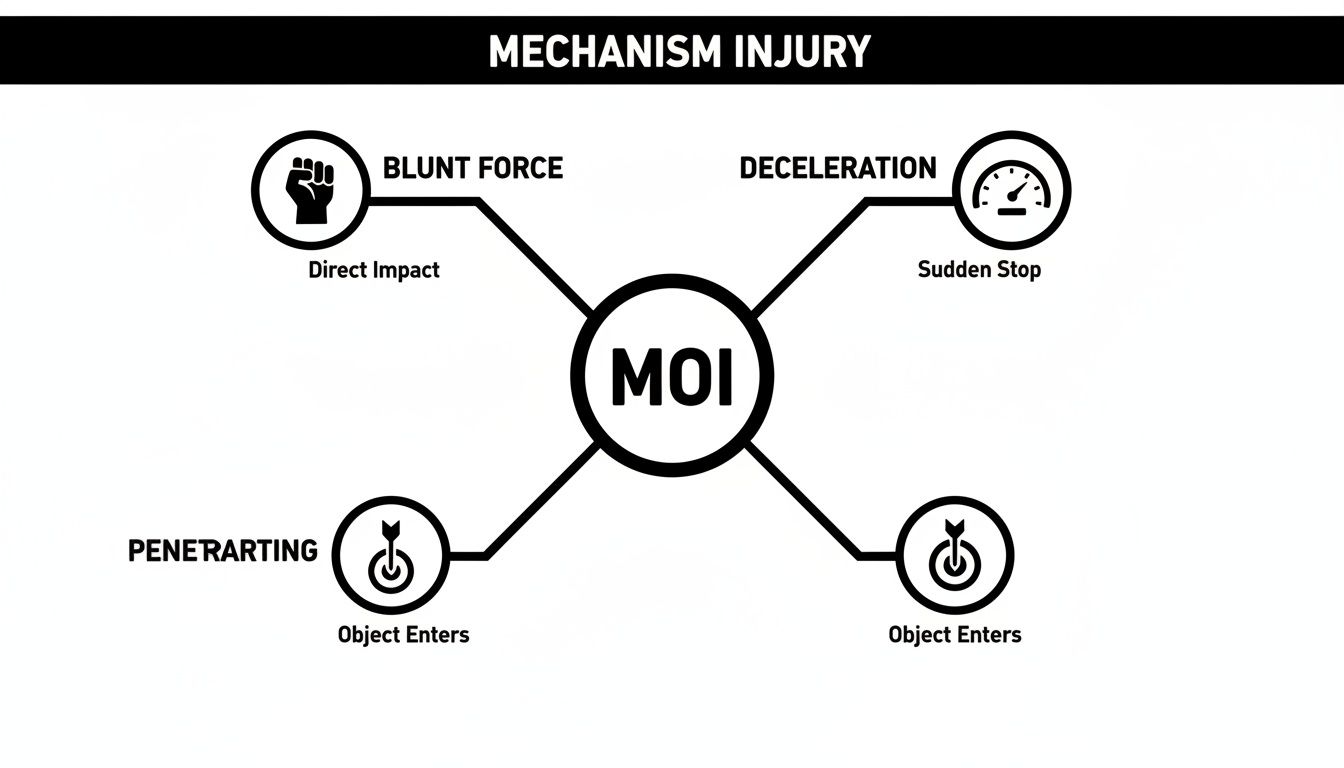
These three forces—Blunt Force, Deceleration, and Penetrating—represent the primary ways energy is transferred to the body to cause damage.
The Main Types of Injury Mechanisms
To give you a clearer picture, let's break down how these forces work in the real world.
The table below summarizes the most common injury mechanisms we see in car and truck accidents, explaining the forces at play and providing concrete examples.
Common Mechanisms of Injury in Accidents
| Mechanism Type | How It Works | Common Accident Examples |
|---|---|---|
| Blunt Force Trauma | The body is struck by an object, or strikes a stationary object, without the skin being broken. The energy transfer causes damage beneath the surface. | Hitting the steering wheel, dashboard, or window in a crash; being thrown against the side of the car in a T-bone collision. |
| Deceleration Trauma | The body comes to a sudden and violent stop, but the internal organs keep moving, crashing into the inside of the body (e.g., the skull or ribcage). | Whiplash in a rear-end collision; traumatic brain injury from the brain hitting the skull; aortic tears from the heart's sudden stop. |
| Penetrating Trauma | An object breaks through the skin and enters the body, causing direct damage to tissues and organs along its path. | Injuries from shattered glass, broken metal parts, or cargo that comes loose inside the vehicle during a crash. |
Each of these mechanisms creates a unique "signature" of injuries that experienced medical and legal professionals learn to recognize.
A Closer Look at Each Mechanism
Blunt Force Trauma is exactly what it sounds like—a powerful impact. This happens when your body collides with something, like the steering wheel, or something collides with you. Imagine a semi-truck, which can legally weigh up to 80,000 pounds, sideswiping your car. The force transferred in that impact is immense, capable of causing devastating internal injuries even without a single cut.
Deceleration Trauma is one of the most misunderstood and dangerous forces in a crash. Your car may stop abruptly, but your body—and all your internal organs—don't. They keep moving forward until they slam into a solid surface.
This is the violent, internal collision that causes whiplash and many traumatic brain injuries. It can happen even in a "fender bender" where the car looks almost undamaged, because the damage isn't to the vehicle—it's to the people inside.
The sudden stop is often far more destructive than the initial impact itself. You can learn more about how this specific type of force causes harm in our guide on acceleration and deceleration injury.
Finally, Penetrating Trauma occurs when something sharp breaks the skin and enters the body. In a car wreck, this is often caused by shards of broken glass from a window or twisted pieces of metal from the car's frame.
How MOI Plays Out in Car and Truck Accidents
The mangled steel and shattered glass of a car wreck tell a story. They’re not just random damage; they’re a physical record of the incredible forces unleashed on the people inside. Seeing how mechanism of injury works in a real-world crash makes the concept tangible, and frankly, terrifying.

A car crash is a chaotic event, often involving multiple types of injury all at once. The most obvious is blunt force trauma—the harm caused when your body slams into the steering wheel, dashboard, or door. This is what causes the visible cuts, bruises, and broken bones.
But it's the invisible force that is often the most dangerous.
The Hidden Damage From Deceleration
Picture a multi-car pileup on I-25 during Denver’s rush hour. A car going 65 mph smashes into stopped traffic and comes to a dead halt in a split second. The car has stopped, but your internal organs haven't. They’re still traveling at 65 mph.
Your brain lurches forward, crashing into the hard interior of your skull. Your heart and aorta are violently tugged and stretched by shearing forces, which can cause devastating internal tears. This is deceleration trauma. It’s why you can suffer a severe concussion or a whiplash injury without ever hitting your head on anything.
The damage happens entirely inside the body, a direct result of that brutal change in speed. For first responders, the amount of vehicle damage is a critical clue. A crumpled front end doesn’t just mean a big repair bill; it’s a giant red flag that the people inside experienced severe deceleration and may have hidden, life-threatening injuries.
In high-speed rollovers, like those that happen on I-70, the body is subjected to these forces over and over as the car flips. Emergency medical teams know that a high-speed mechanism signals a high potential for severe trauma, including traumatic brain injuries (TBIs). As experts in trauma care from the International Academies of Emergency Dispatch have detailed, understanding the "how" of the crash is key to predicting the "what" of the injuries.
Truck Accidents Amplify the Forces
When a commercial truck enters the equation, the physics become exponentially worse. A fully loaded semi can weigh up to 80,000 pounds. Your car weighs around 4,000. Because of that massive weight difference, the car and its occupants absorb a catastrophic amount of force.
The mechanism of injury in a truck crash is often a devastating mix of forces:
- Crush Injuries: The sheer weight of the truck can simply collapse the passenger compartment of a car.
- Extreme Deceleration: Being hit by a vehicle that massive brings a car to an instantaneous, violent stop unlike almost any other collision.
- Underride/Override: A smaller car can slide underneath the high chassis of a truck trailer, which can shear the top of the vehicle right off.
These crashes are fundamentally different, and understanding the unique forces at play is essential. You can learn more about the specific challenges of these cases by reading our guide on truck accidents in Colorado. By drawing a clear line from the physics of the accident to the medical harm it caused, we can start to build the true story of what happened to you.
The Critical Link Between MOI and Brain Injuries
Of all the harms a car crash can cause, one of the most serious is also one of the most invisible: a Traumatic Brain Injury (TBI). When it comes to a TBI, the mechanism of injury isn't just a piece of the puzzle—it's the entire story.
Understanding the forces at play is fundamental to recognizing and proving a brain injury, especially since the symptoms can be incredibly subtle or show up days, even weeks, after the wreck.
Imagine the brain is like the yolk inside a raw egg. The skull acts as the hard shell, and the brain itself floats in cerebrospinal fluid. When a collision jerks your head violently forward and back, your brain doesn’t stop moving with your skull. It continues, crashing against the hard bone on one side (a coup injury) and then rebounding to slam into the opposite side (a contrecoup injury).
This brutal internal impact is what causes concussions and more severe brain trauma. It can happen even if your head never actually hits the steering wheel or window. The injury isn’t from direct impact; it’s from the extreme deceleration and rotational forces unleashed by the crash itself.
Why a "Minor" Crash Can Cause a Major TBI
Because the brain is so soft and fragile, it’s extremely vulnerable to the shearing and stretching forces generated in a collision. The damage occurs on a microscopic, cellular level, disrupting the complex networks that control everything from your memory to your mood.
This is precisely why a significant mechanism of injury—like a high-speed wreck or a T-bone crash—should always raise a red flag for a potential TBI, no matter how you feel at the scene.
You might feel “fine” or just a bit dazed right after the crash. But this is often just the beginning of a cascade of symptoms. Research shows memory disruption happens in the majority of concussion patients, sometimes sticking around for months.
The initial absence of symptoms does not mean you are uninjured. A high-energy MOI is a strong predictor of brain injury. It’s crucial to treat the potential for injury as seriously as a visible one.
This understanding is your most powerful tool when seeking medical care. When you tell a doctor the full story of the crash—the speed, the direction of impact, how your body was thrown—you give them a concrete reason to look beyond what’s visible.
This context helps them justify ordering the right diagnostic tests, like advanced imaging, to check for brain injuries that a standard ER evaluation might otherwise miss. Never downplay the violence of the crash. The physics of what happened to your body is a critical piece of your medical record and the first real step toward a proper diagnosis.
Why Doctors Ask About Your Accident Details

When paramedics or ER doctors start asking questions about your accident, they aren’t just making small talk. They are becoming medical detectives, and the story of your crash—the mechanism of injury—is their most important clue.
How your body was thrown around gives them a roadmap to injuries that might not be obvious yet.
This whole process revolves around a concept called the index of suspicion. It’s the framework doctors use to anticipate specific injuries based on how an accident happened. A high-energy crash automatically raises their suspicion for severe, hidden damage.
For instance, if you tell a doctor you were in a high-speed rollover, they immediately start looking for certain types of internal trauma. The violent, multidirectional forces in a rollover are notorious for causing specific, life-threatening injuries that can’t be seen from the outside.
What Your Crash Details Reveal
Based on the story you tell, the medical team builds a mental checklist of injuries they need to rule out. They are connecting the physics of the crash to the likely biological damage.
- A "bullseye" crack in the windshield? That tells them your head likely struck the glass. Their index of suspicion for a traumatic brain injury and cervical spine fractures just went way up.
- A bent steering wheel? That means your chest took a massive blow. They’ll be looking for rib fractures, a bruised heart (cardiac contusion), or even a torn aorta.
- A side-impact (T-bone) collision? This immediately alerts them to check for pelvic fractures, internal organ damage like a lacerated spleen or liver, and shoulder injuries on the impacted side.
This is why every detail you can remember is so critical. The speed of the cars, the direction of the hit, whether you wore a seatbelt, and where your car was damaged all help paint a complete picture for the people trying to help you.
Your story guides their investigation. A severe mechanism of injury is a direct instruction to look deeper, prompting doctors to order CT scans, MRIs, or other advanced imaging that can reveal damage invisible to the naked eye.
Advocating for Your Own Health
Understanding this concept is one of the best ways to advocate for yourself. When you talk to your doctors, never downplay what happened. The more clearly you can describe the forces your body went through, the better chance you have of getting a proactive and complete evaluation.
Remember, the goal is to make sure your treatment plan is based on the full picture of the accident, not just the symptoms you happen to feel in that moment. The mechanism of injury gives them the context they need to find injuries before they turn into bigger problems down the road.
Using MOI to Build a Stronger Personal Injury Claim
While your doctor uses the mechanism of injury to figure out what's wrong and how to treat it, your attorney has a different but equally vital job: proving the other person was negligent. A personal injury claim isn't just about showing you were hurt. It's about drawing a direct, undeniable line from the other driver's mistake to the specific forces that injured you.
The mechanism of injury is the bridge connecting their negligence to your medical chart.
Think about it this way: someone was texting, ran a red light, and T-boned your car. Their action—running the red light—is the mistake. But how does that legally connect to your torn rotator cuff and herniated disc? Your attorney proves it by explaining the mechanism of injury. They show how that violent side-impact collision created shearing forces that whipped your body, causing those exact injuries.
Connecting Actions to Consequences
To build that story, your legal team pieces together specific evidence that paints a clear picture of the forces involved. This isn't just about retelling what happened; it's a scientific reconstruction of the event.
Key evidence often includes:
- Police Reports: These give an official first account of the crash, often with diagrams, vehicle positions, and notes on what caused it.
- Vehicle Damage Photos: A crumpled frame, a shattered window, or a bent steering wheel are all physical proof of the energy that was transferred in that split second.
- Scene Evidence: Skid marks, debris fields, and road conditions all help establish speed and the point of impact.
- Expert Testimony: In more complex cases, an accident reconstructionist can use physics to calculate the exact G-forces your body endured.
By meticulously documenting the MOI, your attorney builds a solid foundation for your case. This detailed evidence becomes the core of the argument, demonstrating precisely how the defendant's negligence resulted in your injuries and financial losses.
Defeating Common Insurance Company Tactics
A well-documented mechanism of injury is your best defense against the arguments insurance companies use to deny or weaken claims. One of their most common tactics is to argue your injuries are unrelated to the crash, suggesting they were pre-existing or happened later.
A strong MOI narrative cuts right through this. It establishes a clear cause-and-effect relationship that's hard to dispute. If you have a classic deceleration injury like whiplash, your lawyer can use crash data to prove the sudden stop was more than forceful enough to cause it.
Another frequent argument is the "low-impact" defense. The insurer might point to a small dent and claim a crash with minimal vehicle damage couldn't have possibly caused a serious injury. But as we've seen, deceleration and rotational forces can cause severe harm even in a "fender bender."
By explaining the physics of the MOI, your attorney can educate the adjuster—or a jury—on why a lack of crumpled metal doesn't mean a lack of human harm.
Understanding the legal process is crucial after an accident. To help you get started, we've outlined the essential steps in our guide on how to file a personal injury claim.
Practical Steps for Documenting Your Mechanism of Injury
After a crash, your first priority is your safety and getting medical help. Once the immediate chaos has passed, however, your role changes. You now need to gather the evidence that tells the story of how you were hurt.
The details you capture in the hours and days that follow are the foundation for documenting the mechanism of injury. This evidence is what your doctors and legal team will use to reconstruct the forces that harmed you and build your personal injury claim.
Create a Detailed Accident Record
Start documenting everything immediately. Memories fade and change, but a photograph is a permanent record. This is the single most important thing you can do to preserve what actually happened.
A strong record should include:
- Vehicle Photographs: Get pictures of all cars from every possible angle. Take close-ups of the damage and wide shots that show their final resting positions.
- Scene Photos: Document the entire crash site. Photograph skid marks on the pavement, debris scattered on the road, traffic lights, and any road signs that are relevant.
- Your Injuries: As soon as you notice them, take clear, well-lit photos of any visible injuries like bruises, cuts, or swelling.
This visual evidence makes the abstract idea of "force" tangible. It shows the violence of the impact.
Crucial Tip: Never downplay what happened. When you talk to the police, paramedics, or your doctor, describe the crash exactly as you remember it. A seemingly innocent comment like, “I feel fine,” or “It wasn’t that bad,” can be twisted by an insurance company to argue the mechanism of injury wasn’t severe enough to have caused your injuries.
Write down every detail you can remember about the collision itself—the direction you were hit from, the estimated speed, and how your body was thrown around inside the car. These details help define the mechanism of injury and draw a straight line from the other driver's actions to the harm you’ve suffered.
Answering Your Questions About Mechanism of Injury
After a traumatic accident, you're left with a storm of questions. The term mechanism of injury can sound technical and overwhelming, but understanding what it really means is one of the most practical things you can do. Let’s clear up some of the most common questions that come up while you’re trying to heal and protect your legal rights.

Can I Have a Serious Injury if My Car Has Little Damage?
Yes, absolutely. This is one of the biggest and most dangerous misconceptions out there—one that insurance companies love to use against injured people.
A car’s steel frame and bumper are designed to absorb and resist tremendous force. Your body isn't. Even in a crash that just looks like a "fender bender," the sudden jolt from the impact can be incredibly violent.
That violent jolt is the mechanism of injury. It’s the force that whips your head back and forth, causing a spinal injury. It’s what can make your brain slam against the inside of your skull, resulting in a traumatic brain injury (TBI). The force your body endured is far more important than the amount of crumpled metal on your car.
Why Does My Lawyer Need to Know How the Crash Happened?
Your lawyer needs to understand the mechanism of injury to draw a clear, undeniable line from the other driver's actions to your medical diagnosis. It isn't enough to just say, "The crash hurt me." They have to prove exactly how it caused the specific injuries you're suffering from.
By reconstructing the accident with police reports, photos, and expert analysis, your attorney can demonstrate the exact forces your body sustained. This evidence is crucial for proving causation and defeating insurance company arguments that your injuries are unrelated to the wreck.
This detailed story becomes the solid foundation for a strong personal injury claim, leaving no room for doubt.
What if I Don’t Remember the Exact Mechanism of Injury?
That is completely normal. In fact, it’s extremely common. Memory loss, even for just a few moments, is a classic sign of a concussion and a natural response to a deeply traumatic event. If you have gaps in your memory of the crash, you are not alone, and it doesn't hurt your case.
Your own memory is just one part of a much bigger picture. An experienced attorney knows how to find the other pieces to define the mechanism of injury and rebuild the story of what happened. They will use:
- The official police report
- Photos and videos from the accident scene
- Data from the car’s “black box,” also known as an Event Data Recorder (EDR)
- Statements from any witnesses
- Input from accident reconstruction experts
These sources can tell the story clearly, even when your own memory can't.
Navigating the aftermath of a serious accident is overwhelming. At Nares Law Group LLC, we provide the clarity and determined advocacy you need to protect your rights and secure your future. If you were injured in a crash, contact us for a free, no-obligation consultation to understand your options. Learn more about our approach at nareslawgroup.com.